II- The law of contradiction: sole fundamental law of materialist dialectics
Return to The New Democratic Revolution is the main force of the World Proletarian Revolution
II- The law of contradiction: sole fundamental law of materialist dialectics
Marxism-Leninism-Maoism is the scientific ideology of the proletariat, it is the “omnipotent because it is true” 1 doctrine, as defined by Lenin. It is ideology because it is the thought of a certain social class, it is scientific because it seeks and relies in truth as a weapon to transform the world:
“In a word, every ideology is historically conditional, but it is unconditionally true that to every scientific ideology (as distinct, for instance, from religious ideology), there corresponds an objective truth, absolute nature.” 2
Marxist philosophy is dialectical materialism. The fundamental problem of philosophical materialism constitutes the relationship between thinking and being, in which being is primacy. Engels establishes this issue in a crystal-clear way in his work Ludwig Feuerbach and the end of classical German philosophy, by defining that dialectical materialism defends the primary character of being in relation to thinking, and that thinking can reach knowledge by reflecting the objective laws of matter and by transforming it. Dialectics deals with the general laws of motion, the connection between processes, things and phenomena. Materialist dialectics studies the general laws of the motion of matter in its various manifestations: nature, society and thinking.
The most general formulations of dialectical materialism were developed in the course of the class struggle and the process of applying the ideology of the international proletariat, Marxism-Leninism-Maoism, to the concrete revolutionary practice. Philosophy, as an indispensable part of revolutionary theory was formulated more precisely at each stage of the development of the ideology. As a product of this process, in its third stage, Maoism, the superior synthesis is achieved, the most advanced of the revolutionary content of the materialist dialectics. In his works On Practice, On Contradiction (1937), On the correct handling of contradictions among the people (1957), and Where did Men’s Correct Thinking Come From? (1963), as well as in the great philosophical polemics in the CPC, which took place between May 1964 and May 1965, around the philosophical principle that everything in the universe is one that divides into two, Chairman Mao, in the midst of acute class struggle and two-line struggle, made a great leap in Marxist philosophy, both in its formulation and application, as well as in its ability to bring this revolutionary philosophy to the broad masses.
The leap in materialist dialectics made by Maoism can be summarized as follows: all processes of matter, that is, in the universe (nature, society and thinking) occur as the development of a unity between two contradictory aspects, the struggle between opposites runs through all the processes from the beginning to the end – or their resolution. Opposite aspects are interdependent and opposed at the same time. In the process of development of a thing or phenomenon, interdependence – or unity between opposites – is relative and struggle is absolute. In the development of the contradiction, from a stage of quantitative changes it advances to a stage of qualitative change, in which transformation is apparent and manifest. Qualitative change corresponds to the quality leap in the phenomenon, when the interdependence between opposite aspects breaks and, finally, the opposites transform into each other, forming a new unity of opposites and, like this, infinitely developing. From the affirmation of the old unity of opposites we move towards the negation of this unity, towards the transformation of the quality of the phenomenon or towards the emergence of a new process.
As we will see in more detail below, this is the highest formulation of the Marxist philosophy established by Maoism on the eve of the launch of the GPCR. It represents both a leap in the philosophical formulation of Marxism and a continuity of it. For, although Marx and Lenin did not have the opportunity or time to establish the law of contradiction in this form as the sole fundamental law of materialist dialectics, they have applied this same content in their theoretical and practical work. Taking Capital, Marx’s magnum opus, we will find this same fundamental law applied, whose most precise and popular formulation achieved a higher development with Maoism. Likewise, we will find countless examples of the precise application of the sole fundamental law of materialist dialectics throughout the Leninist arsenal.
Obviously, the establishment of the law of contradiction by Chairman Mao constitutes a leap because it arms the proletariat with a sharper and more precise philosophy. However, philosophy is not a science above the sciences and its development is an inseparable part of the process of advancing humanity’s systematized knowledge. In the same way as the advancement of the different branches of science depends on the advancement of philosophy, the advancement of philosophy also depends on the advancement of social and natural science; and they all depend on the advancement of social practice in its three fundamental types: the struggle for production, the class struggle and scientific experimentation.
Philosophy is an inseparable part of theory, so that Marx could not truly establish the objective laws of the emergence, development, crisis and replacement of bourgeois society by communism if he did not depart from the most advanced philosophy, the most revolutionary world outlook in human history which is dialectical materialism. Chairman Mao, therefore, formulates and applies materialist dialectics in its superior form, not in opposition to Marx and Lenin, but rather by fulfilling theoretical tasks that could not be previously solved. Truth does not emerge ready at once, there is no immediate knowledge in any scientific branch and this is also the case in the scientific ideology of the proletariat. Lenin highlights that:
“If Marx did not leave behind him a “Logic” (with a capital letter), he did leave the logic of Capital, and this ought to be utilized to the full in this question. In Capital, Marx applied to a single science logic, dialectics and the theory of knowledge of materialism [three words are not needed: it is one and the same thing] which has taken everything valuable in Hegel and developed it further.” 3
The leap taken by Chairman Mao in Marxist philosophy constitutes precisely the elaboration, formulation and systematization of this “logic of Capital”. In doing so, it generates a leap, as it arms the proletariat with greater theoretical precision, which is a key issue for the solution of new problems that arise in particular revolutionary processes and in new situations that inevitably appear in the course of history. The development of philosophy is particularly important for the conduction of two-line struggle, because as a world outlook, mastering and staying resolute in dialectical materialism is decisive for persisting in the proletarian revolutionary line, swimming against the current and tide. Chairman Mao’s contributions to Marxist philosophy provided the international proletariat with it in a profound, simple and combative way. This arms the class in a special way against revisionist deviations. Consistently embodying Marxist revolutionary philosophical principles is of great importance to successfully face the turbulence of class struggle, of the process of revolution and counter-revolution in the world, and to develop the revolutionary struggle to greater heights, to persist in it until the complete victory of the World Proletarian Revolution.
In the struggle against revisionism, Marxist philosophy has a particular importance. Revisionism does not arise from a philosophical “error” per se; Revisionism is an inevitable phenomenon in the class struggle of the proletariat against the bourgeoisie and emerges in revolutionary organizations as an inevitable reflection of class struggle in the consciousness of the vanguard. Revisionism increases its economic and social base with the advent of imperialism and, furthermore, it is a product of the intensification of the struggle between revolution and counter-revolution, of the struggle to persist in Marxism or to capitulate by revising its truths. The most heated moments – on the eve of decisive clashes or after important temporary defeats – reflect in the consciousness of individuals in two ways: overcoming difficulties versus limping in facing them. Limping is the tendency towards revisionism, which initially appears in the form of a conduct, then ideas, conceptions and, then, a line.
Revisionism, therefore, finds one of its first manifestations in the change in world outlook, in the abandonment of the proletarian (dialectical materialist) conception and in assuming other ones, whether bourgeois or petty-bourgeois. In order to structure a revisionist line, revisionism will invariably have to falsify Marxist philosophy to create this way a “theoretical basis” corresponding to its class betrayal. After all, it is impossible to sustain a right and/or “left” opportunist line by seriously basing oneself on dialectical materialism. However, as the contingencies of political struggle often require important tactical modifications, revisionism always seeks to sneak and hide behind what they call “particularities of the moment”. Therefore, it is often easier to unmask a revisionist position on philosophical grounds than on political grounds. The importance of the theoretical struggle in unmasking revisionist positions or lines is that it allows the proletarian line to maintain initiative, to anticipate and crush the manifestations of revisionist positions in their outset, through two-line struggle, preventing the revisionist line to structure itself within the Party.
The importance of the latest philosophical debate in the two-line struggle in the ICM against revisionist positions has already become evident in the course of the historical experience of the RIM. In 1980, the RCP-USA and the Chilean RCP called the Autumn Conference, whose most important result was the struggle to overcome the dispersion in the ICM caused by the counterrevolutionary coup in China and to call the Conference in 1984 that gave birth to the RIM. Between 1980 and 1984, Bob Avakian and other leaders of the RCP-USA published a series of philosophical and historical evaluation articles on the experience of the first wave of the world proletarian revolution. These documents constitute the philosophical falsification undertaken by Avakian with the aim of imposing a right opportunist line on the ICM. The fundamental of his positions is defeated at the 1984 Conference, the result of which is the founding of the RIM with a fundamentally correct declaration of principles, despite containing important revisionist contraband. With the PCP joining the RIM and the two-line struggle led by it, supported by the resounding progress of the People’s War in Peru, the Avakianist revisionist positions went into defensive, waiting for the opportune moment to once again stick their heads out. This opportunity occurred after the arrest of Chairman Gonzalo, in September 1992, and principally after the “peace letters” scam. Avakian then jumps onto the stage attacking the leftist positions in the RIM, first covertly and then openly.
On the ICM, the impact of the reaction’s blow over the PCP, as well as the setback that the people’s war got into, had a negative impact with Avakian’s opportunist line, which raises the controversy of the need to investigate whether or not Chairman Gonzalo was the author of the rotten “peace letters”. This position, which took the tricks of the Peruvian reaction and the Yankee CIA as truth, led, in 1994, to the demobilization of the International Campaign in defense of the life of Chairman Gonzalo. With this, Avakian intended to open space to advance his capitulationist and liquidationist line in the RIM, and soon, in 1998, with the absurd expulsion of the TKP/ML from the RIM, he achieved the predominance of his line in the CoRIM.
In the meantime, On February 1996, the glorious people’s war in Nepal was initiated, led by the then CPN(M), which initially took a position against Avakianism, but soon started to converge with its capitulationist position in the face of the general counter-revolutionary offensive that, since the end of the 1980s and beginning of the 1990s, had free reign around the world, but concentrated its attack on the people’s war in Peru. After five years of significant progress in the people’s war, at the 2nd National Conference of the PCN(M), in 2001, Prachanda launched the document Great Leap Forward where the first philosophical falsifications of dialectical materialism already appear with his rotten “fusion theory”. In a re-presentation of the old theory of “reconciliation of contradictions”, or the revisionist conception of “two combine into one”. In November 2006, when the Prachandist revisionist leadership capitulated from the people’s war and signed the “Global Peace Agreement”, the process of complete ideological-political and military capitulation, which the philosophical falsifications of 2001 had already foreshadowed, were merely being concluded.
The examples of Avakian and Prachanda illustrate the old and rotten revisionist path: capitulation – revisionism – philosophical falsification to theoretically support the change on line. Bernstein sought to substantiate his revisionism by using neo-Kantian philosophy, advocating that there was no essential difference between materialism and idealism, between metaphysics and dialectics. Bukharin and Trotsky sought the theoretical foundation of their revisionist position that sought to prevent the process of collectivization in agriculture in the philosophical falsifications of Deborin – who advocated that the contradiction only emerged at a certain moment in the process, that is, the reconciliation of opposing aspects. Khrushchev, in turn, philosophically based his revisionist position with the “theory of productive forces” in the rehabilitation of Deborin school in the USSR, after the capitalist restoration. Liu Shao-chi, in turn, sought to theoretically base his rotten line of capitalist restoration on the philosophical falsification of Yang Sien-chen, a revisionist theorist, who argued that the law of contradiction meant the fusion of contrary aspects, their reconciliation, according to the revisionist principle that “two combine into one”, as opposed to the Maoist principle that “one divides into two”.
Revisionism always seeks to lead the philosophical debate to an academic ground, where the polemics appears as a quarrel over terminological or very abstract issues. Different revisionist currents often oppose each other around abstract philosophical terms, however, in essence, they defend the same bourgeois or petty-bourgeois philosophical conception. The revolutionary proletariat must clear the field of philosophical debate from these academicist quarrels in order to reach the essence of the issue in the most objective way possible and thus reveal the content of the positions in dispute. One cannot underestimate, however, the importance of the philosophical struggle for the adequate and correct development of the two-line struggle. This is clearly demarcated in the important document of Chairman Mao’s left line, published by the CPC in 1971, Three Major Struggles on China’s Philosophical Front, where it is stated that:
“The three major struggles on the philosophical front showed that the confrontation of the two opposing sides in this field has always been a reflection of class struggle and the struggle between the two lines, that it serves these struggles, and that we must not take the struggle in philosophy to be merely an ‘academic controversy.’ In frenziedly attacking dialectical materialism and historical materialism, spreading reactionary idealism and metaphysics and provoking one struggle after another, Liu Shao-chi, Yang Hsien-zhen and company were motivated by the vile attempt to shake the philosophical basis of Chairman Mao’s proletarian revolutionary line and create a ‘theoretical basis’ for the counter-revolutionary revisionist line aimed at restoring capitalism. The three major struggles on the philosophical front also told us that the struggle between the two lines is, in the final analysis, the struggle between the two world outlooks, the proletarian and the bourgeois. One’s world outlook decides which line he defends and implements.” 4
In many terminological and conceptual aspects, Prachanda’s and Avakian’s philosophical falsifications seem to oppose each other. Avakian formally defends the Maoist principle that one divides into two and criticizes Prachanda’s fusion theory as being an expression of the revisionist conception of two combine into one. Prachanda opposes Avakian by saying that the ICM paid much attention to the principle that one divides into two, but very little to the principle of unity-struggle-transformation. Avakian condemns Marx’s use of the negation of the negation in Capital as being an “expression of quasi-religious and metaphysical determinism” present in the first stage of the ideology of the international proletariat. Prachanda in turn will defend the negation of the negation by stating that this law is what explains the development of the two-line struggle in the history of the Communist Party in Nepal. Avakian would say that the law of contradiction is the most fundamental law of dialectics and that the negation of the negation must be completely discarded. Prachanda objects to this and states that he enriched the law of contradiction by adding to it the law of quantity and quality and the law of negation of the negation.
When basing themselves on the terminology and manipulation of concepts, Prachanda and Avakian seem to be in opposite positions. However, from a practical and ideological point of view, they essentially represent the same revisionist modality of the 21st century. Proletarian philosophical criticism must clear this terrain of terminological controversy to demonstrate the shared bourgeois essence of these two positions and, thus, completely destroy them as revisionist, capitulationist and traitorous positions to revolution.
UOC (MLM), in their attacks to the ICL and the P.C.B., begin their philosophical argument by rehearsing an apparent modification in their formulation on the law of contradiction. In their document from January 2023, they say that: “we do not deny that the law of unity and struggle of opposites is the fundamental law of dialectics”, furthermore they claim to recognize the law “of the negation of negation as one of the general laws of dialectics” and, even, that this would only be “the third law of dialectics”. 5 With this declaration, the UOC (MLM) seems to agree with a basic principle of Maoism, namely, the condition of the law of contradiction as the sole fundamental law of materialist dialectics. This would be the least to expect from a political force that claims Maoism, but just a closer look at this same document from UOC (MLM) is enough to realize the falsity of their initial statement. For, by opposing the condition of contradiction as fundamental law of dialectics, they state that: “What is this ‘role’ played by the ‘negation of the negation’? Well, it is the general law which indicates the direction of movement and which manifest itself in various spheres of social and natural life”. 6 So, isn’t their initial statement a falsehood? Stating that the negation of the negation is the law that indicates the direction of movement is not divergent with the assertion that the “law of unity and struggle of opposites is the fundamental law of dialectics”?
This is not, however, a conceptual or argumentative incongruity on the part of the UOC (MLM). Knowing a little about their history is enough to know the weight they give to the negation of the negation as the most important law of dialectics. An illustrative example: in the 1990s, their theoretical organ was called Contradiction, from the 2000s onwards, it was called Negation of Negation. Already at that time they formulated that: “It is precisely the general law of dialectics that we call the negation of the negation that explains the meaning, the direction, of the movement: the ascension, the progress, the advancement and the replacement of the old by the new” 7 And the importance they give to this issue is not restricted to a theoretical or philosophical problem, they consider the handling of the law of negation of the negation as a decisive factor in the course of the ICM during the experiences of the dictatorship of the proletariat in the 20th century:
“It is known how Stalin, in his work on dialectical materialism that is published in the History of the CPSU(b), cuts out the law of the negation of the negation from dialectics. And this was not left ‘unpunished.’ The proletarian revolution, which cannot but move through dialectical riverbeds, has to negate the state, to extinguish it and cannot but negate the negated, affirming the realm of freedom, in an apparent return to the stateless society of the primitive community, albeit over the base of all the economic, cultural and political development (of democracy) during the many centuries of class societies. Negation of the negation! Not accepting and not taking opportunity of this tendency, this social law, as the programmatic postulate and political objective of the working class, has led us to two great defeats: Russia in 1956 and China in 1976.” 8
In other words, they state that the fact that Stalin and Chairman Mao did not adopt the law of negation of the negation resulted in capitalist restoration in Russia and China. Evidently, they dispute the importance of the law of contradiction and the leap represented by Maoism in Marxist philosophy. Conceiving that the negation of the negation is the law that indicates the direction of movement is a serious misunderstanding of Marxist dialectics. Saying, however, that only the negation of the negation would completely explain the replacement of the old by the new, since “movement does not occur in a linear way but as apparent cycles, in which each advance is in turn a setback, but definitely an ascension” 9 constitutes in turn a philosophical falsification of Marxism.
This position reaffirmed by the leadership of the UOC (MLM) is erroneous for three reasons: 1st) the law of contradiction is what governs the process of overcoming the old by the new, and which therefore indicates the direction of the movement and transformation of matter; 2nd) to affirm that the upward spiral movement, resulting from the negation of the negation, would correspond to an advance that is at the same time a setback is to apply the revisionist theory of reconciling contradictions, of combining two into one, is to oppose Marxist dialectics. And, 3rd) because the law of contradiction is the sole fundamental law of dialectics, which we will substantiate below.
Chairman Mao in On Contradiction states that:
“We often speak of ‘the new superseding the old’. The supersession of the old by the new is a general, eternal and inviolable law of the universe. The transformation of one thing into another, through leaps of different forms in accordance with its essence and external conditions — this is the process of the new superseding the old. In each thing there is contradiction between its new and its old aspects, and this gives rise to a series of struggles with many twists and turns. As a result of these struggles, the new aspect changes from being minor to being major and rises to predominance, while the old aspect changes from being major to being minor and gradually dies out. And the moment the new aspect gains dominance over the old, the old thing changes qualitatively into a new thing.” 10
This is the most objective and developed philosophical formulation about the new superseding the old, about the direction of movement. It is necessary to notice that this formulation by Chairman Mao corresponds to a major development of Marxist dialectics. For it clarifies, as never before, what the process of things and phenomena in the transformation of the two aspects into their opposites consists of. Everything and every phenomenon are one that divides into two, it exists as a unity of opposites; In the formation of this unity, the new aspect always emerges fragile and weak, thus as a dominated aspect. The old, initially, is the dominant aspect that determines the quality of said phenomenon, through the struggle of the new against the old, from fragile the new becomes strong, from a dominated aspect it becomes a dominant aspect and this change corresponds to an alteration of the quality of the thing and the phenomenon, a new thing and a new phenomenon appears, but there is still the struggle of the new against the old, now in new conditions, through this struggle the new strengthens even more until the old aspect gradually dies out. In this new thing and new phenomenon, as a new unity of opposites, the struggle between its two aspects never ceases.
In their argument in favor of the negation of the negation as the general law of dialectics that would best explain the direction of movement, the UOC (MLM) contrasts Avakian’s attacks with the use by Marx and Engels of the negation of the negation in Capital and Anti-Dühring. However, they assume the same falsifying interpretation as Avakian that, for Marx and Engels, the negation of the negation would be an advance that is at the same time a setback. On the other hand, in their defense of the negation of the negation, the leadership of the UOC (MLM) blatantly lies to their bases and to the proletariat by presenting that Prachanda would oppose this dialectical principle, whereas in reality it was exactly the opposite. In a critique of the shameful Prachandist capitulation they state:
“Let’s start with a small sample in the field of philosophy. The great leap forward: an inevitable historical necessity is a document presented by Prachanda and adopted by the II National Conference of the CPN(m) Feb/2001 (…). In the attempt to silence the qualitative leaps – the law of revolutions – and to ignore the negation of negation – the law of development, perspective, future, socialism and communism – Prachanda argues that ‘Lenin elevated the philosophy of dialectical materialism to new heights. He broadly explained that the principle of the unity and struggle of opposites is the sole fundamental principle of dialectics’ (…).” 11
They cite a document in which Prachanda was supposedly “unaware of the negation of the negation”, and it is precisely in this document where the renegade, trying to evade the law of contradiction and the principle that one divides into two, presents the history of the Communist Party of Nepal departing from the negation of the negation:
“The whole process of the Nepalese communist movement can also be seen as a negation of negation. The initial correct policy of the Party was negated by the revisionism and later the revisionism by the correct revolutionary policy, and, eventually, the great process of People’s War emerged.” 12
Once again, we do not think this is a trivial error on the part of the UOC (MLM)’s leadership. Wouldn’t this be an intentional forgery? After all, they repeat on other occasions, such as in this passage where they apparently differentiate themselves sometimes from Avakian and sometimes from Prachanda:
“It turns out, therefore, that the founders of dialectical materialism, according to the ‘new synthesis’, were, in the end, neither materialists nor dialectics, they had ‘a somewhat narrow and linear vision’, they took the concept of the negation of the negation from Hegel’s idealist system, a horrible thing that manifests itself as ‘the tendency towards reductionism’ and ‘can tend towards inevitabilism and a simplistic formula’; neither more nor less like the grotesque ‘refutation’ of the negation of the negation made by one of the followers of the ‘Prachanda path’ in Red Star, nº 21 (…).” 13
The article in question is not a refutation of such a dialectical law, on the contrary it is entitled Negation of Negation and in fact makes an open defense of the revisionist positions of the CPN(M) and, particularly, of the rightist Bhattarai. This article interprets the negation of the negation as an “advance that is at the same time a setback” and thus defends taking both the Marxist classics and making a combination with their revisionist opponents.
This procedure by UOC (MLM) is the typical revisionist one: a small textual fraud to “sustain” a large conceptual falsification. Textual fraud is the one that matters least, it is only useful for us to unmask them to clear the ground so we can engage in the debate that really matters: the content of these philosophical falsifications and their political and economic consequences. As seen: Avakian “defends” the law of contradiction as opposed to the negation of the negation and the principle that one divides into two as opposed to two combines into one. Prachanda defends the negation of the negation, integrated with the law of contradiction, the theory of fusion and the opposition of unity-struggle-transformation to the principle that one divides into two. The UOC (MLM), in turn, defends the negation of the negation as a general law of dialectics in “opposition” to Avakian and hides from their militancy that Prachanda is a defender of this same position. It is necessary to clear the “terminological” ground of the controversy, clarify the development of the sole fundamental law of dialectics, contradiction, in the course of the three stages of the ideology of the international proletariat, and investigate the real content of the positions of Avakian and Prachanda, in order to reveal that behind the “hermeneutical” difference there is, in fact, a convergence of the UOC (MLM) with these variants of revisionism in the 21st century. In essence, all revisionism is based on one or another variant of bourgeois philosophy, as this is the capitulators’ world outlook. Therefore, what are these statements of Avakian and Prachanda if not the negation of the law of contradiction, the negation of the principle that one divides into two and the negation of the Marxist theory of knowledge?
1- The establishment of the law of contradiction in the process of development of Marxism-Leninism-Maoism
The development of Marxism-Leninism-Maoism, taken as the process of forging the scientific ideology of the proletariat, like every social and theoretical process is governed by the laws of dialectics and the Marxist theory of knowledge. By applying the law of contradiction to the Marxist theory of knowledge, Chairman Mao develops Lenin’s theory of reflection establishing that:
“It is man’s social being that determines his thinking. Once the correct ideas characteristic of the advanced class are grasped by the masses, these ideas turn into a material force which changes society and changes the world. […] In social struggle, the forces representing the advanced class sometimes suffer defeat not because their ideas are incorrect, but because, in the balance of forces engaged in struggle, they are not as powerful for the time being as the forces of reaction; they are therefore temporarily defeated, but they are bound to triumph sooner or later. […] Often, correct knowledge can be arrived at only after many repetitions of the process leading from matter to consciousness and then back to matter, that is, leading from practice to knowledge and then back to practice. Such is the Marxist theory of knowledge, the dialectical materialist theory of knowledge.” 14
Social practice and knowledge form the unity of opposites of the process of knowledge. The social being determines the thinking of men, in turn, the correct ideas, when embodied by the masses, become the material force capable of transforming the world. In its eternal process of development, matter, under certain conditions, is reflected in thinking, likewise, under certain circumstances, thinking turns into a material force. Furthermore, Chairman Mao highlights that the process of knowledge is not immediate, correct ideas do not fall from the sky, they can only come from this incessant movement that leads from practice to knowledge and from knowledge to practice. As Lenin had already established:
“Human conceptions of space and time are relative, but these relative conceptions go to compound absolute truth. These relative conceptions, in their development, move towards absolute truth and approach nearer and nearer to it.” 15
This successive process of bringing knowledge closer to truth occurs in both natural and social sciences. For this reason, Chairman Mao highlights that, in social struggles, the advanced social forces can suffer setbacks even if their ideas are correct. For correct ideas to triumph over reactionary forces, the existence of certain objective conditions and the construction of subjective factors are necessary to produce the leap and the new predominates over the old and, this way, crush it, which requires a certain amount of time and accumulation of strength. The defeat for the new can only be temporary and, sooner than later, it triumphs over the old. This is the revolutionary world outlook of the proletariat, this is the Marxist theory of knowledge formulated by Marx, developed and improved by Lenin and Chairman Mao.
The revisionist and renegade Avakian has been floundering against such a proletarian world outlook for a long time. Assuming the revisionist conception of the Marxist theory of knowledge, Avakian considers the temporary defeats of the proletariat to be caused by “errors” in the ideology of the international proletariat; and he takes any and all errors or insufficiency as manifestations of idealistic or metaphysical philosophical conceptions. In his obstinate search for errors, Avakian, the man who never makes mistakes by doing nothing other than giving vent to his “fantastic movement in his head”, identifies metaphysical errors in Marx, Lenin and Mao. Furthermore, he presents the development of the stages of the ideology of the international proletariat, as if each stage essentially represented the “correction of errors and insufficiency” of the preceding stage. Thus, Avakian takes Chairman Mao’s law of contradiction as a “correction” of Marx’s use of the negation of the negation in the final part of Book I, of Capital. This is yet another historical falsification woven by Avakian, aiming to present himself as the general rectifier of errors in his pure, insipid and revisionist “New Synthesis of Communism”.
The motive force behind the development of the ideology of the international proletariat is the social practice of class struggle. It is in this contradiction between consciousness and practice that Marxism-Leninism-Maoism was forged and will continue to develop. It was in the struggle to transform the world that the titans of the international proletariat established powerful truths for the class. Did Marx, Lenin and Chairman Mao make mistakes in their practice? Certainly yes, but, as great communist leaders, they rectified their mistakes as promptly as possible, without mercy towards their individual mistakes and inaccuracies. However, what is condensed in the definition of Marxism-Leninism-Maoism is the most correct in the practice of these great leaders and in the revolutionary processes guided by them. Marxism-Leninism-Maoism is therefore a set of truths as an integral and harmonious doctrine and not a combination of two into one, of rights and wrongs. But the ideology of the international proletariat, like everything in the universe, is one that divides into two, it is composed of particular truths and universal truths. With the passage of capital from the stage of free competition to the stage of monopoly capital, the particular truths in Marx’s thought, in relation to the time and place in which it was forged, that is, the 19th century and Europe respectively, from where he drew universal laws, had to be developed and overcome by the universal truths of Leninism, which managed to develop Marxism for the time of imperialism and the proletarian revolution and for regions where capitalist productive forces either barely existed or were still very backward, the immense majority of nations oppressed by imperialism. In the same way, Maoism develops and overcomes the particular truths of Lenin’s thought, referring, for example, to the democratic revolution led by the proletariat in Russia, a country in which capitalism was developing, but where backward feudal and semi-feudal relations still prevailed in vast regions, but it was an autocratic empire that oppressed dozens of other nations and peoples and, i.e., were fighting against the Russian bourgeoisie itself. Thus, Chairman Mao establishes a more universal truth, the bourgeois-democratic revolution of a new type, the new democratic revolution, as an inseparable and necessary part of the world proletarian revolution, for all colonial and semi-colonial countries. The brilliant definition of Maoism established by Chairman Gonzalo, with the leadership of the People’s War in Peru, constituted precisely the accurate delimitation of the universal truths contained in Mao Zedong’s thought that was generated from the integration of Marxism-Leninism with the concrete practice of the Chinese Revolution.
The process of developing the formulation of the law of contradiction, in the course of the three stages of development of the ideology of the international proletariat, follows the same laws of dialectics and the Marxist theory of knowledge. From correct initial formulations, they acquire greater precision as further experience is accumulated in the process of social transformation of the struggle for production, class struggle and scientific experimentation. Therefore, there is no inconsistency between the law of contradiction fully established by Chairman Mao in On Contradiction, in 1937, and the dialectics or “the logic of Capital”. What occurred in Marxist philosophy was the process of bringing “relative representations” closer towards absolute truth.
1.1- The development of the philosophical formulation in the course of the first stage of the ideology of the international proletariat
The philosophical richness of the work of Marx and Engels is enormous. There is no doubt that their proletarian world outlook, philosophically developed as dialectical materialism, was fully forged between the years 1845 and 1848. Works from this period include The Holy Family and Theses on Feuerbach (1845), German Ideology (1846), The Poverty of Philosophy and Wage Labor and Capital (1847) and the Manifesto of the Communist Party (1848). In this spectacular set of works, in which the scientific ideology of the international proletariat rises up against bourgeois and reactionary ideology, the foundations of Marx’s thought, that is, of the nascent communism, are established. It contains the rupture and reckoning with the Young Hegelians, the criticism of the absolute system of Hegel’s philosophy and the a-historical limits of Feuerbach’s materialism; the first elaboration of dialectical historical materialism; the beginning of economic investigations; the critique against Proudhon’s petty-bourgeois socialism; and the theory of proletarian revolution presented to the European working class on the eve of the great wave of democratic revolutions that swept the European continent in 1848.
However, the theoretical and philosophical development of Marxism did not end there. After years of arduous theoretical work inseparable from revolutionary practice, Marx would publish another spectacular sequence of works: Book I of Capital (1867), The Civil War in France (1871), Critique of the Gotha Program (1875) and, together with Engels, a last preface to the Manifesto of the Communist Party (1882), in which they address the issue of the dictatorship of the proletariat, which was absent in the Manifesto until then. As Engels, seconding Marx, would publish Anti-Dühring (1877-78), Books II and III of Capital (1885 and 1894, respectively), The Origin of the Family, Private Property and the State (1884), in addition to Ludwig Feuerbach and the end of classical German philosophy (1886) and left the important work Dialectics of Nature (written between 1878-88) unpublished. This set of works, in addition to his various correspondence and notes, splendidly completes the theoretical formulation of the first stage of the ideology of the international proletariat in its three constituent parts as a unit: Marxist philosophy, Marxist political economy and scientific socialism. The most important scientific work is undoubtedly Capital, in its four Books. However, after the publication of Book I, much progress was made in Marxist theory about the State, in the question of the dictatorship of the proletariat, of the condition of socialism as a lower stage of communism. There is already progress made against the nascent revisionism expressed in the influences of Lassalle and Dühring in the German social democracy. And, with Engels, also the philosophical question is concluded, which establishes the central questions that would need to be developed in Marxist philosophy: the theory of knowledge and dialectics. These tasks were assumed and fulfilled by Lenin and Chairman Mao.
In the present philosophical polemics and the eclectic handling that the UOC (MLM) makes of the negation of the negation, as well as in the unmasking of the philosophical falsifications of Avakian and Prachanda, the most important thing is the analysis of the development of Marxist philosophy, particularly in the works Capital and Anti-Dühring. As part of the work of clearing the field to reach the essence of the revisionist conceptions and thus smash them by the root, it is decisive to clarify the content that Marx puts to the negation of the negation in Capital and what is the real weight of this application in his whole work. To clarify this content, Engels’ work is fundamental, as one of Dühring’s attacks against Marx is precisely around the use of the negation of the negation to explain the “expropriation of the expropriators”. The philosophical part of Marx’s polemic against Proudhon is also very important for understanding the revisionist content of the use of negation of the negation, as well as Marx’s conception of it.
Let us see in detail at Marx’s use of the negation of the negation in the final part of Capital. He begins by presenting the issue as follows:
“Private property, as the antithesis to social, collective property, exists only where the means of labor and the external conditions of labor belong to private individuals. But according as these private individuals are laborers or not laborers, private property has a different character. The numberless shades, that it at first sight presents, correspond to the intermediate stages lying between these two extremes.” 16
Marx initially departs from the opposition between collective property and private property, and then focuses on the analysis of private property over instruments of production and other external conditions of work. He then divides the process of development of private property into two contradictory aspects: the private property of laborers versus the private property of non-laborers. Next, Marx analyzes which were the historical conditions in which the private property of laborers over their own means of production existed as a dominant aspect in society in relation to the private property of non-laborers:
“The private property of the laborers in his means of production is the foundation of petty industry (…) But it flourishes, it lets loose its whole energy, it attains its adequate classical form, only where the laborer is the private owner of his own means of labor set in action by himself: the peasant of the land which he cultivates, the artisan of the tool which he handles as a virtuoso.” 17
Historically, Marx is referring to the process of decomposition of feudalism, of loosening the bonds of servitude, in which peasants and artisans become free owners; concretely, he is referring to the end of the 15th century in England. However, the development of this mode of production based on the private ownership of laborers of their own individual instruments of labor due to their own particular characteristics engenders the contradiction that leads to its dissolution:
“This mode of production presupposes parceling of the soil and scattering of the other means of production. (…) At a certain stage of development, it brings forth the material agencies for its own dissolution. (…) Its annihilation, the transformation of the individualized and scattered means of production into socially concentrated ones, of the pigmy property of the many into the huge property of the few, the expropriation of the great mass of the people from the soil, from the means of subsistence, and from the means of labor, this fearful and painful expropriation of the mass of the people forms the prelude to the history of capital. (…) Self-earned private property, that is based, so to say, on the fusing together of the isolated, independent laboring individual with the conditions of his labor, is supplanted by capitalistic private property, which rests on exploitation of the nominally free labor of others”. 18
The unity of opposites between the two extremes of private property identified by Marx, means of production belonging to the laborers themselves versus the private property of non-laborers, is negated by its own development. Laborers are expropriated from their means of production and the dominant private property becomes the property of non-laborers, which takes the form of capitalist property. This first negation gives rise to a new process, in which the contradictory aspects are: capitalist private property (as dominant) and increasingly social production (as dominated aspect). The development of this new unity of opposites will engender the second negation that will inaugurate a third process.
As indicated in the quote above, for Marx, the expropriation of free laborers who own the means of production constitutes the prehistory of capital. This expropriation corresponds to the transformation of laborers into proletarians and their working conditions into capital, aspects that configure the capitalist mode of production. In this new process, another process of expropriation develops, which is expropriation between the capitalists themselves, called by Marx the centralization of capital. In the development of capitalism, the owners of the best conditions of production tend to drive competing capitalists into bankruptcy and then, by expropriating them, centralize the means of production in an increasingly restricted number of bourgeois. The centralization of capital in turn propels the opposite aspect of the contradiction, that is, the socialization of production, which becomes increasingly greater, develops thus: “(…) the cooperative form of the labor-process, the conscious technical application of science, the methodical cultivation of the soil, the transformation of the instruments of labor into instruments of labor only usable in common”. 19 Thus, social means of labor are increasingly monopolized by a small class of capitalists, as follows:
“The monopoly of capital becomes a fetter upon the mode of production, which has sprung up and flourished along with, and under it. Centralization of the means of production and socialization of labor at last reach a point where they become incompatible with their capitalist integument. This integument is burst asunder. The knell of capitalist private property sounds. The expropriators are expropriated.” 20
The contradiction between capitalist property and the social character of production reaches such a level of development that the struggle for its resolution intensifies. The expropriation of the expropriators is the negation of this unity of opposites, it is a second negation, therefore, a negation of the negation. Marx summarizes the first and second negations in the following terms:
“The capitalist mode of appropriation, the result of the capitalist mode of production, produces capitalist private property. This is the first negation of individual private property, as founded on the labor of the proprietor. But capitalist production begets, with the inexorability of a law of Nature, its own negation. It is the negation of negation. This does not re-establish private property for the producer, but gives him individual property based on the acquisition of the capitalist era: i.e., on cooperation and the possession in common of the land and of the means of production.
The transformation of scattered private property, arising from individual labor, into capitalist private property is, naturally, a process, incomparably more protracted, violent, and difficult, than the transformation of capitalistic private property, already practically resting on socialized production, into socialized property.” 21
The first negation (expropriation of laborers from their own means of production) constitutes the prehistory of capital; the second negation (expropriation of the expropriators) constitutes the end of capital. Capitalist property dominates social production, places the social productive forces (laborers and means of production) under its control; The social character of production negates this unity of opposites and inaugurates a new process, the communist society that does not reestablish private property over the means of production, but rather institutes social property over them. The negation of the negation does not govern the development of contradiction, it explains the development and solution of two or more contradictions in a sequential process of unities of opposites. This is the negation of the negation used by Marx, in Capital. On the one hand, thrown away by the renegade Avakian, for considering it “determinism” and “expression of religious metaphysics in Marxism”, and, on the other hand, chosen by the UOC (MLM) as the “general law of dialectics that best explains the direction of movement”, as it would demonstrate that “every advance is in turn a setback” 22 Both positions are falsifications of Marxism. Let us see.
Marx analyzes here the historical movement in its broad course, he is dealing with five centuries of development of humanity, three great interconnected social processes, past, present and future: laborers owning individual means of production, capitalists owning social means of production, laborers who own social means of production (social property). Marx analyzes three forms of ownership of these means of production: individual property, capitalist property and social property. He describes as negation of the negation three distinct historical processes. Was the great Marx in disagreement with the law of contradiction when presenting the course of history in this way? No. Chairman Mao himself shows that the processes are placed in front of each other also according to the law of contradiction:
“All processes have a beginning and an end; all processes transform themselves into their opposites. The constancy of all processes is relative, but the mutability manifested in the transformation of one process into another is absolute.” 23
In turn, is describing the suppression of capitalist private property in the form of the negation of the negation the most developed and complete way of describing this movement and its direction? No, because in this way, different historical processes are analyzed in a succession of unities of opposites in a broader historical sequence without analyzing in detail the fundamental contradiction of the present process to be transformed, that is, capitalist society. In other words, the negation of the negation corresponds to the successive resolution of two contradictory unities, each corresponding to a distinct historical process and the emergence of a third process, in this case, communist society. The table below illustrates this sequence:
| Decomposition of feudalism | Capitalism | Communism | ||
| Private property of laborers over the means of production | 1st negation laborer expropriated | Capitalist property (developed form of private property of non-laborers) | 2nd negation expropriation of the expropriators | Social property of the means of production (form of property that corresponds to the social character of production) |
| Versus | Versus | Versus | ||
| Private property of non-laborers | Social production | Individual property of laborer over articles of consumption |
The negation of the negation, therefore, is nothing more than the sequential resolution of two unities of opposites, of two distinct and linked social processes, which in turn relate to each other as a contradictory unity (process of decomposition of feudalism versus process of emergence and development of capitalism). The negation of the negation, therefore, is a particular case or a form of manifestation of the law of contradiction. As a particular case it cannot be the best way to explain the direction of movement. This is evident in the very development of the ideology of the international proletariat in its first stage, in Engels’ struggle against Dühring’s falsifications in his attack on Marxism, especially against Capital.
Another important aspect to understand is the content of the negation in Marx, because it is the same that is covered by Chairman Mao in On Contradiction. That is, for Marx, the negation of a unity of opposites by another unity of opposites corresponds to the suppression of the old aspect by the new and not to a combination or conciliation of the struggling aspects, much less to an advance that is at the same time a setback, as advocated by the UOC (MLM). To assimilate the revolutionary and non-conservative content of Marx’s negation, it is very useful to return to Engels’ brilliant refutation of Dühring. This professorial socialist, criticizing this same passage from Capital, slanderously states that:
(…) the Hegelian negation of the negation has in fact to serve here as the midwife to deliver the future from the womb of the past. The abolition of individual property, which has been affected in the way indicated above since the sixteenth century, is the first negation. It will be followed by a second, which bears the character of a negation of the negation and hence of a restoration of ‘individual property’, but in a higher form, based on the common ownership of land and of the instruments of labor. Herr Marx calls this new ‘individual property’ also ‘social property’, and in this there appears the Hegelian higher unity, in which the contradiction is supposed to be sublated, that is to say, in the Hegelian verbal jugglery, both overcome and preserved (…) Herr Marx cheerfully remains in the nebulous world of his property which is at once both individual and social, and leaves it to his adepts to solve for themselves this profound dialectical enigma.” 24
Dühring’s falsification lies in presenting Marx’s negation of the negation as identical to the Hegelian conservative system. So, according to Dühring, the Marxist negation of the negation would consist in a simultaneous overcoming and conservation of private property, or in a synthesis between individual property and social property. Engels rejects this falsifying interpretation of Marx’s dialectic as if it were the same as the Hegelian negation of the negation; Referring to an earlier text by Dühring, Engels states that he had“(…) even then committed the blunder of identifying Marxist with Hegelian dialectics” 25 Regarding the Dürhingian falsification presented above, Engels specifically refutes it in the following way:
“(…) so here, too, without any great effort he can, following Hegel, put Marx right by foisting on him the higher unity of a property, of which there is not a word in Marx. (…) The state of things brought about by the expropriation of the expropriators (…) means that social ownership extends to land and the other means of production and individual ownership to the products, that is, to articles of consumption.” 26
Engels irrefutably clarifies the revolutionary meaning of Marx’s use of the negation of the negation. It is not about reconciling contradictions, much less about a synthesis (taken in the sense of a combination of opposites) between social property and individual property. The expropriation of the expropriators for Marx is the complete suppression of capitalist private property, and with this the entire private property of the means of production, whether its capitalist form or its form of small ownership, is thrown into the garbage of history. What continues to exist in communism is social production that finds in social property the only corresponding form of property. However, by abolishing private ownership of the means of production, social production transforms into another historical process, thus modifying its essence. With the end of social classes, the social division of labor also ends, the difference between workers and peasants, between countryside and city, between intellectual labor and manual labor, a process that will take a long time to transition from capitalism to communism, from dictatorship of the proletariat, a period of permanent revolution, as defined by Marx. Communist production, based on the socialization of previous production, will reach a level of unprecedented development in history and will culminate in humanity’s way out from the realm of necessity and entry into the realm of liberty: Human Emancipation. But will there be contradictions in communism? Obviously, social antagonism has come to an end, the struggle between the new and the old is incessant and infinite, as well as between the right and the wrong, as well as the struggle in an infinity of things and phenomena, just as Marx states the contradiction between social production and individual needs for consumption will continue to exist, the permanent struggle for production to surpass consumption is a condition for fulfilling the communist motto from each according to his ability, to each according to his needs. This motto will not be achieved by reconciling contradictions, for only struggle can resolve any contradiction, whether antagonistic or non-antagonistic.
Both Avakian and Prachanda and also the UOC (MLM) conclude that the content of the negation of the negation in Marx is the same as that slanderously described by Dühring, that is, as if it were a tripod of the thesis-antithesis-synthesis type, in which the synthesis is a combination or conciliation of opposing aspects. In a relatively recent publication, the RCP-USA states that:
“In the original conception of human society’s historical development toward communism, even as formulated by Marx, there was a tendency (…) toward a somewhat narrow and linear view. This was manifested, for example, in the concept of the “negation of the negation” (the view that things proceed in such a way that a particular thing is negated by another thing, which in turn leads to a further negation and a synthesis which embodies elements of the previous things, but now on a higher level). As Bob Avakian has argued, the “negation of the negation” can tend in the direction of “inevitable-ism”—as if something is bound to be negated by another thing in a particular way, leading to what is almost a predetermined synthesis.” 27
Renegades and falsifiers, they repeat the same argument as Dühring against Marx, as if the negation of the negation in Capital indicated a synthesis at a higher level, in which elements of previous things were reconciled. Avakian turns against a supposed “inevitable-ism” of the negation of the negation, only to hide that he stands against the “inevitable-ism” of the law of contradiction fully established by Chairman Mao. After all, it is defined in the law of contradiction by Chairman Mao, and not in the negation of the negation, that: the replacement of the old by the new is the “general, eternal and inviolable law of the universe”. The anti-Maoist Avakian takes aim at Marx, but also seeks to hit Chairman Mao.
Prachanda and the leadership of the UOC (MLM), in turn, defend the negation of the negation in Dühring’s slanderous sense as if this was the true one and the one used by Marx and Engels. They say that: “movement does not occur in a linear way but as apparent cycles, in which each advance is in turn a setback”. The renegade Prachanda, on the other hand, falsifies saying that:
“At last, while synthesizing the Nepalese communist movement, it can be said that it is marching forward by forging new unity on a new basis in accordance with the dialectical principle of unity-struggle-transformation, or thesis-antithesis-synthesis. (…) The whole process of the Nepalese communist movement can also be seen as a negation of negation.” 28
Prachanda clearly takes Dühring’s slanderous interpretation of the negation of the negation in Marx to substantiate his rotten theory of fusion, an updated version of the old theory of reconciliation of contradictions. Lenin, like Engels, also makes clear the revolutionary and non-conciliatory meaning of Marx’s negation of the negation:
“Still, this idea, as formulated by Marx and Engels on the basis of Hegel’s philosophy, is far more comprehensive and far richer in content than the current idea of evolution is. A development that repeats, as it were, stages that have already been passed, but repeats them in a different way, on a higher basis (“the negation of negation”), a development, so to speak, that proceeds in spirals, not in a straight line; a development by leaps, catastrophes, and revolutions; “breaks in continuity”; the transformation of quantity into quality; inner impulses towards development, imparted by the contradiction and conflict of the various forces and tendencies acting on a given body, or within a given phenomenon, or within a given society; (…)” 29
Only a falsifier like Avakian can claim that the negation of the negation in Marx is a combination between the opposite aspects of a contradiction. As Lenin makes clear, the dialectical movement in an upward spiral repeats steps already taken only in appearance. Therefore, there is nothing in Marx’s negation of the negation that represents a resurrection of the past, or a reconciliation between past and present in the future for which we fight.
Marx himself, in The Poverty of Philosophy (1847), has already criticized Proudhon’s conciliatory use of the negation of the negation as a way of fusing contrary aspects in a contradiction. In this work, Marx destroys the petty-bourgeois positions of Proudhon, who had sought to apply a conciliatory dialectic to the critique of political economy and Utopian socialism in his two previous books. In his work What is Property? from 1840, Proudhon in an idealistic way begins by criticizing the legal concept of property and not its material existence. The foundation of his anarchist society is: “Suppress property while maintaining possession, and, by this simple modification of the principle, you will revolutionize law, government, economy, and institutions; you will drive evil from the face of the earth. 30 Suppressing property and maintaining possession of the means of production, there is the Proudhounian application of the conservative negation of the negation to the critique of political economy. In the book The System of Economic Contradictions, 1846, Proudhon increases his attempt to apply idealistic dialectics to political economy, seeking to deduce all the economic categories through what he considered a dialectic method.
In his response, Marx briefly presents Proudhon’s miserable attempt to apply the negation of the negation as a conciliation of contradictions:
“The economists’ material is the active, energetic life of man; M. Proudhon’s material is the dogmas of the economists. But the moment we cease to pursue the historical movement of production relations, of which the categories are but the theoretical expression, the moment we want to see in these categories no more than ideas, spontaneous thoughts, independent of real relations, we are forced to attribute the origin of these thoughts to the movement of pure reason.
(…)
Impersonal reason, having outside itself neither a base on which it can pose itself, nor an object to which it can oppose itself, nor a subject with which it can compose itself, is forced to turn head over heels, in posing itself, opposing itself and composing itself — position, opposition, composition. Or, to speak Greek — we have thesis, antithesis and synthesis. For those who do not know the Hegelian language, we shall give the ritual formula: affirmation, negation and negation of the negation.” 31
Marx clearly demarcates with Proudhon’s petty-bourgeois dialectic, which takes negation of the negation, in the form thesis-antithesis-synthesis and of synthesis as the composition between the opposite aspects of a contradiction. The Proudhonian negation of the negation results in anarchy, a composition between the suppression of private property and the conservation of private possession of the means of production. This idealist and conservative formula, harshly criticized by Marx, was precisely the one that Dühring slanderously attributed to him; and it is precisely the form which Avakian and Prachanda falsify as if it corresponded to Marx’s use in Capital.
Prachanda falsifies the content of the negation of the negation in Marx, as if it was identical to the petit-bourgeois “dialectics”, because what he assumes in essence is the negation of the negation of Proudhon. The following critique of Marx, made in 1847, to the Proudhonian dialectic, serves as a complete critique of the renegade Prachanda’s theory of fusion:
“(…) once it has managed to pose itself as a thesis, this thesis, this thought, opposed to itself, splits up into two contradictory thoughts — the positive and the negative, the yes and the no. The struggle between these two antagonistic elements comprised in the antithesis constitutes the dialectic movement. The yes becoming no, the no becoming yes, the yes becoming both yes and no, the no becoming both no and yes, the contraries balance, neutralize, paralyze each other. The fusion of these two contradictory thoughts constitutes a new thought, which is the synthesis of them. This thought splits up once again into two contradictory thoughts, which in turn fuse into a new synthesis. (…) M. Proudhon, in spite of all the trouble he has taken to scale the heights of the system of contradictions, has never been able to raise himself above the first two rungs of simple thesis and antithesis; and even these he has mounted only twice, and on one of these two occasions he fell over backwards” 32
The “fusion of these two contradictory thoughts” as a higher synthesis that appears in the Marxist work criticizing Proudhon’s petty-bourgeois socialism represents the precise description of Prachanda’s philosophical falsification, which first insinuates itself into philosophy, in the so-called theory of fusion and then culminate explicitly and shamefully in the political sphere, in the capitulation of the people’s war, in the proposition of a “joint dictatorship of both the proletariat and the bourgeois class.” 33 In his overwhelming criticism of Proudhon, Marx refutes any attempt at conciliation and fusion of contradictions, he shows that society up to the present has moved through the struggle of opposites, through the antagonistic struggle of opposites, and only through this struggle can it resolve its contradictions:
“The working class, in the course of its development, will substitute for the old civil society an association which will exclude classes and their antagonism, and there will be no more political power properly so-called, since political power is precisely the official expression of antagonism in civil society. Meanwhile the antagonism between the proletariat and the bourgeoisie is a struggle of class against class, a struggle which carried to its highest expression is a total revolution. Indeed, is it at all surprising that a society founded on the opposition of classes should culminate in brutal contradiction, the shock of body against body, as its final dénouement? Do not say that social movement excludes political movement. There is never a political movement which is not at the same time social. It is only in an order of things in which there are no more classes and class antagonisms that social evolutions will cease to be political revolutions. Till then, on the eve of every general reshuffling of society, the last word of social science will always be: “Le combat ou la mort; la lutte sanguinaire ou le néant. C’est ainsi que la question est invinciblement posée.” George Sand. [Combat or death, bloody battle or nothingness. This is how the question is unavoidably put]” 34
Marxist dialectics is explicit: only the struggle of opposites and not their reconciliation can resolve the contradictions inherent to bourgeois society. This is the same world outlook, the same philosophy, that is present in Capital, the expropriation of the expropriators is the final hour of capitalist property; For Marx, the negation of the negation is therefore not the reconciliation of contradictions, but rather their revolutionary resolution through irreconcilable struggle.
Having clarified the content of the negation of the negation used by Marx, it only remains to evaluate the weight of its use in his work as a whole. In Book I of Capital, Marx uses the negation of the negation only once. Therefore, the philosophical core of Capital cannot be summarized as the negation of the negation. The whole Capital is based on the dialectical law of the unity and struggle of opposites and its content can be more easily grasped and popularized based on the Maoist principle that one divides into two.
Marx, when studying the concrete phenomenon of capitalism, had to analyze it in its two contradictory aspects, the capitalist production process (presented in Book I) and the capitalist circulation process (presented in Book II), the production process being the dominant aspect that ultimately determines the mode of circulation of capital. In Book I, therefore, Marx abstracts, as far as this is possible, the influence of the phenomena of circulation on production. This abstraction cannot be absolute, as the law of value itself, which precedes the emergence of the capitalist mode of production, results from the interaction between the two contradictory aspects: production and circulation. In Book II, Marx abstracts, in the same way, the effects of the production process in the sphere of circulation, in order to understand the circulation of capital, which is the value endowed with surplus value. Finally, Marx analyzes the relationship between these two aspects in Book III: the global process of capitalist production, where the result of the unity and struggle between the mode of production and the mode of circulation appears, making it possible for Marx to study the concrete functioning of the rate of profit, the law of distribution of surplus value, in the capitalist mode of production.
When analyzing the capitalist production process, Marx departs from the most concrete element, the most primary unit that, historically, precedes capital, the commodity. He demonstrates how the commodity is a unity of two contradictory aspects: the use-value and the exchange-value or value, that is, one that divides into two, and demonstrates how the development of the division of labor and increasing exchanges make the exchange-value or value to be the dominant aspect in this contradiction. He also demonstrates the two-fold character of labor materialized in the commodity: the useful labor that produces use-value, and the abstract labor that constitutes the substance of the value of the commodity. He concludes, in turn, that exchange-value is the form of value and by analyzing the contradictory development of value in its form he arrives at the money-form, in which, once again, one divides into two. In the money-form of value, the unity between use-value and exchange-value is broken in the commodity; Money, in its most developed form, consists of a commodity whose only utility is to serve as a general equivalent or measure of value among other commodities. He shows how money impulses exchange and how this growth increases the social division of labor, then how the quantitative accumulation of values in the form of money, within a set of other social relations, determines the transformation of money into capital.
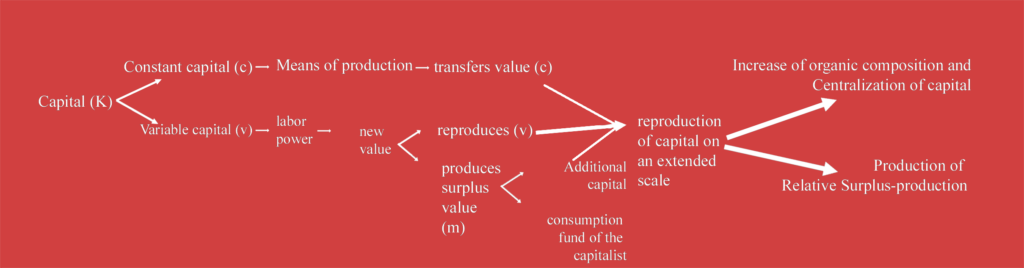
Marx then analyzes how capital is a value that divides into two opposite aspects: constant and variable. And how, in the production process, constant capital reproduces its own value while variable capital, by purchasing labor power, produces a new value through it. This new value, in turn, is also one that divides into two: one aspect is the reproduction of wage, the other is the production of surplus value, that is, the part of the new value created that is appropriated by the capitalist without costing him anything. Surplus value in turn is also divided into two contradictory aspects: excess capital and the consumption fund of the capitalist, which are the individual expenses of the bourgeois, for luxury and for his maintenance. Excess capital corresponds to the phenomenon of reproduction on an extended scale, which is the transformation of surplus value into capital. Surplus value constitutes the particular, specific product of the capitalist mode of production; its production conditions and is conditioned by free competition. The production of surplus value, on the one hand, and free competition on the other, determine that capitalist production needs to always reproduce itself, increasingly, in order to maintain the production of surplus value, that is, the profit of the capitalist. The necessary result of the production of surplus value under free competition is a growing capitalist accumulation and, consequently, a high centralization of capital. Capitalist accumulation and the centralization of capital, by increasing its organic composition, result in the final product of the capitalist mode of production: excess overpopulation. Thus, the reproduction of capital on an extended scale inevitably leads, on the one hand, to the expropriation of the capitalists by the capitalists themselves, and, on the other, to the production of the colossal mass of pauper people who will, in time, necessarily expropriate the capitalists and throw the private ownership of the means of production in the garbage of history.
This development of contradiction and the process of one dividing into two, in Capital, can be represented as follows:
The great work of Marx, Capital, therefore, is not based on the negation of the negation, but rather on the law of contradiction. For this reason, Chairman Mao emphasizes:
“As Lenin pointed out, Marx in his Capital gave a model analysis of this movement of opposites which runs through the process of development of things from beginning to end” 35
And:
“When Marx and Engels applied the law of contradiction in things to the study of the socio-historical process, they discovered the contradiction between the productive forces and the relations of production, they discovered the contradiction between the exploiting and exploited classes (…). When Marx applied this law to the study of the economic structure of capitalist society, he discovered that the basic contradiction of this society is the contradiction between the social character of production and the private character of ownership.” 36
In other words, Marx brilliantly applied the law of contradiction to the study of capitalist society. He just didn’t have time to formulate it in a separate philosophical work.
As seen, Marx’s use of the negation of the negation in Capital constitutes only a particular form of the law of contradiction in the analysis of the suppression of capitalist private property. It is important to note how the Marxist philosophical formulation develops in Anti-Dühring, as part of the two-line struggle against metaphysical conceptions within German social democracy. The work Anti-Dühring is divided into three large sections: Philosophy, Political Economy and Scientific Socialism; Engels thus presents, for the first time, the doctrine of the proletariat in its entirety, in its three component parts. As a whole, from the point of view of the development of Marxist philosophy, the book advances from the revolutionary negation of the negation to the law of contradiction.
In the first section, when refuting Dühring’s falsifications, Engels, as already seen, still presents the suppression of private property in the form of the revolutionary negation of the negation. However, when returning to the same theme, in the last section of the work, Scientific Socialism, Engels no longer deals with the suppression of capitalist property by taking the broad course of history, but presenting in detail the fundamental contradiction of capitalist society. Expressing this development of Marxist philosophy, Engels presents the same phenomenon, described in Capital, now based on the unity of opposites of the capitalist process, its resolution, or revolutionary negation:
“(…) the bourgeoisie could not transform these puny means of production into mighty productive forces without at the same time taking it out from its fragmentation and scattering, concentrating them, transforming them from individual means of production into social means of production only workable by a collectivity of men. (…)
The means of production and production itself have become social in essence. But they are subjected to a form of appropriation which presupposes private production by individuals, and under which, therefore, everyone owns his own product and brings it to market. The mode of production is subjected to this form of appropriation (…) The whole conflict of today is already present in embryo in this contradiction which gives the new mode of production its capitalist character.” 37
In other words, means of production that are only socially operable and a mode of production “social in essence” in contradiction with the mode of appropriation, that is, with the regime of private property, with capitalist property. And Engels highlights that, in embryo, the whole conflict of today lies “in this contradiction”. And so, this great titan of the proletariat continues:
“The separation of the means of production concentrated in the hands of the capitalists, on the one side, from the producers now possessing nothing but their labor-power, on the other, was accomplished. The contradiction between social production and capitalist appropriation became manifest as the antagonism between proletariat and bourgeoisie.” 38
Engels clearly presents the fundamental contradiction of the process, its economic basis: social production versus private appropriation and its social expression: proletariat versus bourgeoisie. Centrally departing from the contradiction of the process of capitalist society, and no longer from the negation of the negation in chained succession of two unities of opposites from different historical processes, Engels explains the crises of overproduction, departing from the development of the fundamental contradiction itself:
“In these crises, the contradiction between social production and capitalist appropriation ends in a violent explosion. The circulation of commodities is for the moment reduced to nothing; money, the means of circulation, becomes an obstacle to circulation; all the laws of commodity production and commodity circulation are turned upside down. The economic collision has reached its culminating point: the mode of production rebels against the mode of exchange, the productive forces rebel against the mode of production, which they have outgrown.” 39
And the resolution of this contradiction, between social productive forces and private property, between the mode of production and the mode of circulation is presented by Marx and Engels in Anti-Dühring as follows:
“But once their [the social productive forces] nature is grasped, they can be transformed from demoniacal masters into willing servants (…). With this treatment of the present-day productive forces according to their nature, which is now at last understood, a socially planned regulation of production in accordance with the needs of the community and of each individual takes the place of the anarchy of social production. The capitalist mode of appropriation, in which the product enslaves first the producer and then the appropriator as well, will thus be replaced by the mode of appropriation of the product based on the nature of the modern means of production themselves: on the one hand, direct social appropriation as a means of maintaining and extending production, and on the other direct individual appropriation as a means of existence and enjoyment.” 40
Engels presents in detail how to resolve the fundamental contradiction, in its economic aspect: social appropriation of the means of production and planning. And from a political point of view:
“The proletariat seizes state power and to begin with transforms the means of production into state property.” 41
The presentation of the suppression of private property assumes its classic formula for the international proletariat in this presentation by Engels, later popularized in the work Socialism: Utopian and Scientific (1880). In Capital, the suppression of private property had to be presented based on the sequential and chained resolution of two unities of opposites; capitalism arises from the negation of the first unity, capitalism is destroyed from the negation of the second unity. This initial explanation was accurate from a scientific point of view, correct from a philosophical point of view, but it needed to be deepened and this is what happens through two-line struggle against Dühring’s position. By presenting the suppression of capitalist property focusing on the analysis of the fundamental contradiction of capitalist society, the content and form of the proletarian revolution could be presented in greater detail. Presenting the upward historical movement based on the law of contradiction proved to be both more concrete and more universal. This constituted an important development of Marxist philosophy in the course of the first stage of development of the ideology of the international proletariat.
However, this development was not only the product of the ideological struggle against academic socialism, but also of the progress of the class struggle, after all, revolutionary philosophy advances and will always advance seeking to transform reality. Capital was published in 1867, Anti-Dühring was fully published only in 1878. In this short historical hiatus, great episodes for the world proletarian revolution and the two-line struggle in the nascent ICM took place. In 1871, the immortal Paris Commune took place, with the direct intervention of the First International, under the personal leadership of Marx, even though Marxists were a minority in the leadership of the Commune; and, in 1875, the very important two-line struggle against Lassallism emerged in Germany. From the first, Marx formulates the powerful document The Civil War in France, in which he highlights that the Paris Commune had resolved the historical problem of the state form of the dictatorship of the proletariat; secondly, Marx establishes in the Critique of the Gotha Program that the construction of communism would go through a first stage, of socialist society; in which, after the socialization of the means of production, would undoubtedly fight against the bourgeois law still in force and the social division of labor, particularly against the differences between countryside and city, between workers and peasants and between manual and intellectual labor – differences that are an expression of the existence of antagonistic classes in socialism.
In Capital, as Marx’s objective was to demonstrate the historical necessity of the expropriation of the expropriators, he considers it to be related to three qualitatively distinct social processes. Thus, in the form of the negation of the negation between these processes, the expropriation of the expropriators appears as a single act. After the Paris Commune and its correct assessment in The Civil War in France, after the Critique of the Gotha Program, the theoretical and practical development of ideology, in the fight against Dühring, became evident that the question could not be raised again in the same terms. Therefore, the expropriation of expropriators is now presented as a process, in which it the fulfillment of certain stages is necessary. The expropriation of expropriators as a process can only be philosophically presented through the law of contradiction.
In Anti-Dühring, Engels presents a series of examples of the negation of the negation in different processes of development of nature, society and thinking. These demonstrations were of great philosophical importance, because by highlighting the universality of the negation of the negation in the different forms of motion of matter, Engels was upholding the universality of dialectics. The formulation of the universality of dialectics was a necessary step towards establishing the universality and absolute validity of the law of contradiction. And, therefore, the work of Engels constitutes an important progress for the development of Marxist philosophy in every sense.
However, although the negation of the negation is present in all forms of motion of matter, it is not present in all phenomena as is the absolute validity of the law of contradiction. Engels, after presenting the universal aspect of the negation of the negation in the process of development of the barley grain, also presents its particular aspect. Let us first see how Engels analyzes its universal validity:
“Let us take a grain of barley. Billions of such grains of barley are milled, boiled and brewed and then consumed. But if such a grain of barley meets with conditions which are normal for it, if it falls on suitable soil, then under the influence of heat and moisture a specific change occurs in it, it germinates; the grain as such ceases to exist, it is negated, and in its place, there appears the plant which has arisen from it, the negation of the grain. But what is the normal life-process of this plant? It grows, flowers, is fertilized and finally once more produces grains of barley, and as soon as these have ripened, the stalk dies, is in its turn negated. As a result of this negation of the negation we have the original grain of barley once again, but not as a single unit, but ten-, twenty-or thirty-fold.” 42
The barley grain constitutes a unity of opposites that, when negated, under certain conditions, becomes a barley plant; this same plant, in turn, under certain conditions, grows, is fertilized and produces many other grains that deny the unity of opposites that constitutes the plant. The grain is negated in the first negation, the plant is negated by the set of grains in the negation of the negation. Two processes of units of distinct and linked opposites that necessarily give rise to a third one distinct from the two that preceded it: the quantitative expansion of barley grains. Then, Engels indicates the limits of this sequential form of movement:
“Negation in dialectics does not mean simply saying no, or declaring that something does not exist, or destroying it in any way one likes. Long ago Spinoza said: Omnis determinatio est negatio — every limitation or determination is at the same time a negation. Further, the kind of negation is here
determined, firstly, by the general, and, secondly, by the particular, nature of the process. I should not only negate, but also in turn sublate the negation. I must therefore set up the first negation in such a way that the second remains or becomes possible. In what way? According to the particular nature of each individual case. If I grind a grain of barley, if I crush an insect, it is true I have carried out the first act, but have made the second act impossible.” 43
This is the particularity of the negation of the negation: the first unity of opposites must be negated in a specific way so as to ensure the possibility of the second negation. In this case, the negation of the negation can explain the natural, spontaneous growth of barley, but not the phenomenon of agriculture for consumption, in which another specific form of negating the barley grain emerges, which makes the negation of the negation unfeasible. In this case, the process of the barley seed progresses from the affirmation of the unity of opposites of the grain to the negation of this unity through the germination of the plant; however, the unity of opposites of the plant progresses from the affirmation of this unity to its (unnatural) negation in the form of its milling. The affirmation and negation of the unity of contraries constitutes an ensued and universal form of the law of contradiction; The negation of the negation, in turn, constitutes only a particular form present in all forms of motion of matter but which is not capable of explaining the transformation of all processes and phenomena. This understanding regarding affirmation and negation, as we will see later, is one of the very important philosophical results of the two-line struggle in the CPC around the Maoist principle that one divides into two.
Engels not only culminates the development of Marxist philosophy in the first stage, but also establishes which were the philosophical problems that the next generations of communists should focus their attention on in order to complete their resolution. In Ludwig Feuerbach and the End of Classical German Philosophy, Engels highlights what were the present tasks for revolutionary philosophy:
“In every place it is no longer a question of inventing connections out of our brains, but of discovering them in the facts. For philosophy, which has been expelled from nature and history, there remains only the realm of pure thought, so far as it is left over, that is, the theory of the laws of knowledge process itself, logic and dialectics.” 44
The theory of the laws of the process of knowledge was formulated in Marxism by the great Lenin in his masterful work Materialism and Empirio-criticism, which was brilliantly developed by Chairman Mao in On Practice and Where Do Correct Ideas Come From?. Regarding logic and dialectics, Engels, in his work Dialectics of Nature, gave another important indication on the need for further developments:
“It is, therefore, from the history of nature and human society that the laws of dialectics are abstracted. For they are nothing but the most general laws of these two aspects of historical development, as well as of thought itself. And indeed, they can be reduced in the main to three:
– The law of the transformation of quantity into quality and vice versa;
– The law of the interpenetration of opposites;
– The law of the negation of the negation.
All three are developed by Hegel in his idealist fashion as mere laws of thought: the first, in the first part of his Logic, in the Doctrine of Being; the second fills the whole of the second and by far the most important part of his Logic, the Doctrine of Essence; finally, the third figures as the fundamental law for the construction of the whole system
(…)
We are not concerned here with writing a handbook of dialectics, but only with showing that the dialectical laws are really laws of development of nature, and therefore are valid also for theoretical natural science. Hence we cannot go into the inner interconnection of these laws with one another.” 45
Engels clarifies, therefore, that he takes the most general laws of nature, society and thought from Hegel’s work Science of Logic. He highlights the relationship of each law with the Hegelian philosophical system: the law of transformation of quantity into quality as part of the Doctrine of Being; the law of contradiction as part of the Doctrine of Essence, highlighted by Engels as the most important part of Hegelian logic; and the law of negation of the negation as part of the Doctrine of the Notion and, at the same time, as a fundamental law of the Hegelian system. Most importantly, however, Engels indicates the need to address the internal interconnection of these laws.
The great Lenin, unfortunately, was unable to see the work Dialectic of Nature, as it was only published in 1927, in the USSR. However, in his brilliant philosophical notebooks, particularly in his studies on Hegel’s Science of Logic, he precisely addressed the internal interconnection of these laws. In turn, it was up to Chairman Mao, largely based on what was advanced by Lenin, to offer the international proletariat the most advanced formulation of the materialist dialectic in On Contradiction, delivering the exposition of the law of contradiction as the sole fundamental law of dialectics in a straightforward way and, subsequently, its internal interconnection with its expressions or ensued laws: quantity/quality and affirmation/negation. This is what we will seek to address in the following topics.
1.2- Leninism: the law of unity and struggle of opposites as the kernel of dialectics
In the second stage of the ideology of the international proletariat, Lenin made an important leap in the theoretical elaboration of the Marxist world outlook, that is, in dialectical materialism. Marxism-Leninism drives the development of Marxist philosophy in its two central problems: the theory of knowledge and dialectics. Regarding the first problem, Lenin fully and completely established the theory of knowledge as an active reflection of matter in consciousness. In relation to dialectics, it was Lenin who, for the first time, formulated that the unity of opposites constitutes “the kernel of dialectics”. One of Lenin’s first theoretical works constitutes an important philosophical work, a polemics with Russian populists and their attacks against Marxism. In What the “Friends of the People” are and How They Fight the Social Democrats (1894), Lenin makes a great defense of dialectical materialism and particularly of the materialist conception of history developed by Karl Marx and Fredrich Engels, demonstrating his broad theoretical and practical grasp of Marxism very early on.
His most important philosophical work, Materialism and Empirio-criticism (1909), would be published a few years later, at a time of ideological crisis among communists in Russia. In 1905, the first Democratic Revolution took place in Russia, which massively mobilized workers and peasants in a great armed insurrection followed by a relatively protracted civil war until 1907. This first revolutionary attempt was defeated by tsarism which, after the ebb of the revolutionary wave, institutes a broad and violent counter-revolution, the Stolypin reaction. Many revolutionaries were arrested and exiled, but the biggest impact on Russian social democracy was ideological, that is, whether or not it would be possible to carry out a democratic revolution to defeat the tsarist autocracy, whether or not the revolutionary tactics of that period were correct.
At that time, Lenin was already the main communist leader in the country, heading the Bolshevik Fraction of the Russian Social Democratic Labor Party. At the beginning of 1905, after the start of armed uprisings of workers and peasants, Bolsheviks and Mensheviks met in separate Congresses and formulated opposing tactics for the Democratic Revolution in Russia. While the Mensheviks advocated a right-wing tactic of placing themselves at the tail of the Russian liberal bourgeoisie, entrusting the latter with the leadership of the bourgeois democratic revolution; Lenin, and the Bolsheviks, in turn, established the powerful tactic that advocated that the proletariat should fight for the leadership of that revolution to take it as far as possible and for the establishment of the worker-peasant alliance so, based on an armed contingent led by the proletariat, unleash the insurrection against the tsarist aristocracy and the liberal bourgeoisie, seeking to provide leadership to this revolution by establishing the revolutionary-democratic dictatorship of the proletariat and the peasantry.
Despite the correctness of this political line, the conditions for greater subjective development and greater organizational capacity of the Bolshevik Fraction to carry out the revolutionary tasks required in the conduct and achievement of revolution and its triumph were lacking. These subjective conditions would be obtained in the following years through the enormous effort of the then Russian Social-Democratic Labor Party, reconstituted by Lenin and the left-wing Bolsheviks, in 1912, at the Prague Conference, which ensured the transformation of the democratic revolution in February, 1917, into the victorious Great Socialist Revolution of October, in this same year. However, the defeat of the democratic revolution of 1905 had caused enormous ideological vacillation in the social democratic ranks, including the Bolshevik faction. These ideological vacillations sought to theoretically justify their capitulation by assuming bourgeois philosophical conceptions, in order to, in the name of the latest advances in natural sciences, contest the validity of the revolutionary philosophy of the proletariat, dialectical materialism.
Bogdanov, Bazarov, Lunacharsky and other Bolshevik militants and leaders started to defend that the Empirio-critical philosophy formulated by the Austrian physicist Ernst Mach corresponded to a great philosophical advance, which represented the overcoming of the opposition between materialism and idealism. The great Lenin, following the footsteps of Engels in Anti-Dühring, waged a formidable two-line struggle against these positions, unmasking their philosophical falsifications, their surrender to the bourgeois world outlook, thus managing to crush this rotten revisionist position in the Bolshevik fraction. In this way, Materialism and Empirio-criticism constitutes the decisive ideological work to overcome the setback of the defeat in 1905 and to achieve victory in 1917 and the great advances that followed.
For this “critical” empiricism, in the process of knowledge, sensation was taken as primary, but it was maintained that matter did not exist as such and that the essence of the phenomenon could not be known. Empirio-criticism mocked philosophical materialism, arguing that this revolutionary conception took matter as something “sacred”. For Empirio-criticism, objective matter outside consciousness did not exist; for this idealistic conception, the physical bodies were “complexes of sensations”.
Initially, Lenin unmasks the philosophical content of Empirio-criticism by showing that in Mach’s philosophical foundation there was no “novelty”, but rather the reissue of the old subjectivist idealist philosophical theory of the 17th century, by Bishop Berkeley. Mach’s philosophy established an absolute identity between sensation and the physical body, in this way he reduced matter to the sensation we have of it and the process of knowledge to the discoveries of the necessary relationships between our own sensations and not the material motion that is prior and, relatively, independent of our consciousness. In turn, Berkeley’s philosophy maintained that things are a “set of ideas”, this way he established an indissoluble identity between consciousness and things, thus reducing the process of knowledge to the discovery of divine ideas present in advance in all natural and social phenomena.
In opposition to this conception, Lenin will defend the two fundamental principles of philosophical materialism, systematized by Engels in Ludwig Feuerbach and the end of classical German philosophy: 1st) matter is prior to consciousness and exists independently of it; 2nd) consciousness can reflect the objective essence of all phenomena. Next, he would develop, in a new level, the dialectical materialist theory of knowledge, that is, the communist conception of the relationship between thinking and being.
Firstly, Lenin demonstrates that there is no indissoluble link between thinking and thing, nor between sensation and physical bodies. He demonstrates that matter is prior to human consciousness, he reveals that this is a result, a product of the development of inorganic matter into organic matter and a consequence of the transformation of life in human society. Matter, therefore, is prior to consciousness and, in turn, consciousness is a product of the transformation of matter and, in this way, matter can be neither a “complex of sensations” nor a “collection of ideas”. Matter is, according to Lenin’s brilliant definition:
“(…) is a philosophical category denoting the objective reality which is given to man by his sensations, and which is copied, photographed and reflected by our sensations, while existing independently of them.” 46
Lenin precisely demonstrates the conditional and relative character of the unity of opposites between thinking and being. This unity is not indissoluble, as consciousness is neither prior to matter nor immediately arising from it; the unity between being and thinking is, therefore, a product of the Dialectics of Nature, as Engels brilliantly defined it. Certain conditions are necessary for this unity to arise and, without these conditions, there can be no consciousness. In turn, the conditions for inert matter to transform into organic nature and this organic nature to transform into consciousness are created by the motion and transformation of matter itself. Consciousness does not arise from nature caused by a force external to nature, but by its own motion and transformation, therefore, Lenin highlights that although matter is not a “collection of ideas” or a “combination of sensations” it is “logical to assert that all matter possesses a property which is essentially akin to sensation, the property of reflection” It is the intrinsic property of inert matter to reflect, to react to mechanical, chemical, electrical motion, etc., that is, it is the contradiction inherent to eternal matter that drives its self-movement in incessant transformation.
In this way, Lenin sustains the dialectical materialist conception of the transformation of matter into consciousness, which corresponds to the first fundamental principle of philosophical materialism, or the first form of identity between being and thinking. Next, Lenin addresses the issue of the capacity of consciousness to know being, to reflect the essence of objective phenomena external to consciousness. This is the second fundamental principle of philosophical materialism, or the second form of identity between being and thinking. The first form of identity corresponds to the passive aspect of theory of reflection; The second form of identity corresponds to the active aspect of the theory of reflection. In the first form, the being transforms into consciousness; in the second, consciousness transforms into being. Let’s see how Lenin establishes this issue on a new level when developing the Marxist theory of knowledge.
Lenin begins dealing with this issue by taking up Engels when he said:
“Hegel was the first to state correctly the relation between freedom and necessity. To him, freedom is the appreciation of necessity. (…) Freedom does not consist in the dream of independence from natural laws, but in the knowledge of these laws, and in the possibility, this gives of systematically making them work towards definite ends. (…) Freedom therefore consists in the control over ourselves and over external nature, a control founded on knowledge of natural necessity” 47
Then Lenin brilliantly defends and develops this Marxist postulate:
“The development of consciousness in each human individual and the development of the collective knowledge of humanity at large presents us at every step with examples of the transformation of the unknown “thing-in-itself” into the known “thing-for-us,” of the transformation of blind, unknown necessity, “necessity-in-itself,” into the known “necessity-for-us.” (…) in the above-mentioned argument Engels plainly employs the salto vitale method in philosophy, that is to say, he makes a leap from theory to practice. (…) The mastery of nature manifested in human practice is a result of an objectively correct reflection within the human head of the phenomena and processes of nature, and is proof of the fact that this reflection (within the limits of what is revealed by practice) is objective, absolute, and eternal truth.” 48
In this formulation, Lenin makes an important leap in Marxist philosophy, by establishing that knowledge corresponds to the transformation of necessity, that the process of knowledge requires a leap from theory to practice and, furthermore, that practice constitutes the criterion of the objective truth of certain subjective reflection of reality in consciousness.
Lenin masterfully resolves the problem of the identity between thinking and being, thus advancing greatly in the theoretical formulation of the Marxist conception of the issue. He thus presents the necessary relationship between thinking and being, of thinking as a product of the development of matter; he thus establishes his first form of relative unity. He shows that thinking is a reflection of social practice, in the same way that social consciousness is a reflection of social being. By showing that freedom is the knowledge of necessity, and that such knowledge is the transformation of that necessity, that this transformation occurs through the leap from theory to practice, Lenin presents the second form of identity between thinking and being, or between knowing and doing, in a superior form. And he also shows the relative character of this unity between thinking and being, of this correspondence between the subjective and the objective, by solving the problem of the relationship between the relative character and the absolute character of truth:
“From the standpoint of modern materialism i.e., Marxism, the limits of approximation of our knowledge to objective, absolute truth are historically conditional, but the existence of such truth is unconditional, and the fact that we are approaching nearer to it is also unconditional. The contours of the picture are historically conditional, but the fact that this picture depicts an objectively existing model is unconditional. When and under what circumstances we reached, in our knowledge of the essential nature of things, (…) is historically conditional; but that every such discovery is an advance of “absolutely objective knowledge” is unconditional.” 49
Each discovery constitutes the identity between the subjective and the objective, as every unity of opposites is relative, this achieved truth will also have a relative, conditional character. However, the endless set of relative truths constitutes the unconditional, absolute, truth of the universe. The process of knowledge, therefore, is the infinite movement of consciousness approaching this objective and absolute truth. This Leninist formulation represented an important leap in the Marxist theory of knowledge.
When refuting idealist positions on the theory of knowledge, whether empiricist ones like Mach’s, or subjective idealists like Berkeley’s, the great Lenin harshly attacked the idealist foundation of these positions that sometimes proclaim the existence of a divine consciousness prior to nature, and sometimes the existence of an “indissoluble connection between the environment and the self”, as is the case with Fichte’s idealist philosophy and Bogdanov’s use of it. As already seen above, Lenin showed the relative character of this unity and the necessary condition of matter as prior to consciousness. However, when correctly criticizing the indissoluble unity between matter and consciousness, Lenin took the term “identity” as equal to the concept of “indissoluble connection” and thus put forward the following formulation:
“’Social being’ and ‘social consciousness’ are not identical, just as being in general and consciousness in general are not identical. From the fact that in their intercourse men act as conscious beings, it does not follow that social consciousness is identical with social being. (…) Social consciousness reflects social being — that is Marx’s teaching. A reflection may be an approximately true copy of the reflected, but to speak of identity is absurd. (…) For this theory of the identity of social being and social consciousness is sheer nonsense and an absolutely reactionary theory” 50
It is evident that Lenin, when speaking of the non-identity between the social being and social consciousness, is not denying that one aspect transforms into the other, under certain conditions. So much so that he emphasizes that “social consciousness reflects social being”. In this passage, Lenin is combating Bogdanov’s philosophical falsification that established an absolute identity between social being and social consciousness. Departing from the false assumption that social being = social consciousness, Bogdanov concluded that it was enough to study social consciousness to deduce the characteristics of social being from it. Besides being idealistic, this revisionist conception is metaphysical, as it takes two contradictory aspects, in this case social being and social consciousness, as if they were one and the same thing. The absolute, and not relative, identity of the opposite aspects of a contradiction is one of the metaphysical ways of combining two into one.
Lenin, therefore, is defending Marx’s materialist conception of history, which establishes that men enter into certain social relations without initially being aware of these same relations. The social consciousness of these relationships is a product of the dialectical development of social practice and social consciousness, and therefore cannot be immediately given. As established by Lenin, only under certain conditions there is this identity, which is not absolute but relative; the approximate reflection of the subjective in relation to the objective.
This passage of Materialism and Empirio-Criticism was later used by revisionist philosophers in China, epigones of Liu Shao-chi, as a way to combat Maoism. We will look at this issue in detail later. Here, we shall only highlight the following: in Lenin’s passage cited above, there is no error of philosophical conception, but there is an inaccuracy in the formulation of the question, in the handling of the dialectical concept “identity”, which encompasses at the same time the difference and equality. It will be Lenin himself who will resolve this conceptual issue in the Philosophical Notebooks, but here it is important to see that just as in the class struggle, not every defeat corresponds to an error in political line or philosophical conception; Also in the theoretical struggle, not every imprecise or insufficient formulation corresponds to a manifestation of idealism or metaphysics. Philosophy corresponds to the theoretical formulation of the world outlook of a certain class; This formulation is also a process in which one approaches more exact and precise forms. This is what happens in the present case. The importance of highlighting it consists in pointing out the importance of Lenin’s struggle against the absolute identity of aspects in a contradiction. Because as we will see, there are two ways of combining two into one; Prachanda does so through the reconciliation of contradictory aspects and Avakian does so through the absolute identity between the opposites. Both correspond to revisionist perspectives of Marxist philosophy, as ultimately, both suppress the struggle of opposites.
In relation to the other major problem for Marxist philosophy, highlighted by Engels, dialectics, the great leap made by Lenin in this field is condensed in the aforementioned Philosophical Notebooks (1914-1915), which were published in the USSR in 1929 and 1930. In this vast material, two manuscripts are the most important: the Conspectus of Hegel’s Book “The Science of Logic” (1914) and On the Question of Dialectics (1915). The first constitutes a notebook of Lenin’s notes from his studies of Hegel’s book The Science of Logic; the second is a systematization of Lenin’s conclusions about materialist dialectics. This material contains a series of brilliant Leninist philosophical formulations on dialectics and some essential finishing touches to his theory of reflection.
In relation to the dialectical materialist world outlook, he formulates that:
“(…) the inner contradictions lead to the replacement of the old content by a new, higher one.” 51
This formulation, as is generally known, would later be brilliantly developed by Chairman Mao. Regarding the concept “identity”, Lenin fully completes his understanding of it, precisely formulating that:
“Dialectics is the teaching which shows how Opposites can be and how they happen to be (how they become) identical, —under what conditions they are identical, becoming transformed into one another, —why the human mind should grasp these opposites not as dead, rigid, but as living, conditional, mobile, becoming transformed into one another.” 52
The development of Lenin’s philosophical thought in the course of his own work is clear in this and other passages. Just as Marx and Engels advanced from the negation of the negation to contradiction in explaining the suppression of private property, Lenin advances from the absolute non-identity between social consciousness and social being to the understanding that opposites are and become identical under certain conditions. The concept is the same, but the formulation took a significant leap. The advance in the understanding of dialectics allows Lenin to formulate the Marxist theory of knowledge in an even more developed and clear form, particularly regarding the problem of the identity between thinking and being:
“The abstraction of matter, of a law of nature, the abstraction of value, etc., in short all scientific (correct, serious, not absurd) abstractions reflect nature more deeply, truly and completely. From living perception to abstract thought, and from this to practice, —such is the dialectical path of the cognition of truth, of the cognition of objective reality.” 53
Here Lenin fully presents the two leaps in the process of knowledge, fully developed later by Chairman Mao in On Practice. Regarding the issue of transforming the subjective into objective, Lenin highlights that:
“Man’s consciousness not only reflects the objective world, but creates it. i.e., that the world does not satisfy man and man decides to change it by his activity.” 54
Regarding practice as the principal aspect in the process of developing knowledge, Lenin formulates that:
“Practice is higher than (theoretical) knowledge, for it has not only the dignity of universality, but also of immediate actuality.” 55
And:
“The result of activity is the test of subjective cognition and the criterion of objectivity which truly is.” 56
In relation to the Leninist leap in the formulation of dialectics, in Marxist philosophy, present in Conspectus of Hegel’s Book the Science of Logic, it appears in the immortalized and fully developed passage in On Contradiction:
“In brief, dialectics can be defined as the doctrine of the unity of opposites. This embodies the essence of dialectics, but it requires explanations and development.” 57
In the Manuscript On the Question of Dialectics (1915), Lenin goes further in establishing the law of contradiction as the sole fundamental law of materialist dialectics. Laying the foundations for the revolutionary principle that everything in the universe is one that divides into two, Lenin establishes that:
“The splitting of a single whole and the cognition of its contradictory parts is the essence of dialectics.” 58
Developing the formulation of the unity of opposites as the kernel of dialectics, Lenin establishes that:
“The identity of opposites (…) is the recognition (discovery) of the contradictory, mutually exclusive, opposite tendencies in all phenomena and processes of nature (including mind and society). The condition for the knowledge of all processes of the world in their “self-movement,” in their spontaneous development, in their real life, is the knowledge of them as a unity of opposites. Development is the “struggle” of opposites.” 59
Lenin, following the footsteps of Engels, brilliantly establishes the relationship between objective dialectics and subjective dialectics. All processes in nature advance as an identity and struggle of opposites, therefore, the condition for knowing these processes is to consider them as a unity of opposites. Lenin upholds in classical way the dialectical materialist world outlook, in his broadly known formulation:
“The two basic (…) conceptions of development (evolution) are: development as decrease and increase, as repetition, and development as a unity of opposites (the division of a unity into mutually exclusive opposites and their reciprocal relation).” 60
In a single passage, the law of contradiction and the principle that one divides into two is summarized. Furthermore, Lenin establishes the proletarian revolutionary principle of Marxist dialectics:
The unity (coincidence, identity, equal action) of opposites is conditional, temporary, transitory, relative. The struggle of mutually exclusive opposites is absolute, just as development and motion are absolute.” 61
There is no doubt about the gigantic role of the great Lenin, in these two great works Materialism and Empirio-criticism and in the Philosophical Notebooks, for the establishment of the law of contradiction as the sole fundamental law of dialectics. Therefore, what causes the UOC (MLM) to insist that it is the law of negation of the negation that “best explains the direction of movement” constitutes a complete absurd. This is not only in clear opposition to Maoism, but also, of course, to Marxism and Leninism.
Finally, it is necessary to dedicate a few words to the role of the great comrade Stalin in the development of Marxist philosophy. Stalin was Lenin’s continuer and took on the extremely difficult task of continuing socialist construction with great aptitude, after Lenin’s premature death in 1924. He then led with great mastery the complex two-line struggle against Trotskyism and, later, against Bukharinism. In the fight against Bukharin’s revisionist line, which opposed the completion of the NEP (New Economic Policy) and socialist collectivization, Stalin faced a more structured restorationist line than Trotsky’s openly counter-revolutionary and treacherous position. Bukharin, a loyal follower of the Trotskyist current, started to defend that the socialist economic base should combine capitalist and socialist elements for a long period. To support his position, he relied on the philosophical formulations of the School of Deborin, a revisionist philosopher who defended the theory of conciliation of contradictions. According to Deborin, in the course of a given process, contradictions only arise from a given moment, before which only differences would subsist, but not contradictions. In other words, for him, difference is not contradiction.
Stalin managed to crush Bukharin’s restorationist line in time to prepare the USSR for the great clash that was announced in the world with the rise of Nazi-fascism in Italy, Germany and Japan. He also defeated Deborin’s school by vigorously upholding the flag of the struggle of opposites contrary to the rotten theory of conciliation of contradictions. Comrade Stalin’s theoretical formulation that condenses the foundations of the proletarian line to crush the revisionist line is contained in the work Dialectical and Historical Materialism, which constitutes a chapter of the very important work History of the CP(b)USSR Short Course (1937). However, two important errors of unilateralism by Comrade Stalin in fighting the positions of Bukharin and Deborin stand out. In the struggle over the collectivization of the countryside, Stalin excessively emphasizes the importance of the productive forces regarding revolutionizing the relations of production. This was a difficult error to avoid, as it was simply the first experience of socialist construction. However, when dealing with the “The principal features of the Marxist dialectical method”, 62 Comrade Stalin commits important errors in presenting materialist dialectics. These were errors that could be avoided, as they were issues already advanced by Lenin in the Philosophical Notebooks. For this reason, Stalin’s presentation of dialectics in this work constitutes a setback.
It is decisive to emphasize that, despite the errors, the presentation of the Marxist philosophical conception was principally correct and the errors constituted the secondary aspect, but needed to be overcome by the subsequent development of the ideology. Comrade Stalin formulates four fundamental features of Marxist dialectics as: 1) everything is connected; 2) everything changes; 3) the transformation of quantity into quality; and 4) the struggle of opposites. Stalin rightly establishes that:
“Further, if the world is in a state of constant movement and development, if the dying away of the old and the upgrowth of the new is a law of development, then it is clear that there can be no “immutable” social systems, no “eternal principles” of private property and exploitation, no “eternal ideas” of the subjugation of the peasant to the landlord, of the worker to the capitalist.” 63
As Chairman Mao highlights, the replacement of the old by the new is a “general, eternal and inviolable law of the universe” and, therefore, a central issue in the world outlook of Marxist philosophy. Another very important aspect highlighted by Stalin in this text is that a phenomenon can only be resolved through its internal contradictions and through the struggle between opposites. In this way, he correctly emphasizes the absolute character of the struggle of opposites, highlighted by Lenin and later developed by Chairman Mao:
“Further, if development proceeds by way of the disclosure of internal contradictions, by way of collisions between opposite forces on the basis of these contradictions and so as to overcome these contradictions, then it is clear that the class struggle of the proletariat is a quite natural and in evitable phenomenon. Hence, we must not cover up the contradictions of the capitalist system, but disclose and unravel them; we must not try to check the class struggle but carry it to its conclusion. Hence, in order not to err in policy, one must pursue an uncompromising proletarian class policy, not a reformist policy of harmony of the interests of the proletariat and the bourgeoisie, not a compromisers’ policy of ‘the growing of capitalism into Socialism.’” 64
With this formulation, Comrade Stalin sought to smash Bukharin’s revisionist line and Deborin’s philosophical theorization and his defense of the reconciliation of contradictions.
However, Comrade Stalin ends up unilaterally emphasizing the struggle of opposites, treating it in a way that is dissociated from the unity of opposites. And he treats in incomplete way the identity of opposites in its most important content: the mutual transformation of opposites and how the conditions for this transformation are created. When dealing with what he lists as the first fundamental feature of the dialectical method, Stalin deals with the mutual dependence between phenomena, the “inseparable connection with surrounding phenomena, as one conditioned by surrounding phenomena.” 65 He thus addresses one of the aspects of the unity of opposites, their interdependence, but he errs in treating it in a way dissociated from the struggle, since what connects the different phenomena, as well as the opposing aspects in a contradiction, is not an indissoluble connection, but the absolute struggle and relative unity between opposites.
On the other hand, when he addresses what he classifies as the fourth feature of the dialectical method, the struggle of opposites, Stalin does so separately from the unity of opposites, and does not analyze the transformation of phenomena based on the struggle and identity of opposites, thus not revealing that the qualitative leap in a process constitutes the mutual transformation between the new and old aspect in the contradiction, with the new assuming the principal, dominant condition and the old becoming the secondary, dominated condition. Thus, the comrade formulates the quality leap as follows:
“(…) the process of development from the lower to the higher takes place not as a harmonious unfolding of phenomena, but as a disclosure of the contradictions inherent in things and phenomena, as a “struggle” of opposite tendencies which operate on the basis of these contradictions.” 66
As Lenin had already highlighted, the process of development of a phenomenon is a process of unity and struggle between opposites, and that through the absolute struggle of opposites under certain conditions each opposite transforms into its opposite and this constitutes the most important aspect of the identity of opposites.
Not sufficiently understanding the relationship between unity and struggle of opposites and, particularly, this aspect of the identity of opposites, constituted the errors of metaphysical conception that Comrade Stalin sometimes incurred, errors that were criticized and rectified by Chairman Mao. This conceptual error is related to Stalin’s other errors, such as not considering the identity of contraries in the contradictions between productive forces and relations of production, between economic base and superstructure. That is, although the productive forces and the economic base are, ultimately, the dominant aspect compared to the relations of production and the superstructure, under certain conditions of the development of the social process, relations of production and the superstructure become the principal aspect of the contradiction.
However, it is necessary to emphasize that an important part of these errors was corrected by Comrade Stalin himself in the course of the process of developing his leadership. For example, in Economic Problems of Socialism in the USSR (1952), Stalin rectifies his view on the importance of the development of productive forces for the construction of socialism and focuses his attention on the problem of the development of the relations of production. However, in this work the other error of underestimating the importance of revolutionizing the superstructure to fully complete the revolution of relations of production in socialist society appears. In an earlier work, Marxism and Problems of Linguistics (1950), however, Stalin had correctly established that:
“The superstructure is created by the base precisely in order to serve it, to actively help it to take shape and consolidate itself, to actively fight for the elimination of the old, moribund base together with its old superstructure.” 67
Here Stalin correctly deals with the conditions in which the superstructure assumes the principal aspect in the contradiction, from the active role in the destruction of the old economic base of society as a condition for the flourishing and development of new relations of production. This shows how Comrade Stalin’s world outlook was fundamentally correct, and, at the same time, how errors in the theoretical formulation regarding this conception hinder ideological development.
Contrary to what UOC (MLM) states, Stalin’s philosophical error is not that he “cut out” the negation of the negation from the fundamental laws of dialectics. The issue lies in the handling and development of the law of contradiction, in moving forward from what was established by Lenin in his work Philosophical Notebooks. The problem is not in the negation of the negation, but in the lack of understanding of Lenin’s advances and the recognition of the great philosophical leap taken by Chairman Mao in 1937, with On Practice and On Contradiction.
1.3- The law of contradiction and its scientific-popular expression in the principle that “one divides into two”
The leap in Marxist philosophy made by Chairman Mao, in turn, does not arise from the correction of the errors of Stalin. The development of Marxist dialectics and the Marxist theory of knowledge, achieved shortly after the epic Long March, emerges as a necessary leap to Marxism-Leninism to the development of the military line and the line of democratic revolution in China. Without this leap in dialectics, it would not have been possible to establish the method of two-line struggle in dealing with internal contradictions in the Communist Party, the theory of Protracted People’s War, the Three fundamental instruments of revolution -party, people’s army and revolutionary united front – and of the six laws of this for the New Democratic Revolution. The struggle to resolve the concrete problems of the Chinese revolution takes place in the midst of important two-line struggles, assumed and applied by Chairman Mao’s leadership, against the right and “left” opportunist positions and the dogmatic ones in the CPC and are, therefore, the origin of the great leap in Marxist philosophy achieved by Chairman Mao Zedong.
Maoism, as a whole, begins its development as the third stage in the development of the ideology of the proletariat when solving the problem of the Proletarian Revolution in colonial/semi-colonial countries. This development, in turn, begins through the application of the universal truths of Marxism-Leninism, notably the contributions of Stalin’s thought, including the definition of Leninism, the main contribution to the ideology of the international proletariat, to the concrete reality of the Chinese revolution. Among Stalin’s contributions, the justified and correct international line of the anti-fascist united front during the course of the Second imperialist World War also stands out. It was by applying these universal contributions to the Chinese revolution that Chairman Mao forged the theory of the New Democratic Revolution and the theory of the three instruments of Revolution.
The development that Maoism contributed with the precise formulation of the Marxist political economy of socialist construction and the resolution of the problem of the continuity of the revolution under the dictatorship of the proletariat, that is, the Great Proletarian Cultural Revolution, necessarily implied the correction of Comrade Stalin’s philosophical errors. This was a pressing need for the development of the ideology, but it was not the reason for its development, as pointed out by the capitulationist and revisionist assessments of Avakianism and Prachandaism.
The works On Practice and On Contradiction were written after a major setback in the Chinese revolution. The fifth major campaign of encirclement and annihilation personally led by Chiang Kai-shek against the revolutionary base areas, mainly against the most consolidated one located in the Tchincan Mountains, which resulted in a significant defeat for the revolution, mainly for the contingents of the Red Army led by CPC. On October 16, 1934, the Red Army managed to break the siege and began the strategic withdrawal that would become the 12,500 km Long March. The principal cause of this defeat was subjective, the predominance of Wang Ming’s “left” opportunist adventurist line of “attacking in all directions” and seeking to quickly conquer large cities; and, soon, after breaking the Kuomintang siege, the line of aimless “escape”. This opportunist line resulted in the loss of many living forces of revolution and all the territory liberated by the agrarian revolutionary war. Chairman Mao, however, knowing that a defeat of the proletarian revolution could only be temporary, persisted in the two-line struggle in the CPC and crushed, firstly, Wang Ming’s military line and then his line for the democratic revolution in China. Thus, it was established, in 1935, that the increasing expansion of the Japanese invasion to the interior of China, which began in 1931 from Manchuria, corresponded to the modification of the principal contradiction in the Chinese revolution and, in this way, the Long March turns towards northern China, defeating Chang Kuo-tao’s line of capitulation and escape. The Shensi base area was established in Yenan, to place itself in the first lines of resistance against the Japanese offensive and turning Yenan into the great general rearguard of the revolution and the anti-Japanese national war.
The aforementioned philosophical works, among others, prepared by Chairman Mao immediately represented the ideological consolidation of the left-wing line in the CPC, something similar to what Materialism and Empirio-criticism represented in the Bolshevik Party. The philosophical principles he presented in mid-1937, however, were already present in their applied form in military theory, in the very important work Problems of Strategy in China’s Revolutionary War, which was prepared in December 1936. In the study of the laws of war revolutionary revolution in China, Chairman Mao establishes the cardinal principles of the law of contradiction:
1) He highlights that war is the highest way to resolve antagonistic social contradictions:
“War is the highest form of struggle for resolving contradictions, when they have developed to a certain stage, between classes, nations, states, or political groups, and it has existed ever since the emergence of private property and of classes.” 68
2) He points out that there are only two types of war and one way to eliminate war:
“War, this monster of mutual slaughter among men, will be finally eliminated by the progress of human society, and in the not-too-distant future too. But there is only one way to eliminate it and that is to oppose war with war, to oppose counter-revolutionary war with revolutionary war, to oppose national counter-revolutionary war with national revolutionary war, and to oppose counter-revolutionary class war with revolutionary class war. History knows only two kinds of war, just and unjust. We support just wars and oppose unjust wars. All counter-revolutionary wars are unjust, all revolutionary wars are just.” 69
3) He Analyzes all the military problems from the perspective of unity and struggle between two opposing aspects:
“Giving proper consideration to the distinction as well as the connection between losses and replacements, between fighting and resting, between concentration and dispersion, between attack and defense, between advance and retreat, between concealment and exposure, between the main attack and supplementary attacks, between assault and containing action, between centralized command and decentralized command, between protracted war and war of quick decision, between positional war and mobile war, (…) between civil war and national war, between one historical stage and another, etc., etc.” 70
4) He establishes the question of the fundamental contradiction in the course of the development of the process of war:
“These are the two aspects of China’s revolutionary war. They exist simultaneously, that is, there are favorable factors and there are difficulties. This is the fundamental law of China’s revolutionary war, from which many other laws ensue.” 71
5) He establishes the two basic forms of combat and their necessary intercalation in the revolutionary war in China:
“(…) there are only two basic forms of fighting, attack and defense. (…) It is a strategic defeat for the enemy when his “encirclement and suppression” campaign is broken and our defensive becomes an offensive, when the enemy turns to the defensive and has to reorganize before launching another “encirclement and suppression” campaign.” 72
6) He highlights the need to create the conditions to reverse the contradictory aspects of war:
“The object of strategic retreat is to conserve military strength and prepare for the counteroffensive. (…) In the past, however, many people were stubbornly opposed to retreat, considering it to be an “opportunist line of pure defense”. Our history has proved that their opposition was entirely wrong. To prepare for a counter-offensive, we must select or create conditions favorable to ourselves but unfavorable to the enemy, so as to bring about a change in the balance of forces, before we go on to the stage of the counter-offensive.”
7) In turn, he emphasizes that only through struggle can a leap in quality be achieved and the contradictory aspects of war reversed:
“(…) the presence of these conditions and of a situation favorable to ourselves and unfavorable to the enemy does not mean that we have already defeated him. Such conditions and such a situation provide the possibility for our victory and his defeat, but do not constitute the reality of victory or defeat; they have not yet brought actual victory or defeat to either army. To bring about victory or defeat a decisive battle between the two armies is necessary. Only a decisive battle can settle the question as to which army is the victor and which the vanquished.” 73
8) He emphasizes that in the mutual transformation, in identity, of contradictory aspects, the difference and struggle of opposites continues to exist:
“Whether in a counter-offensive or in an offensive, the principles with regard to these problems do not differ in their basic character. In this sense we may say that a counter-offensive is an offensive. Still, it is not exactly an offensive. The principles of the counter-offensive are applied when the enemy is on the offensive. The principles of the offensive are applied when the enemy is on the defensive. In this sense, there are certain differences between a counter-offensive and an offensive.” 74
In summary, Chairman Mao’s military line establishes that the fundamental contradiction of the revolutionary war in China has the opposite aspects of favorable conditions (a vast semi-colonial country and a just war led by the Communist Party) versus unfavorable ones (facing a powerful enemy with a small and weak army). The only way to resolve this contradiction is through a protracted revolutionary war. Faced with the enemy’s offensive, its campaigns of encirclement and annihilation, the revolutionary forces put up an active defense, as part of the counter-campaign of encirclement and annihilation. The objective of the defensive phase in the campaign is to create the conditions to go on the counteroffensive; This is only possible when we manage to create the conditions to fight a decisive battle that allows us to temporarily reverse the correlation of forces and impose a tactical offensive against an enemy that is strategically superior. The succession of tactical offensives in the protracted people’s war, throughout its three strategic stages (defensive, stalemate and offensive), makes it possible to change the correlation of forces as a whole in order to achieve the annihilation of the enemy and conquer power throughout the country.
In On Contradiction, Chairman Mao philosophically develops this brilliant dialectic in his military thought, already successfully applied in the first four campaigns of encirclement and annihilation by the Kuomintang against revolutionary base areas in southern China (1930-1933) and during the epic Long March (1934-1936). On Contradiction generalizes and develops this dialectic, arming the Chinese and international proletariat with an all-powerful philosophy established in a deeply scientific way and, at the same time, genuinely popular way.
He begins his work by establishing that there are only two world outlooks regarding the development of a thing and phenomenon: the dialectical conception according to which things develop as an “internal and necessary self-movement” through quantitative and qualitative changes; and the metaphysical conception according to which movement occurs due to external causes and changes are only quantitative. He establishes that the “universality of contradiction or absolute character of contradiction” has two aspects:
- contradiction exists in the process of all things and phenomena; and
- that contradiction runs through the entire process from beginning to end.
Chairman Mao, in turn, when studying the “particularity and relativity of contradiction”, he analyzes it on five levels, demonstrating:
- that each form of movement of matter has its particular contradictions;
- that in a given form of movement of matter, each of its processes has a particular, or fundamental, contradiction that distinguishes it from the other processes of this form of movement;
- that this contradiction is composed of two particular opposing aspects;
- that the development of a process is divided into stages, and each stage also has a particular contradiction;
- that the particular contradiction of a stage of a process also has two particular contrary aspects.
Chairman Mao concludes the study of the particularity of contradiction, showing the dialectical relationship between universality and particularity in the study of all things and phenomena:
“Since the particular is united with the universal and since the universality as well as the particularity of contradiction is inherent in everything, universality residing in particularity, we should, when studying an object, try to discover both the particular and the universal and their interconnection, to discover both particularity and universality and also their interconnection within the object itself, and to discover the interconnections of this object with the many objects outside it.” 75
Furthermore, of the 5 plans mentioned in the study of the particularity of contradiction, Chairman Mao analyzes two other issues in particular:
- the principal contradiction; and
- the principal aspect of the contradiction.
He thus highlights that every complex process is composed of countless contradictions, but that only one of these will be the principal contradiction, at a given stage or phase of development of this process. Furthermore, he formulates that the solution of the principal contradiction determines and conditions the resolution of secondary contradictions; and that the study of the principal aspect of the principal contradiction in a given phenomenon is decisive to achieve the resolution of its contradictions.
After studying universality, the particularity of contradiction, and the dialectical relationship between both of them, Chairman Mao moves on to the study of the identity and struggle of the aspects of a contradiction. He then establishes that identity has two meanings:
- the existence of an aspect presupposes the existence of its opposite; and
- under certain conditions, each aspect transforms into its opposite.
Furthermore, he establishes that the second meaning is the most important, as it is what indicates the change in phenomena, as well as their direction. Regarding the relationship between identity and the struggle of opposites, Chairman Mao, based on what was established by Lenin, formulates that:
“All processes have a beginning and an end; all processes transform themselves into their opposites. The constancy of all processes is relative, but the mutability manifested in the transformation of one process into another is absolute.” 76
He then establishes the relationship between the identity and struggle of opposites, with the previously called law of transformation of quantity into quality:
“There are two states of motion in all things, that of relative rest and that of conspicuous change. Both are caused by the struggle between the two contradictory elements contained in a thing. When the thing is in the first state of motion, it is undergoing only quantitative and not qualitative change and consequently presents the outward appearance of being at rest. When the thing is in the second state of motion, the quantitative change of the first state has already reached a culminating point and gives rise to the dissolution of the thing as an entity and thereupon a qualitative change ensues, hence the appearance of a conspicuous change. Such unity, solidarity, combination, harmony, balance, stalemate, deadlock, rest, constancy, equilibrium, solidity, attraction, etc., as we see in daily life, are all the appearances of things in the state of quantitative change. On the other hand, the dissolution of unity, that is, the destruction of this solidarity, combination, harmony, balance, stalemate, deadlock, rest, constancy, equilibrium, solidity and attraction, and the change of each into its opposite are all the appearances of things in the state of qualitative change, the transformation of one process into another. Things are constantly transforming themselves from the first into the second state of motion; the struggle of opposites goes on in both states but the contradiction is resolved through the second state. That is why we say that the unity of opposites is conditional, temporary and relative, while the struggle of mutually exclusive opposites is absolute.” 77
This passage is very significant in the process of establishing the law of contradiction as the sole fundamental law of dialectics, since for the first time in the development of Marxist philosophy the transformation of quantity into quality is based on the unity and struggle of opposites, that is, through the law of contradiction. Chairman Mao divides the movement of all things and phenomena into two stages: relative rest and conspicuous change; establishes that the movement in these two stages has its origin in the struggle of opposing aspects. That in the first stage, quantitative changes that occur create the conditions for the manifest change, the leap in quality. In the first stage, harmony, balance between contradictory aspects are manifestations of the stage of quantitative change; in the second stage, the contradictory unity dissolves and one aspect or process transforms into its opposite. He emphasizes that the struggle of opposites takes place in both stages, but that the contradiction is only resolved in the second stage, that of manifest change. He thus substantiates Lenin’s definition of the unity of opposites being relative and the struggle between opposites absolute.
The work On Practice, which for reasons of length we cannot deal with in detail in this document, appears a few months before On Contradiction and constitutes the application of the law of contradiction, in its most elaborate form, to the process of knowledge. In this way, it also constitutes a philosophical leap in this key issue of dialectical materialism. In this work, Chairman Mao analyzes social practice and knowledge as a unity of opposites, truth is the result of the unity and struggle between these two contrary aspects, but mainly of the struggle between them. Through social practice, the human brain reflects objective reality, and returns to this same reality that confirms or refutes these reflections. Social practice and reflection of this practice in consciousness constitute the contradictory aspects that originate the movement of human thought. Human knowledge in turn, in its movement towards truth, also has two stages: 1) sensitive knowledge, and 2) rational knowledge. Through the first stage, human consciousness collects an immense amount of information that allows it to reflect the appearance of things and phenomena. The accumulation of this information, the analysis of this data, create the conditions for a leap in quality: sensitive knowledge transforms into rational knowledge, the analysis of objective data transforms into a synthesis that seeks to reflect the essence of things and phenomena. However, the movement of knowledge does not end in this subjective synthesis, as rational conclusions need to be confirmed by social practice. The process of knowledge is never immediate, therefore, the search for truth is the infinite movement from practice to theory and from theory to practice. In the unity of contraries between social practice and social consciousness, social practice constitutes the principal aspect, as it constitutes the origin of knowledge and, at the same time, the criterion of truth. Theory is born from practice and only through practice can it be confirmed. In turn, in this contradictory movement, one aspect transforms into its opposite: practice becomes rational knowledge and rational knowledge, when true, transforms objective reality through practice. Furthermore, Chairman Mao highlights, in On Contradiction, that under certain conditions consciousness becomes the principal aspect of the contradiction.
In the final session of On Contradiction, Chairman Mao further analyzes the place of antagonism in contradiction as part of the study of the struggle of opposites. He establishes that although the resolution of the contradiction can only occur through the struggle of opposites, this in turn has two forms of development, which vary according to the character of the contradiction:
- antagonistic contradictions; and
- non-antagonistic contradictions.
The struggle of opposites is absolute, present in all processes, things and phenomena; However, contradiction is not the same as antagonism, antagonism is a particular form of contradiction that requires a different and corresponding method to resolve it. When misidentified, a non-antagonistic contradiction can turn into an antagonistic contradiction, thus making its resolution difficult. On the other hand, a given contradiction can be antagonistic in a given process and non-antagonistic in an opposite process, as is the case of the contradiction between countryside and city, which is antagonistic in capitalism, but which in socialism must be resolved with non-antagonistic methods.
In On Contradiction, Chairman Mao establishes in a profound way, and for the broad masses, extremely complex questions in philosophy, never before resolved at this level in the entire history of bourgeois philosophy. Clearly, he advances towards the establishment of contradiction as the sole fundamental law of dialectics, by analyzing it in its various aspects and by substantiating the transformation of quantity into quality in the law of contradiction. That is why Chairman Mao concludes this magnum opus of Marxist philosophy with the following brilliant synthesis:
“The law of contradiction in things, that is, the law of the unity of opposites, is the fundamental law of nature and of society and therefore also the fundamental law of thought.” 78
By establishing the law of contradiction as the fundamental law of dialectics, the universality and particularity of contradiction and, in particular, the two forms of struggle of opposites (antagonistic and non-antagonistic), Chairman Mao completely smashes the conceptions of the School of Deborin, also fought by Comrade Stalin. In this way, On Contradiction served as an important contribution from Chairman Mao to the two-line struggle in the ICM against Bukharinism and against Trotskyism, as emphasized in an important article during the Great Philosophical Polemic, in the CPC, between 1964 and 1965 (a question that we
“Deborin distorted the law of the unity of opposites as the reconciliation, integration or synthesis of opposites. He excluded the struggle of opposites within things. Proceeding from this theory, he also disavowed the existence of class contradictions in Soviet society. Thus, Deborin’s anti-dialectical philosophy was useful as the ideological weapon to the Bukharin-Trotsky anti-Party gang.” 79
The positions pro-capitalist restoration and against socialist construction in a single country by Bukharin and Trotsky sought their theoretical foundation in Deborin’s philosophy. They sought to support their right-wing line, of maintaining the NEP (New Economic Policy) after it had essentially fulfilled its objectives for the reconstruction of the country after the civil war (1918-1922), in the rotten theories of class reconciliation, integration of opposites and in defense of the non-existence of class struggle in the USSR. Stalin fought this position, but only the developments in Marxist philosophy carried out by Chairman Mao completely smashed the philosophical falsification of the Deborin School.
In the same way as in the Bolshevik Party, revisionist lines sought to theoretically base themselves through the philosophical falsifications of dialectical materialism in the CPC. In this case, the same phenomenon occurred after the conquest of Power throughout the country, in 1949. During the fifteen years from 1949 to 1966, the principal two-line struggle in the CPC, against capitalist restoration, took place against the right-wing opportunist line of the renegade and worker-seller Liu Shao-chi. On several occasions, Chairman Mao’s red line had to smash revisionist restorationist positions. Through this important two-line struggle, the concrete experience of the Socialist Revolution in China (from 1949) and the beginning of the GPCR (which culminates the struggle against Liu Shao-chi’s line), Mao Zedong thought develops and transforms into Maoism: third, new and higher stage, as Chairman Gonzalo would later define it. In the course of this two-line struggle (1949-1966), which is inseparable from the development of class struggle in the socialist society, new and significant advances occurred in Chairman Mao’s philosophical formulations.
This long and decisive two-line struggle in the CPC took place around the problems of the principal contradiction in socialist society, of the general line for the transition period (socialization of industry/commerce, small businesses and handicrafts and the co-operation and collectivization movement of the countryside) and the general line for socialist construction (which included the construction of the People’s Communes and the Great Leap Forward). It is important to emphasize that an important part of this two-line struggle against Liu Shao-chi’s right-wing line took place in the midst of the two-line struggle in the MCI against Khrushchev’s modern revisionism, whose peak occurred between 1963-64, in the Great Debate, with which the CPC, under the leadership of Chairman Mao’s red line, crushes the Khrushchevite positions.
The conquest of total power in China marks the opening of the two-line struggle of Chairman Mao against Liu Shao-chi. In March 1949, a few months before victory at the II Plenary Session of the CC of the CPC, Chairman Mao pointed out that, after the conquest of all power, the principal contradiction in Chinese society became the “contradiction between the working class and the bourgeoisie.” 80 At the end of 1952, Chairman Mao establishes the general line for the transition period, that is, the course of the Socialist Revolution:
“(…) bringing about, step by step, the socialist industrialization of the country and the socialist transformation of agriculture, handicrafts and capitalist industry and commerce.” 81
In opposition to the advancement of the Socialist Revolution, Liu Shao-chi formulates the right-wing opportunist line of “consolidation of the new-democratic system”. This position was smashed by Chairman Mao in 1953, in his speech on the Party’s general line for the transition period:
“After the success of the democratic revolution, some people stand still. Failing to realize the change in the character of the revolution, they continue with their new democracy instead of undertaking socialist transformation. Hence their Rightist errors.” 82
The application of the CPC’s general line for the transition period in the countryside of China has made flourish the agricultural co-operation movement, driven by the socialist initiative of poor peasants and lower middle peasants. The reaction of the right to the socialist offensive in the countryside was to reformulate the theoretical foundations of their restorationist line, from the struggle to “consolidate the new-democratic system” into defending that the socialist superstructure would be based on a “synthesized economic base” during the transition period, that is, both socialist and capitalist and that the dictatorship of the proletariat should promote and serve both. The theoretical formulation of this opportunist line was entrusted by Liu Shao-chi to the revisionist philosopher Yang Xian-zhen, who wrote the reactionary pamphlet On the Question of the Base and the Superstructure During the Transition Period in the People’s Republic of China.
This right-wing offensive initially resulted in a reduction in the “number of co-operatives.” 83 However, the position of the “synthesized economic basis” was smashed by the struggle waged by Chairman Mao in 1955, who, with the document On the Question of Agricultural Co-operation, attacked the essence of that bourgeois right-wing position: the reissue of the rotten theory of productive forces adapted to Chinese conditions, which advocated that the relations of production in the countryside in China could only advance towards socialist relations after the mechanization of the countryside. As the industrial base of the country was very backward, this would be a process that would take a long time. Chairman Mao razes these positions and demonstrates how the relations of production could actually take precedence over productive forces and boost their development. In this way, agricultural co-operation advanced rapidly in China, even with still precarious and insufficient mechanization. This was a major contribution by Chairman Mao to the socialist political economy.
After this second defeat, Liu Shao-chi’s right-wing opportunist line tried to regain momentum after the 20th Congress of the CPSU, which took place in February 1956 and which gave the slogan for a fast pace towards capitalist restoration in the USSR, with Khrushchev’s revisionist offensive and his rotten and lying Secret Speech. Based on the revisionist and restorationist theories of that Congress and the temporary defeat of the dictatorship of the proletariat in the USSR, Liu Shao-chi’s right-wing bourgeois clique launched the offensive at the 8th Congress of the CPC, held in October of the same year, and managed to approve the setback in the ideological definition of the Party that removes part of that was adopted by the 7th Congress, in 1945, from “Marxism-Leninism, and the ideas of Comrade Mao Zedong” to “Marxism-Leninism”, precisely at a time when Mao Zedong thought was advancing in great strides towards transform into a new, third and higher stage of Marxism. From the point of view of the general line for socialist construction, after the defeat of the theory of “synthesized economic base”, the right-wing opportunist line tries to create a new ruse, approving still at the 8th Congress the position that the principal contradiction in China was “the contradiction between the advanced socialist system and the backward social productive forces.” 84 thus, proclaiming the old and revisionist theory of productive forces with a new label, arguing that only after the advance of mechanization could socialist relations of production advance.
Despite the setback at the 8th Congress of the CPC, Chairman Mao’s revolutionary proletarian line maintains the initiative and launches new blows against Liu Shao-chi’s right-wing line. Still in 1958, Chairman Mao wins in the CC, establishing the general line for socialist construction:
“Going all out, aiming high and achieving greater, faster, better and more economical results in building socialism.” 85
With this powerful line, the masses in China, under the leadership of the CPC and under the leadership of Chairman Mao, boldly launched themselves into socialist construction, promoting the Great Leap Forward and the construction of People’s Communes, economic-social and political units, where the struggle to overcome the differences between the city and the countryside, between workers and peasants, and between manual work and intellectual work was promoted. Furthermore, to ensure greater rights for working women by guaranteeing their broad participation in production, class struggle and scientific experimentation.
The difficulties caused mainly by inevitable natural calamities (drought, floods, earthquakes, plagues, etc.) and other performance difficulties in implementing a bold plan such as the Great Leap Forward, which involved hundreds of millions of workers, peasants, intellectual workers, women and youth, in addition to counterrevolutionary sabotage, were used by Liu Shao-chi’s right-wing clique to attack Mao Tse-tung thought. Once again, the right-wingers use the revisionist philosopher Yang Xian-zhen to attack the red line in the CPC, who, also in 1958, wrote the reactionary article A Brief Discussion of Two Categories of ‘Identity.’, in which he stated that the defense of identity between thought and being was an idealistic conception. This document was used to theoretically substantiate, based on the falsification of the Marxist-Leninist theory of knowledge, the revisionist position that criticized Chairman Mao’s line of socialist construction, as if it were subjectivist. He thus pointed out that the setbacks in the application of the socialist construction plan were products of an idealistic conception of the theory of knowledge, of a theory that would be subjectivist, as it believed it was possible to adapt reality to the Party’s plans.
These philosophical falsifications by Yang Xian-zhen in 1958 were crushed by Chairman Mao’s red line. In this clash, the Maoist cadre and proletarian philosopher Ai Szu-chi stood out, as highlighted by the Revolutionary Mass Criticism Writing Group of the Party School, subordinate to the CC of the CPC, in 1971:
“Because they are decadent and moribund reactionaries and a handful of fools blinded by inordinate ambition, the enemies invariably miscalculate the situation. While they were in the midst of their wild counter-attacks, the proletarian headquarters headed by Chairman Mao sharply pointed out: Yang Hsien-chen and company had for a long time deliberately distorted Engels’ words to buttress up their reactionary fallacy and they had to be criticized. With the proletarian headquarters’ guidance, Ai Szu-chi and other comrades published articles exposing and criticizing theoretically and politically the fallacy that ‘there is no identity between thinking and being.’” 86
The ruse of Liu Shao-chi’s revisionist line was to falsify Marxist philosophy to theoretically substantiate his attack on Chairman Mao’s line for socialist construction. To cover up with pseudo-Marxist phraseology his rotten bourgeois line of capitalist restoration. This revisionist counterattack was once again smashed by Chairman Mao, who pointed out:
“The period of transition is full of contradiction and struggle. Our present revolutionary struggle is even more profound than the armed revolutionary struggles of the past. It is a revolution that will forever bury the capitalist system and all other systems of exploitation.” 87
The understanding that socialism and the dictatorship of the proletariat should be a period of permanent revolution until communism, as upheld by Marx in the Critique of the Gotha Program, was acquiring a higher development, supported by the concrete experience of the struggle for socialist construction and against capitalist restoration. In the midst of this two-line struggle in the CPC, the theory of the need for successive Proletarian Cultural Revolutions to achieve communism was forged.
The two-line struggle against Liu Shao-chi, the “Chinese Khrushchev”, was essentially focused on ideological questions and socialist construction, in defense of Mao Tse-tung thought and his general line for socialist construction. However, this two-line struggle expressed itself in a special way as “Three Great Struggles on China’s Philosophical Front” in the period from 1949 to 1964:
1st great struggle: against the theory of the “synthesized economic base” (1949-1955)
2nd great struggle: in defense of the conception of dialectical identity between thinking and being (1958-1959)
3rd great struggle: in defense of the dialectical principle that one divides into two (1964-1965)
All these philosophical struggles were in essence ideological clashes between Chairman Mao’s red line and Liu Shao-chi’s revisionist line. In all these philosophical struggles, Liu Shao-chi used his follower Yang Xian-zhen aiming to create a theoretical basis and public opinion favorable to his revisionist line. As the article Three Great Struggles on China’s Philosophical Front synthesizes:
“Between 1949 and 1964, three major struggles of principle took place on China’s philosophical front, centering around the question of China’s economic base and superstructure, the question of whether there is identity between thinking and being, and the question of one divides into two or “combine two into one.” These struggles were provoked one after another by Yang Hsien-chen, agent of the renegade, hidden traitor and scab Liu Shao-chi in philosophical circles, at crucial junctures in the struggle between the two classes (the proletariat and the bourgeoisie), the two roads (socialism and capitalism) and the two lines (Chairman Mao Zedong’s proletarian revolutionary line and Liu Shao-chi’s counter-revolutionary revisionist line). They were fierce struggles between dialectical materialism and historical materialism on the one hand and idealism and metaphysics on the other, and were a reflection on the philosophical front of the acute class struggle at home and abroad.” 88
These two-line struggles, as a reflection of the class struggle in the socialist Revolution and construction in China, pushed the development of Marxist philosophy forward. Among the ideological works that mark the philosophical advance of the ideology of the international proletariat during the course of the Socialist Revolution in China, the following stand out: On the Problem of Agricultural Co-operation (1955), On the Correct Handling of Contradictions Among the People (1957), A Dialectical Approach to Inner-Party Unity (1957) and Where Do Correct Ideas Come From? (1963).
As previously mentioned, in On the Problem of Agricultural Co-operation, Chairman Mao tears to pieces, in theory and in practice, the rotten and revisionist “theory of productive forces”. In On the Correct Handling of Contradictions Among the People, Chairman Mao advances the Marxist dialectics in decisive questions for socialist construction, such as how to treat the unity and struggle of opposites when it is necessary to seek relative equilibrium between the aspects of a contradiction. In other words, how to achieve equilibrium between: production and consumption, industry and agriculture, centralism and democracy. Chairman Mao demonstrates that this equilibrium can only be achieved through the struggle of opposites and not through the reconciliation of the contradiction:
“Equilibrium is nothing but a temporary, relative, unity of opposites. By the end of each year, this equilibrium, taken as a whole, is upset by the struggle of opposites; the unity undergoes a change, equilibrium becomes disequilibrium, unity becomes disunity, and once again it is necessary to work out an equilibrium and unity for the next year. Herein lies the superiority of our planned economy. As a matter of fact, this equilibrium, this unity, is partially upset every month or every quarter, and partial readjustments are called for.” 89
The recognition of the contradiction and the appropriate method of struggle to resolve the contradiction are decisive for progressively advancing socialist construction. Neither in socialist society, not even in communism, a point will be reached where there will be no contradictions. The equilibrium between production and consumption can only be achieved by recognizing the contradiction between these two opposing aspects, this equilibrium will not be achieved by reconciling the contradiction; after all, the resolution of every contradiction is only possible through struggle, so the desired equilibrium between these two aspects can only be achieved through a resolute struggle against the disequilibrium that arises “monthly and every quarter year”, between these two contradictory aspects. This was an important philosophical development established by Chairman Mao, essential for the correct formulation of plans for socialist construction, towards the shining communism.
By dealing with the particular contradictions of socialist construction, Chairman Mao reaffirms the universal and absolute character of the law of contradiction. For this reason, in 1957, he reaffirmed in a more incisive way the condition of the law of contradiction as the fundamental law of materialist dialectics:
“Marxist philosophy holds that the law of the unity of opposites is the fundamental law of the universe. This law operates universally, whether in the natural world, in human society, or in man’s thinking. Between the opposites in a contradiction there is at once unity and struggle, and it is this that impels things to move and change. Contradictions exist everywhere, but their nature differs in accordance with the different nature of different things. In any given thing, the unity of opposites is conditional, temporary and transitory, and hence relative, whereas the struggle of opposites is absolute.” 90
By restating the law of contradiction as the fundamental law of the universe, Chairman Mao also emphasizes that it is contradiction that produces the movement and transformation of things and phenomena. Therefore, it is nothing more than a falsification of the leadership of UOC (MLM) to claim to be Maoist and at the same time defend that it is the negation of the negation that best explains the direction of the movement and the transformation of things. In this case, the difficulty is not in identifying the falsification, but in analyzing the relationship of this falsification with other ideological and political distortions, a question that we will also address later.
As mentioned previously, Where Do Correct Ideas Come From? (1963) constituted a significant development in the Marxist theory of knowledge in that it gave greater emphasis to the question of the identity between thinking and being. This development was also a product of the concrete struggle for socialist construction and the two-line struggle against the revisionist Liu Shao-chi and his scribe Yang Xian-zhen. Yang Xian-zhen’s theoretical foundation was based on the philosophical falsification of the Leninist work Materialism and Empirio-Criticism. As we saw in the previous session, in this work, Lenin develops the Marxist theory of knowledge by establishing the theory of reflection, defending the contradictory unity between theory and practice, as well as the identity between both aspects, that is, the identity between thinking and being. However, Lenin also fought another revisionist philosophical falsification that advocated an absolute identity between the social being and social consciousness. This was, for example, the position of the Empirio-critic-revisionist Bogdanov, who applied Mach’s theory that linked the absolute identity between sensation and matter to the theory of knowledge, presenting this eclectic mix as overcoming the “dualism” between materialism and idealism. Yang Xian-zhen uses Lenin’s criticism of Mach and Bogdanov, taking it out of context to falsify its content, denying any and all possibilities of dialectical identity between thinking and being, as analyzed by the comrades of the red line in the CPC, in 1971:
“In his Materialism and Empirio-Criticism, Lenin thoroughly criticized the Machist theory of the sameness of social being, that is, the reactionary subjective idealist fallacies Ernst Mach & Co. advocated, such as ‘things are complexes of sensations,’ and the sameness of social being and social consciousness. Deliberately confusing the theory of the identity between thinking and being with the Machist fallacy that thinking and being are the same, Yang Hsien-chen alleged that Lenin’s Materialism and Empirio-Criticism ‘criticized the identity between thinking and being from beginning to end.’” 91
Chairman Mao, in Where Do Correct Ideas Come From?, smashes these revisionist falsifications and develops the formulation of the identity between thinking and being in the following terms:
“It is man’s social being that determines his thinking. Once the correct ideas characteristic of the advanced class are grasped by the masses, these ideas turn into a material force, which changes society and changes the world. (…) At first, knowledge is perceptual. The leap to conceptual knowledge, i.e., to ideas, occurs when sufficient perceptual knowledge is accumulated. This is one process in cognition. It is the first stage in the whole process of cognition, the stage leading from objective matter to subjective consciousness, from existence to ideas. (…) Then comes the second stage in the process of cognition, the stage leading from consciousness back to matter, from ideas back to existence, in which the knowledge gained in the first stage is applied in social practice to ascertain whether the theories, policies, plans or measures meet with the anticipated success. Generally speaking, those that succeed are correct and those that fail are incorrect, and this is especially true of man’s struggle with nature.” 92
Chairman Mao formulates in an even more crystal-clear way the resolution of the important philosophical question of the identity between thinking and being. He shows the dialectical movement of mutual transformation of thinking and social existence. He highlights that, on the one hand, social existence determines the thinking of people; on the other hand, the correct ideas, when adopted by the masses, become a material force capable of transforming society and the world. He shows how objective matter transforms into subjective consciousness in the first stage of cognition, and how subjective consciousness transforms into material force in the second stage of cognition. The two quality leaps in the process of cognition, that is, from practice to theory and from theory to practice, correspond to the double movement of identity between thinking and being, when being becomes thinking and when thinking becomes being. In this formulation, Chairman Mao refutes Yang Xian-zhen’s conception, which denies the transformation of thinking into material force. Furthermore, he attacks the falsification made by Yang Xian-zhen, who transforms Lenin’s criticism of the absolute identity between thinking and being into a negation of the dialectical identity between these contrary aspects. After all, if this absolute identity between thinking and being existed, cognition would be immediate; however, as the Marxist theory of knowledge establishes, cognition is a process of approaching, reflecting, objective reality through thinking, a process mediated by social practice.
Yang Xian-zhen’s criticism of the absolute identity between social being and social consciousness was completely farcical, what he was pursuing was attacking the Marxist theory of knowledge. As a revisionist philosopher, Yang Xian-zhen shared the same essence of Bogdanov’s bourgeois positions and, just like him, negated knowledge as a process of successive approach to objective truth. As the articles by the Revolutionary Mass Criticism Writing Group highlight:
“Yang Hsien-zhen totally denied the necessity of a process for man’s cognition of objective phenomena. In his eyes, it was “idealism” when the subjective could not readily conform with the objective. Proceeding from this fallacy, he used the tactics of attacking one point to the total disregard of the rest and grossly exaggerated the temporary, isolated shortcomings which were difficult to avoid in our actual work, labeling them all ‘idealism.’” 93
As already demonstrated pages before, we insist, Chairman Mao, in 1963, completely refuted this position of the revisionist Yang. Departing from the rich experience of socialist construction in China, he further defined the Marxist theory of knowledge, allow us to repeat it:
“In social struggle, the forces representing the advanced class sometimes suffer defeat not because their ideas are incorrect, but because, in the balance of forces engaged in struggle, they are not as powerful for the time being as the forces of reaction; they are therefore temporarily defeated, but they are bound to triumph sooner or later. (…) Often, correct knowledge can be arrived at only after many repetitions of the process leading from matter to consciousness and then back to matter; that is, leading from practice to knowledge and then back to practice. Such is the Marxist theory of knowledge, the dialectical materialist theory of knowledge.” 94
Chairman Mao, developing the Marxist theory of knowledge, touches on ideological questions that are extremely important for the ICM today. This is a scientific and proletarian way of facing errors and defeats. Even departing from a just line, a certain proportion of errors, in its application, will be inevitable, after all, “failure is the mother of success”, which is much more valid for those who pursue the truth. Only after repeated application of a just line is it possible to create the objective conditions that allow for a reversal in the correlation of forces between revolution and counter-revolution. For the forces that represent the future, for revolutionary causes, defeats can only be temporary and fleeting, therefore, there is no definitive defeat for the proletariat. Certainty in the future, the certainty that the proletariat will achieve success sooner or later, must constitute an unshakable conviction of communists. Only by overflowing this revolutionary optimism can communists overcome all obstacles to the destruction and sweeping away of imperialism and all reaction, as well as class society. This is not subjectivism, this is the embodiment of revolutionary ideology, it is a Marxist theory of knowledge, this is an important contribution from Chairman Mao.
Where Do Correct Ideas Come From?, the important successes of socialist construction in the early 1960s and the beginning of the Great Debate against Khrushchev revisionism in July 1963, with the publication of the famous Chinese Letter, pushed the revisionist positions in the CPC into a position of total defensive. After the smash of the rotten theory of the “synthesized economic base” and the “impossibility of identity between thinking and being”, Liu Shao-chi, through Yang Xian-zhen, tries one last trick. Departing from a more abstract argument about dialectics, he goes on to argue that the law of contradiction, the identity of opposites, could be synthesized in the philosophical principle that “two combine into one”. This was a surreptitious attempt to attack the principle formulated by Chairman Mao that everything in the universe is one divides into two. Still, in 1957, Chairman Mao, in A Dialectical Approach to Inner-Party Unity, established this important philosophical synthesis:
“One divides into two — this is a universal phenomenon, and this is dialectics.” 95
Furthermore, he established in greater detail the universality of this phenomenon:
“Everything divides into two.” “In society as in nature, every entity invariably breaks up into its different parts, only there are differences in content and form under different concrete conditions” 96
By raising the principle that “two combine into one”, Liu Shao-chi sought to renew the rotten theory of reconciliation of contradictions of Deborin School, which was fought by Stalin and Chairman Mao in the 1930s. However, the formulations of Yang Xian-zhen were more dangerous, as they sought to present themselves as the correct and non-unilateral interpretation of the law of contradiction. As is typical of revisionists, Yang Xian-zhen presented his argument surreptitiously. He presented his philosophical falsification through articles by some of his pupils and with the argument that the law of contradiction could only be fully understood starting from the two principles together: one divides into two and two combine into one.
The publication of the first revisionist article took place in May 1964, in the philosophical magazine Kuangming Ribao. From then on, other revisionist articles were published, but what occurred was mainly an avalanche of articles from the left combating and attacking the revisionist conceptions hidden in the false attempt to integrate two antagonistic philosophical principles. Among the three great philosophical struggles, the debate in defense of the dialectical principle that one divides into two, due to the great dimension that involved the two-line struggle, became known as the Great Debate on the Philosophical Front. Just as the conversations on political economy in the experience of socialist construction in the USSR, which took place in the late 1950s, whose notes were made public during the GPCR through the Red Guards, the Talks on Questions of Philosophy of Chairman Mao Zedong, which took place in August 1964, dealing precisely with the themes of the philosophical polemic about one divides into two, also their minutes were published during the GPCR, of which, only its English version is known abroad. All the materials of the philosophical polemic were published in important newspapers and magazines of the CPC such as Remin Ribao and Hongqi and constituted a very important mass two-line struggle against revisionism, representing a culminating point in the establishment of the law of contradiction as the sole fundamental law of materialist dialectics.
The right-wing arguments, despite being fallacious and falsifying, were not simple to refute and, for this very reason, they demanded and implied a significant development of Marxist philosophy in the course of the process of Maoism itself.
Yang Xian-zhen presented his rotten position as follows:
The idea of unity of opposites merely means that the two sides of a contradiction are inseparably linked together. All things are two combined into one. Therefore, in observing problems, it is necessary to ‘divide one into two,’ to adopt the method of one dividing into two. To learn the law of the unity of opposites is to acquire the ability to link two ideas together. It is necessary to remember always that the two sides of a thing are inseparably linked together, to grasp the opposites in the unity of opposites. In this way it will be possible to avoid one-sidedness in practical work.” 97
The revisionists’ philosophical falsification turns the interdependence of aspects in contradiction into an inseparable link between opposing aspects. They unilaterally take only the first meaning of the identity of opposites, interdependence; and they hide the second and most important meaning of identity: the transformation of an aspect into its opposite. Furthermore, they formulate the eclectic principle that when analyzing a problem or contradiction it is necessary to divide one into two, but that the resolution of this problem or contradiction must integrate two into one. They thus generalize that analysis would correspond to dividing one into two and synthesis would correspond to integrating two into one:
“[according to Yang Xianzhen] the method of knowing things and solving problems includes the two aspects of analysis and synthesis, and that one dividing into two applies only to analysis while ‘combining two into one’ applies to synthesis.” 98
When presenting this philosophical falsification, the revisionists never presented examples related to the class struggle, as this would facilitate its unmasking. None of the revisionist articles, for example, argues that the resolution of the contradiction between the proletariat and the bourgeoisie would occur through the combination of both aspects, or through the reconciliation of the contradiction between the two. Defending this after the smashing of the opportunist line of the “synthesized economic base” would be a blatantly bourgeois position. As a rule, revisionists gave as an example the need to combine two into one precisely those types of contradictions in the course of socialist construction in which a relative equilibrium is sought between contradictory aspects. This ruse of the opportunists is pointed out by Ai Si-chi:
“Comrade Yang Xianzhen and his friends concentrate their main energies on issues not directly appertaining to class struggle, in which they can conceal with comparative ease their true ideological colors. They concentrate on redness and expertness, work and rest, quality and quantity, industry and agriculture, and such questions of synthesis and coordination.” 99
As they sought to coordinate the advancement of industry with agriculture, as there was a struggle to be red and experts, the revisionists sought to confuse public opinion by maintaining that this type of contradictions could be resolved by the method of integrating two into one. And that the principle that one is divided into two was useless for this type of contradiction, as it would lead to unilateralism and a supposed separation of industry and agriculture, etc. This revisionist ruse was the same one copied by Prachanda when he launched his revisionist “theory of fusion” in 2001. Initially, he presented the need to merge the insurrectionary path with the siege of the city by the countryside, then, the need to merge parliamentary work with the people’s war to present, in 2008, the ultimate result of his “dialectic” combinations of “theoryof fusion”: the “joint dictatorship of the proletariat and the bourgeoisie”. 100 If Prachanda presented this explicit falsification back in 2001, he would obviously have been defeated in the Party. That’s why he presented it in more confusing terms, with which he paved the way in the leading center of the Party, only to later smuggle all his revisionist capitulation. As for the left of the then CPN (Maoist), it would be up to everyone to be alert to these revisionist falsifications, as this is where the danger of smuggling bourgeois positions with the appearance of Marxist positions lies.
Like Prachanda, Yang Xian-zhen’s followers always used the metaphor of “walking on two legs” as a way to combat the supposed unilateralism of the Maoist principle that one divides into two. This revisionist falsification is formulated as follows in its first article, from May 1964:
“In the work of building socialism in China, there are many opposite aspects. First, conditions must be found for connecting together and uniting the opposites, and uniting and integrating the opposites in work. To use symbolic language, this is “to walk on two legs”. For example, the general line of building socialism by exerting our utmost efforts and pressing consistently ahead to achieve greater, faster, better and more economical results gives expression of the law of the unity of opposites. Greater, faster, better and more economical results are mutually opposed to and connected with one another, and also condition one another. There is contradiction between greater and faster results on the one hand and better and more economical results on the other. However, greater and faster results cannot be divorced from better and more economical results.” 101
Revisionists intentionally confuse the need for coordination, relative equilibrium, balancing between two contradictory aspects, in a non-antagonistic contradiction, with the principle of integrating two into one. As was already established by Chairman Mao in On the correct handling of contradictions among the people, in unities of opposites in which a relative equilibrium between the two aspects is sought, as in the case between greater and faster results, one must depart from the recognition of the contradictions between the two and through struggle achieving equilibrium on a new level. As they are opposites, a disequilibrium will always arise, this disequilibrium can only be resolved by the struggle between the aspects and not by the fusion or integration of both. Equilibrium, therefore, can only be achieved through the struggle to maintain the principal aspect as dominant in the contradiction. As Chairman Mao establishes in On Contradiction, the contradictory aspects in a unity always develop unequally and a struggle is always necessary so that the most advanced and necessary aspect predominates in the unity of opposites.
Regarding the principal aspect in a contradiction, the revisionists falsify by arguing that in some types of contradiction either aspect can be the principal one:
“Concerning the contradiction between democracy and dictatorship, because contradictions among the people and those with the enemy are intermingled and can easily be confused each with the other, we must distinguish clearly between them so as to prevent the enemy from exploiting the situation when we are talking about democracy, and to avoid giving false impressions to some people when we are talking about dictatorship. Also, dictatorship will eventually have to be eliminated, leaving only Communist all-people unity. Of the two aspects, democracy and centralism, either often takes precedence over the other in real life.” 102
The revisionists, distorting the Maoist principles regarding the correct handling of contradictions among the people, falsify the law of contradiction and start to defend that in certain contradictions it does not matter which is the principal aspect of unity. Once again, they use a contradiction where a relative equilibrium between aspects is sought as an example, after all, whether in the Party or in socialist society, there must be both centralism and democracy, both dictatorship and democracy. But this does not mean that between the two aspects there is not one of them that is the principal one. To negate the principal aspect of contradiction and the struggle for the new to prevail is to negate the upward direction of the resolution of contradictions. Thus, in the contradiction between centralism and democracy, although an equilibrium must be sought between both, centralism is the principal aspect of the contradiction. After all, democracy in party life aims to achieve unity of action, as only the centralized action of the proletariat is capable of destroying capitalism. This contradiction relates to the unity between the collective and the individual, where, ultimately, the collective is the principal aspect of the contradiction. However, under certain conditions, democracy or the individual necessarily assume the principality of contradiction.
The articles of the left manage to refute and unmask the revisionist philosophical falsifications one by one, revealing their vile objective of creating a theoretical basis and public opinion that justify capitalist restoration. By doing so as a two-line struggle, these articles contribute greatly to emphasizing very important elements of the philosophical works of Marx, Engels, Lenin, Stalin and, principally, Chairman Mao Tse-tung, which sometimes go unnoticed in a study outside the heat of polemics. Let us now look at some of the arguments from the left that crushed the revisionist positions in those struggles.
Refuting the revisionist falsification that in contradictions in which a relative equilibrium between opposites is sought, the principle of combining two into one should be applied, and that the motto of “walking on two legs” formulated in the CPC’s line of socialist construction is used as if it corresponded to this revisionist principle, the article by the Maoist left in the CPC states that:
“At the present stage in China, between industry and agriculture and between the workers and peasants connected with them, there exists not only two different systems of ownership, two different kinds of production relationship and two different kinds of laborers. Moreover, as far as the development of industry or agriculture itself is concerned, there also exists objectively a constant imbalance, and such imbalance is also a contradiction. In order to develop the national economy, the way to deal with industry and agriculture is not to implement the “combination of two into one”, that is, to deny the contradiction between them, but to formulate guidelines and policies on the foundation of looking the contradiction in the face. The general line of the Party for developing the national economy with agriculture as the foundation and industry as the leading factor was formulated on the foundation of analyzing the objective contradiction. The line of “walking on two legs” and not on one was precisely designed for correctly handling the contradiction between them.” 103
The concept of “walking on two legs” departs precisely from the recognition of the contradiction and the correct handling in resolving it. The resolution of any contradiction can only occur through the struggle of opposites, and the struggle of opposites corresponds to making the advanced aspect the dominant one in the contradiction. All equilibrium can therefore only be relative, and relative equilibrium, when necessary, only leads to historical progress, when the most advanced aspect predominates in the unity of opposites. In the contradiction between industry and agriculture, the general line of socialist construction envisaged the gradual predominance of industry over agriculture and, at the same time, the elimination of the difference between countryside and city, between workers and peasants, between intellectual and manual work.
Only with the predominance of industry could we advance in this direction, however, only by taking agriculture as a base could we move forward in socialist construction. The complete resolution of this contradiction, based on a relatively balanced predominance of industry over agriculture, is to move towards the transformation of the entire society, the countryside and the city, into a higher form of social organization that are the People’s Communes.
Refuting the falsification that non-antagonistic contradictions would be resolved by combining two into one, an article by the Maoist left, in November 1964, maintains that:
“A life-and-death struggle is a form of struggle of antagonistic contradictions; the opposite is a form of struggle of non-antagonistic contradictions. (…) But like all other contradictions the contradiction between redness and proficiency must be resolved through a tit-for-tat struggle of the two aspects of contradiction, by overcoming one aspect with the other, and not by the way of “uniting two into one”.”104
The contradiction between redness and proficiency is a non-antagonistic contradiction, but like all contradictions it can only be resolved through struggle, not a struggle in general, but a tit-for-tat struggle between the two aspects of the contradiction, by replacing one aspect by the other. This is not a life-and-death struggle; however, it is still a frontal, albeit gradual, struggle between the two aspects of the contradiction. Regarding the problem of the principal aspect of contradiction, in the same article it is highlighted that:
“In the contradiction between redness and proficiency, redness is the principal aspect of the contradiction and is the commander and soul of proficiency; when the contradiction between redness and proficiency is developed and intensified, there will be only proficiency and no redness.
Therefore, this contradiction between redness and proficiency cannot be resolved without involving the question redness; a struggle to ‘promote the proletarian and destroy the bourgeoisie’ must be conducted before both redness and proficiency can be achieved.” 105
The revisionist Yang Xian-zhen falsifies the concept of analysis and synthesis by pointing toward the conclusion that the resolution of every contradiction occurs through the combination of two into one. Presenting the analysis as one divides into two was only a ruse to camouflage his antagonism towards Chairman Mao Tse-tung. Yang Xian-zhen’s philosophical falsification transformed the unity of opposites into an indissoluble bond between opposing aspects. As this link would be indissoluble, the resolution of the contradictions, according to the revisionists, could only be achieved by harmonizing or reconciling the two contradictory aspects.
The offensive of the Maoist left in the Great Philosophical Polemic, when countering this fallacy, will highlight Chairman Mao’s important arguments on the issue. They demonstrate that both the beginning of a process occurs as one that divides into two, and its resolution also occurs through the division of the unity of opposites, through the dissolution of this unity. When an aspect transforms into its opposite, the quality of the phenomenon changes or a new process emerges. If the unity of opposites were indissoluble, the dominated aspect could never become the dominant aspect. This mutual transformation of contraries occurs through the dissolution of the old contradictory unity. The identity of opposites, therefore, in its most important sense is also one that divides into two. When a given pair of opposites disappears and a new process emerges from a new unity of opposites, this resolution of the contradiction is also one that divides in two: from the old unity of opposites, the aspects detach, the old aspect goes to the trash of history and the new aspect is divided into two, starting a new process.
Taking up Engels, the article by the Maoist left, in the Peking Review, from 1971, highlights that:
“Materialist dialectics holds that the nature of a thing is the contradictoriness within the thing and its separability. Engels pointed out: ‘Dialectics has proved from the results of our experience of nature so far that all polar opposites in general are determined by the mutual action of the two opposite poles on each other, that the separation and opposition of these poles exist only within their mutual connection and union, and conversely, that their union exists only in their separation and their mutual connection only in their opposition.’ (Dialectics of Nature.) That is to say, we cannot talk about the links between the two opposite aspects apart from their struggle and separability. The struggle of the opposite aspects inevitably leads to the breaking up of their interconnection, to the disintegration of the entity, and to change in the nature of the thing. Therefore, the interconnection between the opposite aspects is conditional and relative while their separability is unconditional and absolute.” 106
The refutation of Yang Xian-zhen’s philosophical falsification regarding the inseparable bond of aspects of contradiction sheds light on previous formulations of Marxist philosophy that precisely emphasize the unity between interdependence and separability in all contradictions. Thus, highlighting that unity affirms mutual connection and the struggle leads to the separability of contrary aspects, leading to a change in the nature of the thing. This foundation was already contained in On Contradiction, but the course of the two-line struggle highlights these aspects, pointing to their development. In 1937, Chairman Mao established that:
“When we speak of understanding each aspect of a contradiction, we mean understanding what specific position each aspect occupies, what concrete forms it assumes in its interdependence and in its contradiction with its opposite, and what concrete methods are employed in the struggle with its opposite, when the two are both interdependent and in contradiction, and also after the interdependence breaks down.” 107
In this passage, Chairman Mao already points out that the resolution of the contradiction occurred through the breakdown of interdependence, through the division of the unity of opposites into two, thus disintegrating the contradiction and giving rise to a new process or phenomenon. The fight against revisionist philosophical falsification encouraged the left to return to this principle and develop it with new arguments to smash the right. In the article by the Maoist left in July 1964, this problem is stated as follows:
“As we see it, however, different qualitative processes cannot be mixed with one another. Different constituent opposites which form different processes cannot be viewed in the same light. If a new process has begun, then this new process is by no means the outcome of “combination of two into one,” that is, the combination of the two opposites of the contradiction in the old process, but is one inwhich one aspect of the contradiction in the old process has triumphed over the other aspect, thus bringing this old process to an end with the contradiction resolved and replacing it with a new 111 process.” 108
As previously highlighted, in a unity of opposites the new aspect emerges as the dominated aspect, through quantitative accumulation in the fight against the dominant aspect, the new aspect develops until it becomes the dominant one. From weak and dominated to strong and dominant, this is the qualitative leap that transforms the nature of the phenomenon. The continuity of the same contradictory pair, in inverted positions, in the new phenomenon develops with the old aspect seeking to restore dominance and with the new aspect (now dominant) seeking to liquidate the outdated aspect. The resolution of the contradiction or its objective synthesis constitutes the separation, the dissolution of this unity, in the complete triumph of the new over the old and in the emergence of a new process.
The Great Philosophical Polemic ends publicly with the publication of Ai Si-chi’s article, in May 1965. This article summarizes the formulation most developed during the polemic and clearly points to the law of contradiction as the sole fundamental law of dialectics:
“Unity of opposites is the unity of ceaselessly struggling opposites within things. (…) The ceaseless struggle between the opposites puts their unity constantly in a tendency toward splitting and disintegration. Moreover, the splitting and disintegration will be a reality sooner or later, so that things will change from their old form of movement to a new form of movement, from quantitative change to qualitative change, from affirmation to negation. This is exactly a process of one dividing into two, the essence of the law of unity of opposites.” 109
The struggle in defense of the dialectical principle that one divides into two, in the Great Philosophical Polemic, drove the resolution of the question raised by Engels in Dialectics of Nature regarding the connection between the three basic laws of dialectics established by Hegel in Science of Logic. As previously highlighted, Chairman Mao, in On Contradiction, had already demonstrated that the basis for converting quantity into quality was the law of contradiction. During the defense that one divides into two, the last link of the question is completed. The negation of the negation is explained based on the law of contradiction and particularly through the synthesis that one divides into two.
When in the course of the debate it is emphasized that both the beginning of a process and its resolution occur in accordance with one single and the same dialectical principle of the division of unity, of its separability, it becomes clear that the process of origin, development and resolution of a contradiction advances from quantitative changes to qualitative changes, and: from the affirmation of that unity of contraries to the negation of the same unity of contraries. It is thus demonstrated that the dominant aspect is that which seeks to affirm the unity of opposites, to impose its domination through struggle and through this to prevent the dissolution of unity. The new and dominated aspect, in turn, is what seeks through struggle to negate that unity of opposites, to dissolve that unity, and through struggle to transform itself into the dominant aspect – thus negating the old contradiction, inaugurating a new process, or a phenomenon with a new quality.
In this formulation presented by left cadres and by Ai Si-chi in the last article of the Great Philosophical Polemic, it appears in a single formulation, around one single dialectical principle, what were the three basic laws of dialectics: one is divided into two as the essence of the law of contradiction revealing that the conversion of quantity into quality and the transformation of affirmation into negation do not constitute laws separate from the law of contradiction. The conversion of quantity into quality, and the transformation of affirmation into negation of the unity of opposites are inseparable elements of the law of contradiction. In each and every thing and phenomenon, contradiction arises immediately, that is, a thing or phenomenon only exists as a unity and struggle of opposites. The resolution of every contradiction, in turn, is never immediate, but always the result of a process. The process of resolving every contradiction invariably goes through a stage of quantitative changes that convert into a qualitative change. The struggle of contrary aspects, in turn, is always a struggle for the affirmation of the unity of opposites by the dominant aspect against the struggle for the negation of the unity of opposites by the dominated aspect.
By basing the negation of the negation departing from the law of contradiction, defining it in its universal form as the movement from affirmation to negation of a unity of opposites, the Great Philosophical Polemic sheds light and is linked to the first contributions of the great Marx in the formulation of dialectical materialism. An article from the Maoist left makes use of important quotes from The Holy Family (1845), in which Marx and Engels settled accounts with the metaphysical conceptions of the Young Hegelians. These passages illustrate in an enlightening way how the basis for the affirmation and negation of a unity of opposites is the law of contradiction:
“Proletariat and wealth are opposites; as such they form a single whole. They are both creations of the world of private property. The question is exactly what place each occupies in the antithesis. It is not sufficient to declare them two sides of a single whole. Private property as private property, as wealth, is compelled to maintain itself, and thereby its opposite, the proletariat, in existence. That is the positive side of the antithesis, self-satisfied private property. The proletariat, on the contrary, is compelled as proletariat to abolish itself and thereby its opposite, private property, which determines its’ existence, and which makes it proletariat. It is the negative side of the antithesis, its restlessness within its very self, dissolved and self-dissolving private property. (…) Within this antithesis the private property-owner is therefore the conservative side, the proletarian the destructive side. From the former arises the action of preserving the antithesis, from the latter the action of annihilating it.” 110
Proletariat and bourgeoisie form a unity of opposites. The bourgeoisie occupies the dominant position in the contradiction and is therefore forced to maintain its existence and also the existence of its opposite, the proletariat – which constitutes the source of its wealth. The bourgeoisie is the positive side of the contradiction, as it affirms this unity of opposites, it is therefore the conservative side that seeks by all means to keep this unity intact. The proletariat is the negative side of the contradiction, which needs to abolish bourgeois domination and with this also abolish itself as a class; The proletariat is, therefore, the destructive side, which seeks to revolutionarily negate the unity of opposites that shapes bourgeois society.
Affirmation and negation are universal to all phenomena. The negation of the negation, as already seen, is particular to some types of phenomena in which a chained and necessary sequential resolution of two unities of opposites occurs. Therefore, contrary to what the UOC (MLM) says in its latest tergiversation about negation of the negation, when Chairman Mao talks about affirmation and negation, he is not changing the name of the law, he is also changing its content, accordingly, as seen, with the revolutionary and proletarian conception of the world, by Marx and Engels.
This significant philosophical development originated by the class struggle in socialist society and the sharp two-line struggle in the CPC, preceded and served as fuel and spark for the flames of the GPCR. As the article in the Peking Review, from 1971, summarizes:
“As soon as Yang Hsien-zhen’s counter-revolutionary theory “combine two into one” appeared, the proletarian headquarters with Chairman Mao as its leader hit the nail on the head and exposed its counter-revolutionary nature and led the people in openly criticizing this renegade. Following this, the onrushing torrent of the Great Proletarian Cultural Revolution swept Yang Hsien-zhen along with his sinister master Liu Shao-chi and the bourgeois headquarters all into the garbage heap of history.” 111
At the same time, this Great Philosophical Polemic that precedes and helps prepare the Great Proletarian Cultural Revolution, was centered around the law of contradiction, as highlighted in an article from the Maoist left:
“The center of this polemic is whether or not the core of materialistic dialectics – the fact that the law of the unity of opposites is the basic law of things – should be acknowledged, and whether or not materialistic dialectics should be acknowledged as the world outlook and methodology of the proletariat.” 112
This was the question posed. And it was up to Chairman Gonzalo, at the leadership of the PCP and the people’s war in Peru, to recognize, put forward and sustain, with the most rigorous scientific foundation, that the law of contradiction constitutes the heart of dialectical materialism. Furthermore, Chairman Gonzalo was the first to apply the law of contradiction to the study of the development of the ideology of the international proletariat and to affirm it as the sole scientific ideology. In this way, Chairman Gonzalo takes Marxism as a process in the course of which necessary stages of its development are delimited, corresponding to the movement of objective reality, of societies and of the world. He highlights that a new stage corresponds to a necessary development in the three constituent parts of Marxism as the realization of a great leap in quality as a unit. Masterfully handling the law of contradiction in the fire of the class struggle of the protracted people’s war, he will define Maoism as a new, third and higher stage in the development of Marxism, Marxism-Leninism, Marxism-Leninism-Maoism, principally Maoism: ideology of the proletariat international, almighty because scientific, true. In this definition, he describes Maoism as this great leap in the three constitutive parts of the ideology as a unit, firmly gathering among other conclusions to establish that the law of contradiction is the sole fundamental law of dialectics, since it is the law that governs eternal matter in its incessant transformation, in all its manifestations, nature, society and human thought. He thus manages to definitively resolve the relationship between the universal aspects of the stage of ideology with the particular aspects of its concrete application as a unity of opposites, fully formulating the theory of guiding thought as a peremptory necessity for each communist party in the leadership of the revolution of their respective country, resulting from the creative application of the universal truths of the ideology of the international proletariat, in its most developed and high stage, to the concrete and particular reality of that country and their integration with the practice of revolution in that same country. Thus, Chairman Gonzalo points out to the communists of the world to reconstitute/constitute militarized communist parties to unleash more people’s wars for revolution in their countries and in the service of the World Proletarian Revolution and to place Maoism as their sole command and guide and sweep away imperialism and all reaction from the face of the Earth.
2- Avakian and Prachanda: revisionism, capitulation and philosophical falsification
The rich process of establishing the law of contradiction as the sole fundamental law of materialist dialectics spanned more than a century of development of the ideology of the international proletariat. The most advanced theoretical formulation of Marxist philosophy resulted from extremely important two-line struggles, led by Chairman Mao in the CPC and the ICM, to provide the necessary solution to the challenging problems of the proletarian revolution. In the course of this process, it is confirmed that the phenomenon of revisionism, as a reflection of the class struggle – from the point of view of the bourgeoisie within the communist vanguard – tends to get stronger in situations of major changes in objective reality or from the demand of these changes, when new and crucial problems present themselves to the revolutionaries, whether triumphs or defeats. Two historical examples illustrate this phenomenon: after the triumph of the new democratic revolution in China in 1949 and the challenge of passing uninterruptedly to the socialist revolution, the struggle against Liu Shao-chi’s line deepened; After the defeat of the 1905 revolution, the Empirio-critic influence took hold in the Russian Social-Democratic Labor Party of Russia. Revisionism is the ideological expression of capitulation, whether in situations of great setbacks or in positive situations, given that they represent great challenges and risks for revolutionaries. Furthermore, revisionism, as a reactionary bourgeois current within the proletariat and its vanguard, seeks to base its capitulation with a Marxist color in order to hide its class content. It is impossible for revisionism to be theoretically based on dialectical materialism, which is why it is inevitable for renegades, in one way or another, to falsify Marxist philosophy, in a vain attempt to base themselves theoretically to cover up their bourgeois positions and create public opinion that justifies them. Therefore, the mastery of dialectical materialist philosophy, its principles and foundations, by the class and its vanguard constitutes an essential weapon for formulating and keeping the line red and for the necessary unmasking and obliteration of revisionist positions.
The detailed study of the establishment of the law of contradiction and its essential principle that one divides into two arms us not only to have a correct evaluation of the process of the WPR and the ICM and to solve new problems of the revolution, but also to distinguish the exact content of the philosophy of Avakian, Prachanda, Miriam’s ROL and other revisionists. It allows us to clearly see that behind the formal divergence between them there is the same content, the same reactionary, idealistic and metaphysical bourgeois philosophy. Avakian argues that the law of contradiction is the “basic law of dialectics”, in turn, Prachanda argues that, in addition to it, the law of quantity and quality and the negation of the negation must also be included; however, they are all against and are covertly, but antagonistically, opposed to the revolutionary content of the law of contradiction. Avakian formally defends the principle that one divides into two, Prachanda in practice applies the fusion between the two antagonistic principles: one divides into two and two combine into one. However, both apply in different ways the revisionist principle of combining two into one.
These two recent varieties of revisionism, Avakianism and Prachandism, share the same ideological essence: the essentially negative assessment of the experience of the dictatorship of the proletariat in the 20th century, the absurd criticisms of Comrade Stalin and Chairman Mao, the cowardice before Yankee imperialism, the defense of lasting unity with the bourgeoisie and the petty bourgeoisie in socialism and the need for a refoundation of communist ideology. Both represent the same type of opportunist right-wing revisionism. Avakianism bears the responsibility for having initiated this revision and denial of Marxism within the ranks of Maoism itself; a falsification systematically undertaken by Avakian since 1981. Prachandism is responsible for having put these conceptions into practice in a concrete revolutionary process, shamefully betraying the People’s War in Nepal.
The UOC (MLM), since the beginning of its formation, in the 1990s, has shared many of these Avakianist dogmas of the early 1980s. Although they do not openly recognize it, an important part of their ideological formulations, their analyzes of imperialism, of their conception that there are no longer semi-feudal relations in the Colombian countryside, that the character of the revolution in their country is already immediately socialist, are based on revisionist theses formulated by Avakian. The UOC (MLM) upholds the Avakianist position against the universality of the new democratic revolution for all colonial and semi-colonial countries in the world, which is why they consider the RIM Declaration of 1984 to be a setback in relation to the Autumn Conference Declaration from 1980. The founders of UOC (MLM) state, for example, that:
“Before proceeding to examine the way in which the RIM and its members have referred to the problem [of revolution in countries oppressed by imperialism], it seems pertinent to mention the warning made by comrade Avakian (…). This anti-Marxist, anti-materialist tendency, on some occasions, reaches the point of authorizing itself of using Comrade Mao Zedong, taking literally his words ‘colonial or semi-colonial’ which are only referred to in his work ‘On New Democracy’ to the oppressed countries in which the revolution should go through two stages.” 113
In their belated, insufficient and lacking any self-criticism of Prachandism and Avakianism, the UOC (MLM) presents the Nepali revisionist as right-wing opportunism and the ‘hero’ of the “New Synthesis” as a “centrist”, respectively. They do this for two reasons, to camouflage their former affiliation with Avakian’s revisionist theses from the 1980s and to deny their convergence with Prachandism from 2001 to 2006, when Prachanda’s capitulation and philosophical falsification were becoming increasingly evident. In their newspaper, the UOC (MLM) was never tired of exalting the People’s War in Nepal as the vanguard of the
World Proletarian Revolution, even in 2005, when the signs of revisionism were already very evident117. And this support was not restricted to the justified enthusiasm for the military conquests of the Nepalese revolution, but extended to the convergence with Prachandist revisionist theses:
“Led by the Communist Party of Nepal (Maoist), the People’s War advances its offensive strategy and, as part of the creative combination between armed struggle and peaceful struggle, in a four-month unilateral ceasefire, the support of the masses for the Party guidance and the union of the political forces of society against the Nepalese monarchy.” 114
Blatant defense of the Prachandist theory of fusion, integration, combination, conciliation of two opposing aspects: armed struggle and peaceful struggle. They do not raise the problem that the principal form of struggle is the armed struggle, nor even the question that peaceful struggle is only justified when it serves the armed struggle. On the contrary, they openly defend conciliation between the two opposing aspects of this contradiction. This conciliation can only lead, as it did, to the disarming of the masses and the betrayal of the revolution. In March 2006, the UOC (MLM) praised the revisionist leadership of the CPN(M) and its rotten revisionist line in the following terms:
“Since the beginning of the People’s War, the party [CPN(M)] has maintained a correct line (…). The correct political line held by the CPN(M), based on a firm strategy and flexible tactics, has allowed it to achieve great advances in the war, to the point that today the communist forces have control over more than 80 percent of Nepalese territory, because due to its flexible tactics it has managed, without sacrificing the strategy, which is the State of New Democracy, to win over the parliamentary parties to form a united front against the monarchy.” 115
In the same year of 2006, the UOC (MLM) loudly attacked the capitulation of the CPN(M) leadership and Prachanda’s revisionism. It boasted of having been the first organization in the world to have made this public criticism and spared no words in its accusations against comrade Miguel Alonso, from the Committee for the Reconstitution of the Communist Party of Galicia, demanding a public self-criticism of him. However, the UOC (MLM) never made any mention of its previous convergence with Prachandist theses, nor the slightest self-criticism about them.
Armed with the analysis of the process of establishing the law of contradiction and the principle that one divides into two in the development of the ideology of the international proletariat, let us move forward to unmask the philosophical falsifications of Avakian, Prachanda and the convergence of the UOC (MLM) with these.
2.1- Avakian’s philosophical falsifications from the early 1980s
In the late 1970s, the RCP-USA acted positively when it denounced the counter-revolutionary coup d’état by Teng Siao-ping’s revisionist clique and the arrest of the leaders of the CPC’s left line, notably Comrade Chiang Ching and Comrade Chang Chung-chao. Furthermore, together with the RCP-Chile, it convened the 1980 Autumn Conference, which brought together revolutionary Parties and Organizations seeking to reverse the dispersion of communist forces after the capitalist restoration in China. Despite the positive initiative, the limitations of the ideological and political content of the document for the discussion at the Autumn Conference already revealed Avakian’s capitulationist positions. Analyzing the international policy of Teng Siao-ping’s revisionist China, the document concludes that:
“(…) if China were a socialist country, its international line today would represent carrying to an extreme certain very serious errors made before by the international communist movement and in particular the Soviet Union when it was a socialist country, especially in relation to World War 2 (…)” 116
The document insinuates that the renegade Teng’s international line was a continuation of Comrade Stalin’s line. This and other contraband present in the document proposing the Autumn Conference were just a sample of Avakian’s typically petty-bourgeois ideological vacillation in the face of the temporary defeats of the proletariat. The ebb of the revolutionary struggle in the USA with the end of the war in Vietnam, in 1975, with the capitalist restoration in China, in 1976, and with the challenging situation faced with the defeat of Yankee imperialism in Vietnam (1975), in Nicaragua (1979) and in Iran (1980) – in this case the Islamic theocratic regime that was conformed had carried out the most brutal repression against communists – was the environment in which Avakian’s ideological rupture was consolidated. From this came Avakian’s sinister path of searching for “errors” in the ideology of the international proletariat with which he could present them as the cause for those temporary defeats. Avakian thus denies the Marxist theory of knowledge and starts to consider, like the revisionist Yang Sien-chen, every error and every temporary defeat as a consequence of flaws in the philosophical conception.
From 1981 to 1984, Avakian and his consorts worked systematically on the philosophical falsification of Marxism with the aim of providing a theoretical basis for their revisionist line and influencing the founding Conference of the RIM. In 1981, Avakian presents his philosophical falsifications in the following articles: Once again on the question of dialectics, On the philosophical basis of proletarian internationalism and Main and fundamental contradictions at the world level. In these articles, Avakian attacks the foundations of the law of contradiction fully established by Chairman Mao. Still in 1981, Avakian presents his capitulationist and defeatist assessment of the history of the ICM in the document Conquer the World?, where he throws mud at the work of Marx, Engels, Lenin, Stalin and Chairman Mao. In 1984, they completed the theoretical foundation of their revisionist line through the book published in the name of Raymond Lotta, America in Decline, where they presented their rotten position that the inter-imperialist contradiction is the principal contradiction in the world in the imperialist stage of capitalism.
Reviewing these documents is important to demonstrate how the novelty of the “New Synthesis” was not something produced in the 21st century, but rather a revisionist line that had already been, for a long time, generated and cooked in the sauce of arguments that were already formulated by Avakian before the founding. of the RIM, in 1984. Analyzing these texts is important to demonstrate how the 1984 Conference mainly represented a defeat for the Avakianist line, as most of its theses were rejected by the group of participating parties. The rejected Avakianist theses are precisely the points that the UOC (MLM) regrets, which were in the 1980 Declaration, but not in the one of 1984. At the same time, analyzing this manual of sophisticated revisionism reveals that the negative aspects still contained in the Declaration of 1984 are all Avakianist contraband formulated in the early 1980s.
The assessment of the development of the ideology of the international proletariat made by the renegade Avakian, in the early 1980s, can be summarized in this statement of his:
“Marxism without Leninism is Eurocentric social-chauvinism and social democracy. Maoism without Leninism is nationalism (and also, in certain contexts, social-chauvinism) and bourgeois democracy.” 117
In a pretend defense of Leninism, which would elevate Marxism and at the same time substantiate Maoism, Avakian throws mud at the ideology of the international proletariat. Although he formally declares that the principal aspect in this ideology would be positive, his entire assessment leads to the opposite; ideologically broken in the face of temporary defeats, Avakian can only accept Marxism as a pile of errors. It is clear that his defense of Leninism is false, so much so that Avakian in the same text states that:
“(…) there is a certain bourgeois logic to Lenin’s argument here.” 118
And regarding Chairman Mao, Avakian shamelessly declares that:
(…) even in Mao, despite and in contradiction to his contributions to and development of materialist dialectics, there were some metaphysical tendencies which interpenetrated with nationalist tendencies on this question.” 119
Here is the ideological assessment of the renegade Avakian, applauded by the UOC (MLM) in the 1990s and characterized as centrist in the early 2000s. Later, in their criticism of Prachanda’s evident capitulationism, Avakian would try to present his dismal assessment of the ICM disguised as revolutionary dialectical principle:
“(…) Marxism-Leninism-Maoism – is ‘dividing into two’: its revolutionary, correct and scientific kernel is both validated and is advancing to new levels, while secondary but nonetheless real and damaging errors in politics and theory have been identified and can and need to be struggled against as part of making the leap that is required.” 120
Another one of Avakian’s petty-bourgeois philosophical falsifications. It is evident that the ideology of the international proletariat, in each of its stages, dealt with successes and errors and progressed, mainly, by relying on the former, and through the rectification of the latter, gaining experience in their handling, in an increasingly greater approach to objective truth. But in each of the stages, what were defined as the elements of the doctrine of the proletariat, in its three constituent parts, are the true aspects proven by the revolutionary practice of the class struggle, over the course of more than 170 years. Marxism-Leninism-Maoism is, therefore, a set of countless integrated truths, as a scientific doctrine and not a pile of successes and errors. Like everything in the universe, the ideology of the international proletariat is one that divides into two, but not into rights and wrongs, but into universal truths and particular truths. There are truths forged in Marxism that were valid only for Europe in the 19th century, they were particular truths that are no longer universal today. But that doesn’t mean they became errors. The ideology of the international proletariat, the leap in its stages, moves mainly according to the need to solve new problems that arise and will always arise in the arena of international class struggle and in each country.
Avakian, in his pseudoscience, is a hunter of “errors”, a typical petty bourgeois without any revolutionary practice, beyond his readings and speculative formulations about the revolutionary practice of others, without the risks of the real practice of class struggle. From the pulpit where he delivers his verdicts, he emits judgments against those who actually risk doing revolutionary work and who, in doing so, inevitably make a certain number of errors and suffer defeats, persist in the fight, rectifying their errors and advance forward with victories, suffer new defeats, persist until the fight is completely triumphant. Against this type of people Lenin powerfully declared:
“Capitalists and their lackeys (including Mensheviks and right socialists) shouted that we have made mistakes. Behind 100 mistakes, there were 100 great and heroic actions which were common, inconspicuous, and hidden in the daily lives of a factory or a village.”121
To sustain this capitulationist evaluation of the ideology of the international proletariat, it was essential for Avakian to attack the heart of dialectical materialism, that is, the law of contradiction. Like every revisionist, Avakian makes this attack while supposedly defending Chairman Mao’s formulations. Avakian’s ruse is to attack Marx and Engels’ use of the negation of the negation by targeting one of the foundations of the law of contradiction. Attacking Engels’ exemplification of the barley cycle departing from the negation of the negation, Avakian declares:
“[Engels states] that crushing this grain [of barley] will not lead to the negation of the negation by arguing that ‘every kind of thing has its characteristic kind of way of being negated’ (Anti -Duhring). But what has this to do with dialectics? Why, and who said, that everything has its ‘characteristic’ way of being negated? This to me smacks of predetermination and of the notion of the unchanging essence of things. Mao opposed this kind of thinking when he pointed out that heredity and mutation are a unity of opposites. (…) Here we can see how the concept of the negation of the negation comes into antagonism with the actual fundamental law of materialist dialectics, the unity of opposites (contradiction).” 122
Here it is possible to see a typical procedure of Avakianist falsifications: it pits one of the classics against the other in order to attack the essence of the position of both. In this case he places Chairman Mao in an antagonistic position in relation to the great Engels. He puts a Chinese wall between the negation of the negation in its use by Marx and Engels and the Maoist law of contradiction. He does this to find a major “error” in the first stage and a supposed “resolution” in the third one. Then he accounts for everyone’s error and emerges as the redeemer who rectifies them all in his “new synthesis”. This is a shameful, falsifying procedure. As we were able to analyze previously, in the course of the first stage, particularly in the work of Engels (Anti-Dühring), the theoretical formulation of Marxist philosophy advances from the negation of the negation to the contradiction. We also saw that there is no such antagonism between the negation of the negation and the contradiction; after all, the negation of the negation is just a particular form of resolving the unity of opposites. Furthermore, Avakian’s falsification is so vile that he claims that it was Chairman Mao who identified the unity of opposites between heredity and mutation in the life cycle of barley, and it is Engels himself who points out this contradiction:
“(…) from the simple cell – onwards the theory of evolution demonstrates how each advance up to the most complicated plant on the one side, and up to man on the other, is effected by the continual conflict between heredity and adaptation.” 123
A typical maneuver of revisionism: a small textual fraud to smuggle a large falsification in ideological content. Avakian says that the negation of the negation “smacks of predetermination”, he considers Engels’ reasoning that each thing has a characteristic way of being negated to be absurd. For the renegade Avakian, such a conclusion would constitute determinism, teleology. Discovering the necessary laws in a phenomenon is the task of science; Marxism discovered the necessary laws of capitalism and, therefore, constituted itself as a scientific ideology. It is Marx himself who summarizes his scientific discoveries as follows:
“Now as for myself, I do not claim to have discovered either the existence of classes in modern society or the struggle between them. Long before me, bourgeois historians had described the historical development of this struggle between the classes, as had bourgeois economists their economic anatomy. My own contribution was:
1. to show that the existence of classes is merely bound up with certain historical phases in the development of production;
2. that the class struggle necessarily leads to the dictatorship of the proletariat;
3. that this dictatorship itself constitutes no more than a transition to the abolition of all classes and to a classless society” 124
The need for the dictatorship of the proletariat is a social law discovered by Marx and not a teleological predetermination constructed by him. Bourgeois society has a particular way of being negated and this way is the dictatorship of the proletariat as a transition to overcoming social classes, communism. Chairman Mao, contrary to what the juggler Avakian claims, does not turn against this. On the contrary, he establishes as a universal law that the new aspect in a unity of opposites will necessarily become the principal aspect of the contradiction, that is, it will negate the old unity of opposites:
“We often speak of ‘the new superseding the old’. The supersession of the old by the new is a general, eternal and inviolable law of the universe. The transformation of one thing into another, through leaps of different forms in accordance with its essence and external conditions — this is the process of the new superseding the old. In each thing there is contradiction between its new and its old aspects, and this gives rise to a series of struggles with many twists and turns. As a result of these struggles, the new aspect changes from being minor to being major and rises to predominance, while the old aspect changes from being major to being minor and gradually dies out. And the moment the new aspect gains dominance over the old, the old thing changes qualitatively into a new thing.” 125
Every process has a particular way of being negated: the new aspect negates the old process, becomes the dominant aspect and modifies the quality of the phenomenon. The antagonism between Engels and Chairman Mao is nothing more than Avakianist falsification. What he wants to negate is the Marxist theory of knowledge which establishes that in the active process of humanity, through social practice, human consciousness is able to reflect the essence of phenomena, discover their laws and, this way, to transform reality according to their goals. For bourgeois science, for its reactionary relativist philosophy, this is determinism. For the proletariat this is science, it is materialism, it is dialectics.
Avakian, criticizing Marx and Engels’ use of the negation of the negation in the early 1980s, intended to smuggle philosophical relativism masquerading as scientific criticism. Much in line with the petit-bourgeois philosophy of Michel Foucault and company, precursors of the rotten post-modernism that is now popular in academia, Avakian rises against the law of contradiction which states that the replacement of the old by the new “is a general, eternal and inviolable law of the universe”. Avakian is against this universal truth, and through one of his minions states that:
“This is the process of synthesis, the creation of the new, which can only proceed through struggle 130 against and eventual overcoming of the old.” 126
And:
“In a certain sense, the more fully an idea corresponds to reality the more unpredictable will be the ways in which it changes that reality.” 127
In the early 1980s, Avakian presented his relativistic idealism in ridiculous paradoxes like this. In the 2000s, he used even cruder forgeries to pass off his contraband. Analyzing the quoted passage from Marx that speaks of the imprescriptible 128 necessity of the dictatorship of the proletariat, Avakian quibbles as follows:
“Regarding the word “necessarily”: I have to say that it is not entirely clear to me exactly what Marx meant by “necessarily” in this context, but the relation—and in particular the difference—between “necessity” and “inevitability” is a very important question.” 129
Charlatan as always, Avakian initially tries to make a distinction between “necessity” versus inevitability. To then achieve his true goal:
“The goal of communism, the necessary process leading to that—revolution and the thorough transformation of society, and ultimately the world as a whole (…) and the possibility (not the inevitability but the possibility) of this revolution: all this is established not through some kind of subjective, and utopian, fantasy but on a scientific basis (…). Here, as indicated in the observation contrasting possibility with inevitability, is a crucial distinction and a profound question of methodology. In the history of the communist movement, from the time of its founding, there has been a tendency to “inevitable-ism”—the mistaken belief that historical development will inevitably lead to the triumph of communism (…)” 130
Avakian opposes necessity to inevitability and then inevitability to possibility; He thus surreptitiously negates Marx’s assertion that “the class struggle necessarily leads to the dictatorship of the proletariat”, transforming the necessity of communism into a mere possibility. Negating the need for communism, converting it, to petit-bourgeois taste, into one possibility among many, this is the ideological objective of Avakian’s philosophical falsification. Therefore, when he opposes Chairman Mao to Engels, he apparently aims at using the negation of the negation, to hit, in essence, the law of contradiction.
But Avakian does not only negates the Marxist theory of knowledge, that is, the possibility of reflecting the objective laws of society to transform it, acting in accordance with these laws, transforming necessity. Avakian, in addition to being a relativist, is a metaphysist and opposes the dialectical world outlook that predicts that the transformation of all things and phenomena occurs from their internal causes; that external conditions influence the development of the phenomenon, but always act through its internal contradictions.
As part of his capitulationist assessment of the ICM, Avakian identifies a supposed nationalist “error” in the practices of Engels, Stalin and Chairman Mao. According to him, this “error” would be linked to a metaphysical conception of the relationship between internal and external factors in a given process. Handling the opposing aspects in a non-antagonistic contradiction in a sophistic way, exactly as the revisionist defenders of the principle of combining two into one did, Avakian presents his pastiche as follows:
“[For Mao] … internal causes are in fact principal over external. (…) But, to a certain extent there was the tendency to conceive and apply this principle itself metaphysically, which was linked to a certain amount of nationalism in the Chinese Party, including among the genuine Marxist-Leninists, even Mao. In fact, this tendency was in opposition to another principle stressed in ‘On Contradiction’: that ‘Because the range of things is vast and there is no limit to their development, what is universal in one context becomes particular in another,’ and vice versa. This means that what is internal in one context becomes external in another, and vice versa. China, for example (or the U.S., or any other country) has its own particularity, its own particular contradiction; and in one context, the rest of the world (and struggle and change in it) is external (to China, er the U.S., etc.). But It Is also true that, in another context, China, the U.S. and the rest of the countries in the world form parts of the world (of human society) as a whole, with its internal contradiction and change; determined in an overall way by the fundamental contradiction of the bourgeois epoch, between socialized production/private appropriation. This means that in an overall sense the development of the class (and national) struggle, the development of revolutionary situations, etc., in particular countries are more determined by developments in the world as a whole than by developments in the particular countries–determined not only, as a condition of change (external cause) but as a basis of change (internal cause).” 131
Avakian is a sycophant who intentionally seeks to confuse things. Firstly, he says that Chairman Mao conceives the dialectical relationship between internal causes (as basis) and external causes (as conditions) in a metaphysical way, that is, as if there were no identity of opposites between these two opposing aspects. This is a blatant lie, because in On Contradiction itself, Chairman Mao provides us with a historical example and how internal transformations in a country can imply a qualitative modification of external conditions, that is, of the world as a whole:
“Does materialist dialectics exclude external causes? Not at all. It holds that external causes are the condition of change and internal causes are the basis of change, and that external causes become operative through internal causes. (…) There is constant interaction between the peoples of different countries. In the era of capitalism, and especially in the era of imperialism and proletarian revolution, the interaction and mutual impact of different countries in the political, economic and cultural spheres are extremely great. The October Socialist Revolution ushered in a new epoch in world history as well as in Russian history. It exerted influence on internal changes in the other countries in the world and, similarly and in a particularly profound way, on internal changes in China. These changes, however, were effected through the inner laws of development of these countries, China included.” 132
What is nationalism in Chairman Mao’s conception of the relationship between the Revolution in a given country and the World Revolution? What is metaphysics in the Maoist formulation of the relationship between the internal and external conditions of a given process? In no way does Chairman Mao negates the identity of opposites between internal and external conditions. As is evident in the passage above, the Socialist October Revolution, that is, the internal transformation in a given country determined a change in the world situation as a whole, inaugurating a new era in world history. What does this mean philosophically? That the internal condition of a country has become the dominant aspect of contradiction, determining and influencing each and every country in the world. However, this identity of opposites does not negate the dialectical principle that it is always the internal causes that constitute the basis of development and transformation of a process. After all, as Chairman Mao highlights, the change that the Russian Revolution determines in the international situation operates in each country according to and through its internal contradictions. That is, the GSOR determined, for example, the change in the character of the Chinese Revolution, which from an old-style Democratic Revolution would then have to be a New Democratic Revolution; however, the GSOR did not change the character of the French Revolution, which continued as before demanding a socialist revolution.
In addition to falsifying and lying about Chairman Mao’s philosophical and ideological conclusions, Avakian distorts the content of the identity of opposites. According to materialist dialectics, the transformation of an aspect into its opposite means that the dominant aspect becomes dominated, and vice versa. Avakian falsifies this content and claims that in a given context an opposite becomes equal to its contrary, thus eliminating the difference between the two. That is, for Avakian, in certain contexts, external = internal and vice versa. Thus, he reaches the apex of sophistry when he states that in a given context the world, that is, the external becomes the internal, the basis of change. In this way, he attributes the fundamental contradiction of the capitalist process (social production x private appropriation) to the internal contradiction of this world. If the world becomes the “internal”, what would be the external? Each particular country or the galaxy? Neither, because Avakian’s identity of opposites is the old absolute identity of opposites, for him mutual transformation is not one in which the opposites fight each other, change position while maintaining their differences and their mutual struggle. For Avakian, mutual transformation is the equalization of opposites, there is no longer a difference between internal and external, and a “revolution” that is immediately international emerges. But this can only be a speculative “revolution”, because by negating that the World Proletarian Revolution takes place in each country, Avakian negates that there is an uneven development of the revolutionary situation between these countries. This theory is nothing new, it is just the reissue of the rotten Trotskyist conception that denies the possibility of socialism in a single country. Not by chance, he shamelessly states:
“(…) we have to forge further ahead under the glorious ideological banner of “national nihilism.” 133
Avakian’s attack to the law of contradiction does not stop there. With a pseudo-leftist position, Avakian rises against the principal contradiction, in a supposed defense that the proletarian revolution can only win if it fights the enemy in all directions and at the same time. Thus, after attacking the supposed “nationalism” of Chairman Mao who “did not take external conditions as internal”, Avakian states that:
“And there is, along with this, a certain tendency recurring in Mao to make a principle out of the policy of making use of contradictions among the enemies, defeating the enemies one by one.” 134
And:
“There’s no principle that says I should defeat you one by one; if I’m capable of defeating you all at one time, I should just take you all on and wipe you out and so much the better for the international proletariat.” 135
This is Avakian in the early 1980s, the farce of a Wang Ming, a general of no battles. The philosophical falsifications are: 1) subjectivist idealism: transforms the need for the dictatorship of the proletariat into a mere “possibility”; 2) denies that internal causes are the basis for the transformation of phenomena and external causes are the conditions for transformation; 3) denies the existence of a principal contradiction in a phenomenon and advocates resolving all contradictions at once. These philosophical falsifications were part of the Avakianist devise to formulate his revisionist line. From the point of view of historical materialism, Avakian, still in 1981, turned against the law discovered by Marxism that “(…) class struggle is the immediate motive force of history” 136. According to the renegade:
“It is the anarchy of capitalist production which is, in fact, the driving or motive force of this process, even though the contradiction between the bourgeoisie and proletariat is an integral part of the contradiction between socialized production and private appropriation. While the exploitation of labor-power is the form by and through which surplus value is created and appropriated, it is the anarchic relations between capitalist producers, and not the mere existence of propertyless proletarians or the class contradiction as such, that drives these producers to exploit the working class on an historically more intensive and extensive scale. This motive force of anarchy is an expression of the fact that the capitalist mode of production represents the full development of commodity production and the law of value. Were it not the case that these capitalist commodity producers are separated from each other and yet linked by the operation of the law of value they would not face the same compulsion to exploit the proletariat—the class contradiction between bourgeoisie and proletariat could be mitigated. It is the inner compulsion of capital to expand which accounts for the historically unprecedented dynamism of this mode of production, a process which continually transforms value relations and which leads to crisis.” 137
The shamelessness of a revisionist has no limits, Avakian transforms the anarchy of production, the contradiction between capitalists, into the driving force of the capitalist process. Marx in Capital, as seen above, analyzes the importance of competition between capitalists, shows how capitalist property through competition engenders the expropriation of the means of production among the bourgeoisie itself. This is indeed a dynamic factor indispensable to capitalist development, but transforming this contradiction into the driving force of history is nothing more than cheap revisionism. Furthermore, Avakian concludes that if it were not for the contradiction between the bourgeoisie, the exploitation of the proletariat could be mitigated; This is the same reasoning as the renegade Kautsky who argued that the monopolistic tendency of imperialism could soften the antagonism between the bourgeoisie and the proletariat. Avakian says that it is competition between capitalists and not the search for surplus value, which leads these “producers” to exploit the working class in a more intense and extensive way.
For Marxism, the self-expansion movement of capital has a clear origin: the social contradiction between the proletariat and the bourgeoisie. This relation of production has surplus value as its particular product, characteristic of the capitalist mode of production. Surplus value is the labor unpaid by the capitalist that is transformed into capital. Capital produces surplus value, accumulated surplus value becomes capital. This is the economic process of self-expansion of capital discovered by Marx. Free competition acts as an indispensable external cause of this process, but the basis is the contradiction between the proletariat and the bourgeoisie, between social production and private appropriation. Surplus value, unpaid work, profit constitutes the leitmotif of capitalist production. The self-expansion of capital is its unavoidable result; The freer the competition between capitalists, the faster this self-expansion will be, the faster the centralization of capital will be, the more acute the fundamental contradiction of capitalist society will be and the better the conditions will be for its resolution. However, the resolution of this contradiction can only occur through the ideological strengthening of the dominated aspect in the contradiction, that is, the proletariat, as this is the social and political representative class of social production in the struggle against private property. Capitalists are the individual representatives of the dominant aspect of the fundamental contradiction, the contradiction between them, whether in the stage of free competition or in the stage of monopolies, the imperialist one, they influence the resolution of the contradiction, but do not determine it. Only the struggle between the opposing aspects of a contradiction can resolve that contradiction.
In 1984, in the book America in Decline, Avakian and Lotta attempt to substantiate this falsification in historical and dialectical materialism through Marxist political economy. As a typical procedure of revisionists, they depart from a small textual fraud to create a major falsification of Marxist principles. Lotta states that:
“There are two manifestations, two forms of motion, of the contradiction between socialized production and private appropriation: (1) the contradiction between the organized character of production in individual enterprises (or at higher and more integrated levels of ownership) and anarchy in social production overall; and (2) the contradiction in class relations between the bourgeoisie and the proletariat. According to Engels: ‘The capitalistic mode of production moves in these two forms of the antagonism immanent to it from its very origin.’ (…) the theoretical and political implications of this passage from Anti-Dühring necessitate further interpretation and elaboration. First, the fundamental contradiction of capitalism constitutes the material foundation for these two forms of motion. (…) But, to stress the point again, movement compelled by anarchy is the principal form of motion of the contradiction between socialized production and private appropriation.” 138
Lotta states that Engels had established two forms of movement of the fundamental contradiction, but that there was a lack of further development of this formulation, duly done by him and Avakian when they established which of these forms would be the principal one. They falsify Engels’ quote, to intentionally seek a false foundation in Marxism for their rotten theory that the anarchy of social production, the inter-bourgeois and inter-imperialist contradictions are more important than the contradiction between the proletariat and the bourgeoisie and between the oppressed nations and imperialism. Let us go back to Engels’ complete passage to see precisely in what terms he puts it:
“The contradiction between social production and capitalist appropriation reproduces itself as the antagonism between the organization of production in the individual factory and the anarchy of production in society as a whole. The capitalist mode of production moves in these two phenomenal forms of the contradiction immanent in it by its very origin (…)” 139
Therefore, the two forms of movement of contradiction highlighted by Engels are: 1) social production versus private appropriation, and 2) organization of production versus anarchy of social production. The two forms are inseparable, but the first is evidently the principal one, as it constitutes the basis of the production of surplus value. The anarchy of production results from the relationship between capitalist production, that is, the production of surplus value, and its corresponding mode of circulation: free competition. Production of surplus value and free competition result in anarchy of social production. Lotta falsifies this passage by saying that the two forms of movement would be: 1) the anarchy of social production and 2) the class contradiction.
But this small textual fraud by Avakian and Lotta, countless times contained in the publications of the RCP-USA over the last few decades, is nothing compared to the content of the revisionist international political line that they seek to substantiate with this falsification. Based on this set of philosophical falsifications and the capitulationist ideological assessment that they make of the process of the world proletarian revolution and the ICM, Avakian formulates his international line based on the following dogmas: 1) imperialism implies the transformation of the world into one and single productive process; 2) therefore, the international arena becomes the “internal” condition for the revolution in each country, so the revolutionary transformation in a nation is determined principally by the international situation and not by the degree of development of its internal contradictions; 3) the fundamental contradiction of the capitalist process is the “internal” contradiction of the revolution in the international arena; 4) the principal form of movement of this contradiction is the anarchy of social production, the inter-bourgeois and inter-imperialist contradictions; 5) this principal form of movement of fundamental contradiction determines the principally dynamic character of imperialism which thus “sweeps away semi-feudal relations of production” in semi-colonial countries; 6) is the development of inter-imperialist contradictions, a developed form of the anarchy of production, which creates the conditions for the advancement of the class struggle and the world proletarian revolution.
Let’s quickly see the political consequences of the entire Avakianist philosophical falsification, summarized in points 5 and 6.
“World capitalism confronts and must subsume pre-existing social and economic structures. On a world-historic scale, imperialism works in the direction of undermining and transforming precapitalist modes. This occurs through the force of competition or through the direct capitalization of the factors of production, including labor power—the result of which is to accelerate the expulsion 143 of self-sustaining peasant and handicrafts labor from the countryside.” 140
Thus, according to Avakian and Lotta, imperialism preserves the progressive character of capitalism of free competition that expanded through the dissolution of pre-capitalist production relations. For Avakianism, imperialism develops, reaches the maximization of profits, through the destruction of pre-capitalist modes of production and not by relying on semi-feudal relations that constitute a decisive internal foundation for national oppression. For Avakianism, not only imperialism in general acts this way, but also even the inter-imperialist wars:
“Further, since inter-imperialist world wars are, after all, military contests fought through to lesser or greater victory, their immediate outcome may not, in some important aspects, correspond to the economic requirements of durable expansion (even though such wars objectively recompose the conditions for renewed accumulation). But whatever the specific terms of redivision and reorganization, leaps are made in organization at the level of individual and national capital – and in the dissolution of precapitalist relations throughout the world.” 141
This is the typical Trotskyist conception of imperialism, diametrically opposed to Leninist formulations. Lenin rejects the entire thesis of a supposed progressive character of imperialism, on the contrary, he formulates that:
“Imperialism is the epoch of finance capital and of monopolies, which introduce everywhere the striving for domination, not for freedom. Whatever the political system the result of these tendencies is everywhere reaction and an extreme intensification of antagonisms in this field. Particularly intensified become the yoke of national oppression and the striving for annexations, i.e., the violation of national independence (for annexation is nothing but the violation of the right of 145 nations to self-determination).” 142
The revisionist falsification in the definition of the anarchy of production, as the principal form of movement of the fundamental contradiction of the capitalist process, aims solely and exclusively to create a theoretical basis that justifies the rotten Avakianist thesis that the imperialist war is what decides the future of the World Proletarian Revolution. Avakian’s hope was always placed in the conflagration of a new imperialist world war, as a condition for the advancement of the revolution. As Lotta explicitly formulates, in 2014, it is the anarchy of production and the inter-imperialist contradiction derived from it:
“(…) that sets the primary stage and foundation for the transformation of society and the world.” 143
For these revisionists, the class struggle is not the motive force of history but rather the development of the inter-imperialist contradiction, after all it would be the development of this contradiction that would create the conditions for revolutions to occur:
“(…) as long as the capitalist mode of production is dominant on a world scale, it is the anarchy of capitalist production that brings about the fundamental changes in the material sphere that set the context for the class struggle.” 144
The Colombian Maoist organization, Proletarian Power – M-L-M Party Organization, in one of its interventions in the two-line struggle, in 2022, around the Bases for Discussion for the UMIC, correctly unmasked this Avakianist philosophical falsification and its ideological-political consequences. In its document Demarcating ourselves from Avakianist Opportunism we are Forging Unity Among Communists, it is stated that:
“In the discourse of the supposed principal form of movement of the fundamental contradiction, Avakian has left out monopoly and its effects on free trade and, of course, its effects on anarchy.” 145
And after citing an important passage in which Lenin describes the transformation of free competition into monopoly, they conclude:
“This is happening, and has come ‘before our eyes’ (i.e., covered by evidence), and cannot be ignored. It has implied that, for much of the world, when the impositions of imperialism (monopolies) displace free competition, anarchy is not the driving force of the development of the productive forces, nor of the other contradictions.” 146
This is one of the main points falsified by Avakian, he treats the effect of the anarchy of production on the productive forces and the relations of production as if there were no difference between 19th century capitalism and its imperialist stage.
Faced with this bourgeois philosophical basis, after these great falsifications of Marxism, Avakian & Co. could only develop a capitulationist strategy – in accordance with their imperial theory. If the conditions for revolution are created by competition between capitalists and inter-imperialist contradictions, what remains for communists, the international proletariat and oppressed peoples and nations is to wait for these conditions to be ripe and then… make the revolution. While he propagandizes his anti-Marxist-Leninist-Maoist theses and makes his repeated attacks on the giants of the international proletariat, it remains for Avakian to launch his audacious slogan:
“To hasten while awaiting the emergence of a revolutionary situation”. 147
Avakianist capitulationism in the 20th century and its tomes called “New Synthesis” are already too evident in themselves. What is important here is to demonstrate how these positions are anchored in philosophical falsifications from the early 1980s. What is important is to demonstrate the falsifying philosophical content of Marxism behind the supposed defense of the law of contradiction and the principle that one divides into two, a source from which some organizations and their leaders have been drinking heavily. This is the most important question to uncover in this topic. By removing the falsifications, it becomes easier to locate the reactionary bourgeois content of the Avakianist philosophy; its relativist essence and its application of the revisionist principle of combining two into one. Avakian applies the same Prachandist combining of two into one, but does it through a different route. While Prachanda openly preaches the reconciliation of contradictions, Avakian applies the absolute identity of opposites, covered by a “leftist” discourse (this in the early 1980s).
Thus, as the revisionist Bogdanov, smashed in his idealist positions by Lenin in Materialism and Empirio-criticism, established an absolute, metaphysical, non-dialectical identity between social being and social consciousness, Avakian establishes an absolute identity between external conditions and internal contradictions and, between theory and practice. It is evident that this absolute identity does not occur in equal proportion, but rather as an affirmation of external conditions and suppression of internal contradictions and affirmation of theory and suppression of practice. Just as Yang Sien-zhen’s conception eliminated the struggle of opposites through the reconciliation of contradictions, Avakian’s absolute identity eliminates the struggle of opposites by disregarding the aspect of contradiction that represents the new, that is, it eliminates revolutionary practice from its unity with theory, he artificially eliminates the internal contradictions of a country as the basis for the revolutionary transformation of that country to take the external conditions as the determinants for such process.
In his “scientific epistemology” Avakian completely suppresses practice. The result of his absolute identity between theory and practice appears when he states that:
“(…) this must be understood to mean practice in the broad sense,” 148
In other words, the practice without the risk of concrete practice of the class struggle, of the theoretical practice of the office, of the chair, completely apart from the masses and the concreteness of the class struggle. Thus, Avakian claims that it is possible to develop revolutionary theory divorced from revolutionary struggle and denies the active role of the masses in promoting and forging their scientific ideology. Avakian’s conception of science is the bourgeois conception of truth. The Marxist theory of knowledge, the movement of practice – theory – practice, from the masses to the masses, for him is nothing more than a “populist epistemology”:
“That whole notion of populism and populist epistemology has to a significant degree found its way into, and in some significant ways vitiated, the communist movement and its need to be scientific” 149
Yang Sien-chen, Liu Shao-chi’s philosopher, defended the reconciliation between the opposing aspects: redness and proficient, clearly aiming to promote the proficiency to the detriment of the partisan and militant revolutionary character of the workers. Avakian promotes the same bourgeois and reactionary conception:
“All this is closely related to the point in the ‘Outline’ on the new synthesis where it says: ‘Epistemology and partisanship. In the relation between being scientific and being partisan, being consistently scientific is principal.” 150
Avakian is a long-time revisionist, an inveterate falsifier, a cowardly capitulationist. The UOC (MLM)’s characterization of Avakianism as centrism only aims to hide the traces of their former ideological affiliation, camouflaging the origin of a significant part of their theoretical principles. It was Avakian who inaugurated the revisionist modality that operated in the RIM, thus opening the path of philosophical falsifications followed later by Prachanda. Avakianism did not prosper in the 1980s, as the presence of the TKP/ML at the 1984 Conference and the subsequent entry of the PCP, sustained by the tremendous theoretical-practical and ideological-political advances of the People’s War in Peru, pushed Avakian into a defensive position. For years he was forced to dance to the music that the left played there. After the fall of Chairman Gonzalo, Avakian raises his head in his most nefarious actions: 1st) he organized, in 1994, an international campaign to defame Chairman Gonzalo, which resulted in the demobilization of the International Campaign in defense of the life of the PCP great leadership; 2nd) shamefully articulated, in 1998, the expulsion of TKP/ML from RIM. After that, he suffered an important defeat at CoRIM with the declaration of the millennium, in 2000, but this victory for the left was only circumstantial. As soon as Prachandism became openly revisionism, notably at the II National Conference of the CPN(M), in February 2001, Avakian and Prachanda began to dance together the waltz of capitulation. In 2005 they divorced, but they continue to share the same revisionist ideology and the same bourgeois philosophy.
2.2- Prachandism as a practical realization of Avakianist speculations
When in November 2006, Prachanda signed the nefarious “global peace agreement” agreeing to the quartering and disarmament of the People’s Liberation Army, his revisionist capitulation became clear. At that time, essence and appearance coincided in the Prachandist position and it did not require much science to identify Prachandist revisionism. Despite this, many organizations and parties within the RIM continued for some years to vigorously defend Prachanda’s capitulationist line as if this were a non-dogmatic application of Maoism. In 2008, when Prachanda, already Prime Minister of Nepal, was promoting his newest invention, the mediocre and a-historical “(…) joint dictatorship of both the proletariat and the bourgeois class” 151, the PCm of Italy, for example, declared:
“(…) the evaluation of the experience of the International Communist Movement and of socialism, the battle for revolution in the 21st century, had an important first appraisal, given that it is based on the real advance of the Nepalese revolution and in the theoretical, practical and political contributions to Marxist-Leninist-Maoist science improved by the Communist Party of Nepal and by Comrade Prachanda.” 152
Instead of self-criticizing for having upheld and given international support to traitorous positions of the Prachandist leadership, many of these organizations distort their responsibility and seek to present Prachanda’s capitulation as something “surprising” and “unexpected”. They thus seek to separate the Prachandist positions from 2006 onwards from his previous formulations, from during the first years of the People’s War. Positions like these hide the bourgeois philosophical foundations of Prachanda’s position and thus fail to escape or break with the presumptuous influence of this revisionist modality. Just as Avakian begins his philosophical falsifications in the early 1980s, seeking to create a theoretical basis that would justify his capitulationist revisionism, Prachanda begins, in February 2001, at the II National Conference of the CPN(m), the same process already in an apparent way. It is at this Conference that the so-called “Prachanda Path” is formed, which is already born as a revisionist modality, although still covered with left-wing phraseology.
These Prachandist positions were not covered up by the CPN(m), on the contrary, since 2001 they have been widely publicized by their propaganda organs: the Maoist International Bulletin, The Worker magazine and interviews by the renegade Prachanda for press and communication international monopolies. The Maoist Parties and Organizations that at the time were not aware of this shift to the right of the CPN(m) leadership were either very inattentive, deluded by appearances, or converged with the Prachandist ideological positions. In one case or another, they should self-criticize and rectify their positions. Criticizing philosophical falsifications, of this ideological capitulation of Prachandism in the early 2000s, is decisive in going deeper into rectifying these positions. To dwell on the criticism of laying down weapons by the PLA held by the UN, to the formulations of “Globalized Imperialist State”, “Multiparty Competition”, in short, of “Socialism of the 21st Century” is to remain merely in the shell of the capitulationist position without being able to smash its essence.
Like every revisionist position, Prachandism was the expression of capitulationism in the leadership of the Nepalese revolutionary process. Not capitulation in the face of defeat, but capitulation in the face of the great challenges that the advancement of the revolution presented to its leadership. The advancement of the Nepalese revolution was taking large steps towards the beginning of a new phase of the New Democracy Revolution; Faced with the imminent fall of the reactionary monarchy, Yankee imperialism, Chinese social-imperialism and Indian expansionism, each in their own way, prepared a military intervention that would make it possible to stop the extraordinary advance of the People’s War. It is under these circumstances that Prachanda shamefully capitulates, justifying this betrayal of the revolution and the Nepali nation in the following terms:
“It is a geographical fact that our country, inhabited only by 25 million people, is sandwiched between two giant nations, India and China, each of which has more than one billion inhabitants. Chinese military strength is being developed so as to counter US imperialism. The Indian army is known to be the fourth-strongest army in the world. From the resources we have in our country and the strength of our PLA, even if we recruit all of the youths within it, we cannot think of defeating either of the armies neighboring us, let alone the US imperialist army, to defend our geographical integrity from foreign military aggression.” 153
This is the testament of a revisionist in his attempt to justify his capitulation enshrouded by an opportunistic “realism”. It throws in the garbage the entire experience of the International Communist Movement, the National Liberation Movement, which throughout the 20th century gave countless proofs that the masses led by the Communist Party, through the People’s War, can defeat any enemy: imperialism is a paper tiger. Today, the Palestinian people are giving the most current and heroic proof that, even surrounded by a genocidal imperialist gendarme state, like Israel, compressed into a narrow strip of, on average, just 9 km wide by 40 km long, composed by just over 2 million inhabitants, in the struggle for resistance and national liberation, it can defeat imperialist domination when it has a consequent leadership that drives a protracted war of masses, even if this leadership is not armed with the scientific ideology of the proletariat. Prachanda’s shameful capitulation is so evident that only revisionist betrayal can justify it. The leadership of the UOC (MLM), echoing the Trotskyist praises of Avakianism, analyzed Prachanda’s capitulation in the following terms:
“For a long time now, there has always been a struggle between Marxism and Opportunism adapted to petty-bourgeois nationalism in the ICM, and between the ICM and the nationalist inclination of the petty-bourgeois movement toward the national liberation divorced from class struggle, or in some cases painted as petty-bourgeois socialism and, in any case, aloof and opposed both to the alliance with class struggle for the socialist revolution and the leadership of the proletariat. In the end, the same content of the current struggle between Marxism and Prachandaism.” 154
Prachandism was not characterized by a nationalist deviation, on the contrary Prachanda capitulates precisely from the national liberation struggle; capitulate from advancing the people’s war to its national revolutionary phase, capitulate from advancing the new democratic revolution to its national liberation phase. It capitulates and betrays the Nepalese nation and people, the proletariat with the most advanced part of it and the international proletariat, to fraternize with Yankee imperialism, Chinese social-imperialism and Indian expansionism, exchanging Nepalese national liberation for a plate of lentils. There is nothing nationalistic about this position.
The ideological expression of Prachandist capitulation appears explicitly in the document Great leap forward, resolution of the II National Conference of the CPN(m), 2001, when Prachanda shamelessly embraces the Avakianist assessment of the ICM. Although there are many concessions to the left in this document, Prachanda openly highlights that:
“(…) the document and articles written and prepared by Revolutionary Communist Party, USA and its Chairman Bob Avakian played an important role in lifting the debate to a new height” 155
And Prachanda in this document clarifies what the new height raised by the renegade Avakian would consist of:
“At this moment, the revolutionaries all over the world are free, without any political pressure, to draw the essence of the experiences of history, and a great responsibility has been laid on their shoulder, (…) In this context, we must go into the depth of what has been mentioned in the very beginning of the letter entitled “The Question of Stalin” during the Great Debate launched by the Communist Party of China led by Mao against the Khrushchev revisionism.” 156
The “deepening” of Prachanda’s criticism of Stalin is nothing more than a repetition of Avakian’s arguments at the beginning of the 1980s:
“(…) the emphasis on safeguarding the Soviet society from external threat virtually undermined internationalism and exaggerated Russian nationalism, which created a lot of confusions about understanding and advancing the world revolution and functioning of the Comintern” 157
The same Avakianist litany about a supposed nationalist tendency also in Stalin and the ICM. The same Avakianist strategy of starting the ideological attack on Marxism by attacking Stalin and then denying the entire essence of the ideology of the international proletariat. The “freedom” announced by Prachanda, in 2001, to “deepen” the criticism of Comrade Stalin resulted in 2005 in the public announcement of the abandonment of Marxism-Leninism-Maoism:
“The attention of the proletarian revolutionaries of the 21st century must be focused seriously on the fact that the analysis that Lenin and Mao had made on imperialism and a number of concepts they had developed on its basis regarding proletarian strategy have lagged behind.” 158
Completely converging with Avakian’s ideological assessment on the ICM, since 2001 Prachandaism has been converted from the practical expression of Avakianist speculations. Thus, the “lots of elasticity” of Avakian’s “solid core” presents itself as Prachanda’s “multi-party competition”. The Avakianist “New Synthesis” presents itself as Prachanda’s “Socialism in the 21st Century”. The thesis of anarchy of production as a dynamic element in Avakian imperialism, applied by Prachandism, presents itself as a theory of the globalized imperialist State. The Avakianist muddle that converts the international situation into internal causes for the development of the revolution in a given country presented itself as Prachanda’s ideological justification for the capitulation of the People’s War in the country.
And this manifestation of the Avakianist theory as a Prachandist practice did not only occur in 2006, but since 2001. The overestimation of the strength of Yankee imperialism, so pronounced in Prachanda’s capitulationist testament, already appears in the II NC of the CPN(m), in 2001:
“Mainly the U.S. imperialism grew more and more encouraged to amass unlimited profits by combining the unprecedented progress in science and technology, including electronics, with the cheap labor of the third world.” 159
In addition to the apology for imperialism and the supposed progressive role of the anarchy of social production in imperialism, Prachanda repeats the Avakianist mantra about the “globalization of the productive process”:
“(…) with the process of globalization to grab profits, the unprecedented development in the field of information technology, mainly electronics, has narrowed down the world just to a small rural unit.” 160
All this apology for imperialism was made to present the false assessment that the international situation in the first decade of the 21st century was very unfavorable for the world revolution. This is the assessment Avakian trumpeted, mainly after the events of September 11th. Contrary to this assessment, the machination of September 11th was the Yankee reaction to the decline of the general counter-revolutionary offensive of imperialism and the entire reaction, unleashed in the second half of the 1980s, whose peak was reached in the period from 1992 to 1996. This general counter-revolutionary offensive aimed against Marxism, counting on the harmful action of Russian revisionism and social-imperialism (which then collapsed once and for all), decreed the death of communism and even the end of History, liquidating the Potsdam System with the partition of Eastern Europe and spheres of influence in the rest of the world, all wrapped up in the false slogans of “Neoliberalism” and “Globalization” and established the condition of the sole hegemonic superpower of Yankee imperialism. But, contrary to what the entire reaction estimated, the disorder in the world only increased. Extreme nationalisms were awakened, as well as fascism, ethnic and rapacious wars driven by imperialism for the spoils of the partition and the intensification of the class struggle and national liberation, without achieving the expected growth and stability of the world economy. September 11 was the Yankee machination to create public opinion without which the counter-revolutionary offensive could not be resumed, as it followed, with the occupation of Afghanistan by the Yankee-led coalition and then of Iraq. And this offensive resumption was not based on a period of expansion or resetting of the rate of profit of imperialism as a whole, but rather based on a deep economic crisis, the same one that continues to worsen without ceasing to this day, at unprecedented levels of decomposition of monopoly capital. The most apparent manifestation of what was already occurring on an objective basis at the time occurred with the real estate and derivatives crises in the USA, at the end of 2007 and beginning of 2008, the biggest crisis in the US financial system in the post-war period and which spread throughout the world, thus unmasking the entire apologetic analysis of imperialism by misters Avakian and Prachanda.
The situation of the Nepalese renegade, in turn, required a little more juggling. Because, alongside the supposed unfavorable international situation, there was a formidable national situation that placed the CPN(m) on the eve, not of the conquest of Power throughout the country, but of the advance towards the stage of the national revolutionary war that would lead the proletariat, the peasants and the Nepali people as a whole towards their national liberation, raising internationalist support across the world and increasing the tension in the class struggle in both India and social-imperialist China. To maneuver in this situation, the Prachandist make use of the Avakianist-Trotskyist precept that the international situation constitutes the principal cause of the advance or setback of the revolution in a given country. Thus, if the international situation was not favorable, the capitulation and delay of the Nepalese revolution were justified, in order to wait for a favorable “conjuncture” on a global scale. Prachanda thus applied the Avakianist “slogan”: to hasten while awaiting. He hastened the capitulation of the people’s war while “awaiting” for the promised favorable global situation, which for these masters, only a new world war can achieve. This position appears as formulated by the rightist Bhattarai when analyzing the resolution of the Meeting of the CC of the CPN(m) in September/October 2005:
“(…) the resolution made an objective assessment of the present-day globalized imperialism and advanced the conception that only by taking a worldwide initiative of revolution in the newcontext that the revolution in a particular country can be accomplished and defended.” 161
The practical application of Avakianism to a concrete revolutionary process could only be the most shameful capitulation of a revolution. The divergences, expressed between RCP-USA and CPN(m) in the letters exchanged between 2005 and 2008, represent only the contradiction between revisionist speculation and its practical application. While it is in the world of ideas, revisionism may appear somewhat contesting, when taken into ‘practice in a given country’ it fully reveals its dark, conservative and reactionary essence.
Prachandist capitulation and revisionism is the same as Avakianism, both in content and form. The philosophical falsifications have different nuances but keep the same essence: metaphysical and idealistic bourgeois philosophy. These philosophical falsifications by Prachanda are prior to 2001 and reveal his ideological trajectory, which reiterates once again the importance of the philosophical struggle for the development of the two-line struggle, for the strengthening of the left and crushing the right.
Contrary to what the UOC (MLM) claims for its militants, Prachanda has been defending and applying the “law of negation of the negation” for a long time. Still, in 1991, before the start of the people’s war, Prachanda defined Marxist philosophy as follows:
“Dialectical materialism, the world outlook of Marxism-Leninism-Maoism, considers the absolute character of struggle prevalent even in the relative unity of opposites of the matter concerned as the causing factor of growth and destruction of every incident of nature, society and human thinking. Thedialectics of evolution of every matter and event which are interrelated and in the dynamic flow of continuous change is, as Lenin says, not in a simple and straight line but seems in a zigzag curve; it does not happen spontaneously and unknowingly gradually but does happen in the forms of a sequence break of continuity, a leap, a calamity and revolution, transformation of quantity into quality, and negation of the negation. This is scientific essence of the Marxist dialectics regarding development.”162
When we study in detail the Great Philosophical Polemic in the CPC, the Prachandist falsification becomes more evident, because the highest synthesis of the law of contradiction established under the leadership of Chairman Mao, on the eve of the GPCR, affirmed the unity of opposites as the heart of materialist dialectics, that every contradiction is resolved through the principle that one divides into two, that the resolution of every contradiction advances from quantitative changes to qualitative changes, and from the affirmation of a certain unity of opposites by its dominant aspect to the negation of this unity by its dominated aspect. This philosophical synthesis, as mentioned, resolves the question posed by Engels regarding the interconnection between the then three basic laws of dialectics.
Prachanda falsifies this question, replaces affirmation and negation, reaffirm the negation of the negation as an essential and absolute element of Marxist dialectics. Furthermore, in this same initial document there is a subtle, but pernicious, falsification of the principle that one divides into two:
“Profound analysis and application of the question of one dividing into two as the principal aspect of dialectics during the anti-revisionist struggle, has made available in the hands of the revolutionaries a sharp weapon to fight against revisionism.” 163
In this formulation, Prachanda presents the principle that one divides into two as an aspect of dialectics. What would be the other aspect? In the texts from the 1990s, he does not say which one this was, but this inaccuracy left the door open for subsequent falsifications. In the 2000s, Prachanda presented in a still covert way what, in his conception, would be the other aspect of dialectics:
“The process of application of the science of ‘one divides into two’ & the unity-struggle-transformation of the opposites from the heights of the lessons of GPCR, has led to the development of a unique wealth in the form of continuous development & establishment of the revolutionary current within the Party on the basis of broad democracy by defeating all sorts of non-proletarian tendencies” 164
We saw in detail that the wisest philosophical lesson on the eve of the GPCR was precisely that:
“‘One divides into two’ is a complete, scientific and popular way of expressing the law of the unity of opposites. It means to say that everything in the world (including nature, human society and human 168 thinking) is ‘one divides into two’.” 165
Prachanda’s reasons for replacing affirmation and negation with negation of the negation, within the law of contradiction, and for placing alongside the principle that one divides into two the slogan of unity-struggle-transformation were not in vain. All of these are philosophical formulations that intentionally distort dialectical materialism in order to give it an opposite content in an imperceptible and surreptitious way. The intention behind the “subtle” Prachandist falsification was the same as that of Liu Shao-chi and Yang Sien-chen: to add, alongside the revolutionary principle that one divides into two, the bourgeois and conciliatory principle that two combine into one. Like Yang Sien-chen, Prachanda advances in this direction by initially taking non-antagonistic contradictions, or contradictory aspects in which there is struggle to achieve a relative balance between the two for a while. Let’s see:
“Along with the advance of the PW this distinctive understanding of ours also got developed & refined. By the time of successful implementation of the Fifth Plan of the PW this understanding of the Party has manifested in the particular forms of. balance between political & military attack, balance between local & central intervention, balance between PW & mass movement. balance between main force & secondary force. balance between main zones & secondary zones. balance between centralization & decentralization. balance between independent initiative & tactical alliance. dialogue & adjustment. balance between local UF & central UF. balance between activities within & without the country. balance between class struggle & two-line struggle. etc., and developed to thelevel of tactical principles & thus given rise to the Guiding Thought of the Party.” 166
The emergence of the Prachanda path is announced as the result of balancing contradictory aspects. At no point is it highlighted that any relative balance can only be achieved through struggle and that in every contradiction, even in relative balance, the most advanced aspect must predominate, as only in this way can the contradiction be resolved in a revolutionary way.
The following step of Prachandism was to present its rotten “theory of fusion”, at the II NC, in 2001. Like the revisionist Yang Sien-chen, Prachanda initially presents the “fusion” of contradictions not directly related to class antagonism:
“(…) there has been a significant change in the prevailing concept of model of revolution after the 1980s. Today a new fusion of the strategies of armed insurrection into the protracted People s “ War and that of protracted People s War into the armed insurrection has been imperative. Without such a fusion, a genuine revolution is impossible in any country of the world today.” 167
Presented in this way, neither the philosophical falsification nor its content is evident. For the need to combine Protracted People’s War with insurrection seems relatively logical; in fact, this is something already implicit in the military theory of the proletariat established by Chairman Mao itself, after all the strategic offensive corresponds with the completion of the encirclement of the city from the countryside and the capture of large cities through their insurrectionary uprising from within. This Maoist principle was also brilliantly developed and applied by Chairman Gonzalo, with his contribution regarding the “unitary people’s war” countryside as principal and city as necessary complement. Prachanda presents the theory of fusion initially with leftist colors precisely to hide its capitulationist political content.
The supposed armed insurrection contained in the Prachandist theory of fusion was nothing more than the capitulationist rush to close an agreement with sectors of the ruling classes and imperialism, thus denying the essential phase in the People’s War in colonial countries, which is the national revolutionary war. Behind the loud slogan of armed insurrection was the right-wing proposition of forming a constituent Assembly with reactionary parliamentary parties, the negation of the new democratic revolution and the revolutionary dictatorship of workers and peasants. The theory of fusion between People’s War and insurrection aimed to hide its political content: “joint dictatorship of the proletariat and the bourgeoisie”. And this was already evident in the content of the resolutions of the II NC of the CPN(m):
“From tactical point of view, the policies like centralizing attacks on the main enemy, continuing the Party policy for negotiation, stressing on the development of tactical united front etc. will be retained. But this alone will not be enough to achieve the above-mentioned strategic objectives today. For this the Party needs to advance in a planned way the issues like organizing a conference of all political forces to be participated by representatives of all political parties and people’s organizations of the country, conducting the election for an interim government by the conference and guaranteeing the formation of constitution by the people under the leadership of this elected interim government. The Central Committee will develop a concrete program and plan for its initiation. This outline plan will incorporate the tactics of general insurrection in the protracted People’s War, (…)” 168
To say that the Prachandist capitulation, in 2005 and 2006, was something surprising is an outright lie. The capitulation plan was already outlined in the II NC of the CPN(m). The political content of the theory of fusion of People’s War with insurrection was already given in the proposal to create an interim government based on a conference with all the country’s reactionary parties. In other words, the Prachandist theory of fusion, from the outset, was nothing more than the most blatant bourgeois philosophy of combining two into one.
The conciliatory content of the theory of fusion, of the balance between the aspects of a contradiction and the Prachandist negation of the negation was also evident in the resolutions of the II NC of the CPN(m). The content of combining two into one appears clearly when Prachanda analyzes the process of the communist movement in Nepal:
“At last, while synthesizing the Nepalese communist movement, it can be said that it is marching forward by forging new unity on a new basis in accordance with the dialectical principle of unity-struggle-transformation, or thesis-antithesis-synthesis. The founding of the Party, its preliminary manifesto, policy and program was unity or thesis. In the process of development, various trends, internal conflicts, ups and downs, splits and factions were struggle or anti-thesis in the Nepalese communist movement. The great People’s War led by CPN (Maoist) going on for 5 years is a manifestation of the transformation and synthesis or a new unity on a new basis. The whole process of the Nepalese communist movement can also be seen as a negation of negation. The initial correct policy of the Party was negated by the revisionism and later the revisionism by the correct revolutionary policy, and, eventually, the great process of People’s War emerged.” 169
By presenting unity-struggle-transformation as thesis-antithesis-synthesis, Prachanda makes the typical revisionist move: he separates struggle from unity, separates struggle from transformation, and then makes struggle relative and unity absolute in contradiction. The struggle appears only at the most negative moment of the Nepalese communist movement, of its dispersion, of the predominance of petty-bourgeois and conspiratorial conceptions. The struggle opposes transformation, so much so that this is achieved in the Unity Congress, which establishes the basis of transformation, of synthesis. In relation to the negation of the negation, the meaning given by Prachanda is the same as that given by Proudhon: an advancement that is at the same time a setback, that is, a combination between right and wrong. The degeneration of the Party into revisionist is presented by Prachanda as the first negation, thus, revisionism appears as the new and necessary aspect for party development. For Prachanda, the revolutionary line can only advance in alliance with revisionist positions.
This becomes even more explicit when Prachanda systematizes the “method of developing the Party”:
“This ideological struggle is linked with the struggle against metaphysical thinking that practices factionalism on the pretext of monolithic unity instead of dialectical method of developing the Party through unity of opposites and two-line struggle.” 170
There is only one method and conception for party development: the two-line struggle. The unity of opposites does not constitute a method that stands alongside the two-line struggle; After all, the two-line struggle departs from the recognition of the party as a contradiction and constitutes the only way to resolve this contradiction with the objective for the left to prevail. Therefore, there is no method of uniting opposites in the Party, seeking coexistence with revisionism in the Party, this is nothing more than the rotten theory of combining two into one.
Prachanda reissues Yang Sien-zhen’s philosophical falsification only using new words. In 2006, he defined the law of contradiction as follows:
“Historical and dialectical materialism is the philosophy of revolution; it not only applies to society but also in human thinking. The unity and struggle of opposites is its fundamental law. It meansevery entity divides into two, and each of the two aspects transforms into its opposite. We think the latter is the principal aspect for us communists.” 171
Here Prachanda detaches the division of unity into two from the mutual transformation of aspects. He therefore presents the principle that one divides into two only as the beginning of the contradiction and not as its resolution. As we could see in detail in the study of the Great Philosophical Polemic, this was precisely the argument of the revisionists, that the movement of contradiction began with one dividing into two, but that its resolution occurred through two combining into one. Analysis as one divides into two and synthesis as combining two into one. The Prachandist fusion theory is, therefore, nothing more than the re-edition of the rotten revisionist philosophy of Liu Shao-chi and Yan Sien-chen. Already in the 1960s, the Maoist line had unmasked another, essentially identical, variant of the theory of fusion:
“If we act in accordance with Yang Hsien-zhen [Prachanda] and other comrades’ [Bhattarai] viewpoint of ‘combining two into one,’ it only leads to the fusion of contradiction and the reconciliation of struggle, and we will be fundamentally unable to attain the revolutionary goal. this is precisely the viewpoint to which modern revisionism gives wide publicity.” 172
Prachanda’s philosophical falsification is identical to that of Yang Sien-chen, Prachanda is nothing more than the Nepalese Liu Shao-chi. Sooner than later, it will be swept away by the Nepalese masses who, led by their vanguard, will retake the path of Protracted People’s War and New Democratic Revolution.
It is necessary to differentiate the revisionist theory of fusion, which considers it as the reconciliation of contradictions or as its absolute identity, from the objective, natural and social process of fusion. Not every fusion implies “combining two into one” or the reconciliation of contradictions. For example, when Lenin emphasizes the need for the fusion of national revolutionary wars with the war of the proletariat against the bourgeoisie, it is clear that he is not denying the differentiation between the struggle of the international proletariat and the democratic struggle for national liberation, but exactly how one develops in the other. The leadership of PCC-FR formulates this question very precisely in its response to the UOC (MLM), in 2022, let’s see:
“To this statement, the Comrades of the UOC vehemently point out that it is ‘a big mistake to impute the hateful theory of fusion of the class struggle of the proletariat with the national struggle to Lenin’.
Without referring to what the Comrades call ‘theory of fusion of class struggle with the national struggle’, let us depart from whether is it correct or not that Lenin defined the fusion of the two great currents or forces of the world revolution and, for that, what is better is to quote textually the words of Lenin:
‘Hence, the socialist revolution will not be solely, or chiefly, a struggle of the revolutionary proletarians in each country against their bourgeoisie—no, it will be a struggle of all the imperialist-oppressed colonies and countries, of all dependent countries, against international imperialism. Characterizing the approach of the world social revolution in the Party Program we adopted last March, we said that the civil war of the working people against the imperialists and exploiters in all the advanced countries is beginning to be combined with national wars against international imperialism. That is confirmed by the course of the revolution, and will be more and more confirmed as time goes on. It will be the same in the East.’ 173
From this we can state that it is not a ‘big mistake’ of the Coordinator Committee to impute to Lenin this ‘hateful’ theory. Which is not correct that Lenin has always denounced this ‘fusion’ as a ‘fatal mistake’ for the world proletarian revolution, which, far from being ‘hateful’, on the contrary, it was an integral part of the Program of the great CPSU and today it is an invaluable and valid guidance on the strategy of the world proletarian revolution afterwards developed by Chairman Mao.
Some years later, in 1919, in the context of the 2nd Congress of the Comintern, Lenin again defends this idea in another way:
‘World imperialism shall fall when the revolutionary onslaught of the exploited and oppressed workers in each country, overcoming resistance from petty-bourgeois elements and the influence of the small upper crust of labor aristocrats, merges with the revolutionary onslaught of hundreds of millions of people who have hitherto stood beyond the pale of history, and have been regarded merely as the object of history.’ 174
Also, if we see in The Military Program of the Proletarian Revolution, written in 1916, this definition of the strategy of the world proletarian revolution to sweep away imperialism and the reaction from the face of earth is even more clear and precise, as it shows that the path of the two forces cannot be other than the revolutionary wars and their fusion.
‘Theoretically, it would be absolutely wrong to forget that every war is but the continuation of policy by other means. The present imperialist war is the continuation of the imperialist policies of two groups of Great Powers, and those policies were engendered and fostered by the sum total of the relationships of the imperialist era. But this very era must also necessarily engender and foster policies of struggle against national oppression and of proletarian struggle against the bourgeoisie and, consequently, also the possibility and inevitability, first, of revolutionary national rebellions and wars; second, of proletarian wars and rebellions against the bourgeoisie; and, third, of a combination of both kinds of revolutionary war, etc.’.” 175
The fusion advocated by Lenin corresponds to the international proletariat movement, present throughout the world, leading the national liberation movement of colonial and semi-colonial countries. In this unity of opposites, the principal aspect that must therefore prevail is the proletarian leadership, which in addition to leading the socialist revolution in the imperialist countries is the only one capable of leading the national revolutionary wars and their uninterrupted transition to the socialist revolution to the complete victory. The leadership of the UOC (MLM) is not opposing the principle of “combining two into one”, but rather denies the need put forward by Lenin for the decisive role of national revolutionary wars, under the leadership of the proletariat, for the triumph of the World Proletarian Revolution.
2.3- The convergence of the UOC (MLM) with the revisionist principle of combining two into one
Avakian and Prachanda make a shamefully capitulationist assessment of the ICM, in general, and of the experience of the dictatorship of the proletariat in the 20th century, in particular. The UOC (MLM) essentially agrees with this assessment, starting with the attacks on Comrade Stalin called by Prachanda in 2001. The UOC (MLM) analyzes the glorious experience of the dictatorship of the proletariat in the USSR in this way:
“The errors of the Russian communists and particularly Stalin (…) fundamentally [result] from the change of course in the construction of the new type of state: the soviets, of ‘permanent and single base of all state power’, they became mere transmission chains and ended up converted into an apparatus identical to that of the bourgeois parliament. In 1936, the Soviet Constitution (the ‘state of law’ that Prachanda and Avakian and all the petty-bourgeois claim) formalized depriving the soviets of all power and converted them in a mere parliamentary instrument; that is to say, in essence, the same form of bourgeois parliamentary state was adopted, where the masses do not participate nor decide on the public matters, where the state bureaucracy and the military forces were apart from the masses, above and against society;” 176
And after launching this typically Trotskyist nonsense against the dictatorship of the proletariat in the USSR, they make the following ideological assessment of the set of experiences of socialist states in the 20th century:
“The critical analysis of the experience of the proletariat in power makes it clear that (…) there was no effort in making the old class domination machinery was extinguished and, in this sense, the communist movement fell to the superstitious faith in the state that was criticized by Marx and Engels, and they imposed a Kautskyist idea on this regard. In practice, Kautsky won the battle both in Russia and in China.” 177
They thus conclude that in the experience of the dictatorship of the proletariat in the USSR under the leadership of Stalin and in China under the leadership of Chairman Mao, the Kautskyist conception of the State prevailed. They claim that the soviets, in the 1930s, became a bourgeois parliamentary instrument and the Red Army placed itself apart from the masses, above them and against them. The defeat of the Nazi-fascist invasion by the USSR, under the command of Marshal Stalin, is clear proof of the falsity of these revisionist attacks. The UOC (MLM) just repeats the old Avakian cant that:
“(…) World War 2 on the part of the Soviet Union, was fought on a patriotic—that is bourgeois-179 democratic —basis.” 178
There is no difference between this assessment by Avakian and the aforementioned conclusion of the UOC that:
“For a while there was always a struggle between Marxism and opportunism adapted to bourgeois nationalism in the ICM.” 179
In relation to the experiences of the dictatorship of the proletariat, the UOC (MLM) goes so far as to highlight the Paris Commune as the most advanced experience, a typically petty-bourgeois assessment convergent with the positions of Prachanda and Bhattarai:
“The dictatorship of the proletariat is a demand that emerges from the content of the new social relations of production. Therefore, the socialist content of these social relations demands a new form of state: a Paris Commune-kind state.” 180
The glorious Paris Commune, which did not have time to develop new social relations of production, heroically outlined in general lines the content of the proletarian state, but in no way can it be considered the typical model of the dictatorship of the proletariat. This is a false defense of the Paris Commune, which aims exclusively to disguise the capitulationist assessment they make of the socialist experience in the 20th century. The proletariat was in Power in the USSR from 1917 to 1956, during this period it performed incredible feats, defeated the Nazi-fascist beast and gave the world enormous hope; in China, the dictatorship of the proletariat developed from 1949 to 1976, one of the most backward countries in the world, divided between several imperialist powers, advanced with its own forces in a spectacular way, carrying out the GPCR, the most transcendental mass movement in the history of humanity, built the People’s Communes, and the typical model of dictatorship of the proletariat is the Paris Commune? Like Avakian, the UOC (MLM) does not say that the principal aspect of the ICM in the 20th century was negative, formally they say that the experience was principally positive. But when the UOC (MLM) assesses that the two-month experience of proletarian power in the 20th century in the city of Paris advanced more towards the extinction of the State than the 39 years of dictatorship of the proletariat in the USSR and the 37 years in China, it is clearly shown that, in essence, his assessment completely converges with that of Avakian and Prachanda, who would easily repeat these same words:
“This was the case of the concept on the new state expressed by Stalin in the end of his life, and that actually became like a heel of Achilles for the state of the dictatorship of the proletariat in Russia and China.” 181
And the convergence of the UOC (MLM), especially with Avakianism, is not restricted to the capitulationist assessment of the ICM. The UOC (MLM) almost entirely assumes Avakian’s revisionist conception of imperialism, that is, of the supposed progressive tendency of imperialism that liquidates pre-capitalist relations in the semi-colonies, furthermore, of the supposed dynamic role of the anarchy of social production in the imperialist stage:
“Imperialism, as an internationalized mode of production has chained all countries with their specific modes of production into one single world economy. The exported capital acts on the capitalist germs or developments of the oppressed countries and, as an overall tendency, accelerates their development, sweeps away the traces of precapitalist modes of production.” 182
In its criticism of Prachandism, the UOC (MLM) highlights what it considers positive about Avakianism and criticizes it for its lack of consequence:
“We support the correct criticism of the RCP, USA to the revisionist party of Nepal; what we do criticize is their lack of consistency to the end, their centrist position.” 183
Avakianism is right-wing revisionism from head to toe, there is nothing of centrism. Avakian is the precursor of this revisionist modality, he was Prachanda’s master and must be criticized and held responsible as such. The UOC (MLM)’s criticisms of Avakian’s philosophy are only nominalist criticisms, as they defend the same bourgeois conception just with different labels.
How can an organization call itself Maoist and not take the systematization of Marxist philosophy contained in On Contradiction as the most developed from Marx’s punctual use of the manifestation of a particular movement of the law of contradiction, which is the negation of the negation? What would be the reason for an organization that calls itself Maoist, at a certain point in its history, to change the name of its theoretical organ from Contradicción to Negación de la Negación if not because it considers this law to be the most essential of materialist dialectics? Or was it because they considered the negation of the negation to be the law “that best explains the direction of movement, of the solution of contradiction”? However, as in philosophy not defending the law of contradiction as the fundamental law of materialist dialectics would be to deny Marx, Engels, Lenin, Stalin and Chairman Mao, they had to explicitly declare that “ we do not deny that the law of unity and struggle of opposites is the fundamental law of dialectics”, however goes on to state that the negation of the negation” is “only the third law of dialectics”, but states, at the same time, that this is “the general law that indicates the direction of movement in different spheres of social and natural life”. Therefore, this is not a question of ignorance, it is a question of philosophical falsification. Smuggling bourgeois conceptions wrapped in the abstract concept of negation of the negation is impossible with the law of contradiction so fully formulated and applied by Chairman Mao in all his work.
The UOC (MLM) do not take the negation the of negation with the content defended by Marx and Engels, in Capital and in Anti-Dühring. This content, as demonstrated in the previous session, is none other than one divides into two, that is, the unity between social production and private property, dissolves, interdependence is broken, private ownership of the means of production – all of it – goes to the garbage of history; social production as the new aspect transforms into a superior form: it is based on social productive forces, but advances towards the end of social classes, the social division of labor, the separation between countryside and city. The negation of the negation of the UOC (MLM) is an advance and at the same time a setback, a synthesis between progress and backwardness, as defined by Proudhon, Dühring and Prachanda. And this falsification of the concept of the negation of the negation serves the leadership of the UOC (MLM) to theoretically justify its revisionist positions, such as the Avakianist conception of imperialism:
“Thus, in certain moments and in certain oppressed countries, imperialism finds it more beneficial for its interests to sustain the precapitalist modes of production, as a counter-tendency to the capitalist development of these countries (…), in the process as a whole, the most general tendency and resulting from numerous and contradictory particular tendencies, there is a progressive direction to introduce and develop the capitalist relations in the oppressed countries, according to the law of the negation of the negation, one of the general laws of movement, the movement of society in this case”. 184
We have already seen that the thesis of the progressive character of imperialism, which sometimes hinders and sometimes impulses the relations of production in colonial and semi-colonial countries, is authored by the renegade Avakian. What should be highlighted in the passage above, in addition to the UOC (MLM)’s total agreement with this revisionist thesis, is its attempt to justify it based on their law of negation of the negation. In other words, for UOC (MLM), the supposed progressive tendency of imperialism coexists with its conservative “counter-tendency”, in accordance with their negation of the negation, that is, a progress that is at the same time a setback. This philosophical falsification is nothing more than the old revisionist principle that two combine into one, that is, for the UOC, imperialism is the result of the combination of progress and backwardness. And, furthermore, progress is the “most general tendency”.
The UOC (MLM) uses the negation of the negation thrown away by Avakian to support the Avakianist thesis on imperialism. There is no incoherence in this argument from UOC (MLM), after all, both UOC and Avakian, in different ways, attack the law of contradiction in the same way. Through different means they apply the revisionist principle of combining two into one.
And this is not an isolated example. In their military line, the UOC (mlm) repeats the same content and form of the Prachandist theory of fusion, espoused by them until March 2006. Let’s see:
“The People’s War assumes different forms depending on the country in question, be it in the form of an insurrection in the imperialist countries, be it in the form of protracted people’s war in the semi-feudal and semi-colonial countries, be it a combination of urban insurrections with peasant uprisings and the armed struggle in the countryside in the predominantly capitalist oppressedcountries.” 185
Prachanda had announced that his theory of fusion was valid for all countries in the world. The UOC (MLM), following its precept, formulates its military line according to the revisionist mantra of Prachandism, to announce the insurrection in the cities with the aim of abandoning the armed struggle in the countryside. They exalt the future insurrection as a way of evading their capitulation in the face of the present task of organizing the peasant war as a People’s War.
In their analysis of the agrarian and peasant problem in Colombia, which we will analyze in detail later, the UOC (MLM) once again applies the philosophical falsification of combining two into one. They merge big landowners and peasants into a single category, combining two antagonistic aspects into one: land owners. They thus conclude that in the Colombian countryside the contradiction between big landowners and small landowners no longer exists, or is no longer important, they assert that this antagonistic contradiction no longer exists and defend the struggle of “agricultural proletarians” against “capitalist landowners” and by smuggling a Trotskyist agrarian program:
“It is indispensable that the agriculture proletariat, who does not have the degree of concentration as the industrial proletariat, gets independent of the peasantry, both due to their program as for their organization; only then he is able to get rid of the rural petty-bourgeois atmosphere of the proprietor and of the illusion in the small property. Only then he could teach the peasants that for them to save themselves they must ally with the proletariat to struggle against private property and to convert the property of their land into collective property and collective exploitation, because the individual exploitation conditioned by the individual property is what pushes the peasants into ruin.” 186
Thus, the UOC (MLM) does not correctly differentiate friends from enemies, transforms all landowners into enemies and abandons the just and necessary struggle of the peasants, that are poor, landless or with little land, for the revolutionary seizure and sharing of landowners’ lands. This is what their philosophical falsification is for, their false negation of the negation, their rotten revisionist philosophy that defends combining two into one.
Finally, the UOC (MLM) argues that the anti-imperialist struggle is immediately an anti-capitalist struggle, combining the tasks of the new democratic revolution and the tasks of the socialist revolution into the same program. With “radical anti-capitalist” phraseology, they argue that the revolution in such oppressed capitalist countries is immediately socialist, and thus completely abandons the essential stage of national liberation:
“The problem lies on how to scientifically understand the relation between the struggle against foreign imperialism, and the struggle for socialism in an oppressed country (…) And, in this case, when the proletariat aims directly toward socialism, the struggle against imperialism fully coincides with internationalist general character of the proletarian struggle, thus ceasing to be a democratic struggle to defend the bourgeois nation, and becoming an anti-capitalist struggle to rid the world of imperialism.” 187
They combine two into one in the Avakian style, suppressing the most important task of the moment. They deny the New Democratic Revolution and assume the Trotskyist slogan of “permanent revolution”.
3- Unity in the ICM cannot advance under the principle of combining two into one
The leadership of the UOC (MLM), when stating that the negation of the negation “(…) is the general law which indicates the direction of movement and which manifests itself in various spheres of social and natural life”, at no point demarcates the differences between the conception of Proudhon, Dühring, Avakian or Prachanda on the negation of the negation from Marx’s understanding and use of it. Revisionism falsifies the use of the negation of the negation as being thesis, antithesis and synthesis, and takes synthesis as combining two into one. In the two-line struggle around the UMIC, the UOC (MLM) explained its idealistic way of applying the negation of the negation and synthesis as combining two into one. In their position, last year, on the Bases for Discussion, the leadership of the UOC (MLM) states that the proposal presented by the CUMIC:
“(…) do not represent a common general Unity Base to proceed the struggle around the divergences that are legitimate, for now, in the midst of the revolutionary communists, because such a proposition only expresses the position of a particular shade of the communist movement.” 188
The leadership of the UOC (MLM) protests against the fact that the Bases for Discussion, presented by the CUMIC for the public debate in the ICM, expresses only what they call “a particular shade” and proposed that the CUMIC should have presented a Common General Unity Base. In other words, we should present a synthesis before the development of the struggle. This method does not correspond to the communist method, because a common base can only be achieved through two-line struggle. After all, this common base, as an expression of a revolutionary synthesis, and not of balanced and eclectic composition; could only be achieved through a two-line struggle that would result in an adequate solution for divergences, making possible for certain compromises to be reached. This is what the CUMIC did: it launched a Bases for Discussion, which evidently should express the ideological shade of its proponents, which, made public, as had not happened in the ICM for decades, led to the very important two-line struggle on this proposition that reflected, as expected, in the debates at the UMIC, expressing itself in the Political Declaration and the Principles and other resolutions such as the formation of the International Communist League. A two-line struggle that continues and will continue to develop on another, new level.
It is too idealistic to believe that an organization, or even a set of organizations, could find at the outset, through their mere intellectual effort, a common unity base. What would be the criteria for preparing this document? Searching among the different positions for a common result, a synthesis, that would mean unity? Should we act like Proudhon, criticized by Marx for idealistically trying to “(…) snatch from God, from absolute reason, a synthetic formula” 189 that represented a general basis of unity? This would be nothing other than “combining two into one”, this would represent the degradation of the two-line struggle, it would be transforming communist unity into bourgeois diplomacy. To face the concrete problem of dispersion in the communist movement, we could not put our positions, our shades under the carpet, as some do, pretend that divergences are secondary problems and unimportant for the proletarian revolution. These are problems that must be on the table, avoiding the struggle over them is deceiving ourselves with a false unity colluded with good intentions outside the field of struggle.
The strength of the UMIC and the strength of its Political Declaration and the Principles is that they were the result of the two-line struggle that preceded them and the two-line struggle that took place within the Conference itself. During the course of the UMIC, a two-line struggle between the positions that were present took place, and not criticism behind the backs of organizations that were absent. It was this correct method that allowed the Bases for Discussion to be modified, in the form of a new understanding of certain divergences and the solution of some other problems, allowing compromises between organizations to be reached. And did this unity reached there represent the end of the two-line struggle? No, it allows the two-line struggle to continue developing at another level now, a new unity on a higher base. At the UMIC, what was taught to us by Chairman Mao about the dialectical approach to the inner Party unity was strictly followed:
“The unity of opposites is the fundamental concept of dialectics. In accordance with this concept, what should we do with a comrade who has made mistakes? We should first wage a struggle to rid him of his wrong ideas. Second, we should also help him. Point one, struggle, and point two, help. We should proceed from good intentions to help him correct his mistakes so that he will have a way out. (…) provided that no damage is done to the principles of Marxism-Leninism, we accept from others certain views that are acceptable and give up certain of our own views that can be given up. Thus, we have two hands to deal with a comrade who has made mistakes, one hand to struggle with him and the other to unite with him. (…) The integration of principle with flexibility is a Marxist-Leninist principle, and it is a unity of opposites. (…) One divides into two — this is a universal phenomenon, and this is dialectics.” 190
This is the communist method in facing differences: firstly, struggle; secondly, deciding by unanimity or by a majority, or reaching compromises, according to the nature of the differences, whether antagonistic or non-antagonistic, depending on the conditions of a given process and for a certain period, even with the enemy it is possible and necessary to reach compromises. To seek compromises before the struggle is to apply the philosophical falsifications of Proudhon or Prachanda, it is to seek to accommodate, balance and merge different positions. This means the end of the two-line struggle, its replacement by collusion and, consequently, the impossibility of the development of communist organizations. In the Great Philosophical Polemic, in 1964/65, in People’s China, the revisionists from Liu Shao-chi’s band advocated that Chairman Mao’s international line was an example of “combining two into one”. The aforementioned article by Remin Ribao, dated May 20, 1965, refutes this falsification as follows:
“They try to create the impression that this [international] line too can be made to conform to their ‘combining two into one.’ (…) The so-called ‘synthesis’ of ‘combining two into one’ advocated by Yang Xian-zhen and other abolishes struggle. (…) Criticism and struggle based on a desire for unity is exactly a process of one dividing into two. The new unity on a higher basis is achieved through criticism and struggle and after overcoming of error, and is therefore also a result of one dividing into two. This higher basis is absolutely not a basis of ‘combining two into one’ between correctness and error, but a basis of one dividing into two between correctness and error.” 191
In the present two-line struggle in the ICM regarding the UMIC and the founding of the ICL, the leadership of the Communist Party of Nepal (Revolutionary Maoist), CPN(RM) spoke publicly on two occasions, one on the Bases for Discussion, in September 2022, and another one some months after the announcement of holding UMIC. In the first one, they welcome the public stance taken by Parties and Organizations on political and ideological questions, stating that “A new debate has begun. Many questions of unity and divergence came to the surface in these debates. This is not wrong”. They then take a position, arguing several times that the struggle is absolute and unity is relative; This is correct and we salute them for their clear stance on this. However, they criticize the fact that a joint declaration between the different initiatives that advocated a Unified Conference has not emerged. However, this common declaration could only be the result of the development of the two-line struggle at a new level, that is, at the UMIC itself, to which those who publicly expressed disagreements were invited to take part with rights and duties like all others. 192 Therefore, to defend the need for a joint declaration before the struggle is minimally developed is as much idealism, an illusion, as the possibility of “combining two into one”. The leadership of the CPN(RM) also proposed: “forming a new organizing committee to hold a Unified International Conference through the dissolution of both Coordinating Committees”. In this regard, it is necessary to clarify that, in 2022, there was only one Coordinating Committee, which was the CUMIC, which promoted the two-line struggle, publicly, starting from the publication of the Bases for Discussion and had already held dozens of meetings and attempts of understandings, as is clear in the reference note above. The advocates of another Conference held a meeting called via the internet by the PCm-Italy, with their liberal and legalist criteria, calculating that their defamatory report on the P.C.B. and the attacks against what they called the “Gonzaloist bloc” and “bloc of the principally Maoism” by others, would in itself unite those Parties and Organizations to hold a “unity conference” at the end of that same year that was beginning, as the meeting had decided, with the objective of holding it before the UMIC, based on the document Our Stand on the Formation of an International Organization of the Proletariat, from the CPI(Maoist), they also decided that they would invite the “Gonzaloist bloc” to participate and if they did not participate, they would be denounced to the ICM as splitters, etc. These are the terms of the minutes of this meeting, in which not even any assessment – to be minimally serious as a Marxist – was made of what was proposed in the meeting of 2013, in which some of those participants there, made official the end of the already bankrupt RIM, of promoting a series of tasks and activities in support of an international conference for reviving the RIM. This is not to say about the lack of any proposition regarding the assessment of the ICM and the historical experience of the World Proletarian Revolution. Regarding the international situation at the time, which was already characterized by great disorder and the sharpening of the world’s fundamental contradictions, especially the principal one that opposes the oppressed nations/peoples to imperialism, there was also nothing about that. Much less was there any self-criticism of their immobility and even negligence regarding the ICM, due to narrow and petty hegemonist interests. Of the participants in this January 2020 meeting, not all of them signed the same declaration on May Day, 2022. Therefore, proposing, as the CPN(RM) declaration does, the dissolution of the CUMIC to merge into a single “coordination” with parties that, after all this, unilaterally accepted the falsified reports about the UMIC process presented at that meeting, by the leadership of the CPm-Italy, regarding everything accomplished in more than ten years of hard and selfless internationalist work by almost 20 M-L-M Parties and Organizations, would mean leaving UMIC and everything that had cost more than a decade of painful, but successful efforts, to be dragged into cowardly liquidationism, therefore, we could not consent.
As for their second public note on the UMIC and the founding of the ICL, in November 2023, the leadership of the CPN(RM) declares that they were late in speaking out, when they had already done so, due to the fact that they were committed to the process of unifying the CPN(RM) with the CPN(Majority) for entire previous year and that it was not appropriate to deal with this issue separately and they had waited for the conclusion of this process to have one single statement. They also said that it is admirable that so many parties and organizations were able to hold a conference to create an international center for the proletariat, particularly at the moment the world is passing through. They then announced that they had disagreements on some topics in the ICL Political Declaration and the Principles and list them as 9 questions. Throughout these questions, they claim that certain statements in the Declaration are correct, however they consider that the declaration does not have a full understanding of the concepts of Marxism. Even though this statement by the CPN(RM) is not the direct object of this document, even because the positions expressed in it are also put forward in the aforementioned UOC (MLM) document from January 2023, which deals with the founding of the ICL as well, we cannot avoid reaffirming our criticisms to the positions of the CPN(RM), which in this second statement on the ICL expressed their rightist nature in a more complete way. Let us just take the first point in which they say they are in agreement with 4 of the 5 principles of demarcation between Marxism and revisionism defined in the ICL Declaration, and that, the principle of “acknowledging or not acknowledging the omnipotence of revolutionary violence in order to make revolution in each one’s own country” is to reduce Maoism to “revolutionary violence”. They state that violence is just “an integral part of Marxism but not more powerful than Marxism”; and, citing Chairman Mao, in Problems of War and Strategy, all his assertions that are summarized in “Power grows out of the barrel of a gun”, and then argue that Chairman Mao would have stated these concepts in a certain context. Now, what was the context if not the treatment of the problems of war and strategy as a means of making the revolution? Pure wordplay. Then they say that the Declaration conceives the statement that “yes, we are advocates of the omnipotence of revolutionary war” as if in a narrow way and, in a pun, presents Lenin’s quote that “Marxism is omnipotent” to say that Marxism “is more omnipotent than violence.” Here, who is trying to separate violence from Marxism if not the leadership of the CPN(RM)? It is Avakianist revisionism to attempt to dissociate revolutionary violence, People’s War, from Maoism, because the fundamental thing of Maoism is power to the proletariat, power conquered and defended by an armed force led by the Communist Party. Then, the argument turns to another position on the same and states that the Declaration is right, as currently all revisionism is against the people’s struggle using violence. But their inconsistencies do not end there, as, suddenly, they conclude that the Declaration has “militarist” concepts. Could it be that so many years of people’s war and the break with Prachanda’s national and class betrayal have not been enough to clarify such a patent issue? Or could it be that the break with Prachandism was not to the point of getting rid of its revisionist inventions such as the “theory of fusion”, a new way of presenting the rotten Khrushchevite “peaceful transition” under the misleading form of the “combination of all the forms of struggle”. Militaristic is the conclusion drawn by the leadership of the CPN(RM) when lamenting about the “frailty” of the revolutionary forces in the world, citing the mass uprisings that are exploding around the world with the example of those that occurred in Sri Lanka, complaining that the massive uprisings in this country, those from so many countries, just as they appear, soon disappear, and that not even, in the case of Sri Lanka, there was a “small army” there to carry on the struggle. It is not the military organization that defines the character of the revolutionary war of the proletariat in the New Democratic Revolution or Socialist Revolution, but rather the ideology and military conception that the revolutionary Party of the proletariat nurtures.
As a general conclusion, the leadership of the CPN(RM) concludes its criticism by throwing the epithet “divisionist” at the UMIC and the ICL. On the contrary, the UMIC and the ICL have placed the two-line struggle at a higher level, divisionism is not joining what advances based on the principles of Marxism to struggle for unity on a new and higher basis. So, was Marx divisionist for having sent the General Council of the I.W.A. to the United States so that it could have its end and not allowing it to be murdered by the unprincipled unity? Was Lenin divisionist for having founded the Third International, ignoring the “heroes of the Second International”? Who divided the ICM in 1963/64, was it Chairman Mao’s CPC or was it the Khrushchevite revisionism of the “Three Peacefuls and Two Wholes”? How was the exhaustion of the I and II Internationals overcome, if not by leaping forward organizationally as an expression of ideological-political advancement with a total break with opportunism? When the vast majority of social-democratic parties in Europe and the United States were drowned into the betrayal of defending the bourgeoisie of their respective countries in the First Imperialist World War, had Lenin founded the Third International on a “common basis” that drew back from the most advanced organizational experiences of the international proletariat or was it based on the unyielding defense of the principles of Marxism, the most prominent among these being the organizational principle of Democratic Centralism formulated by him? To defend a generic unity of the ICM by rejecting the organizational principle of the international proletariat, democratic centralism, what good does it serve? Posing as very responsible, prudent and cautious and in correspondence with objective reality and speaking in principles of Marxism: which principles should be left out in such a “common basis”? What “broader unity” is this, said to be necessary to reunify the ICM? There is only one unity, the one achieved in class struggle and in two-lines struggle, based on the unyielding defense of all the principles of Marxism. To argue that the communist movement is not in a position to unite on the basis of democratic centralism is to defend an unprincipled unity among communists. Treating the application of democratic centralism as something sectarian because many “communist parties” would not agree, that insisting on this causes the weakening of the international communist movement is absurd, as well as narrow. It is not understanding this principle as a unity of opposites. The principles are applied with mediation, applying democratic centralism does not mean having to make all decisions by majority. The just and correct application of democratic centralism addresses divergences on issues that are crucial for the unity, in which acute contradictions are manifested, through a patient process of two-line struggle and after exhausting it to the maximum without obtaining a solid majority that does not threaten to precipitate undesirable splits, through reaching transitional temporary commitments. This clearly demonstrates the practice of true communist parties in historical experience. It is false and misleading, as well as a peregrine argument, to say that the adoption of the principle of democratic centralism does not unite the ICM today, this is a revisionist point of view. This is how it is; this is how it takes place, in actual communist parties. It is very strange for Marxism to not organize itself based on the principle of democratic centralism, in its defense as the organizing principle of the revolutionary proletariat. What party can claim to be communist and not take democratic centralism as a principle or take it as if it were a measuring scale, without mediation in its application? A party that claims to be communist and does not accept to unite on the basis of democratic centralism either has nothing to do with Marxism or must take part in other broader forms of united front, such as the necessary and decisive anti-imperialist movement to be built. The end of the Comintern took place in a much more complex situation than the simple alleged reason that its organizational form no longer served to strengthen the ICM. No. There were also at least two other extremely important reasons, one was to keep the world anti-fascist united front united, in the midst of the war, in which the Allies were making pressure and blackmailing against its existence (see the secret correspondences between Stalin, Churchill and Roosevelt) and the other one was about the danger of right-wing positions being adopted in it (signs of the new revisionism were already emerging in important parties in the West, the short existence of the later Cominform proves this substantially). For various reasons, the Comintern had reached exhaustion and had to leap to a new level corresponding to the international situation of strategic stalemate between the proletariat and imperialism, of the reaction of the imperialists then already under Yankee hegemony, which drew its claws with its Cold War strategy and atomic blackmail. The still very little-known history of the Comiform illustrates and clarifies the issue very well. It is opportunistic to claim Chairman Mao’s statement that the end of the Comintern “was the right decision” to justify rightism, just as he said that Stalin “gave some bad advice” without taking in full what he expressed, as we can see here: “When Stalin did something wrong, he was capable of criticizing himself. For instance, he had given some bad counsel with regard to the Chinese revolution. After the victory of the Chinese revolution, he admitted his mistake.” 193
For the new to be born, it is necessary for the old to die, the old which prevents the flourishing of this new and it is the struggle, the rupture and leap, the division of one into two that takes place with the new establishing itself as a new unity of opposites, also one divided into two. It is necessary that in something old, the new, as a dominated aspect, defeats the dominant old aspect in the struggle, subdues it, becoming dominant, dividing and destroying the old thing, thus emerging something new. One must divide into two. The birth of the International Communist League therefore marks the death of Prachandism, Avakianism, revisionist and capitulationist ROL within the ICM; the UMIC also marks the death of sectarianism, intrigue and hegemonism in place of the two-line struggle, which the RIM turned to be in its last years of existence. And the Political Declaration and the Principles is superior to the previous declarations of the RIM, because, in addition to positive advances in the assessment of the ICM, the anti-Stalin revisionist positions and unacceptable opportunist criticisms of Chairman Mao present in the 1980 and 1984 documents are not present in it. The UMIC is a victory for the international proletariat, the dispersion in the ICM has been largely overcome and we are marching firmly and decisively towards the Reconstitution of the Communist International amid the development of the World Proletarian Revolution, in this New Period of Revolutions in which world history is entering.
Finally, one last question on the philosophical topic. In their recent position, the UOC (MLM) statement that the law of contradiction is the fundamental law of dialectics but that it is not its sole fundamental law, is a peregrine attempt to cloud the discussion. They can no longer deny that the law of contradiction is the fundamental law, however they continue to affirm that the negation of the negation is the one that best explains the direction of movement. Their rectification must be complete: recognizing that the law of contradiction is the sole fundamental law of dialectics and extending this recognition to that the other laws are ensued or forms of the particular manifestation of the law of contradiction. What does ensued laws mean? It means that they are particular laws, specific expressions, of the sole fundamental law that is contradiction. It means that, as expressed in the great philosophical polemics, the law of quantity and quality, the law of affirmation and negation, are ensued laws or internal elements of the law of contradiction. In the great work Problems of Strategy in China’s Revolutionary War, written in December 1936, that is, just a few months before the formulation of On Contradiction, Chairman Mao states that:
“These are the two aspects of China’s revolutionary war. They exist simultaneously, that is, there are favorable factors and there are difficulties. This is the fundamental law of China’s revolutionary war, from which many other laws ensue.” 194
Other laws can be ensued from a given fundamental law; these ensued laws are particular manifestations of the fundamental law. Just as the law of freedom and necessity is an expression in social life, a particular manifestation in this form of movement of the matter of the law of contradiction. In relation to the negation of the negation it is the same, we understand that it is a form of manifestation of the sole fundamental law of dialectics, the law of contradiction. However, what we consider to be the most important in the current debate in the ICM about Marxist philosophy is: 1st) that the law of contradiction is the sole fundamental law of eternal matter in its incessant transformation, therefore, of materialist dialectics; 2nd) that, consequently, the law of contradiction is the one that omnipotently governs, describes and explains, in its complexity, the movement of matter and its direction in the infinite ascending spiral form; 3rd) that the application of the negation of the negation by Marx is distinct from the negation of the negation by Proudhon, Dühring, Avakian and Prachanda; 4th) that Marxist dialectics is based on the single principle that one divides into two, and that revisionist philosophy, on the contrary, advocates balance between opposing principles: that one divides into two and that two combine into one.
Communist Movement, 1980, our emphasis.
General Politics, 2022, our translation and emphasis.
194 Footnotes