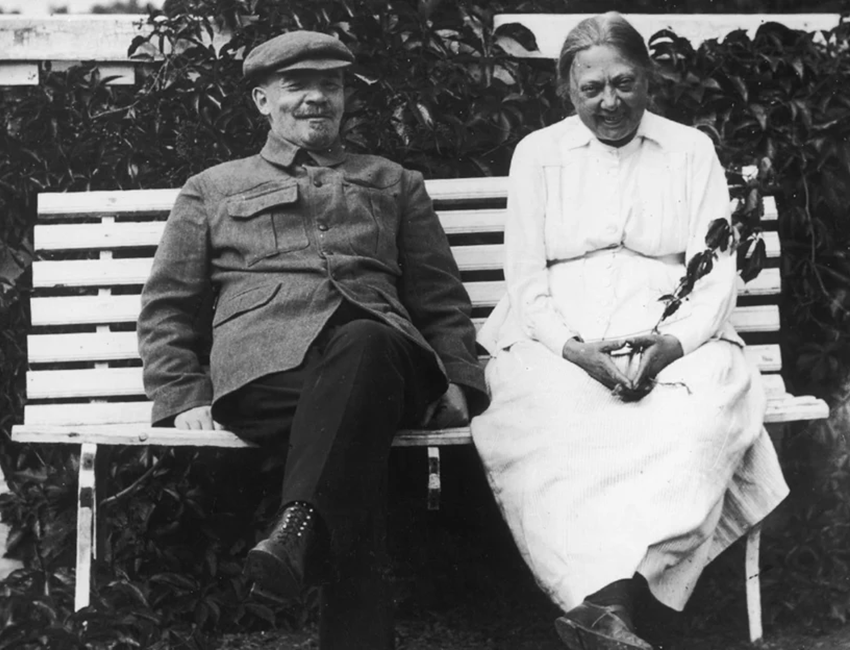
Lenin and Krupskaya – Cecilia Bobrovskaya
Lenin and Krupskaya 1
by
C. BOBROVSKAYA
1940
Childhood and Youth
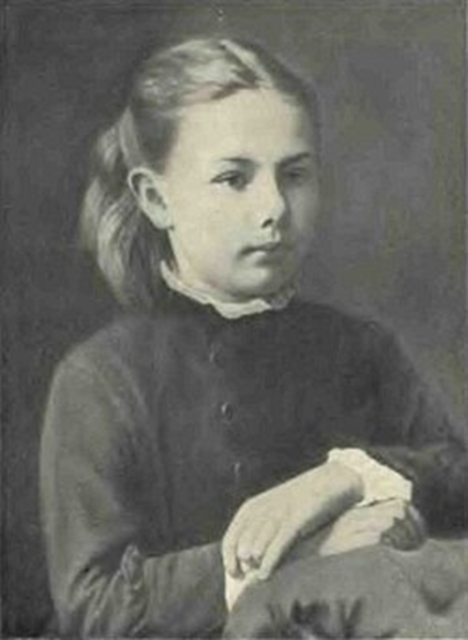
NADYEZHDA KRUPSKAYA, the wife and comrade of V. I. Lenin, a stalwart representative of the Bolshevik Old Guard, and an outstanding worker in the field of cultural progress in the Soviet country, was born in St. Petersburg on February 26, 1869.
Her father, Constantine Krupsky, the son of an impoverished nobleman, held a commission in the army, He was a very well-read man, with a-searching, inquiring mind. This set him apart from the ordinary type of tsarist army officer, and earned him the ill-will of his superiors from the very beginning of his career.
Her mother, Elizabeth Krupskaya, née Tistrova, had been orphaned in childhood. She had received her education in a state institution, and after graduation had worked as a governess in the families of wealthy landowners.
When Krupskaya’s parents married, as her mother later related, they “had neither hearth nor home, and there were days when they had to borrow a few kopeks to buy food.”
Later on, Krupskaya’s father was appointed a county official in one of the Polish provinces then belonging to Russia-the “provinces of the Polish realm.” But his political convictions made him utterly unfit to carry out the policy of rabid Russification that the tsarist government applied in the “border lands” of Russia in those dark and bygone days when Russia was a prison of nations.
Constantine Krupsky felt a profound sympathy with the Polish and Jewish population of his county, and was greatly respected by them. Conduct so unbecoming a tsarist official aroused the suspicions of the local gendarmes and secret police agents, who in numerous reports denounced him as being politically unreliable. Even the fact that he was able to speak to the Polish population in their own language was enumerated in the list of “crimes” for which he was finally removed from office and prosecuted. For ten long years the investigation dragged from court to court, until it finally reached the Senate, which, shortly before Krupsky’s death, dropped the “case” for lack of evidence.
The persecutions to which Nadyezhda’s father was subjected, his constant search for employment (as an insurance agent, a clerk, an auditor) and the consequent moving about from city to city, his association with people of his own convictions, her mother’s sympathy towards his revolutionary views-all this had a profound effect on the sensitive, impressionable girl.
From her very childhood Krupskaya was inspired with the spirit of protest against the ugly life around her.
When Krupskaya was six years old, her father was employed as an inspector in a factory in Uglich, a small town on the Volga. The stories she was continually hearing from him of the conditions in the factory and of the savage exploitation of the workers made her hate the factory manager. She would aim a snowball at him every time he passed through the factory yard where she played with the other children. It made her very happy if her snowball hit the mark.
After Constantine Krupsky’s untimely death, the position of the family became still worse. As a schoolgirl of fourteen Krupskaya had to try her hand at giving lessons in order to earn a few pennies to eke out her mother’s scanty income-the meager pension she received after the death of her husband.
Things did not improve after Krupskaya graduated from high school. “We lived rather poorly, mother and I,” she wrote later, “on what we could make by letting out rooms, copying work, and the like. Giving lessons took up all my time from morning to night, but all these lessons were chance windfalls. The only regular work I had was an evening class at the high school; but it prevented me from attending meetings and from working in the evening school, and so I had to give it up.” 2
This little incident, so casually told, of sacrificing a needed source of income in order to be able to give free classes to workers and take part in political discussions clearly foreshadows what was to be the pattern of Krupskaya’s life-complete self-sacrificing devotion to the cause of the working class, to the cause of socialism.
This striving for contact with the workers came as the culmination of a period of painful seeking for self-expression, of which we learn from a letter Krupskaya wrote in 1899, from her place of exile in Siberia, to Lenin’s sister, Maria Ulyanova:
“. . . Your letter to Volodya [Lenin—C.B.] in which you ask him what school to enter brought back to my mind my own restlessness when I was your age. First, I decided to be a village school teacher and work in the countryside; but I couldn’t find a position. Then the Bestuzhev courses [higher educational courses for women-C.B.] opened, and I enrolled, in the hope that there I would learn everything I wanted to know; but when I found that we were taught something entirely different, I dropped out. In a word, I floundered about helplessly. It was only at the age of 21 that I discovered that there was such a thing as ‘social science.’ 3
And with all the fervor of youth, with all her unquenchable thirst for knowledge, with all the ardor of which her splendid heart was capable, Krupskaya began the study of these “social sciences.’
This was the period (the beginning of the ‘nineties) when the best of the Russian intellectual youth-and Krupskaya was among the best of the best!-were absorbed in Marx; the period when the young Lenin, in controversy with the Narodnik (Populist) 4 Mikhailovsky, wrote in his remarkable book What the “Friends of the People” Are:
“The irresistible force of attraction which draws the Socialists of all countries to this theory [i.e., the Marxist theory-C.B.] consists indeed in the fact that it combines a strict and supreme scientific spirit (representing as it does the last word in social science) with a revolutionary spirit, and combines them not by chance, not only because the founder of the doctrine combined in his person the qualities of a man of learning and a revolutionary, but does so intrinsically and inseparably within the theory itself.” 5
In the period when the class-consciousness of the working masses in Russia was only just taking shape, and when the most advanced representatives of the working masses were just beginning to come forward, Nadyezhda Krupskaya, then in her early twenties, studied Marx in student circles and independently. Even before she had met Lenin these studies had led Krupskaya to the conviction that Marxism was not a dogma, but a guide to action: “As soon as I began to understand the part that the workers must play in the emancipation of all the working people, I felt an irresistible desire to be among the workers, to work among them. 6
The young propagandist began the realization of this aim by teaching in an evening school for workers. It was in this evening and Sunday school beyond the Neva gates on the outskirts of St. Petersburg that Nadyezhda Krupskaya first established the close ties with the workers that grew ever stronger throughout her life. It was here that she learned to understand the working man, his needs and aspirations, and to conduct heart to heart talks with the workers. About one of these talks she later wrote to the great Russian writer Maxim Gorky (this was after Lenin’s death):
“The other day I was visited by a delegation of workers from the Ivanovo region-workers often come to see me, just to talk things over, or to ask for advice, or to tell me how things are going on-and we had a fine talk. When they were about to leave, one of them said, ‘We’d been wanting to come and talk to you for a long time, but we never thought it would turn out to be such a workers’ talk.’ And I thought how pleased Ilyich would have been to hear about that.” 7
It was no easy task to make use of a legal school for revolutionary purposes. On one occasion, for instance, an inspector visited the school during an arithmetic lesson. The pupils did their best to show what progress they had made in mastering decimals. The inspector smiled rather sourly, said a word of praise, and left. The result of it all was an order to break up the group, which was supposed to study only the four basic rules of arithmetic (addition, subtraction, multiplication and division), but by no means decimals-that was in excess of the program.
Such was the result of the “struggle of souls” that was then going on in the hearts of the Russian manufacturers. On the one hand, they required literate workers; but on the other hand, they were afraid that once the workers acquired some education they would refuse to stand for the low wages and the long hours of work, unlimited by law-as much as fourteen hours a day, and even more. That was why they were so anxious that the school keep within “bounds,” that its pupils go “through the first four rules of arithmetic,” but under no circumstances “get as far as decimals.”
Krupskaya kept in touch with the more advanced of her pupils outside school hours as well. Among these were such outstanding people as the worker Ivan Babushkin, whom Lenin later called a hero of the people. It was of this same Babushkin that Lenin wrote in 1910: “Without such people, the Russian nation would remain forever a nation of slaves, a nation of bondsmen. With such people among it the Russian nation will attain complete emancipation from all exploitation.” 8
Lenin’s Arrival in St. Petersburg
The first groups taught by Marxists in the tsarist capital, faced difficulties.
The difficulty of their work lay not only in the necessity of surmounting the barriers set up by the police and the gendarmerie and of finding a way to reach the workers; it lay also in the keen ideological struggle that had to be waged against the Narodnik ideas, which were still very prevalent among the more advanced workers and among the revolutionary section of the intelligentsia.
We must remember that at that period the Narodnik conception that Marxism could not be applied to backward, agrarian, “muzhik” Russia, where the percentage of industrial workers was so very small, was still widely accepted. The Marxist teachers had to advance weighty arguments to sustain their viewpoint, but they themselves were as yet none too well versed in theory. “We were still very poorly equipped,” writes Krupskaya of that period of her life. “Many of us knew nothing of Marx’s works save the first volume of Capital, and had never even seen The Communist Manifesto.”
It was at this period that Lenin entered the scene.
The appearance of this twenty-three-year-old Marxist whom no one had heard of before, his vast theoretical knowledge, and the maturity and clarity with which he posed and solved not only the theoretical, but also the practical problems of the revolutionary struggle, caused a sensation.
“At the end of 1893 Lenin moved to St. Petersburg. His very first utterances in the Marxist study groups of that city made a deep impression on their members. His extraordinarily profound knowledge of Marx, his ability to apply Marxism to the economic and political situation of Russia at that time, his ardent and unshakable belief in the victory of the workers’ cause, and his outstanding talent as an organizer made Lenin the acknowledged leader of the St. Petersburg Marxists.” 9
Lenin devoted himself entirely to the needs for uniting Marxism with the labor movement in Russia. Krupskaya’s accounts of the evening and Sunday school for workers beyond the Neva gates, and of her connections and studies with the workers deeply interested him. His interest was caught especially by Ivan Babushkin, who later became a close friend of Lenin and Krupskaya. Babushkin died in the performance of his revolutionary duty. He was shot in Siberia in 1906 by a tsarist punitive expedition headed by the hangman Baron Rennenkampf.
Krupskaya took a leading part in Lenin’s work of training the first active workers for the future party of the Russian proletariat. With the help of Ivan Babushkin, she organized a workers’ group which was taught by Lenin. This is what Babushkin wrote of this group:
“We began studying political economy from the works of Marx. Our teacher explained the subject orally, without referring to notes. He often attempted to arouse a controversy, to get us to debate a given point, and when he succeeded, he would spur us on, making each try to prove to the others that his point of view on the given question was the correct one. This made our lessons very lively and interesting, and helped us learn to speak in public. “We were all very pleased with these lectures, and were constantly admiring the wisdom of our lecturer.”
As time went on this educational work took on ever broader dimensions, and the number of Marxist study circles grew.
“In 1895 Lenin united all the Marxist workers’ circles in St. Petersburg (there were already about twenty of them) into a single League of Struggle for the Emancipation of the Working Class. He thus prepared the way for the founding of a revolutionary Marxist workers’ party.
“Lenin put before the League of Struggle the task of forming closer connections with the mass working-class movement and of giving it political leadership. Lenin proposed to pass from the propaganda of Marxism among the few politically advanced workers who gathered in the propaganda circles to political agitation among the broad masses of the working-class on issues of the day. This turn towards mass agitation was of profound importance for the subsequent development of the working-class movement in Russia.”10
In this transition to new methods of work, when it became necessary to issue revolutionary leaflets and pamphlets touching on the daily needs of the workers, despite the terrorism of the tsarist secret police, Krupskaya was very active both in collecting concrete data on the conditions of the workers and in the actual printing of this literature. She made use of her connections with revolutionary-minded intellectuals to organize the printing of leaflets in their homes, using a hectograph or some other such crude method.
Somewhat later Krupskaya managed to get in touch with a secret printing shop organized by the Narodovoltsi 11 in 1895 in Lakhta, not far from St. Petersburg. Although the Narodovoltsi were anti-Marxists and terrorists the compositors were Marxist sympathizers, and with their help leaflets and pamphlets were printed in this shop-among others, Lenin’s pamphlet On Fines. It was intended to use the Lakhta printing shop for the publication of the first illegal popular magazine The Workers’ Cause. The material had been prepared by Lenin, and the final text was read at Krupskaya’s home.
But this magazine of Lenin’s was never published. The manuscript was seized by the gendarmes when they arrested Lenin and his group, on the night of December 8, 1895. Krupskaya and Babushkin, however, managed to evade arrest.
But even after his arrest Lenin did not give up the leadership of the organization. While in prison he wrote and sent out texts for leaflets, worked on a draft program for the future party, etc. Krupskaya, through Lenin’s sister who was allowed to visit him, organized regular connections between Lenin and the organization, transmitting his instructions and advice from prison and keeping him informed of the state of affairs in the League of Struggle.
The spring and summer of 1896 was a busy time for Krupskaya. She was entirely taken up with propagandist and organizational work in connection with the huge wave of strikes-what were known as the summer strikes of 1896 -that swept over a number of factories in St. Petersburg. These strikes resulted in the adoption of the first law ever introduced in Russia restricting the working day-to eleven and a half hours.
It was during this period of intense mass revolutionary work, when it was very difficult to observe strict secrecy, that Krupskaya was traced by the tsarist police spies. On August 12, 1896, she was arrested, together with Babushkin and a number of other comrades.
Prison and Exile
As soon as Krupskaya was committed to solitary confinement in the St. Petersburg detention prison, she established a secret correspondence with Lenin, who had been confined in the same prison since December, 1895. Lenin’s letters to her and to the other comrades in the prison were full of cheer and a call to further struggle.
Krupskaya was kept in solitary confinement for seven months as a political prisoner. She put this time to good use, devoting herself to a thorough study of Marxian theory. Although the gendarmerie had no evidence whatever, except the testimony of its spies, to involve Krupskaya with the St. Petersburg League of Struggle for the Emancipation of the Working Class, still they would not have released her as quickly as they did if it had not been for a tragedy that occurred in the prison. A girl student, Mary Vetrova, another political prisoner, poured the kerosene from her lamp onto her clothes and set fire to them.
This suicide caused a furor, especially as rumor had it that the girl had been raped by one of the officers of the gendarmerie. The gendarmerie, frightened at this universal indignation, hastily released all the women political prisoners in the detention prison, including Krupskaya.
On her release from prison Krupskaya was faced with exile in Ufa under police surveillance.
During her short stay in the capital prior to her departure for her place of exile, Krupskaya submitted a petition asking permission to spend her term of exile with Lenin, in the remote village of Shushenskoye in Siberia, rather than in Ufa Province. As can be seen from the following documents, her petition was granted, but only on the condition that she be married to Lenin immediately upon her arrival in Shushenskoye. This is probably the only tsarist order ever issued which corresponded to the wishes of Krupskaya and Lenin:
Confidential
| Office of the Governor of St. Petersburg Department for Preservation of Public Safety and Order in the Capital to the Governor of Yenisei Province | April 16, 1898 No. 4625 |
By Imperial order of March 11, 1898, in re the report submitted to His Majesty by the Minister of Justice, Nadyezhda Konstantinova Krupskaya, of noble birth, daughter of a collegiate assessor, has been sentenced for political offenses to exile in Ufa Province, under open police surveillance, for three years, to end March 11, 1901.
Upon subsequent petition of Nadyezhda Krupskaya, the Ministry of the Interior has deemed it possible to change her place of exile and to allow her to spend her term under open police surveillance not in Ufa Province, but in Yenisei Province, to which her fiancé, Vladimir Ulyanov, has been exiled for political offenses. She has been warned, however, that if she is not married to the said Ulyanov immediately upon her arrival at his place of exile, she will be transferred to Ufa Province. In view of Krupskaya’s departure from St. Petersburg today, for Minusinsk County, I consider it my duty to inform your Excellency of the above in order that you may issue instructions for open police surveillance over Krupskaya in conformity with the conditions set forth in the Imperial order and in the decision of the Minister of the Interior.
Krupskaya’s passport is enclosed herewith.
Major General
(signature illegible)
Chief of the Department, Colonel
(signature illegible)
Confidential
| His Excellency, the Governor of Yenisei Province, from the Superintendent of Police of Minusinsk County | April 16, 1898 No. 4625 |
Report
In conformity with your instructions No. 321, of April 21, I have the honor to report to your Excellency that the political exile Nadyezhda Konstantinova Krupskaya, daughter of a collegiate assessor, arrived in Minusinsk on the evening of May 6, and was immediately placed under open police surveillance. Krupskaya left yesterday for her place of exile, the village of Shushenskoye. The local officer in charge of Section 3, Minusinsk County, has been instructed to institute open surveillance over Krupskaya and to see that she is married to Ulyanov, concerning which I shall report separately. I am informing the Chief of Gendarmerie of Yenisei Province, his assistant in charge of Minusinsk County, and the Prison Inspector of Yenisei Province of Krupskaya’s arrival.
Stepanov,
Superintendent of Police of Minusinsk County.
Four days after Krupskaya’s arrival at Shushenskoye Lenin wrote jokingly, in a letter to his family dated May 10 (old style), 1898:
“Yes–Anyuta asked me whom I would invite to the wedding. I invite you all, but I’m afraid I had best send the invitation by wire!! Nadyezhda, as you know, was set a tragi-comical condition: if she is not married immediately (sic!) she will be transported to Ufa. I have no intention of letting that happen.”12
In a letter to a young friend, written after Lenin’s death, Krupskaya described the two years she spent with Lenin in exile in Siberia in the following words:
“How clearly I recall that period of pristine completeness and happiness. Everything seemed so unspoiled and simple-nature about us, picking mushrooms, our hunting trips, our close, warm circle of comrades. . . . This was in Minusinsk, just thirty years ago. We would go walking together, singing, indulging in some childish jollity or other; at home my mother was in charge of the simple household arrangements; we were bound by common interests and joint work, living through the same emotions and reactions-indignation when we received Bernstein, 13 etc.
“There’s a bit of lyricism for you.”
It was during this period of life in exile in the backwoods that Lenin wrote several works, including his great work The Development of Capitalism in Russia. 14
Towards the end of the last century and the beginning of the present century there took shape among the Russian Social-Democrats an opportunist tendency, much the same as Bernsteinism, which was called “Economism.” The adherents of this trend maintained that the working-class should limit itself to trade union activities—strikes and other struggles over wages, hours and conditions-and leave all political activity to the capitalists. According to the theory of the “Economists,” the working-class is attracted to socialism spontaneously and needs no political party to educate and lead it, and the task of the socialist party is simply to study the practical development of the working-class movement and to follow after it.
Lenin showed that “Economism” facilitates bourgeois influence on the proletariat; that it destroys the idea of uniting the working-class movement with socialism; that it helps the bourgeoisie. The theory of “Economism” was completely smashed by the Bolshevik Party, under Lenin’s leadership.
Krupskaya’s assistance to Lenin in his fight against “Economism” was not merely of a technical nature. She helped to organize the protest of the exiled Social-Democrats in Siberia against the opportunist, renegade Credo of the “Economists,” a copy of which had been sent to Lenin from St. Petersburg.
Besides her regular assistance in Lenin’s work at that time, Krupskaya independently prepared a splendid agitational pamphlet, The Woman Worker. This pamphlet, which was signed Sablina (one of Krupskaya’s Party pseudonyms), was published abroad in 1900, smuggled into Russia, and circulated among the workers and the intelligentsia. It contributed in no small share to the work of drawing the women factory workers, then the most backward section of the proletariat, into active revolutionary struggle. Krupskaya also worked at that time, together with Lenin, on a translation into Russian of Sidney and Beatrice Webbs’ History of English Trade Unionism. This painstaking task was completed just before they left Siberia.
If we add to all this that during his exile Lenin was especially busy with plans for building up a revolutionary Marxist party; that he was working out plans for establishing a newspaper, to be published abroad, which would serve as a center for rallying the scattered forces of the party; and that Krupskaya also took part in the elaboration of every detail of this plan-if we add all this, it will be evident how full of profound ideological revolutionary content was her life in the years of Siberian exile, spent together with Lenin.
Return from Siberia. Ufa. Departure for Abroad
Lenin’s term of exile was drawing to its close, but Krupskaya still had a year left. They had to separate, for Krupskaya’s efforts to obtain permission to spend the last year of her exile in Pskov, where Lenin would be staying at first, were unsuccessful. She was compelled to complete her term in the Ufa Province, to which she had been exiled originally.
The preparations for departure and the circumstances under which these preparations took place are eloquently described in a letter from Krupskaya to Lenin’s mother.
“Dear Marya Alexandrovna:
“At last things have been settled, and we can leave for Russia proper. There is no cause to expect an extension of sentence. We are sending off our things on the 28th and are ourselves leaving on the 29th. . . . Volodya [Lenin] intends to stop for a day or two in Ufa, to find out whether I am to be allowed to remain there or be sent off to some place like Sterlitamak or Belebei. . . . All our talk now is of the journey. We’ve packed the books in a box-they weigh about 15 poods [about 550 pounds]. We’re sending the books and some of our baggage by transport, though I don’t think we’ll have much. We wanted to order a covered sleigh for protection from the frost, but there is none to be had in the city, and it would be risky to order one here-they might make it so badly it wouldn’t even get to Achinsk. We have plenty of warm clothes, so I hope we won’t freeze; and it seems as though the weather intends to warm up. . . . This morning it was only 28° below. The worst of it is that Mama is always catching cold; she’s coughing again. Volodya and I are accustomed to the cold, for we go out of doors every day, no matter what the temperature, but I don’t know how Mama will ever stand the trip. I wish the days up to the 29th would go faster so the whole thing would be over! . We don’t feel in the mood for reading just now. We’re finally sending Webb 15 off today; I must say it became pretty tedious towards the end.” 16
In Ufa Krupskaya parted with Lenin. He went to Pskov, so as to be as near as possible to St. Petersburg and to be in closer touch with the comrades who were to help in the execution of his plan for launching a central Party paper abroad. When she was settled in Ufa, Krupskaya got in touch with the more advanced workers there.
In Ufa she met Social-Democrats passing through on their way back to Central Russia after completing their terms of exile in Siberia. To them she explained Lenin’s plans for starting a newspaper abroad, and drew them into active work for the speedy realization of these plans.
With the end of her term of exile, in the spring of 1901, Krupskaya left Ufa and joined Lenin abroad, where the newspaper Iskra [The Spark] had been coming out since December, 1900. The first issue of Iskra had contained an article by Lenin entitled “The Urgent Tasks of Our Movement,” which ended with the following words:
“Before us, in all its strength, towers the fortress of the enemy from which a hail of shells and bullets pours down upon us, mowing down our best warriors. We must capture this fortress, and we shall capture it if we combine all the forces of the awakening proletariat with all the forces of the Russian revolutionaries into a single party that will attract all that is virile and honest in Russia. Only then will be fulfilled the prophecy of the great Russian worker-revolutionary, Peter Alexeyev: ‘The muscular arm of millions of workers will be raised, and the yoke of despotism, that is guarded by soldiers’ bayonets, will be smashed to atoms!’” 17
Of the vital role which Iskra played in the developing revolutionary movement, the History of the Communist Party of the Soviet Union says:
“The appearance of the first issues of Iskra (1900-01) marked a transition to a new period-a period in which a single Russian Social-Democratic Labor Party was really formed from the disconnected groups and circles.” 18
Krupskaya arrived in Munich in the middle of April, 1901, searched out Lenin-with some difficulty, for he was living there under the name of Meyer because of police persecution-and immediately started work as secretary of Iskra. Very soon she established a wide correspondence with comrades in different parts of Russia. Her letters served to center the attention of the best Social-Democrats in the various parts of Russia on the tasks of the Party-on Iskra and on the revolutionary tasks set forth by Lenin.
The author of these lines often saw Krupskaya bent over her notebooks which contained a list of all the big proletarian centers in Russia where “we have connections.” Sometimes these “connections” were with only one person, but even that was something to start from: through him it was possible to get in touch with the advanced workers in the given locality; he or his friends might write for Iskra; with his help an Iskra leaflet might be distributed in a factory, in a village, in an army unit, etc. And so, Krupskaya worked unsparingly, far into the night, writing and coding messages, sending out letter after letter to Russia. Her letters brought back a lively response.
Besides this correspondence, Krupskaya was in charge of the complicated work of organizing the transporting of Iskra and Iskra publications across the border into Russia. Here is a sample of one of the hundreds of instructions she wrote in connection with the transportation of Iskra to Russia-a letter to L. Knipovich, in Astrakhan:
“May 28 [1901, Munich]. “Literature has been sent to Persia (from Berlin) in four packages, just as I wrote. The packages contain: Iskra No. 3, Zarya, Witte’s Memorandum, The Woman Worker, May Days. This means we have probably sent you everything. Let me know whether everything has been done correctly. How soon can the literature be delivered? We must know this so as to decide whether this route is suitable for Iskra or only for pamphlets and the like. Write me whatever you know about this.
“It would be best to forward the literature received in Baku to Poltava. Send it there either by mail or with a messenger. The address for arrivals or for mail is the password We have written to Samara-we are thinking of organizing a distribution center of literature there for central Russia (we have Pskov and Smolensk for the North). You can correspond with the center through Voronezh (addresses), and with the Ural through Ufa (address) 19.
“Has anybody gone–? 20
“Let me know what literature you have. Perhaps you could procure some addresses to which illegal revolutionary material could be sent by mail?”
As time went on, Lenin’s Iskra became not only a “collective propagandist” and a “collective agitator,” but also a “collective organizer.” There formed about the paper a group of agents, “the skeleton of just such an organization as we need,” as Lenin wrote at the time. The part Krupskaya played in organizing regular communication with these agents was of the greatest importance.
In his parting talks with comrades about to leave Geneva to take up Party work in Russia, Lenin usually advised them “to discuss the details with Krupskaya.” She was always fully informed of the exact state of affairs in the different localities, kept a strict record of the Bolshevik workers in the localities, and knew exactly what the Party could expect from any given local worker.
As to the “professional” revolutionaries sent out to the localities from headquarters with instructions from Lenin, Krupskaya knew every one of them so well that she knew even their family histories.
The active Party workers of the elder generation-those who carried through Lenin’s directives in the period between the Second and Third Congresses of the Russian Social-Democratic Labor Party-were especially appreciative of the timely information on the state of affairs abroad, at Party headquarters, which they received regularly from Krupskaya.
Here is one of the many letters Krupskaya wrote during the first period of struggle against the Mensheviks and against Trotsky, a period in the life of the Party when there was revealed:
“The existence of grave differences over questions of organization which divided the Party into two sections, the Bolsheviks and the Mensheviks, of whom the former championed the organizational principles of revolutionary Social-Democracy, while the latter sank into the bog of organizational looseness and of opportunism.“ 21
Krupskaya wrote to L. Knipovich, on January 13, 1904.
“The situation now is this: the editorial board [of Iskra— C.B.] is changing its line. In No. 55 there is a ridiculous article by Axelrod. No. 56 will contain an article by Martov attacking What Is to Be Done? 22 and Plekhanov and Orthodox are also preparing articles against What Is to Be Done? Now it turns out (!) that the editors were never in agreement with What Is to Be Done? and that the views there expressed are not the views of Iskra, but only those of Lenin… If that be the case, why did they maintain silence all this time-what right had they to be silent? Trotsky’s report (something absolutely absurd) and the minutes of the League have come out. Lenin and Lenin’s ideas are being slandered on all sides. …
“The Minority [Mensheviks] are waiting for a coup d’etat-they say with open cynicism that they are waiting for the first break in the ranks’ [for the arrest of Bolsheviks in Russia—C.B.].” 23
When the fight for the Third Congress of the Russian Social-Democratic Labor Party later broke out in good earnest, Krupskaya’s correspondence with the Bolsheviks working in Russia took on such proportions that it is hard to understand how she managed it all, working as she did by herself, with no staff of assistants to help her.
1905-1917
In MAY, 1905, Lenin wrote in the Bolshevik newspaper Proletary, published abroad:
“Russia is nearing the climax of the age-long struggle of all the progressive, popular forces against the autocracy. Now no one doubts that the most energetic part in this struggle will be taken by the proletariat and that it is its participation in the struggle that will decide the outcome of the revolution in Russia.” 24
The great revolutionary events that developed and spread to all parts of the vast country in the next few months made it possible for Lenin and Krupskaya to return to St. Petersburg in the autumn of 1905. They had to be careful, however, and observe strict secrecy; for although the tsarist secret police apparatus, the gendarmerie and the spy system were disorganized and in a state of confusion, they still continued to function. Lenin and Krupskaya returned to Russia separately.
In St. Petersburg, again because of police persecution, Krupskaya, under the name of Praskovya Onyegina, lived apart from Lenin.
Immediately after her arrival she hurried off to the district beyond the Neva gates, where she had started her revolutionary activity years before. There she met some of her former students in the Sunday and evening school for workers, and found, to her great pride and joy, that they had developed tremendously politically and had become active Bolshevik revolutionaries.
During these stormy days Krupskaya was entirely taken up by Party organizational work, acting as secretary of the Central Committee of the Party. This work was extremely intricate. Although the Party had come out into the open, yet, in accordance with Lenin’s instructions, it was necessary to preserve the secret apparatus while making full use of all legal possibilities. In December, 1905, when the uprising in Moscow was beginning, Krupskaya took part in the all-Russian Bolshevik conference held in Tammerfors, Finland. Here she met Joseph Stalin personally for the first time.
“The uprising of December, 1905, was the climax of the revolution. The tsarist autocracy defeated the uprising. Thereafter the revolution took a turn and began to recede. The tide of revolution gradually subsided.” 25
The revolutionary proletariat of Russia did not surrender without a fight; it retreated fighting, and the Bolsheviks were the most active participants in these battles, which were directed by Lenin and Stalin.
But soon the “servants of the tsar” became so bold again that it became dangerous for Lenin to remain in St. Petersburg, and he was compelled to go into hiding in Finland and direct the Party’s activities from there. Krupskaya at first remained in St. Petersburg, and later, when she moved to Finland, made frequent visits to St. Petersburg. She was the main connecting link between Lenin, the Central Committee of the Party, and the St. Petersburg Party organization.
This state of affairs continued until the end of 1907, when the bitter political reaction that had gripped the country forced the Party to go underground entirely, and Lenin was compelled to emigrate to Switzerland.
In Switzerland Lenin summed up the results of the recent period of struggle, pointing out to the Party that “it is impossible to avoid utter rout in the event of defeat without knowing how to retreat properly, to retreat without panic and without confusion.” 26While in Switzerland he laid plans for the further struggle, organized the underground Bolshevik press (up to that time Proletary, the Party organ, had been published in Finland), and maintained close connections with the active Bolsheviks who had escaped arrest and were continuing energetic underground work.
In this new period of emigration with Lenin, Krupskaya once more worked untiringly to organize the transporting of Bolshevik literature to Russia from abroad, and carried on extensive correspondence with Russian Party organizations and with individual active Bolsheviks.
“What helped the leading core of the Bolsheviks, centered around Lenin, to safeguard the Party and its revolutionary principles was that this core had been tempered by Marxist-Leninist ideology and had grasped the perspectives of the revolution.” 27
Krupskaya was part of this leading core of the Bolsheviks. But finally, the difficult years, which Lenin termed a period of debauch of the Black Hundred counter-revolution, a period of liberal-bourgeois renegacy and disintegration, began to draw to a close.
The new rise in the working-class movement in Russia formed the background for the all-Russian conference of the Russian Social-Democratic Labor Party that met in Prague in January, 1912, a conference which “. . . inaugurated a Party of a new type, the party of Leninism, the Bolshevik Party.’” 28 In that same year the Bolshevik newspaper Pravda began coming out legally in St. Petersburg, under the direction of Joseph Stalin.
In the summer of 1912 Lenin moved to Cracow, so as to be nearer to Russia, to St. Petersburg, and to the Pravda, to which he ascribed exceptional importance, and in order to direct the daily activities of the Bolshevik deputies in the State Duma.
Here, too, Krupskaya, as Lenin’s closest assistant, was charged with a large share of the organizational work-the organization and maintenance of uninterrupted communication with Russia.
Even in the darkest days of reaction Krupskaya had never given way to despondency and had always remained a cheerful and tireless worker; now, with the beginning of a new upsurge in the working-class movement in Russia, her activity became still more intense. We can judge of her state of mind at this period from a letter written to Maxim Gorky on February 17, 1913, after the conference of the Central Committee of the Russian Social-Democratic Labor Party, with the members of the Duma faction and leading Party workers from the localities, which had just taken place in Poronino, near Cracow.
“You see, while the conference was going on, we were all simply dizzy with joy, for it was evident from the reports that our work had not been in vain-that the masses of workers had grown politically during these difficult years, that there are Social-Democratic workers’ organizations even in the most remote corners of the country, organizations that may not be connected with the Party centers, but that are Party in spirit and have carried on Party work all the time. The elections [to the State Duma—C.B.] helped enormously. The feeling of isolation that formerly oppressed the workers so is now gone.
“The organization is now working at full swing. It seems as though only now is a real workers’ party beginning to take shape.” 29
“On the eve of the imperialist war the Party led the working-class in its revolutionary actions. These were vanguard engagements which were interrupted by the imperialist war only to be resumed three years later to end in the overthrow of tsardom.” 30
At the end of 1913 and the beginning of 1914 Krupskaya helped in the organization of a legal publication for women workers in Russia. The first issue of The Woman Worker, which came out in St. Petersburg in March, 1914, contained an article by Krupskaya.
When the World War broke out, Lenin had to move to neutral Switzerland. Here Krupskaya concentrated mainly on helping him in the organization of the preliminary meetings and conferences that prepared the ground for the subsequent organization by Lenin of the Communist International.
Work Among the Masses in 1917 and in the Period of Civil War and Intervention
The joyous, rousing news from Russia that the blood and mud-bespattered cart of the Romanov monarchy had been overturned reached Lenin and Krupskaya in Zurich, Switzerland. They were very anxious to return to Russia, but the trip involved enormous difficulties.
Stalin managed to get away from his distant place of exile in Siberia and return to St. Petersburg, the capital of the Revolution, earlier than Lenin and Krupskaya could get there. He wrote at the time, in No. 8 of the Bolshevik Pravda:
“The chariot of the Russian revolution is advancing with lightning speed. The detachments of revolutionary fighters are everywhere growing in numbers and extent. The pillars of the old power are being shaken to their foundations and are collapsing. Now, as always, Petrograd is in the forefront. Behind it, stumbling at times, follow the immense provinces.
“The forces of the old power are collapsing, but they have not yet been completely smashed. They are just lying low, waiting for a favorable moment to raise their heads and fling themselves on free Russia. Glance around, and you will see that the sinister work of the dark forces is going on incessantly. . . .
“It should be the next immediate task of the proletariat of the capital to retain the liberties won, so as completely to smash the old forces and, in conjunction with the provinces, to advance the Russian revolution still further.”
In point 2 of the historic theses which Lenin issued on the day of his arrival in Petrograd, April 3, we read:
“The specific feature of the present situation in Russia is that it represents a transition from the first stage of the revolution which, owing to the insufficient class consciousness and organization of the proletariat, placed power into the hands of the bourgeoisie-to the second stage, which must place power in the hands of the proletariat and the poor strata of the peasantry.”
The Bolsheviks were faced with a task of immense importance, the task of explaining to the broad masses, intoxicated with the first successes of the revolution, the treacherous character of the Provisional Government, of the Mensheviks and the Socialist-Revolutionaries.
It was necessary to show the revolutionary masses of town and countryside that they were being carried along by a petty bourgeois wave that threatened to submerge all the gains of the Revolution.
When Krupskaya arrived in St. Petersburg with Lenin she took up work in the apparatus of the Central Committee of the Party; she soon felt cramped there; she wanted to be among the masses, and went to the Vyborg district to work.
Here her attention was attracted especially by the sentiments of the young workers, whose role in the Revolution could not be underestimated. In May and June, 1917, she wrote several articles for Pravda on work among the youth.
In July, Krupskaya delivered a report to the Second Conference of the Petrograd organization of the Russian Social-Democratic Labor Party in which she pointed out the necessity of devoting serious attention to the working-class youth. Krupskaya later spoke at several congresses and conferences on questions concerning the organization of the youth.
In a foreword to a collection of her articles on the youth, published by the “Young Guard” publishing house in 1925, she wrote:
“When I returned to Leningrad in April, 1917, after many years in emigration, the working-class youth movement had already grown to large dimensions. I began to watch this movement attentively and to attend youth meetings. The revolutionary surge had drawn in the working-class youth with great force. They were bubbling over with impatience to take part in the struggle for a new life.
“The working-class youth was as yet non-partisan at that time; but they were young working people, who lived the life of the working class, and the class instinct was very strong among them, showing itself in their every word, their every impulse, their every action. “When the working-class rallied around the Communist Party and acknowledged it as its own party, the working-class youth also followed the Party.
“In that year, 1917, I established close ties with the working-class youth, and learned to take closely to heart all questions in which the youth is concerned.”
During the Petrograd municipal elections in June, 1917, Krupskaya was elected to the City Duma from the Vyborg District. In the Duma Krupskaya was particularly active in the field of culture and public education.
In the District Department of Public Education, which she was put in charge of, she organized a Council of Public Education made up of representatives of shops and factories -of active working men and women who enthusiastically took part in educational work.
Krupskaya enlisted the services of that small section of the local intelligentsia-teachers, doctors, etc.-who in those days followed the Bolshevik Party, in the work of eliminating illiteracy in the district, in organizing schools for adults, evening courses, libraries, factory clubs, lectures, and so forth. Here is what she wrote at that time:
“The workers are faced with enormous tasks. They are miraculously energetic and well organized, but they need assistance. Everyone who can work as a librarian, who can teach people to read and write, who can deliver lectures, etc.-everyone who has special training in any field-all Social-Democrats, all Bolsheviks must join in this work, must bring their knowledge to the workers.” 31
Krupskaya had always taken a keen interest in the lives of the women workers and the workers’ wives. Her first pamphlet, The Woman Worker, was written many years ago, when she was in exile in Siberia.
In the Vyborg District Krupskaya was also in charge of the district department for assistance to wives of soldiers. A liberal society woman-the wife of Peter Struve—who had been in charge of this department, admitted, on handing over the work to Krupskaya, that “the soldiers’ wives don’t trust us.” We can well understand that the soldiers’ wives did trust Krupskaya-that she found the words to reach their hearts. There was wide scope for agitation among these women, most of whom were very backward. Krupskaya carried on systematic work among them and succeeded in winning the soldiers’ wives to the side of the Bolsheviks.
Krupskaya worked unremittingly, spending all her days and nights in her Vyborg District. That was always the work she liked best-to be among the masses, to explain to them daily, hourly, who were their friends and who their foes.
Events were now developing at a truly dizzying speed. The Bolsheviks were gaining great success in their fight to win the majority in the Soviets and to expose the Mensheviks and Socialist-Revolutionaries and their policy of compromise with the bourgeoisie.
“The revolutionary indignation of the Petrograd workers and soldiers boiled over. On July 3 [July 16] spontaneous demonstrations started in the Vyborg District of Petrograd. They continued all day. The separate demonstrations grew into a huge general armed demonstration demanding the transfer of power to the Soviets.”
In the July Days, as we know, the agents of Russian and foreign capital-the counter-revolutionary Provisional Government, the Mensheviks and the Socialist-Revolutionaries— succeeded in crushing for the moment the action of the indignant revolutionary masses. The Bolshevik Party, and Lenin personally, were compelled to go into hiding.
During this difficult period Krupskaya visited Lenin secretly in the places where he was compelled to conceal himself from Kerensky’s spies. She continued her energetic work in her district, not allowing her constant anxiety for Lenin, whose life was endangered by the dark forces of counter-revolution, to distract her from her duties.
Lenin wrote at that time:
“The more savagely the Bolsheviks are slandered and lied about these days, the more calmly must we, while refuting the lies and slanders, ponder over the historical connection of events and the political, that is, class, significance of the present course of the revolution.” 32
In August, Krupskaya participated in the Sixth Party Congress, at which Stalin declared, in his political report, that “the peaceful period of the revolution has ended; a non-peaceful period has begun, a period of clashes and explosions.”
In this turbulent period of “clashes and explosions,” when the Bolshevik Party was beginning practical preparations for the armed uprising by which the workers, soldiers and peasants took power from the discredited Provisional Government and gave it to the popularly-elected Soviets, despite the damaging opposition of the capitulators Zinoviev, Kamenev, Trotsky, and their ilk, Krupskaya and her militant Vyborg District were invariably on the side of Lenin, Stalin and Sverdlov.
As an active member of the Vyborg District Committee of the Party, Krupskaya kept in constant touch with the machine-gun regiment billeted in her district and helped to organize the work of arming the workers and of teaching hundreds of women workers first aid.
In the October days when the great victory of the Revolution was scored, Krupskaya was with Lenin in the Smolny Institute, the headquarters of the Revolution, but at the same time she continued her work in the Vyborg District.
Lenin and Krupskaya greeted the New Year of 1918, the first Soviet New Year, at a mass meeting of workers of the Vyborg District on the occasion of the departure of the district’s Red Guard detachment for the front. The appearance of Lenin and Krupskaya in the hall evoked great enthusiasm among the working men and women, who lifted them shoulder-high and cheered them. Krupskaya later wrote, with her native modesty, in recalling this occasion: “The workers gave Lenin an ovation, and some of it was meant for me.”
In March of 1918 the Soviet Government moved from Petrograd to the new capital, Moscow, in the center of Russia.
In Moscow Krupskaya worked as a member of the Collegium of the People’s Commissariat of Education, and became engrossed in the work of organizing the country’s cultural and educational institutions.
The emancipated peoples of the great country were eager for knowledge, for enlightenment, in this period when:
“… already in the first half of 1918, two definite forces took shape that were prepared to embark upon the overthrow of the Soviet power, namely, the foreign imperialists of the Entente and the counter-revolutionaries at home.” 33
In those days of terrible hunger and economic chaos, when the sabotage of the intelligentsia had not yet been entirely overcome and when the united forces of counterrevolution had launched their offensive, it was necessary to organize schools and study courses, clubs, libraries, and reading rooms for the working people of town and village. It was likewise necessary to take serious steps towards wiping out illiteracy and semi-literacy, that shameful heritage of tsarism.
In her great work in this field Krupskaya was always guided by Lenin’s leadership, by the leadership of the Party. Lenin valued highly Krupskaya’s ability to organize the work along new lines, not bureaucratically, from behind office doors, but by drawing the masses themselves into the work, gaining support from the masses, and developing their creative initiative.
Besides the organization of cultural and educational work among adults, Krupskaya was occupied at that time with the organization of children’s homes, nurseries, kindergartens, etc. We all know what tender care she devoted to children, and how children loved her.
Krupskaya won the love not only of the children, but also of their parents, as can be seen from one of her letters: “I also have children now. In the first place, a stoker from Chita has written to me about his new-born son, Vladimir, asking me to be the boy’s ‘godmother’; and, again, the other day I found myself at a celebration in honor of a new-born child, and had to give the child its name—Vladimir—at the request of the parents, workers at the Golutvin Textile Mills.”
Krupskaya was especially interested in children of Young Pioneer age. It is interesting to note that the Young Pioneers always understood her, no matter how difficult the subject on which she talked with them. Her letters to Young Pioneers and her answers to their letters are models of simplicity and clarity in the exposition of questions most difficult for the child’s mind to grasp.
The following lines from one of Krupskaya’s letters give us an idea of the volume of the correspondence she received from the Young Pioneers:
“Dear Children: I have before me over fifty letters from Young Pioneers, from all parts of our Soviet Union. There are many letters from the Ukraine, especially from the Donbas; there are letters from Armenia, Georgia, and Azerbaijan; a letter from the Far North-from a Young Pioneer group in the forests of the KolaLopar District, 300 kilometers from the settlement of Kola, where the Finnish and Lopar population work at lumbering; letters from the Crimea and from the North Caucasus; many letters from the Urals and from the Nizhni-Novgorod region; letters from the Middle Volga district and from the Ivanovo Region, from Eastern Siberia, and other places. There are letters written in German from the pupils of a school in the Ukraine.” 34
It was not only the Young Pioneers that knew and loved the name of Nadyezhda Krupskaya. Women, members of the Young Communist League, workers, collective farmers, teachers, librarians-all wrote to her and came to her for advice and help.
It caused her great sorrow that she could not find the time to answer all the letters she received.
“There are almost two hundred letters on my desk,” she once complained to a comrade, “that I must answer, that have to be answered. Children share with me their innermost thoughts, and ‘dear Auntie’ doesn’t answer. Young Communists write to me, and working women, and teachers—and I can’t even manage to read all their letters. It’s a splendid correspondence, too-they write me of what is really most important.”
This “splendid” correspondence grew so large, as time went on, that she was obliged to have a staff of several people to keep track of the letters and answer them, setting apart, in accordance with her instructions, such as she considered it necessary to answer personally.
It was not only through letters that Krupskaya kept in contact with the masses. She was always among the masses herself. She was often to be seen and heard in the factories and mills of Moscow and the Moscow Region, especially in those factories where the majority of the workers were women. In the factories, among the women workers, Krupskaya felt at home, in her own element.
The critical period of the Civil War was approaching. The outcome of the war depended to a great degree on the attitude and state of mind of the middle peasantry (working farmers)-on whether they would support the Soviet power or whether they would follow the White Guard generals.
In the autumn of 1918 Lenin issued the slogan:
“Learn to come to an agreement with the middle peasant, while not for a moment renouncing the struggle against the kulak [rich employing farmer] and at the same time firmly relying solely on the poor peasant.” 35
The Eighth Congress of the Communist Party of Russia, which met in March, 1919, revised and radically changed the policy of the Party in regard to the middle peasantry. Until that time the Party had demanded of the middle peasantry only that they take a neutral stand in the Revolution and refrain from supporting the kulaks, who fought to preserve capitalism.
Lenin proposed in his report to the Eighth Congress that the Party change from its policy of neutralizing the middle peasantry to a policy of winning the middle peasantry as firm allies in the fight against the White Guards, the foreign interventionists, and for successful socialist construction. This proposal of Lenin’s was adopted by the Congress:
The backwardness of the middle peasants had to be overcome by persuasion and not by compulsion and coercion. The Congress therefore gave instructions that no compulsion be used in the carrying out of socialist measures in the countryside (formation of communes and agricultural artels). In all cases affecting the vital interests of the middle peasant, a practical agreement should be reached with him and concessions made with regard to the methods of realizing socialist changes. The Congress laid down the policy of a stable alliance with the middle peasant, the leading role in this alliance to be maintained by the proletariat.” 36
Broad educational work had to be carried on in the countryside along the line of the decisions of the Eighth Party Congress. One measure taken in this direction was the equipment of the steamer Red Star with agitational work. V. M. Molotov was appointed its commissar.
Krupskaya also took part in the agitational tour of the Red Star to places recently wrested from the White Guards.
Following in the tracks of the Whites, the Red Star was to organize mass meetings, and conferences with local Party and government workers, at its stopping places, on the heels of the Whites-to consolidate Soviet power in these places, following the line laid down by the Eighth Party Congress.
Throughout the whole of the tour Krupskaya addressed the masses wherever the Red Star stopped. She also carried on her work for the Commissariat of Education, organizing and instructing the village teachers.
She was strongly impressed by a mass meeting at the Votkin Works, which had only recently been wrested from the White Guards. The Whites had been especially savage there. They had destroyed the young people’s club and shot many of its members and organizers, so that there was hardly a family in the small factory town that did not mourn a son or daughter killed by the White Guard bandits.
When the enthusiastic meeting came to an end, the audience arose and sang the Revolutionary Funeral March. There was a sound of sobbing from all parts of the hall. During her work on the Red Star Krupskaya’s ailment, Basedow’s disease, 37 became very acute. But her work of agitation, propaganda, and instruction among the masses in this especially difficult period of the fight to consolidate the Soviet power was so much a part of her, that she decided to continue her activities on the Red Star for some time. Lenin, who knew of her poor health, had great difficulty in persuading her to return to Moscow.
Lenin’s Illness and Death
Krupskaya Continued to work energetically even during the difficult months of Lenin’s illness, when, as she later expressed it, “I felt as though I were walking on the edge of a precipice.”
Her letter to the students of the Sverdlov Party University in 1923, on the occasion of the fifth anniversary of the foundation of this “nursling of the victorious proletariat,” was as usual cheerful and imbued with fervent faith in Lenin’s cause.
“Hearty greetings, comrades.
“The great slogans inscribed on the banner of the October Revolution are a challenge to the bourgeois world. It cast a glaring light on our poverty, our cultural backwardness, our shortcomings; but at the same time, it lighted us the road to communism. We began to build up our life anew.
“We know that the slogans of the October Revolution can be realized only by long and persistent work. The youth will relieve the old people and will carry the work forward with strong, skillful hands. The Sverdlov students will march in the front ranks. They are energetic enough, and their studies in the Sverdlov University will arm them with the materialist outlook, with the Marxist method of approach to social phenomena. In their hands Marxism will become a mighty weapon for transforming life.
“The Sverdlov University is the nursling of the victorious proletariat. It lives and works for the interests of the proletariat. It has bound up its work with the cause of the proletariat, and it serves this cause untiringly.
“The Sverdlov students work and study persistently and unflaggingly to prepare themselves for their profession-that of builders of the new system.
“Those in charge of the University work persistently and unflaggingly to give their students the most effective command of the weapon of proletarian ideology.
“The Political Education Department takes pride in the Sverdlov University. “Accept our hearty greetings, comrades!
“N. Krupskaya.” 38
Nor did she lose courage in the terrible days following Lenin’s death. Vladimir Ilyich Lenin, leader and teacher of the world proletariat, founder of the Bolshevik Party and of the Soviet state, died on January 21, 1924. On January 26 Krupskaya spoke at the memorial session of the Second Congress of Soviets-the session at which Stalin took his great, historic vow. Krupskaya said:
“Comrades, what I am about to say will not be anything resembling a parliamentary speech. But as I am addressing representatives of the republics of working people, my dear, close comrades, whose work it will be to build up life on new foundations, I think, comrades, that there is no need for me to keep to any formalities.
“Comrades, in these days that I have spent by the coffin of Vladimir Ilyich I have thought over the whole of his life, and here is what I want to say to you: His heart throbbed with ardent love for all the working people, for all the oppressed. He never spoke of this himself, and I would probably not speak of it at any other, less solemn moment. I speak of it because he inherited this feeling from the heroic Russian revolutionary movement. It was this feeling that made him search feverishly, passionately for the answer to the question: Where lies the road to the emancipation of the working people? He found the answers to his question in the works of Marx. But he did not approach Marx as a bookman. His approach to Marx was that of a man in search of answers to urgent, tormenting questions. And he found the answers in the works of Marx, and brought them to the workers.
“This was in the ‘nineties. At that time, he could not address mass meetings. He went to the workers’ circles in St. Petersburg— went to impart to them all that he himself had learned from Marx, to tell of the answers he had found in Marx. He came to the workers not as a supercilious teacher, but as a comrade. And he not only talked and explained, but also listened attentively to all that the workers told him. And the St. Petersburg workers told him not only of the conditions in the factories, not only of the oppression of the workers; they also told him of their native villages.
“In the hall of the House of Trade Unions, at Lenin’s coffin, I saw one of the workers who was in the group which Vladimir Ilyich taught at that time. He was a peasant from Tula Province. This same Tula peasant, who was working in the Semyannikov factory, once said to Lenin, ‘Here in the city it’s hard for me to explain anything. I’ll go back home to Tula Province and tell the folks there everything you’ve told me. I’ll tell it to my own people and to the other peasants. They’ll believe me, for I am one of them. And no gendarmes will be able to hinder us.
“We have talked a great deal of late of the alliance between the workers and the peasants. This alliance, comrades, follows from the very course of history. The Russian worker is half worker and half peasant. His work among the St. Petersburg workers, his talks with them, his close attention to all that they said helped Vladimir Ilyich to understand Marx’s great thought—that the working-class is the vanguard of all the working people and that it is followed by all the working masses and the oppressed; that in this lie its strength and the guarantee of its victory. It is only as the leader of all the working people that the working-class can attain victory. Vladimir Ilyich formed this conclusion from his work among the workers of St. Petersburg. And this thought, this idea guided him in all his subsequent activities, in his every step. He wanted power for the working class. He understood that the working-class would not take this power to build itself an easy life at the expense of the other sections of the working people. He understood that it is the historic task of the working-class to emancipate all the oppressed, to emancipate all the working people. This basic idea underlay all Lenin’s activities.
“Comrades, representatives of the Soviet republics, the republics of the working people! I appeal to you and ask that you take this thought of Lenin’s close to heart.
“Comrades, my last few words: Vladimir Ilyich is dead, comrades. Our dear, beloved Vladimir Ilyich is no more.
“Comrade Communists, raise high the banner so dear to Lenin, the banner of Communism!”
Many years later Nadyezhda Konstantinova was asked by close friends what had given her, weak as she was physically, the strength to bear the ordeal of those days of mourning and even to make speeches and write articles. She answered that when she stood by Lenin’s coffin in the House of Trade Unions and saw what great sorrow his death had brought to all, she felt herself one of the masses, ceased to feel her own personal sorrow, and felt a longing to share in the great sorrow of all the people and to tell the people her thoughts about Lenin.
It is characteristic of Krupskaya that she declared at the memorial session of the Second Congress of Soviets that it was only in view of the solemnity of the occasion that she could emphasize Lenin’s personal qualities. She expressed a similar thought somewhat later in one of her letters to Maxim Gorky:
“I have a strange feeling when I work on my Memories of Lenin. 39 On the one hand, it seems to me that I ought to tell the workers and the young people everything I remember about Ilyich; but sometimes get the feeling that perhaps Ilyich would have been displeased with my Memories–he spoke so little of himself.
“When you came, I wanted so much to talk with you about Ilyich, to cry a bit, woman-like, in your presence-in the presence of the person with whom Lenin spoke of himself more than with anybody else; but, to tell the truth, I was too shy.” 40
Intense Activity During the Period of the Stalin Five-Year Plans. Death at Her Post.
Krupskaya’s untiring activity during the period of the Stalin Five-Year Plans was devoted to the most varied fields of cultural endeavor. She took keen interest in everything: schools, club and library work, work among Young Pioneers, literature for children and for young people, scientific research in the pedagogical field, etc.
“There’s an inconceivable amount of work to do,” she wrote to Gorky. “A terrible shortage of forces; all our departments are in need of people; the lower organizations in particular are all on edge; there is an incredible desire to study. No end of interesting things to do, and not a moment to get away from this busy life.” 41
Nor did Krupskaya even attempt to get away from the splendid new life that unfolded before her eyes-the eyes of a person fated to experience the great joy of seeing the boldest dreams of her youth brought into being.
She spoke of this joy, the joy of being a builder of socialist society, on November 15, 1937, in addressing her constituents, the Serpukhov textile workers, who had nominated her as their candidate to the Supreme Soviet of the U.S.S.R.
“It has been my supreme joy to see our country transformed from a land of poverty and darkness, trod down by the tsars, the landowners, and the capitalists, into a land of socialism. That is the greatest of all joys. And nowadays, when I have to attend so many meetings, it gives me especial pleasure to see the solidarity of our people, the love they bear to our Party, the love with which they speak of Lenin, their love for Comrade Stalin and for the leaders of our Party.
“Comrades, permit me to thank you for the confidence you have shown in me. I am happy to have been nominated as candidate to the Supreme Soviet for the Serpukhov electoral area. This is a textile district; and it was while working in a district where there were very many textile factories that I got my training as a Bolshevik. My friendship with Comrade Lenin began in the course of our study of the factories and mills of the Volodarsky district, among them the Thornton, Maxwell, Pall and other textile mills.”
She ended her speech with the following words:
“We must cherish the achievements of socialism in our country as the apple of our eye. Our people feel the most bitter hatred against those who fight against the cause of Lenin and Stalin, against those who betray the cause of the working class. Our people feel a profound hatred and disgust for the Trotskyite Bukharinite spies and diversionists. We can have no other feeling towards our enemies.”
Besides all her work in the field of education and enlightenment, Krupskaya spoke at mass meetings, particularly on such important days as International Woman’s Day (March 8), Youth Day, Constitution Day, Red Army Day, May Day, and November 7. On the anniversaries of Lenin’s death, she spoke to the masses so vividly, so clearly of Lenin, linking up the past with the present and calling on the masses ever and again to work unflaggingly for the accomplishment of Lenin’s behests, under the leadership of Stalin, the great continuer of Lenin’s work.
Krupskaya devoted much of her time to her Party and government duties. She was a member of the Central Control Commission of the C.P.S.U. (B.), and from 1927 on (after the Fifteenth Party Congress) a member of the Central Committee of the Party; she was also a member of the Central Executive Committee of Soviets and, later, a deputy to the Supreme Soviet of the U.S.S.R. and a member of the Presidium of the Supreme Soviet.
At first glance it seems incredible that so much work could fall to the lot of a person who was physically so weak, and still more inconceivable how she managed to cope with all this work.
This is explained easily enough when one realizes Krupskaya’s profound and fervent faith in the creative powers of the emancipated peoples of the U.S.S.R., her ability to rely on the support of active workers who came forward from among the masses themselves, and the inspiration she felt at the thought of our prospects in the future. Of this she wrote to Gorky:
“People must grow both in mind and in heart. And on the basis of this individual growth of each person, in our conditions there will finally take shape a new type of collective, in which ‘I’ and ‘we’ will merge into one indissoluble whole. Such a collective can grow up only on the basis of profound ideological unity and of an equally profound emotional concord and mutual understanding. Both art and literature can be of great importance in this respect.” 42
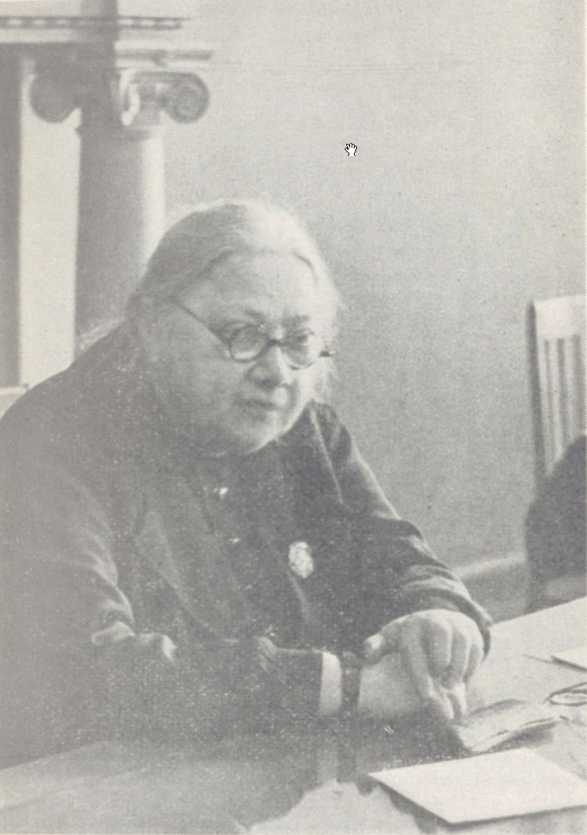
Krupskaya worked unsparing of self to assist in this growth of the people “in heart and in mind.” She was not stopped by her chronic illness, nor by an ailment of her eyes, which the doctors warned her it would be dangerous to strain. Her working day always started at six o’clock in the morning, when she would sit down at her desk to write or edit some article, or draw up some plan, before leaving her modest, student-like room for her office. Her day ended only late at night.
It was very difficult to tear Krupskaya away from her work, to make her rest and undergo medical treatment. It was necessary to resort to subterfuges, to think up some sort of very special reasons. Here is what she wrote to a comrade about her vacation in Kislovodsk in 1937:
“The devil alone brought me to Kislovodsk. It happened this way: Manya [the late Maria Ulyanova, Lenin’s sister-C.B.] has tuberculosis in an active stage, though not very severe. She has not been able to work all this time, and she declared to the doctors that she would not go anywhere without me. And so I went, especially as I had reached the limit myself-my heart was in a very bad state.
“I don’t like things here-too summer-resorty. I feel very queer with no work to do-like a fish out of water.”
For outstanding, self-abnegating work in the field of Communist education, and for unflagging labor heroism, Krupskaya was decorated by the Soviet government with the Order of Lenin and the Order of the Red Banner of Labor.
In January, 1939, not long before her death, Krupskaya spoke at a conference of village teachers of the Moscow Region. She pointed out to them the great part that would be played by the newly published History of the C.P.S.U. (B)—because, as she said,
“It is written in a way that throws an unusually clear light on the entire history of the Party, on the entire history of the fight of the masses for socialism under the leadership of the Party.”
In concluding her speech at this conference Krupskaya said:
“The name of Lenin, the name of Stalin-these to us are a banner. When we speak of Lenin or of Stalin we think of socialism-of the great successes we have attained-of the victory of communism. We must bring up our children to be true Leninists, true Stalinists. We must work so that the children, emulating their teachers and the outstanding Stakhanovites, emulating their parents, their mothers who are active in social work, will grow up into a truly new type of people. If you are to succeed in training the children into such a new type of people, you must work more and more to improve your own knowledge-you must get down to a real study of Marxism-Leninism-you must raise ever higher the banner of Marx, Engels, Lenin, and Stalin.”
This was one of Krupskaya’s last speeches, but not the very last. As her secretary relates, she spoke on February 23, 1939, at a meeting of the Council of People’s Commissars of the R.S.F.S.R., warmly presenting the plan she had worked out for cultural development during the Third Five-Year Plan period.
This was Krupskaya’s last speech.
Her last letter, written only a few days before her death, was addressed to the pupils of a certain school, who had written to ask her what songs she liked best, promising to learn these songs.
“The song I love best of all,” she answered the children, “is the Internationale. I also like the Red Army March. The Red Army men used to sing it in the Kremlin during the Civil War, and Ilyich and I liked it very much.”
On February 24 she went over the stenographic report of her speech on the Leninist conception of propaganda, delivered not long before at the Sverdlov Party University.
On February 26, 1939, the Central Committee of the C.P.S.U. (B.) and the Council of People’s Commissars of the U.S.S.R. the Party, Soviet, and public organizations with great love and respect observed the seventieth birthday of Nadyezhda Krupskaya, splendid proletarian revolutionary, tireless fighter for the cause of Communism, wife and comrade of Lenin.
On February 27, 1939, at daybreak, the glorious life of Nadyezhda Krupskaya came to an end.
The death of Krupskaya was a great loss to the whole Soviet people. On the day of her funeral in the Red Square in Moscow great memorial meetings were held all over the country. At these meetings the young builders of the new life bowed their heads in memory of Krupskaya and vowed to carry on the cause of Lenin and Stalin, the cause of Communism, with all their strength. And, inspired by her splendid life, they will keep their vows.
42 Footnotes