The Entire Bourgeoisie Exploits and Oppresses the Workers
7. The Entire Bourgeoisie Exploits and Oppresses the Workers
The Division of Surplus Value1
In the capitalist society, the worker is subject to the exploitation and oppression not only of the capitalist of the enterprise to which he belongs, but also of the whole bourgeoisie, consisting of the industrial capitalist, the commercial capitalist, the banking capitalist, and the landed class. Industrial profit, commercial profit, banking profit, interest, and land rent are all extracted from the worker and are all transformed surplus value. Then, how do the various exploiting cliques divide up surplus value? And how is surplus value transformed into profit, interest, land rent, and other concrete forms? These are the problems we will be dealing with in this chapter.
Competition among the Industrial Capitalists Leads to the Equalization of the Rate of Profit
Profit Is Transformed Surplus Value
The insatiable greed for surplus value is the nature of the capitalist. What the capitalist exploits is the surplus value created by the surplus labor of the worker. But in appearance, it is revealed as the capitalist’s profit. What then is the distinction and connection between profit and surplus value?
We know that the capitalist must advance some capital in order to exploit the surplus value created by the worker. Of this capital, a part is used to purchase means of production, and the rest is used to purchase labor power for the capitalist production process. In Chapter 4. we stated that that part of the capital used to purchase means of production is constant capital whose value remains unchanged in the production process. That part of the capital used to purchase labor power is variable capital which realizes value augmentation in the production process and brings surplus value to the capitalist. Hence, surplus value is created by the working class and is a product of variable capital. But when the capitalist computes his rate of profit, he compares the surplus value with the total capital advanced as if surplus value is the product of the total capital advanced. Thus, “surplus value, as a conceptual product to recompense total capital, is transformed into profit.” 2
Just as surplus value is transformed into profit, the rate of surplus value is transformed into the rate of profit. The ratio of surplus value to variable capital is the rate of surplus value. Its formula is: surplus value/variable capital, or m/v. The ratio of surplus value to total capital is the rate of profit. Its formula is: surplus value/total capital advanced, or m/c + v.
After surplus value is transformed into profit, the real source of surplus value is concealed, as if constant capital can also bring surplus value to the capitalist. And after the rate of surplus value is transformed into the rate of profit, the degree of exploitation of the worker by the capitalist is concealed. For example, a capitalist advances 10,000 yuan as total capital, of which 8,000 yuan is constant capital and 2,000 yuan is variable capital. Surplus value extracted in one year is 2,000 yuan. The rate of surplus value is 2,000/2,000, or 100 percent. But the rate of profit is 2,000/(8,000 + 2,000), or 20 percent, much lower than the rate of surplus value. Therefore, the purpose of the capitalist in treating surplus value as the product of the total capital advanced is to conceal the real source of surplus value and the degree of exploitation of the worker.
Competition among Capitalists of Various Sectors Equalizes Profit
To go after profit is the class nature of the capitalist. The intent of the capitalist is always to obtain the maximum amount of profit by advancing the smallest amount of capital. The capitalists not only cruelly exploit the worker; they also compete fiercely among themselves.
Competition among capitalists is carried on both among enterprises in the same sector and among sectors. In the competition among enterprises in the same sector, those capitalists adopting new techniques are in a favorable position. The labor productivity of their enterprises is high, and the individual labor time is below the socially necessary labor time so that excess surplus value is obtained. This excess surplus value is transformed into excess profit which is pocketed by the capitalist who adopts new techniques. A different result is obtained in competition among sectors. It leads to a uniform rate of profit among them. The capitalists of various sectors divide up the surplus value created by the worker according to the principle of equal profit for equal capital.
Let us now analyze how competition among the capitalists of various sectors leads to a uniform rate of profit.
In the capitalist society, the rate of profit varies among production sectors with their different organic composition of capital. The organic composition of capital is the ratio of constant capital to variable capital, and surplus value is only the result of the augmentation of variable capital. Hence, under the condition of a uniform rate of surplus value, the higher the organic composition of capital is, that is, the larger the share of constant capital and the smaller the share of variable capital, the smaller the surplus value given an equal amount of advanced capital. The rate of profit is also lower. On the other hand, the lower the organic composition of capital, the higher the rate of profit will be. Suppose shoe-making, spinning and weaving, and machine building are the three sectors of society. The organic composition of capital is 7: 3 in the shoe-making sector, 8: 2 in the spinning and weaving sector, and 9:1 in the machine-building sector. The capital of each of these three sectors is 10,000 (in units of thousands of yuan or ten thousand of yuan or any other convenient unit), and the rate of surplus value is 100 percent. To facilitate analysis, we further assume the rate of capital turnover in these three sectors is once a year. The value of constant capital is completely transformed in one year to products of that year. Thus, with a 100 percent rate of surplus value, the shoe-making sector obtains a profit of 3,000, the spinning and weaving sector obtains a profit of 2,000, and the machine building sector obtains a profit of 1,000. The organic composition of capital is lowest in the shoe-making sector. Its rate of profit is 30 percent. The organic composition of capital is highest in the machine-building sector. Its rate of profit is the lowest, only 10 percent. The organic composition of capital in the spinning and weaving sector is in the middle with a rate of profit of 20 percent. It is lower than that of the shoe-making sector, but higher than that of the machine-building sector.
Such a condition of equal investment with unequal profit cannot long exist in capitalist society. The capitalist always tries to invest capital in the production sector with the highest rate of profit. Therefore, the above condition must undergo changes. First of all, some capitalists of the machine-building sector will withdraw from production and invest their capital in the shoemaking sector for a higher rate of profit. Such a transfer of capital greatly boosts the output of the shoemaking sector. As supply gradually exceeds demand, the price comes down. On the other hand, the output of the machine-building sector is gradually reduced. The supply of machines gradually falls short of the demand for them, and the price gradually goes up. A combination of capital transfers and price adjustments leads to a more or less uniform rate of profit. This is then the average rate of profit. It is the result of comparing the total societal surplus value with the total societal capital. If we take the three sectors as representing the total societal production, the total societal surplus value is 6,000, and the total societal capital is 30,000. The average rate of profit is 6,000/30,000 = 20 percent. The profit obtained according to the average rate of profit is called the average profit. Marx pointed out,
“The average profit is merely the amount of surplus value distributed proportionally to each production sector according to its capital share.” 3
The category of average profit reflects the relationship among the capitalists of various sectors in dividing up the surplus value created by the working class of society.
The formation of average profit further conceals the capitalist exploitative relationship. The transformation of surplus value into profit already confuses the source of surplus value. But the profit obtained by the capitalists in various production sectors is still equal to the surplus value created by the workers of the respective sectors. After the formation of average profit, the capitalists of various sectors divide up surplus value so that the profit obtained by the various sectors is no longer equal to their respective surplus value produced. Now, provided that each sector possesses an equal amount of capital, an equal amount of surplus value can be obtained. The size of profit is entirely determined by the size of the capital advanced. This further obscures the nature of profit and the exploitative relationship it reflects.
| Production sector | Constant capital (1) | Variable capital (2) | Surplus value (3)} | Commodity value (4) = (l)+(2)+(3) | Average profit rate (%) (5) | Average profit (6) = [(l) + (2)]x (5) | Commodity production price (7) = (l) + (2) + (6) | Production price minus value (8) = (7) – (4) |
| Shoemaking | 7,000 | 3,000 | 3,000 | 13,000 | 20 | 2,000 | 12,000 | -1,000 |
| Spinning and weaving | 8,000 | 2,000 | 2,000 | 12,000 | 20 | 2,000 | 12,000 | 0 |
| Machine building | 9,000 | 1,000 | 1,000 | 11,000 | 20 | 2,000 | 12,000 | +1,000 |
| Total | 24,000 | 6,000 | 6,000 | 36,000 | 20 | 6,000 | 36,000 | 0 |
The Equalization of the Rate of Profit Transforms the Value of Commodities into Production Price
After the formation of average profit, the capitalist no longer sells commodities according to their values, but according to their production prices. Production price is equal to cost plus average profit. Based on the earlier assumptions, the formation process of production price is shown in the following table.
From the table, we can see that in the machine-building sector where the organic composition of capital is high, the production price of the commodity is higher than its value, while in the shoe-making sector where the organic composition of capital is lower, the production price is lower than value. Only in the spinning and weaving sector where the organic composition of capital is in the middle is the production price equal to value.
With the formation of average profit and the transformation of value into production price, market price no longer fluctuates around value, but around production price. Does the appearance of production price mean that the law of value no longer matters? No. From the viewpoint of the individual capitalists in various sectors, some sell their commodities at production prices above value and obtain more profit than the surplus value created by their sector, while others sell their commodities at production prices below value and obtain less profit than the surplus value created by their sector. However, from the viewpoint of the whole society, the total value of commodities is equal to the total production price. The total average profit obtained by the industrial capitalists as a whole is equal to the total surplus value created by the industrial workers as a whole. Therefore, production price is merely a transformation of value.
Marx’s theory about average profit tells us: In capitalist society, the worker is subject to the exploitation and oppression not only of the capitalist in his own enterprise, but also of the industrial capitalists as a whole.
The Commercial Capitalists Share in the Surplus Value through Commodity Transactions
The Role of Commercial Capital Is to Realize Surplus Value
In the above analysis, we suppose the surplus value created by the working class was monopolized by the industrial capitalist. In fact, the industrial capitalist cannot monopolize it. He must transfer part of the surplus value extracted from the worker to the commercial capitalist. The commercial capitalist does not engage in commodity production; he merely advances capital to buy commodities in bulk from the industrial capitalist and sells them to help the industrial capitalist in realizing surplus value. This surplus value obtained by the commercial capitalist is called commercial profit.
Why does the industrial capitalist need the commercial capitalist to sell commodities for him, and why is he willing to share a part of the surplus value extracted with the commercial capitalist? Because with the development of capitalism, the volume of commodities produced by the industrial capitalist steadily increases, and the market for commodities steadily expands. If the industrial capitalist has to handle the business of commodity sales, he must establish a large commercial organization and hire a large number of shop assistants. This is not profitable for the industrial capitalist because a large amount of capital would have to be tied down to the exchange process, thus adversely affecting his scale of production and competitive power. If the sale of commodities is delegated to the commercial capitalist specializing in commodity transactions, he can benefit from the advantages of specialization in commodity transaction and save on exchange expenses. In addition, because of the existence of the independent activities of commercial capital, the industrial capitalist can sell his commodities to the commercial capitalist in bulk and more quickly complete the transformation from commodity capital to money capital. Consequently, his capital can be active in the production sphere and play the role of productive capital longer for the extraction of more surplus value. Thus, though a part of the surplus value has to be transferred to the commercial capitalist, it is still to the advantage of the industrial capitalist after all. This is why commercial capital is separated from industrial capital.
Commercial Capital Also Participates in the Formation of Average Profit
By helping the industrial capitalist realize surplus value by investing in commerce, the commercial capitalist not only requires commercial profit, he also requires that this commercial profit not be lower than the average profit of industrial capital. Otherwise, the commercial capitalist would rather invest his capital in the production sector than engage in commerce.
Where does commercial profit come from? On the surface, it appears that commercial profit is brought about by the sale of commodities above their value. The bourgeoisie takes advantage of this illusion and says that commercial profit arises from exchange. This is a distortion of the source of commercial profit and a concealment of exploitation.
In fact, commercial profit is also a part of the surplus value extracted from the worker by the industrial capitalist. Because the industrial capitalist wants the commercial capitalist to sell commodities for him, he cannot sell his commodities according to their production price, but must sell below production price. The commercial capitalist then sells the commodities at production price to the consumers. In this way, a part of the surplus value extracted from the worker by the industrial capitalist is transferred to the commercial capitalist.
For example, suppose the industrial capitalist in society invests 40 billion yuan in a year, of which 30 billion yuan is constant capital, 10 billion yuan is variable capital, and 10 billion yuan is surplus value. Suppose the production cycle is one year, and the value of constant capital is completely transferred to products in one year. Then, the total value of commodities, or the total production price, is 30 billion yuan + 10 billion yuan + 10 billion yuan = 50 billion yuan. The rate of profit is 10/40 = 25 percent. But the circulation of commodities must be handled by the commercial capitalist. Suppose the total value of commercial capital is 10 billion yuan. Then the total capital in the production and exchange spheres is 50 billion yuan. The 10 billion yuan of surplus value must be shared equally between the 50 billion yuan of industrial and commercial capital. The average profit rate can no longer be 25 percent, but instead is 20 percent. According to the average profit rate of 20 percent, the industrial capitalist obtains 8 billion yuan, and the commercial capitalist obtains 2 billion yuan. That the commercial capitalist can obtain these 2 billion yuan of profit is because the industrial capitalist sells his commodities to the commercial capitalist at a price below their production price, that is, at the price of 48 billion yuan (40 billion yuan in cost and 8 billion yuan in profit). And the commercial capitalist sells the commodities according to the production price of 50 billion yuan and obtains a 2-billion-yuan profit. Thus, the 10 billion yuan of surplus value created by the worker is shared proportionally according to the capital advanced by the industrial and commercial capitalists respectively.
The Commercial Capitalist Cruelly Exploits the Employee
The commercial employee is just like the industrial worker. He is a hired laborer and subject to the exploitation of the bourgeoisie. The difference between them is that the industrial worker produces surplus value in the production sphere for the capitalist under his supervision, while the commercial employee realizes surplus value for the capitalist in the exchange sphere under his supervision. Why do we say the commercial employee is subject to exploitation just like the industrial worker? This is because the commercial employee and the industrial worker earn their livings by selling labor power. The value of their labor power has to be determined by labor time needed to reproduce labor power. Although the commercial employee does not create value or surplus value through his labor connected with commodity transactions, the value of commodities and the surplus value embodied must be realized through his labor. Therefore, the labor time of the employee is also divided into necessary labor time and surplus labor time. The part of surplus value realized in the necessary labor time through the employee’s sale of commodities goes to compensate the variable capital with which the commercial capitalist buys the labor power of the employee. In the surplus labor time, the employee works for the commercial capitalist for free in order to enable the commercial capitalist to share part of the surplus value from the industrial capitalist as commercial profit. Therefore, the commercial employee, like the industrial worker, is exploited.
The exploitation of the employee by the commercial capitalist is equally cruel. To obtain more commercial profit, the commercial capitalist raises labor productivity by lengthening labor time and increasing labor intensity. He also resorts to deducting wages from the employee and other ruthless means to intensify exploitation. Take the example of the capitalists in the old Shanghai Hsieh-ta-hsiang Silk Goods Company. In order to intensify exploitation of the employee, they set down 120 regulations. The employee was required to work sixteen to seventeen hours a day at high labor intensity. There were so many deductions from his wages that they were not sufficient for a minimum level of subsistence. Under the bloodthirsty extractions of the capitalist, the broad masses of employees, like the multitude of industrial workers, sell not only their labor power but also their lives.
The Financial Capitalists Share in Surplus Value through Loans and Borrowings
The Source of Interest Is Surplus Value
In the capitalist society, the financial capitalist, in addition to the industrial and commercial capitalists, also shares in the surplus value.
There are certain objective necessities for the existence of capital loans and borrowings because, in the capitalist reproduction process, the capitalist may be short of capital. For example, when products have not been sold but machines and raw materials have to be bought and wages paid, some money capital has to be borrowed. Sometimes, there may also be idle money capital. For example, before fixed capital is replaced, the capitalist may have some accumulated depreciation charges in money form. After commodities have been sold but before raw materials have been bought and wages paid, there may also be some idle money capital. Under these circumstances, those capitalists who possess money capital can lend the temporarily idle money capital to capitalists in need of money. The capitalists who borrow this money capital will use it to produce or sell commodities to extract or realize surplus value. Naturally, the owners of money capital will not lend it to other capitalists without any compensation. They will demand a certain amount of money from the borrowing capitalists as compensation for the loan. The borrowing capitalist must share a part of the surplus value he extracts with the lending capitalist. This part of surplus value is called interest.
Money capital that is lent for interest is known as loan capital. The ratio of interest to loan capital is called the rate of interest. The highest level of the interest rate cannot exceed the average profit rate. If this is not so, the borrowing capitalists will not get any benefit from the loans and will not borrow. The source of interest is surplus value. However, the apologists of the bourgeoisie advance the false theory that “big money breeds little money” and say that “interest comes from money itself” to conceal the nature and source of interest and the capitalists’ exploitative relations. Bank Profit Is Obtained from the Difference between the Borrowing and Lending Interest
In the capitalist society, the borrowing and lending of money is largely done through the bank. By attracting deposits, the bank collects idle capital and funds which the people do not need for a period of time. It then lends the money to the functioning capitalist. The bank pays interest to attract capital and collects interest from loans. The lending interest rate is higher than the deposit interest rate. This difference between the borrowing and lending interest rates, after subtracting the operating expenses of the bank, constitutes bank profit. Like interest, bank profit also comes from the surplus value created by the worker in production. The banking capitalist shares in the surplus value created by the worker by obtaining the interest differential through borrowings and loans.
The purpose of the banking capitalist in advancing capital to operate the bank is to obtain profit. Therefore, bank profit cannot be lower than the average profit obtained by other functional capitalists. If bank profit is below average profit, he will not run the bank but will instead run plants and shops himself.
The Appearance of Stocks Is a Reflection of the Intensification of the Parasitic Nature of Capitalism
With the development of capitalist production, the scale of enterprises expands. The large amount of capital needed to run large enterprises cannot be afforded by individual capitalists. There arises a need for many individual capitalists to form joint-stock corporations. The joint-stock corporation is an enterprise with pooled capital. It is an important means which big capital uses to control medium and small capital and to manipulate capital.
The joint-stock company issues stocks, and those who purchase the stocks become stockholders. Stockholders have a right to share part of the enterprise’s profit according to the amount of stock owned. Income from stocks is known as dividends.
The capitalist who owns stocks does not have to work. He can loaf all day long and lead an extravagant life on dividends. The stockholder may also speculate in stocks. The stock exchange is full of dishonest competition. The appearance of people who live on interest by clipping interest coupons and speculating in stocks reflects the intensification of the parasitic nature of capitalism.
The Landed Class Reaps without Sowing Capitalist Monopoly Operation of Land Leads to Differential Rent
Landowners are another exploitative class in the capitalist society. They own land and rent it out to the industrial and agricultural capitalist in order to share in the surplus value. To reveal the nature of capitalist rent, we start from the two forms of capitalist rent, namely, differential rent and absolute rent.
Land is the basic means of production for agricultural production. But unlike other means of production, its quantity is limited. This limited quantity of land includes superior, medium, and inferior land with respect to fertility. In the capitalist society, this limited supply of land leads to the capitalist’s monopolistic operation of land.
With capitalist monopoly of land, some agricultural capitalists operate superior and medium land; other agricultural capitalists operate inferior land. Because the produce of the superior and medium land cannot fully satisfy the market demand, the price of produce must rise in response to the shortage of supply vis-à-vis demand. It will continue to rise until the agricultural capitalists who operate the inferior land can obtain an average profit. Marx pointed out, “The production price from the poorest land is always the regulating market price.” 4 Thus, those agricultural capitalists who operate the superior and medium land will obtain excess profit. This excess profit constitutes differential rent.
There are two forms of differential rent. One arises from the difference in fertility and location and is known as Differential Rent I. The other arises from successive investments on the same piece of land and is known as Differential Rent II.
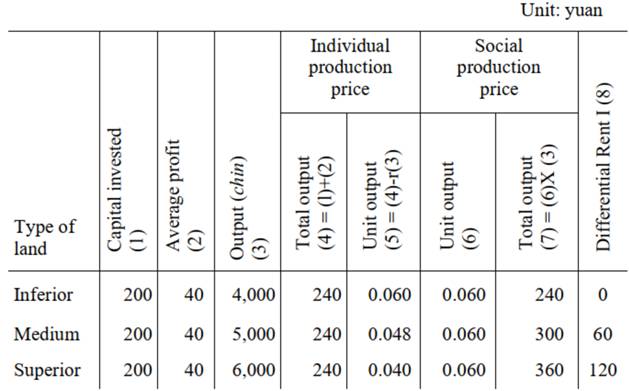
Let us first take the example of three pieces of crop land of equal size but different fertility (see table below).
The capital invested in each of the three pieces of land is 200 yuan. Suppose the capital is completely transferred to products. The cost will be 200 yuan in each case. But labor productivity of the agricultural worker is different on land of different fertility. The agricultural output is 4,000 Chin, 5,000 Chin, and 6,000 Chin respectively. If the average profit is 20 percent, then the production price (cost + average profit) of the total output for each piece of land is 240 yuan. But because the output is different for the different pieces of land, the production price of unit output is different. With inferior land, it is 0.060 yuan. With medium land, it is 0.048 yuan. And with superior land, it is 0.040 yuan. The social production price in the market is determined by the unit production price of inferior land, that is, 0.060 yuan per Chin. Thus, the agricultural capitalist who operates inferior land obtains 240 yuan. After deducting 200 yuan of cost, an average profit of 40 yuan remains. There is no excess profit or differential rent. The agriculturalists who operate medium and superior land obtain 300 yuan and 360 yuan respectively. After deducting 200 yuan as cost, they get 60 yuan and 120 yuan respectively as excess profit in addition to 40 yuan of average profit. This excess profit constitutes Differential Rent I.
Let us now take the example of continually investing on the same piece of crop land to explain the emergence of Differential Rent II. For example, the agricultural capitalist who operates inferior land invests successively on the same piece of land. He invests 200 yuan the first time. The output of produce is 4,000 Chin, and the average profit is 40 yuan with no excess profit or differential rent. If this capitalist invests another 200 yuan the second time to construct water control facilities, add fertilizers, buy new machines, hire more agricultural workers, and increase labor productivity, he may get 5,000 Chin more of produce (that is, he invests 400 yuan in total and obtains 9,000 Chin). With an unchanged social production price for produce, the total price of the 5,000 Chin obtained from the second investment is 300 yuan. After deducting 200 yuan as cost and 40 yuan as average profit, he still has 60 yuan of excess profit. This 60 yuan is Differential Rent II.
We must point out here that the amount of rent was already determined when the agricultural capitalist signed a contract with the landowner. Therefore, within the current contract, the excess profit obtained from successive investment will accrue to the agricultural capitalist. But when the contract expires and is renegotiated, the landowner may again raise the rent. In the end, this excess profit will be transferred to the landowner in the form of Differential Rent II. Marx pointed out: “Differential rent possesses a certain attribute: the ownership of land merely takes away surplus profit. Under a different condition, this surplus profit may be taken away by the tenant. And within the currency of a contract, it is in fact taken away by the tenant.” 5 Therefore, the agricultural capitalist always attempts to have a longer contract. But the landowner tries his best to shorten the duration of a contract. Both sides fight to obtain this excess profit. This contradiction between the agricultural capitalist and the landowner makes the agricultural capitalist plunder the fertility of the land as much as he possibly can before the expiration of a contract.
Monopolistic Private Landownership Leads to Absolute Rent
Inferior land does not provide differential rent. But if the owner of inferior land does not get any rent, he would prefer to let the land remain uncultivated rather than let others use it. In fact, the agricultural capitalist who operates inferior land must also pay rent to the landowner. This rent arising from the monopoly of private landownership is called absolute rent.
If the agricultural capitalist who operates inferior land must also obtain an average profit, where does the rent come from?
In the capitalist society, agricultural technology is always behind manufacturing technology. The organic composition of capital in agriculture is always lower than that of manufacturing. We know that surplus value comes from variable capital. Since the organic composition of capital is lower in agriculture than in manufacturing, an equal amount of capital can bring more surplus value in agriculture than in industry. Suppose the average organic 94 composition of capital in manufacturing is 8:2 and the rate of surplus value is 100 percent. Then, in every 100 yuan of capital, there is 20 yuan in variable capital bringing about 20 yuan in surplus value. The average rate of profit is 20 percent. The value of commodities and the production price are 120 yuan. And suppose the organic composition of capital in agriculture is 6:4 and the rate of surplus value is 100 percent. Then for every 100 yuan, there is 40 yuan in variable capital bringing about 40 yuan in surplus value. The value of produce is 140 yuan, and the rate of profit is 40 percent. In the capitalist society, agricultural produce can be sold at its value (140 yuan). But the agricultural capitalist can only obtain an average profit equal to that of the industrial capitalist, namely, 20 yuan. The production price of produce is therefore 120 yuan. Now agricultural produce is sold above its production price. In addition to an average profit of 20 yuan, the agricultural capitalist still has 20-yuan surplus which is the difference between the value of agricultural produce and its production price. This constitutes absolute rent.
Why can agricultural produce be sold above its production price? This is because of the existence of monopolistic private landownership. In manufacturing, the organic composition of capital in various departments is not all the same. It is natural for departments with lower organic composition of capital to produce more surplus value. But as a result of interdepartmental competition and the transfer of capital, all industrial capitalists can obtain only an average profit. So industrial products can be sold only at their production price. But agricultural production is different from manufacturing production. There is one obstacle in agriculture, namely, monopolistic private ownership, which prevents the unconditional transfer of capital to agriculture. This prevents the surplus value in the agricultural sector from participating in the process of profit equalization. And agricultural produce can be sold at a value higher than its production price.
Therefore, in agriculture, even inferior land can obtain more surplus value from an equal amount of capital. This surplus value is not shared with manufacturing. It remains in agriculture and is converted into absolute rent for the landowner.
Capitalist Rent Is Also a Part of Surplus Value
Although the formation of differential and absolute rent arises from different causes, their substance and source are the same. As a result of capitalist monopolistic operation of land, the price of produce is determined by the production price on inferior land. The agricultural capitalist who operates superior and medium land thus reaps excess profit. This excess profit has no connection with private landownership. Even if there is no private landownership, the agricultural capitalist who operates superior and medium land will still obtain this excess profit. Marx pointed out, private landownership “is not the cause of this surplus profit, but the cause of its transformation into rent.” 6 As a result of the existence of private landownership, this excess profit is transformed into differential rent. Also because of the existence of monopolistic private landownership, the price of agricultural produce can be set at a value above its production price. Even the agricultural capitalist who operates inferior land can obtain excess profit which is transformed into absolute rent for the landowner. The source of differential rent and absolute rent is excess profit. This excess profit is created by the agricultural worker, just as is the whole surplus value in agriculture. The agricultural capitalist rents land from the landowner, buys means of production, hires agricultural workers to engage in production, and extracts surplus value from the agricultural workers. From this surplus value, the agricultural capitalist obtains an average profit. The surplus value over and above the average profit is transformed into rent. Therefore, the substance of rent is also surplus value.
However, the landowner and his spokesman, in order to conceal the exploitation of the agricultural worker by the landowner and the agricultural capitalist, seize upon the superficial differences between the output of produce from superior and inferior land to insist that “rent is brought about by land itself.” This explanation is entirely groundless. Good and superior land only provide favorable conditions for the increase of labor productivity and a natural basis for the creation of surplus profit. But without the labor of the agricultural worker, even the best land cannot create any value. Marx pointed out, “All rent is surplus value and is all a product of surplus labor.” 7 Marx’s theory of rent thoroughly exposes the fallacious explanation of the landowner and his spokesman.
Capitalist rent and feudal rent are a result of private landownership, but their respective exploitative relations are different. Feudal rent is the total surplus labor or surplus produce that the feudal landlord obtains from the peasant. Capitalist rent is the surplus value over and above an average profit obtained by the agricultural capitalist from the agricultural worker. Feudal rent manifests the exploitative relation between the feudal landlord and the peasant. Capitalist rent manifests the exploitative relation between the landowner and the agricultural capitalist on the one hand and the agricultural worker on the other.
Through the above analysis, we can see that in the capitalist society the bourgeoisie is divided into different exploitative groups. There is the manufacturing, agricultural, commercial, and banking capitalists. The landowner is another exploitative class in the capitalist society. They are all foxes of the same ilk sharing among themselves the surplus value created by the working class and concertedly exploiting and oppressing the working class. Therefore, in the capitalist society, the bourgeoisie is on top of the working class. The contradiction between the worker and the capitalist is the contradiction between the whole working class and the whole bourgeoisie. This is the basic contradiction of the capitalist society. If the working class wants to 96 liberate itself, it must unite as a class, take up guns to make revolution, overthrow the whole bourgeoisie, and destroy the capitalist exploitative relationship.
Major Study References
Marx, Capital. Vol. 3, chaps. 1, 2, 9, 17, 21, 38. 45.
Chairman Mao, “The Analysis of Chinese Social Classes.”
Chairman Mao, “The Chinese Revolution and the Chinese Communist Party,” chap. 2, sections 2, 4.
Review Problems
- How do the various exploitative groups in the capitalist society exploit the surplus value created by the working class?
- What is the significance of Marx’s theory on the division of surplus value?