The Incurable Disease of Capitalism
8. The Incurable Disease of Capitalism
Economic Crises 1
Economic crises are the natural product of capitalist economic development. They are pronounced manifestations of the intensification of various contradictions in capitalist production, exchange, distribution, and reproduction. How do capitalist economic crises arise? What are their effects on capitalist development? We will talk about these problems in this chapter.
Economic Crises Are a Product of the Intensification of the Basic Contradictions in Capitalism Capitalist Economic Crises Are Crises of Overproduction
Before capitalism (for example, in the long history of China’s feudal society), there were also many social, economic, and livelihood crises. Because of the cruel exploitation of the peasant by the landlord class, the ravages of war, and natural calamities such as floods, droughts, insect pests, and hailstorms, agricultural production suffered serious damage, the laboring people lost their homes, and hundreds of thousands died of hunger and plagues. Social, economic, and livelihood crises at those times were characterized by insufficient food grain production. Capitalist economic crises are not characterized by insufficient production, but by overproduction. The most notable features connected with capitalist economic crises are: large quantities of commodities cannot be sold, factories close down, banks fold up, values of stocks fall, unemployment figures rapidly increase, productive forces suffer severe damage, and the whole economy is paralyzed and chaotic.
Capitalist economic crises are crises of overproduction. But the so-called “overproduction” is not an absolute overproduction; it does not mean that things produced by society are more than what the masses can consume. In economic crises, the phenomena described below are widespread. Textile workers receive dismissal notices saying that there is an overproduction of yarns and fabrics without sales outlets so production has to be cut back and workers dismissed. However, the textile workers and their families are inadequately clothed. Those who produce fabrics cannot afford them. Miners receive dismissal notices saying that there is an overproduction of coal necessitating production and employment cutbacks. Yet, the miners and their families have to shiver in the cold for lack of money to buy coal. Therefore, capitalist overproduction is relative overproduction. In other words, social production is excessive only in relation to the purchasing power of the masses. During economic crises, inventories pile up in the warehouses of the capitalist for lack of demand. Commodities may be rotting away or even artificially destroyed. On the other hand, the broad laboring masses are too poor to afford food and clothing and are struggling on the verge of starvation.
The economic crisis of overproduction is a special feature of the capitalist economy. Nevertheless, the possibility of economic crises is latent in the development process of the commodity economy from the beginning. When the commodity producer sells his commodities, he does not always immediately use the money obtained to buy means of production or required daily commodities. However, if he does not buy, then those commodity producers who trade with him cannot sell. Here dislocations between sales and purchases may arise, and the possibility of crises exists. However, when commodity production was carried on by petty commodity producers and based on individual ownership, the purpose of production was to trade for other commodities to maintain production and satisfy personal consumption needs. Therefore, sales were usually followed by purchases. At the same time, the productive forces were low, and the scale of production small. Society’s division of labor was not well developed, and production inter-dependencies were not very close. Even if dislocations between sales and purchases arose, their effects were local and would not lead to economic crises affecting the whole society. Therefore, even though commodity production itself embodies the possibility of crises, the inevitability of crises can only be found in the capitalist economic system itself. The Source of Economic Crises Lies in the Basic Contradiction of Capitalism
Economic crises in the capitalist society are inevitable. This is determined by the basic contradiction of capitalism. Stalin pointed out:
‘The source and cause of economic crises of overproduction lie in the capitalist system itself. The source of crisis lies in the contradiction between the social nature of production and the capitalist ownership of products.”
Why does the basic contradiction of capitalism inevitably lead to economic crises?
First of all, the basic contradiction of capitalism inevitably manifests itself in a contradiction in which the productive forces greatly increase while the purchasing power of the laboring people relatively decreases. Capitalist large-scale social production is very different from individual handicraft production. Individual production is characterized by simple reproduction. Even under very favorable market conditions, its growth in production is slow. Capitalist production is production by big machines and is capable of rapid growth. The capitalist tries his best to expand production in search of more profit because the larger the scale of production, the more surplus value he can extract. At the same time, the capitalist must also try to improve his techniques and expand his scale of production in order to avoid being squeezed out by other capitalists. With the expansion of production, the standard of consumption must also be increased so that the increased production of commodities can be sold and social production continued. But under the condition of private ownership of the means of production, the capitalist always tries to reduce wages to the lowest possible level. The development of capitalist production and the adoption of new techniques inevitably keep a large number of workers outside the factory gates and expand the ranks of the unemployed. Capitalist competition inevitably renders a large number of peasants and handicraftsmen bankrupt so that small capital is squeezed out or swallowed by big capital. Thus, on the one hand there is an immense growth of production, and on the other hand there is a relative decrease in the purchasing power of the laboring people. This contradiction makes the economic crises of overproduction inevitable.
The basic contradiction of capitalism also inevitably leads to economic crises because the contradiction inevitably manifests itself in a contradiction in which the production of individual factories is organized while social production is chaotic. As production becomes social, the relationship and inter-dependency among production sectors and among various enterprises are increasingly close. For example, the cotton required by the textile mill is supplied by the agricultural sector, and spinning and weaving machines by the machine-building industry. Therefore, in a given period of time, there must be a unified plan and arrangement to determine the necessary amount of cotton, cloth, and spinning and weaving machines so that social production can be smoothly carried out. However, capitalist private ownership of the means of production divides the whole society into numerous autonomous capitalist enterprises. From the viewpoint of one enterprise, its workers are all controlled by one capital, and its internal production is organized. But from society’s viewpoint, what and how much the various enterprises of different capitalists produce are the private business of individual capitalists. Nobody else can say anything about it. Therefore, the production of the society as a whole is carried on under anarchic conditions. Because social production is uncoordinated, individual capitalists cannot possibly know the actual demand for a certain commodity. Provided that there is profit, capitalists will compete among themselves to expand production. At the same time, capitalist commercial activities may also create false demand that conceals the society’s actual purchasing power. Even though production actually exceeds the purchasing power of the masses, as long as the market price continues to go up, commercial capitalists will still order from industrial capitalists, and financial capitalists will still extend credit to industrial and commercial capitalists to facilitate industrial capitalists to expand production, thus creating false prosperity in the market. This false prosperity conceals the existence and development of overproduction. When overproduction is finally exposed, it is revealed through an avalanche of economic crises.
Thus, we see that the source of economic crises lies in the capitalist system itself and in the basic contradiction of capitalism in which production is 100 social but means of production are privately owned. As long as capitalism exists, economic crises are bound to explode. To eliminate crises, the capitalist system must first be destroyed.
Marxist Theory of Economic Crises Demolishes All Fallacious Theories of the Bourgeoisie Designed to Conceal Crises
The bourgeoisie and its apologists harbor extreme fear and hatred of the scientific conclusions about capitalist economic crises reached by Marxism. They have racked their brains to fabricate various lies in a vain attempt to dissociate crises with the capitalist system in order to deceive the working people and maintain the capitalist exploitative system. For example, some of them attribute the source of crises to “under-consumption” and propose to use “consumption stimulation” to eliminate crises. In fact, under-consumption by the laboring people did not come into existence after the appearance of capitalism. It has been in existence ever since the human society was divided into the exploiting and the exploited classes. But overproduction appears only in the capitalist society. It is, therefore, easy to see that economic crises cannot be explained by “under-consumption.”
After the Second World War, the militarization of the national economy led to temporary false prosperity in some capitalist countries. The apologists of the bourgeoisie seemed to have a lifesaving straw. They made the nonsensical statement that “those who hold the view that the capitalist countries would inevitably run into great economic crises are all mistaken.” They saw the increasing participation of the governments of capitalist states in national economic activities as being “automatic regulators” which would, to a certain extent, enable the development of the capitalist economy to “automatically tend toward stability.” This is also a lie. We know that the capitalist state machinery serves the bourgeoisie. Whatever the bourgeois state does to militarize the national economy or to regulate economic life, it does through various measures in order to intensify the exploitation of the people so that the capitalist can get richer. As Lenin pointed out long ago:
“Whether in the United States or Germany, the result of ‘regulating economic life’ is to create military hard-labor camps for the worker (and part of the peasantry) and to build havens for the banker and the capitalist. The regulating measures of these countries consist in tightening the belt of the worker to the verge of starvation while on the other hand guaranteeing (using secret and reactionary bureaucratic methods) that capitalist profit is higher than before the war.” 2
The regulation of economic life in the bourgeois countries has not only not made the capitalist economy “automatically tend toward stability,” on the contrary, it has impoverished the laboring people and diminished the market while enriching the capitalists. The basic contradiction of capitalism has steadily intensified, and the economic crises of capitalism have become more serious.
The Worsening Tendency of Capitalist Economic Crises
Capitalist Economic Crises Explode Periodically
As long as the capitalist system exists, the basic contradiction of capitalism will play its role. Capitalist economic crises are not problems which break out once or twice, but inevitably appear periodically. Looking at history, we see that the first large-scale economic crisis appeared in 1825 in England. After that, economic crises appeared repeatedly in 1836, 1847, 1857, and 1867. They occurred on the average of once every ten years. After these, they continued to explode with ever greater severity.
The cycle of economic crisis is the period of time between two successive crises. It consists in general of the four phases of crisis, depression, recovery, and boom. Of these, the phase of crisis is basic. It is the end of the last cycle and the beginning of a new cycle.
The Crisis Phase: Crises often strike suddenly. Before their arrival, there is widespread false prosperity in the market, and “business is thriving” in various industries. Although production already exceeds actual needs, plants are still working at full speed to fill up the warehouses and meet orders because of the credit system and active speculative activities. All of a sudden, an economic crisis arrives due to a dislocation in one of the links in the capitalist economy. Once overproduction in one field is revealed and sales become difficult, other fields are soon affected, leading to a chain reaction. For example, production cuts or suspension in the automobile industry due to overproduction inevitably affect the coal, electric power, and transportation industries. Commercial speculators who initially help boost the false prosperity now turn around to unload their stocks at reduced prices, thus worsening the situation. Now the warehouses are overstocked, sales are difficult, and prices drop rapidly. To arrest the drop of prices, the capitalist may even resort to destroying large quantities of commodities. Under the blow of slow sales and falling prices, many medium and small enterprises go bankrupt en masse, and many banks close down. Those plants which continue to operate reduce their scale of production. At this time, the number of unemployed workers from all industries rapidly increases, and the whole economic situation rapidly worsens.
The Depression Phase: After the stormy assaults in the crisis phase, the tide of insolvency among industrial and commercial enterprises subsides. Those enterprises which survive the crisis conduct their activities on a smaller scale. Although shops are brightly decorated and their salesmen shout loudly, business is still very poor. A large number of workers are still unemployed with no means of livelihood. Capitalist industry, commerce, and banking are in the doldrums. However, in this phase, social consumption is still carried on. Stockpiles of commodities, after much damage, are sold slowly at very low prices. Under the surface of the doldrums, factors promoting the recovery of production slowly accumulate.
The Recovery Phase: With the reduction in stockpiles, prices slowly recover, and profits increase gradually. The capitalists step up their exploitation of the worker on the one hand and improve techniques and purchase new equipment on the other. Thus, production in the first category such as electric power, iron and steel, and machine building is the first to expand step by step. Employment gradually increases in this category. And the increase in employment leads to an increase in demand for consumer goods, thus stimulating the development of production in the second category. In this way, production gradually recovers, and the number of unemployed decreases. The once depressed capitalist economy is again gradually on its way to recovery.
The Boom Phase: The basic characteristics of this phase are rapid sales of commodities in the market, high profit, quickening activities in production and exchange, and the revival of credit and speculative activities. There is widespread ’’prosperity” in the market. The capitalists all try hard to expand production. Thus, under the surface of widespread “prosperity,” new factors for another crisis steadily accumulate. Engels described this lively phenomenon of the capitalist economy as:
“Motion is quickened; slow steps turn into quick steps. Industrial quick steps turn into running steps. Running steps in turn become a sprint in a handicapped race in industry, commerce, credit, and speculative activities. In the end, after several final, desperate jumps, it falls into an abyss of collapse.” 3
Crisis — depression — recovery — boom — crisis characterizes the cyclical nature of economic crises. It also manifests the cyclical nature of capitalist production. It shows that capitalist production cannot progress continuously, but can only advance on a zigzag course.
Capitalist Economic Crises Worsen Steadily
In the development process of capitalist production, economic crises repeatedly appear. But each crisis is not a simple recurrence of the previous crisis. Capitalist economic crises tend to worsen steadily. Especially after the Second World War, economic crises have become more frequent and more severe. This is manifest in the following aspects:
First, the cycle of economic crises has shortened, and economic crises are becoming more frequent.
Before the Second World War, economic crises occurred once every ten years. In the twenty-odd years after the Second World War, the cycle of economic crisis shortened markedly.
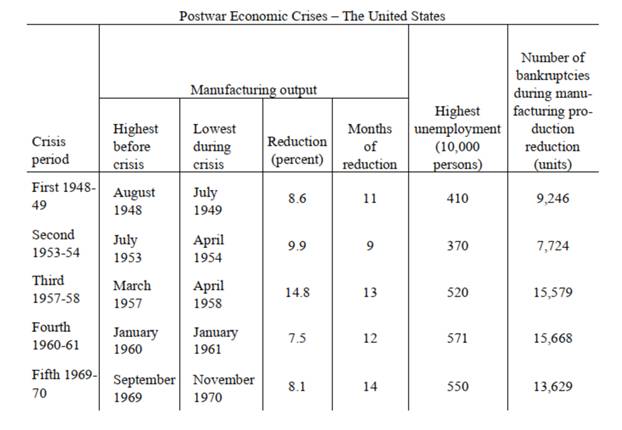
We can clearly see from the following tables that after the Second World War there were five economic crises in the United States and Japan.
The average time between the first and the fifth crisis was less than five years in the United States and less than four years in Japan. After the Second World War, the cycle of economic crises markedly shortened because, under the rule of monopoly capital, the laboring people are subject to increasing exploitation, their purchasing power is reduced relatively, and problems of the domestic market are intensified. Furthermore, because of the external aggression and expansion of various imperialist countries, the contradictions between imperialism and the people of colonies and satellite countries are intensified. This promotes national revolutions in the colonies and satellite countries and consequently reduces the size of the foreign markets. Sales become a chronic problem. Thus, the contradiction between production and consumption is steadily intensified. All these show that the basic contradictions of capitalism are becoming ever more acute, and the capitalist production relation imposes an ever more serious obstacle to the development of the productive forces.
Second, the blind replacement of fixed capital makes the ratio of capitalist reproduction more out of balance. Before the Second World War, whenever economic crises exploded, investment in fixed capital usually dropped rapidly. However, after the Second World War, investment in fixed capital was generally higher than before the war. Even during crises, the level of investment still remained relatively high. In the fifth economic crisis in the United States after the war, investment in fixed capital not only did not fall, it went up instead. There was an increase of 3.5 percent between 1969 and 1970. In the fifth economic crisis in Japan after the war, investment in fixed capital in 1971 was 3.2 percent higher than in 1970.
The higher level of investment in fixed capital after the war shows that, on the one hand, the monopoly bourgeoisie uses the state machinery to increase its exploitation of the laboring people and transforms the surplus value extracted from the worker into capital. This speeds up capital accumulation but also speeds up the impoverishment of the proletariat and further reduces the purchasing power of the people. On the other hand, it shows that investment in fixed capital in the United States after the war consisted primarily of military orders and demands related to armaments and war preparations. Not only was a large number of social resources wasted, but also the first category of industries was expanded without any control. As a result, the ratio of social reproduction was even more out of balance, and the contradiction of capitalist reproduction became more acute. And capitalist economic crises became more frequent and more severe.

Third, manufacturing crises are interwoven and interact with agricultural crises, intensifying the whole economic crisis. Under the capitalist system, economic crises occur not only in manufacturing but also in agriculture. When agricultural crises explode, they are reflected in rapidly increasing stocks in the warehouse of the agricultural capitalist, falling wholesale prices, shrinking cultivated acreage, increasing unemployment of agricultural workers, falling wages among those still employed, and mass bankruptcy among individual farmers. It can be seen that agricultural crises, like manufacturing crises, arise because of overproduction and are caused by the basic contradiction of capitalism. As long as the capitalist system exists, agricultural overproduction crises are just as inevitable as manufacturing overproduction crises.
But, compared with manufacturing crises, agricultural crises last much longer. In the twenty-three years since the agricultural crisis exploded with the manufacturing crisis in 1948, agriculture has never been able to free itself from overproduction.
The intertwining and interaction between industrial and agricultural crises have become a serious problem in the postwar United States economy.
Manufacturing crises lead to insolvency in a large number of enterprises, production cutbacks, unemployment, and falling wages. As a result, demand for agricultural products is reduced, aggravating the crisis of agricultural overproduction. At the same time, agricultural crises also damage agricultural production and impoverish agricultural laborers. Consequently, demand for agricultural means of production and manufacturing products is reduced and crises of manufacturing overproduction are intensified. Under the influence of manufacturing and agricultural crises, capitalist economic crises inevitably worsen.
Fourth, the crisis of capitalist overproduction is interwoven with the fiscal and financial crisis. After the Second World War, at the same time when the cycle of capitalist economic crises shortened, the explosion of fiscal and financial crises became more frequent. Fiscal and financial crises often occur along with economic crises. Fiscal and financial crises, like economic crises, are an inevitable result of a further intensification of the basic contradiction of capitalism. Their major features are: budgetary deficits, indiscriminate expansion of money supply, rising prices, balance-of-payments deficits, dwindling gold reserves, and currency devaluation.
After the Second World War, in order to free themselves of the worsening economic crises, the imperialist powers vainly attempted to resort to armament and war preparations to stimulate national economic growth. However, military expenses and production expenses of the defense industry rose steadily, leading to chronic budget deficits. To pay for the huge defense expenses, imperialist countries have tried hard to increase taxation, negotiate foreign loans, issue currency, and engineer inflation, leading to fiscal crises. From the fiscal year 1946 to 1971, the United States budget deficits amounted to 137.9 billion dollars. The public debt reached 424.1 billion dollars. Even United States government officials claimed in dismay that the “United States public debt was larger than those of all other countries combined.” “If we converted these public debts into United States one-dollar notes, they could form a belt 35 feet wide encircling the equator 1,520 times.”
As inflation worsens, the value of money falls steadily, leading to ever rising prices. In the past, before the explosion of an economic crisis, in general the price level would fall. But since the Second World War, the capitalist countries have been bent on adopting the militarization of the national economy and have pursued a policy of inflation. As a result, prices not only have not fallen during crises, but have gone up instead. For example, there have been five economic crises in the United States since the Second World War. With the exception of the crisis in the 194849 period, prices in the other four periods all rose. This indicated that purchasing power fell. The devaluation of a currency inside a country inevitably affects its external credit standing. United States imperialism launched successive aggressive wars. With large increases in the army stationed overseas and in military expenditures, the huge outflow of United States dollars sent its international credit standing plummeting. Since the Second World War, financial crises have occurred repeatedly in the financial market of the capitalist world. Massive sales of United States dollars and rushes for gold have forced the United States government to devaluate the dollar twice: once at the end of 1971 and again in February 1973. The hegemony of the United States dollar in the capitalist world has disintegrated.
The concurrence of economic and financial crises has bogged down the capitalist economy in a deep quagmire. On the one hand, economic crises have led to a plunge in production and a steady impoverishment of the laboring people and have reduced the revenues of the capitalist countries, resulting in large deficits in federal budgets and in balance-of-payments which aggravate fiscal and financial crises. On the other hand, with the fiscal and financial crises worsening, inflation, higher taxation, falling real wages, and relative reduction in the purchasing power of the masses have inevitably further aggravated the economic crises of overproduction.
We can thus see that the cyclical nature of capitalist economic crises forms a vicious circle which gets worse and worse. The inherent antagonistic contradiction in capitalism is further intensified. Crises on top of crises have shaken the whole capitalist world like so many wild rainstorms.
Economic Crises Undermine the Basis of Capitalist Rule
Economic crises further intensify the basic contradiction of capitalism. During crises, competition among capitalists becomes more acute. Many medium and small enterprises, unable to compete with big enterprises, are the first to go bankrupt. To pay off their debts, many medium and small enterprises are forced to be auctioned off at losses. A few big enterprises which are more competitive take the opportunity to buy in at low prices. Therefore, after each crisis in the capitalist society, capital becomes more concentrated in the hands of a few capitalists. Concentration of production and capital is hastened. The increasing concentration of production and capital implies that the basic contradiction of capitalism, namely, the contradiction between social production and capitalist private ownership, is becoming more acute.
Economic crises intensify class contradictions in the capitalist society. To reduce their own losses during crises, the capitalists inevitably take the knife to the laboring people. They dismiss workers en masse, cut wages, resort to inflation, increase taxation, and try their best to shift the burden of the crises onto the shoulders of the laboring people. At the same time, during crises, the exploitation of agriculture by capitalist manufacturing and of the rural areas by the urban areas also increases, resulting in mass bankruptcy among the peasants. Therefore, capitalist economic crises inflict severe hardship on the working class and other laboring people and intensify the contradiction between the workers and peasants on the one hand and the bourgeoisie and big landowners on the other, causing the proletariat’s tide of struggle against the bourgeoisie to get higher and higher. Thus, the foundation of capitalist rule is continually rocked.
Economic crises fully expose the transitory nature of the capitalist system, revealing the existence of antagonistic contradictions between capitalist production relations and productive forces. The capitalist production relation is too confining for the huge social productive forces. It severely restricts the development of productive forces. During crises, only after immense destruction of productive forces and drastic reductions in production can the contradiction between production and consumption be temporarily and forcibly resolved. But at the same time, factors leading to another crisis are gradually accumulating. In the development process of the capitalist economy, there is a tendency for economic crises to get worse. This indicates that the capitalist production relation is decaying and must be replaced by another, new production relation which can adapt to the developmental needs of new productive forces, namely, the socialist production relation.
Major Study References
Engels, Anti-Dühring. pt. 3, chap. 2.
Lenin, ‘The Lessons of Crises,” Complete Works of Lenin. Vol. 5.
Review Problems
- What is the source of capitalist economic crisis?
- Why do we say that economic crises hasten the downfall of capitalism?