The Unchanging Nature of Imperialism
9. The Unchanging Nature of Imperialism
Imperialism Is Monopoly Capitalism1
Before the 1870s, capitalism was in a stage of free competition. From the 1870s onward, free competition steadily developed into monopoly. At the end of the nineteenth century and in the beginning of the twentieth century, capitalism completed its transition from free competition to monopoly and developed into imperialism. Lenin gave a complete and precise definition to imperialism:
“Imperialism is a special stage of capitalism. This special nature is manifested in three ways: (l) imperialism is monopoly capitalism; (2) imperialism is parasitic and decaying capitalism; and (3) imperialism is moribund capitalism.” 2
This chapter first deals with the basic attributes of imperialism as monopoly capitalism.
Lenin pointed out that there are five basic characteristics in the economic aspect of imperialism. They are:
“(l) production and capital concentration have been developed to such an extent that economic life is dominated by the monopoly organization; (2) banking capital and manufacturing capital have merged, and a financial oligarchy has emerged on the basis of this ‘financial capital’; (3) capital export, as distinct from commodity export, assumes special significance; (4) an international monopoly alliance has been formed; and (5) the most powerful capitalist powers have dismembered the territories of the world.” 3
Lenin’s theory concerning imperialism is our telescope and microscope for understanding the reactionary nature of imperialism.
Monopoly Is the Deep-rooted Economic Basis of Imperialism
Monopoly Is an Inevitable Development of Capitalism
The transition from free competition to monopoly is the most marked economic phenomenon in the development of capitalism into imperialism. Other characteristics of imperialism are all related to monopoly and developed on the basis of monopoly. Therefore, imperialism is often known as monopoly capitalism. The birth of monopoly capitalism passed through three basic stages.
In the first stage in the 1860s and 1870s, free competition in capitalism reached its zenith of development. In manufacturing, the electric motor, the internal combustion engine, and a new steel-refining method were invented. The development of productive forces shifted the relative share of light and heavy industry in favor of heavy industry. With the development of heavy industry characterized by a higher organic composition of capital, concentration of capital was accelerated. Monopoly organizations began to emerge.
In the second stage after the explosion in 1873 of the most severe economic crises in the nineteenth century, competition among enterprises became more acute. Many medium and small enterprises closed down, making way for the extensive development of monopoly organizations. In the United States, in 1879 Rockefeller set up the first trust (the Standard Oil Company). In 1880, the total production of anthracite coal was monopolized by seven companies. However, monopoly was still not in a dominant position. Most monopoly agreements were short-term and unstable. In the last thirty years of the nineteenth century, the steam turbine, the automobile, and the diesel locomotive were invented one after another. Productive forces were highly developed. The relative share of heavy industry was further increased. Conditions for a transition to the monopoly stage were basically completed.
In the third stage at the end of the nineteenth century and the beginning of the twentieth century, the accumulation and concentration of capital greatly accelerated. More and more capital was concentrated in the hands of big enterprises. Monopoly organizations rapidly developed to gain control over various major manufacturing sectors and formed the basis of all economic life. In the beginning of the twentieth century, United States monopoly organizations controlled 70 percent of the metallurgical industry, 66 percent of the iron and steel industry, 81 percent of the chemical industry, 85 percent of the aluminum production, 80 percent of the tobacco and sugar refining industries, and 95 percent of coal and oil production. From this time on, free competition capitalism grew into monopoly capitalism, and capitalism was transformed into imperialism. Hence, Lenin said, “Monopoly is the deep-rooted basis of imperialism.” 4
The transition from free competition capitalism to imperialism has not changed the fundamental nature of capitalism. Its economic basis is still capitalist private ownership of the means of production. Its class contradiction is still the contradiction between the proletariat and the bourgeoisie. Longstanding economic laws such as competition and chaotic production are still playing their active roles. Chairman Mao pointed out:
“When the free competition stage in capitalism has developed into imperialism, the fundamental contradictions between the proletariat and the bourgeoisie, as well as the nature of the capitalist society, have not changed.” 5
In the imperialist stage, some new features emerged, intensifying and magnifying the existing contradictions of capitalism.
Monopoly Organization Guarantees the Extraction of High Monopoly Profits
Monopoly organization is either the largest capitalist enterprise or an alliance of capitalist enterprises. They control the production and distribution of certain products and set monopoly prices by virtue of their monopoly position in order to extract high monopoly profits. The economic pulses of capitalist countries are under their manipulation.
Monopoly organizations assume many forms: some are “short-term price agreements” in which various enterprises collude to fix prices; some are “cartels” in which the enterprises are independent in production but have agreements concerning how to share the market, set up quotas, and fix prices; some are “syndicates” in which the enterprises are independent in production but cooperate in purchasing inputs and selling final products; others are “trusts” in which the enterprises producing identical goods merge; and some are “consortia” which consist of enterprises of different trades (manufacturing and mining, trading companies, transport and shipping companies, as well as banks). The development of monopoly organizations of various kinds gradually controls all economic sectors and the economic pulses of capitalist countries. Especially since the end of the Second World War, social production and social wealth have been increasingly concentrated in the hands of a few monopoly capitalists. This is manifested by:
1) A continuous expansion in the size of enterprises and increasing monopolization. Take the United States as an example. There was only one company with capital assets exceeding one billion dollars in 1901. In 1960, this had increased to 96 companies. In 1970, it had again increased to 282 companies.
2) Increasing control of industrial fields by a few monopoly capitalists. In many industrial fields, a few big companies control a major share of the production or even the whole production. In the United States, in 1969 the big automobile companies monopolized 78.1 percent of the nation’s total automobile production. In England, in 1970 one iron and steel company monopolized 93 percent of the steel output. In Japan, in 1970 seven big monopoly organizations controlled 95.5 percent of the total shipbuilding tonnages of the country. In France, in 1968 one electric power company controlled the electric power generation for the whole country.
3) Increasing concentration and monopolization of agricultural production. In 1939, there were 6.097 million farms in the United States. In 1959, this was reduced to 3.701 million. In 1971, only 2.800 million were left. An average of 90,000 farms went bankrupt each year. In fact, in the United States fewer than 50,000 big monopoly farms, or 2 percent of all the farms, produce and market more than 80 percent of the total United States agricultural produce.
4) Increasing diversification of the monopoly organization. In the past, many companies produced only one or two products. But by the end of the 1960s, their operations extended to many areas. For example, the United States International Telephone and Telegraph Company was established in 1920. During the first forty years, its primary business was to manufacture telecommunications equipment. But during the last decade, it has purchased 50 companies unrelated to telecommunications equipment. Its operations 112 have extended to bread, artificial fibers, construction, hotels, and insurance. It controls 150 companies all over the world, and its distribution networks have spread over more than 100 countries and regions.
Though there are differences among various forms of monopoly organization and further changes may develop, their nature is identical. They all seek to guarantee high monopoly profit to the monopoly capitalist by monopolizing production and markets.
High monopoly profit is profit well in excess of average profit which is obtained by the monopoly capitalist through his monopoly position. Where does high monopoly profit come from? It still comes from the surplus value created by the worker in the monopoly enterprise. The monopoly organization adopts various blood and sweat labor systems to increase labor intensity and exploit the worker. In addition, the monopoly capitalist also transfers part of the income of the worker and other people into his own hands by raising prices of consumer goods. Taking advantage of his monopoly position, the capitalist depresses the purchasing price of agricultural produce and raises the selling price of manufactured products to extract part of the value created by the peasant. Through monopoly pricing, he grabs part of the profit of the capitalists outside the monopoly organization. By nonequivalent exchanges, the monopoly capitalist plunders the people of colonies, satellites, and other countries. This shows that what the monopoly organization gains in the form of high monopoly profit is exactly what the worker, the small producer, and the people of colonies and satellites lose. A small part is extracted from non-monopoly medium and small capitalists. From the viewpoint of the capitalist world as a whole, therefore, monopoly pricing has not changed the sum of the value nor the surplus value created in the capitalist world. In other words, monopoly pricing has operated within the sphere of the law of value; it has merely changed the form in which the law manifests itself. Similarly, the law of surplus value, the fundamental economic law of capitalism, is still functioning in the monopoly stage; only its effects and forms have changed. Prior to the monopoly stage, it was manifested through the average profit; in the monopoly stage, it is manifested through high profit.
The rising of monopoly profits implies that the working class and the laboring people are subject to increasingly heavier exploitation and that the exploitative measures of the monopoly capitalists have become more ruthless than ever before. From 1940 to 1949, the United States monopoly companies obtained an average of 24.356 billion dollars of high monopoly profit every year. From 1960 to 1969, this increased to 67.47 billion dollars. In Japan, the rate of surplus value in manufacturing amounted to 182 percent in 1930; it increased to 313 percent in 1954 and 345 percent in 1960. From these two sets of figures, we can see the acute polarization between the rich and the poor in the capitalist country.
Monopoly Leads to More Intense Competition
Free competition leads to monopoly. But monopoly cannot eliminate competition. On the contrary, it intensifies competition because competition is a product of capitalist private ownership. Monopoly has not changed the nature of capitalist private ownership and therefore cannot eliminate competition. This is especially true because means of production are increasingly concentrated in the hands of a few oligopolists. In order to eliminate their opponents, the monopoly organizations resort to any conceivable means to discourage their competitors. Competition becomes more acute and cruel. In the imperialist stage, life and death struggles among capitalists and capitalist cliques are manifested in the following ways:
Competition between monopoly organizations and non-monopoly organizations. Under capitalist conditions, no matter how concentrated production is, it is impossible to achieve absolute monopoly. A certain number of non-monopoly organizations always exists. Even in countries where monopoly capitalism is most developed, a large number of medium and small enterprises still exists. For example, in the United States, of her 4 million manufacturing enterprises, medium and small enterprises account for more than 3 million. Life and death struggles between monopoly and non-monopoly enterprises are inevitable.
Intense competition also exists among monopoly organizations in their fight for sources of raw materials, markets, and transportation facilities.
There also exists among various enterprises in the same monopoly organization competition for markets and higher production and sales quotas. This kind of competition may even lead to the disintegration of some monopoly organizations and results in new monopoly organizations and new competition.
In trusts and consortia, the struggle among various big capitalists for leadership, stock control, and share of profits never ceases.
Therefore, monopoly capitalism is not “organized capitalism” as the bourgeoisie and the revisionists claim. On the contrary, monopoly intensifies competition and aggravates the capitalist contradiction between social production and private ownership and between the organized production of individual enterprises and the chaotic conditions of social production. Lenin pointed out long ago,
“Monopoly arising from free competition cannot eliminate competition. It is superimposed on competition and coexists with competition, consequently leading to many very acute contradictions, frictions, and confrontations.” 6
“The combination of the two contradicting ’principles’ of competition and monopoly represents the true nature of capitalism. It is exactly this combination that leads to disintegration, namely socialist revolution.” 7
Financial Capital Is an Omnipotent Monopolist
Financial Capital Is Formed by a Merger of Banking Capital and Manufacturing Capital
The first economic attribute of imperialism is monopoly. The second is the formation of financial capital and the rule of financial oligopoly. With the emergence of monopoly in manufacturing, monopoly also appears in the banking industry. When free competition is dominant, the bank serves as a middleman. It pools idle funds in society for the use of manufacturing and commercial capitalists through short-term loans. With the arrival of the imperialist stage, the bank is transformed from a middleman into an all-powerful monopolist. Monopoly in the banking industry leads to a fundamental change in the relation between the bank and the manufacturing industry. Big banks infiltrate the manufacturing industry by purchasing manufacturing stocks. Manufacturing monopoly organizations infiltrate the banks by purchasing banking stocks. As a result, monopoly banking capital and monopoly manufacturing capital gradually merge to form financial capital.
“The concentration of capital; the development of monopoly from concentration; the merger between the banks and the manufacturing industry or their mixed growth — these are the origins of financial capital and the con tent of this concept.” 8
“The characteristic of imperialism is not manufacturing capital, but financial capital.” 9 The few largest capitalists who control a large amount of financial capital are the financial oligopolists. The chief means by which financial capital controls the national economy is the “participation system.” Through a major joint-stock company (“mother company”) which the financial capitalist controls, stocks of other joint-stock companies are purchased. Once their stocks are under control, they become “son companies.” These “son companies” use the same method to control more “grandson companies.” In this way, a relatively small amount of capital can control and manipulate capital many times the amount of the original capital. The national economy and most of the wealth created by the laboring people are thus under the control of a few financial oligopolists. In 1968, eighteen financial groups in the United States controlled capital assets worth 678.4 billion dollars. Of these, the Morgan and Rockefeller groups were the two biggest monopoly financial organizations. They had the most economic power and their influence covered the whole capitalist world. As of 1970, these two financial groups-controlled capital assets totaling 330.4 billion dollars, representing about half of the capital assets controlled by the eighteen United States financial monopoly organizations and exceeding all the capital assets controlled by the financial monopoly organizations of England, France, Japan, and West Germany combined. Enterprises controlled by the Morgan group covered various departments of the national economy, especially basic industries such as iron and steel, electricity and gas, electronics, and chemicals. In public utilities and transportation, the Morgan group’s position was even stronger, playing a vital role in the United States economy. Enterprises controlled by the Rockefeller group were more concentrated. Its five major oil companies controlled 94.1 percent of the oil extraction in the United States in 1967. The two groups exercise a decisive influence in the United States economy.
Financial Capital Directly Controls State Political Power and Other Superstructures
Lenin pointed out, “Once monopoly is formed, controlling vast amounts of capital, it inevitably infiltrates into various aspects of society’s life.” 10 To further exploit and oppress the laboring people for high monopoly profit, financial capital seeks control not only of the economic lifeblood of the state but also of state political power. Financial oligopolists bribe high-level officials and state legislators to serve as their spokesmen for the control of the state machinery. Sometimes they personally occupy the leadership positions of the state. Take the postwar Eisenhower administration as an example. Eisenhower came into power with the support of the Rockefeller and Morgan groups. Of the 272 high-level officials in his administration, 150 were big capitalists. Among them, Secretary of State Dulles was a trustee of the Rockefeller Foundation, Defense Secretary Wilson was a general manager of the General Motors Company, Gates, another defense secretary, was an important person in the Morgan group and served as the director of the Morgan Guaranty Trust Company in 1965, and Secretary of the Treasury Humphrey was a responsible official of the Han-na Mining Company which was a major enterprise of the Cleveland group. The financial oligopoly controlled not only state political power but also various spheres of the superstructure. The newspaper, publishing, broadcasting, television, and movie industries were all under the control of monopoly capital and financial oligopoly. The Rockefeller group also owned the largest “philanthropic enterprises,” various foundations, learned societies, museums, hospitals, “welfare organizations,” and “cultural” centers. These were all tools used by the Rockefeller financial group to expand into various aspects of social life State Monopoly Capitalism Pushes the Relation between Capital and Labor to the Ultimate
Engels once prophesied that when capitalism develops to a certain stage, “the real agent of the capitalist society, the state, must take the responsibility for managing production.” 11 In the imperialist stage when the productive forces have been greatly developed, some monopoly capital groups are shown to be increasingly incapable of controlling the productive forces.
Consequently, the phenomenon arises in which “the state merges ever closer with the alliance of capitalists which possesses enormous power. Its scandalous oppression of the laboring people becomes more severe.” 12 This is state monopoly capitalism. State monopoly capitalism is monopoly capitalism based on capitalist ownership and the merger of monopoly capital with state political power.
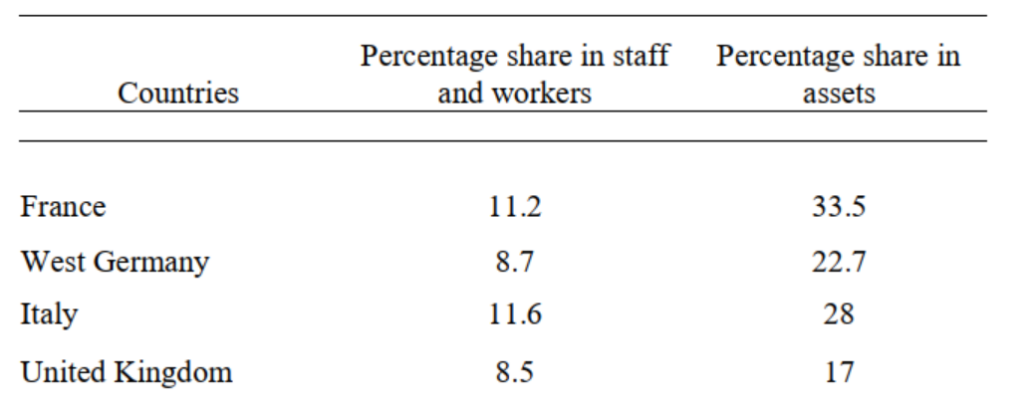
The rapid development of state monopoly capitalism is a prominent feature of contemporary imperialism. Since the Second World War, imperialist countries have implemented so-called “nationalization” by having the state purchase private enterprises; or the state has invested directly in so called “state enterprises.” These state monopoly capitalist enterprises constitute a very high proportion of capitalist enterprises. In 1968, the share of state monopoly capitalist enterprises in four major countries in Western Europe was as follows:
The development of United States state monopoly capitalism had its own characteristics. During the Second World War, the United States government established a large number of “state enterprises.” After the war, they were sold to the monopoly capital groups at very low prices. At the same time, the United States government adopted the “blood transfusion” technique of supporting the monopoly capital groups by means of taxes extracted from the people.
The services rendered by the imperialist countries to the monopoly bourgeoisie, in addition to “nationalization” and “state enterprises,” assumed the following forms, assuring the monopoly groups high monopoly profits: (l) Using federal treasury funds and the people’s taxes to subsidize the capitalists when they undertook the risks of investment; (2) redistributing a large part of the national income in favor of the monopoly capital organization through state legislation and budgets; (3) creating facilities conducive to the monopoly capitalist’s concentration and accumulation of capital and to his absorption of medium and small enterprises; and (4) though the means by which the imperialist countries serve their monopoly bourgeoisie are different, their objective is always the same, namely, the strengthening of the capitalist enslavement of the proletariat.
“The more of the productive forces which the bourgeois state takes into its possession, the more it becomes a truly total capitalist, and the more it exploits the people. The worker is still a hired laborer and a proletarian. The capitalist relation has not only not been eliminated; it has been elevated to its ultimate.” 13
Contrary to the claims of the bourgeois apologists and the modern revisionists, state monopoly capitalism does not have any “socialist element” which can exercise planned leadership over the national economy. On the contrary, state monopoly capitalism has not changed the capitalist nature of production relations a bit. It is merely a tool of the imperialist countries to serve the monopoly organization and strengthen the rule of the financial oligopoly. State monopoly capitalism strengthens the exploitation of the working class and the laboring people by monopoly capital, strengthens the plunder of the people of the colonies by monopoly capital, accelerates armament and war preparations, and intensifies competition and chaos so that the inherent contradiction in the capitalist society becomes more acute. It runs into increasing opposition from the proletariat and the broad laboring people and, at the same time, goes a step further in preparing the material conditions for the proletarian revolution.
Capital Export Leads to World Domination by Financial Capital
Capital Export Is an Indication of Relative Capital Surplus
“The characteristic of the old capitalism in which free competition was dominant is commodity export. The characteristic of the newest capitalism in which monopoly is dominant is capital export.” 14
Capital export exists in the pre-monopoly stage of capitalism; but it is widespread and significant only in the stage of monopoly capitalism. This is because the cruel exploitation of the domestic laboring people by the monopoly organization in the imperialist countries helps accumulate a large amount of capital. However, since almost all profitable business has already been monopolized inside the country and high monopoly profit cannot be guaranteed in other, less developed, domestic sectors, a large amount of accumulated capital thus becomes “surplus capital.” Where can profitable outlets be found for this “surplus capital”? In those developing countries where capital is scarce, wages are low, land and raw materials are cheap, and high profit can be obtained. Therefore, capital is exported for high monopoly profits through direct investment (mining, manufacturing, railroads, shops) and indirect investment (loans), greedily exploiting the broad laboring people of the developing countries. Capital export has developed rapidly only since the beginning of the twentieth century. In 1970, the total capital export from major capitalist countries reached more than 300 billion dollars, an increase of more than five times over that of 1914.
Capital Export Is an Imperialist Tool to Exploit and Oppress the People of Various Countries
In the search for monopoly profits and external expansion, capital export is an important tool used by the monopoly capitalist to exploit and plunder the people of various countries, especially the peoples of the developing Asian, African, and Latin American countries. Take old China as an example. On the eve of the Anti-Japanese War, foreign capital in China totaled 4.3 billion dollars. Near the end of the war, it increased to 9.8 billion dollars, of which, the share of investment by Japanese imperialism was the highest, amounting to 6 billion dollars. This foreign capital controlled 70 percent of China’s modern industry and transportation, 95 percent of the iron and steel and petroleum industries, 75 percent of the electric power and coal industry. More than half of the food processing industry was operated by foreign capital. In 1945, after imperialist Japan surrendered, United States imperialism replaced Japanese imperialism as the dominant power in China. In 1948, the American imperialist investment in China (including so-called “United States aid”) represented 80 percent of foreign investment in China. The invasion of foreign capitalism ‘
“Not only played a role in undermining China’s feudal economic basis, but also created certain objective conditions and possibilities for the development of capitalist production in China.” 15
However,
“The purpose of the imperialist powers in invading China was definitely not to transform feudal China into a capitalist China. Their purpose was just the opposite. They wanted to transform China into their semi-colony or colony.” 16
The influx of a large amount of foreign capital on a long-term basis seriously undermined the social productive forces of China and brought extreme poverty to the livelihood of the Chinese people, reducing China to a semicolonial and semifeudal status.
After the Second World War, there was a large increase of capital export from the capitalist countries, and the United States became the largest capital-exporting country. In 1914, the United States exported only 3.5 billion dollars of capital. In 1970, it rapidly rose to 155.5 billion dollars, an increase of more than forty-three times in fifty-six years. With the rapid increase in capital export, there were also large increases in the high monopoly profits of the monopoly capitalists. From 1950 to 1970, the profit from United States private direct investment in foreign countries amounted to 88.77 billion dollars, or 14 percent higher than the total United States private direct investment in foreign countries up to the end of 1970. Profit from investments made by imperialism in Asia, Africa, and Latin America was astonishingly high. For example, in 1970 United States direct investment in Asia, Africa, and Latin America accounted for 27.3 percent of her total foreign direct investment. In the same year, profit extracted from Asia, Africa, and Latin America accounted for 43.5 percent of the total profit from all foreign direct investment. At the present time, imperialism has become the greediest bloodsucker of the people over a large area of the world.
After the Second World War, in addition to further developing private capital export, the imperialist countries paid increasing attention to state capital export. The major form of this state capital export was foreign “aid.” From mid1945 to mid1971, the total amount of United States foreign aid reached 149.6 billion dollars. This foreign “aid” was classified into so-called “grants” and ’loans.” “Grants” were nominally free; but in fact, they were the strings by which the grantee countries were controlled. Chairman Mao long ago exposed the reactionary political objective of United States imperialist “aid”: “Gifts, yes; but with conditions. What conditions? You have to
follow my footsteps.” (16) In recent years, the proportion of loans from the imperialist countries is increasing, and the proportion of “grants” is correspondingly decreasing. These so-called loans all have interest rates exceeding 5 percent per annum. The highest rate reached 8 percent per annum. In addition, many political, economic, and military strings are attached. It is not only a bloodsucking straw but is also an important tool for the implementation of the aggressive and expansionary policies of imperialism and the fight for world hegemony.
Capital export from the imperialist countries inflicts severe hardships on the colonial and semicolonial countries and their people. However, the imperialists and revisionists try their best to defend these aggressive acts. They claim that capital export can “help” the economically underdeveloped countries to reach economic prosperity. The Soviet revisionist renegades even unabashedly suggested that imperialism could spend all the money saved through total disarmament to “help” the economically underdeveloped countries in Asia, Africa, and Latin America create a new era. All nations and people of the world who have been subject to exploitation and slavery have had their full share of the hardship brought about by the so-called “aid” of imperialism. The market is shrinking for such arguments of the Soviet revisionist renegades.
The International Monopoly Alliance Carved up the World Economically
The International Monopoly Alliance Is a Super-monopoly
The monopoly organizations of a country first carve up the domestic market. Under capitalism, the domestic market is closely related to the foreign market. With increasing capital export and the expansion of the international association and the sphere of influence of the largest monopoly alliance, a few large monopoly organizations of several countries can control most of the world’s production and distribution of some commodities. These large monopoly organizations are comparable in power and may, out of self120 interest and under certain conditions, make temporary international agreements and form alliances to set international monopoly prices, divide up sources of raw materials and distribution markets, limit production quotas, and thus form an international monopoly organization. These monopoly organizations have already exceeded the boundary of one country. Lenin called them “super-monopolies.”
These super-monopoly organizations appeared as early as the 1870s and developed rapidly in the twentieth century. After the Second World War, new international monopoly organizations were formed, and some old international monopoly organizations disintegrated. According to statistics, up to 1968 the total foreign capital assets (accounting value) of international monopoly companies amounted to 94 billion dollars. The annual production value of their foreign subsidiary companies was 240 billion dollars. The five largest international monopoly organizations were: the General Motors Company, the New Jersey Standard Oil Company, the Ford Motor Company, the British-Dutch Shell Oil Company, and the General Electric Company. As a result of the rapid development of international monopoly companies, the monopoly financial groups’ monopoly of world production and trade is strengthened. Some manufacturing fields in the capitalist world such as rubber tires, oil, tobacco, pharmaceuticals, and automobiles are almost completely controlled by international monopoly organizations. In recent years, there have been new developments in regional international monopoly alliances. The Common Market and the European Free Trade Area of Western Europe are, economically speaking, regional international monopoly alliances of sorts. Their development and expansion provide checks and balances to the vain attempts of the United States and the Soviet Union to divide up the world.
The Struggle among International Monopoly Alliances Is Intensifying
In the imperialist stage, the enormous development of monopoly organizations requires more supplies of resources and markets for commodities and more areas for capital investment. Take 1969 for instance: the proportion of raw materials which the United States imported from Asia, Africa, and Latin America was as follows: tin ore, close to 100 percent; manganese ore, 91.9 percent; copper ore, 78.2 percent; petroleum, 62.9 percent; chromium and others, 41.6 percent. The proportion of raw material imports by Japan, West Germany, and the United Kingdom from Asia, Africa, and Latin America was also high. The struggle for sources of raw material supply among international monopoly organizations, therefore, has become increasingly severe. To fight for oil in the Middle East, the monopoly capitalists of many countries tried very hard to get into this area, and consequently, the struggle was especially acute and complex.
The struggle among the monopoly organizations of various countries for markets to sell commodities is also very acute. After the Second World War, the United States dominated the capitalist world market for some time. Her total volume of exports accounted for one-third of the total capitalist world exports. But with the rising economic power of Western Europe and Japan, the United States hegemony began to decline. In 1971, her share of the capitalist world exports was reduced to only 14.2 percent. In Asia, Africa, and Latin America, the monopoly organizations of Western Europe, North America, and Australasia repeatedly engaged in intense struggle for markets. Faced with the influx of Japanese automobiles on the West Coast of the United States, Henry Ford II, the president of the Ford Motor Company, lamented: “This is only the beginning. These Japanese will soon invade the heart of America.” Lenin pointed out profoundly:
“The dismembering of the world among the capitalists is not due to their specific vicious character. Rather, it occurs because concentration has reached such a stage that they cannot but take this path to obtain profit.” 17
The international monopoly alliance is originally an international monopoly organization set up by the monopoly capitalists of various countries to divide up the world market for high monopoly profits. But agreements and alliances among the monopoly capitalists of various countries to divide up the world are at best temporary and relative. Their pursuit of high monopoly profits guarantees that the struggle among them will go on forever. Imperialism and revisionism hold that the internationalization of capital will bring the possibility of peace to nations. This wishful thinking has been sharply criticized by Lenin. Lenin pointed out:
“The form of struggle among international monopoly organizations may change frequently for various comparatively local and temporary reasons. But the nature of the struggle and the class content of the struggle will never change as long as classes exist.” 18
The history of the last half-century or so has fully confirmed Lenin’s scientific judgment.
Competition among the Imperialist Powers for the Division and Redivision of the World Colonies Are Important Conditions for the Existence of Imperialism
In the imperialist era, the economic division of the world by monopoly capital must inevitably be followed by the territorial division of the world into colonies. The implementation of the colonial policy and the seizure of colonies began in the stage of primitive accumulation. But only in the imperialist stage is the “climax” of struggle for colonies begun, and the struggle to divide the world’s territories among imperialist countries intensified. This is because:
First, colonies are the most important source of raw materials for imperialism. Monopoly leads to largescale production. The larger the scale of production, the more raw materials are needed, and the more important it is to control the sources of raw materials. Lenin pointed out,
“The more advanced capitalism is, the scarcer raw materials are, and the more acute the struggle for the world’s sources of raw materials becomes, the more intense the struggle to colonize is.” 19
Second, colonies are the most profitable outlets for the capital exports of imperialism. In colonies, the monopoly organizations of the suzerain can exploit and enslave the laboring people more ruthlessly. They can more easily eliminate competitors through monopolistic means and guarantee high monopoly profits for the exported capital.
Third, colonies are the most profitable sales market for the monopoly organizations. The suzerain can use protective tariffs to guarantee their monopolist position.
Fourth, colonies are also military strategic bases in the struggle for world hegemony among imperialist countries. The suzerain can establish a large number of military bases there, plunder large quantities of strategic materials, and recruit large numbers of soldiers to serve the military policies of imperialism.
In sum, colonies are important conditions for the existence of imperialism. “Only by occupying colonies can the triumph of the monopoly organization be fully secured.” 20 Therefore, the imperialist countries are always fighting for more colonies. After the 1870s, the struggle to divide the world’s territories among the imperialist powers reached an extremely acute degree. Up to 1914, the colonies occupied by England, Russia, France, Germany, the United States, and Japan reached 65 million square kilometers, and they ruled 523 million people. Among them, the area of the colonies owned by the czar of Russia was second only to that of England. At that time, out of Russia’s 22.8 million square kilometers, 17.4 million square kilometers were colonies. Lenin pointed out clearly,
“The czarist government expressed more vividly than other national governments the reactionary nature of war, plundering, and enslaving peoples.”21
Czarist Russia was the “prison of various nationals.” 22
China had long been fiercely carved up by the imperialist powers. From the latter part of the nineteenth century, the imperialist countries who invaded China marked out their respective spheres of influence according to their economic and military power in China and reduced her to a semi-colony. For example, the provinces in the middle and lower reaches of the Yangtze River were under British influence; Yunnan, Kwangtung, and Kwangsi provinces were under French influence. After the Russo-Japanese War in 1905, the southern part of northeast China was brought under Japanese influence. In the process of imperialism’s slaughter of China, czarist Russia was the first “to stretch out her grisly hands.” 23 The old czar invaded China ‘like a thief” 24 and occupied more than 1.5 million square kilometers of Chinese territory, equal to three times the area of France or twelve times that of Czechoslovakia.
The Division and Redivision of Colonies Inevitably Leads to Wars
To obtain high monopoly profits, imperialism must engage in aggression and expansion and fight for the division and redivision of world territories. The outcome of such competition is determined by the relative strength of the imperialist countries. The mightiest holds world hegemony. The highest form of resolving conflicts through strength is war. As long as imperialism exists, wars are inevitable. Imperialism fights for colonies and world hegemony and obtains high monopoly profits through wars. Lenin pointed out, “Modern wars are created by imperialism.” 25 The two world wars in the first half of the twentieth century were caused by the division and redivision of the world and the struggle for world hegemony among the imperialist powers.
Economic monopoly inevitably intensified the fundamental contradictions of imperialism and accentuated the political and economic crises of capitalism. To free themselves from political and economic crises, to reduce domestic class contradictions, and to save the capitalist system, the imperialist powers ran the risk of wars, engaging in moribund struggles. Chairman Mao pointed out, “The outbreak of imperialist world wars was an attempt by the imperialist countries to extricate themselves from new economic and political crises.”26
Once we understand the economic reality of imperialism, we will understand Lenin’s famous statement that “on the economic basis of private ownership of means of production, imperialist wars are inevitable.” 27 United States imperialism prospered through wars. In the two world wars, the United States monopoly organization engaged in largescale rearmament transactions and obtained windfall gains from wars. In the First World War, United States monopoly capitalists obtained 38 billion dollars as windfall profit; in the Second World War, they obtained 117 billion dollars as windfall profit and became the dominant power in the capitalist world. From then on, the United States monopoly bourgeoisie looked all the more to wars as shortcuts to prosperity and continuously waged aggressive wars. According to statistics, in the aggressive war in Korea, United States monopoly capital obtained 115.4 billion dollars as a windfall profit; in the aggressive war in Vietnam, in 1964 and 1965 alone, the windfall profit amounted to 76 billion dollars. Every dollar in the pocket of the United States millionaires is stained with the blood of the laboring people. As long as imperialism exists, the source of 124 modern wars exists. To eliminate wars, we must eliminate the imperialist system.
However, the imperialist and revisionist always fabricate all sorts of nonsense to deceive the people in order to protect the imperialist system. A typical absurdity is found in On Super-imperialism, a work which the chief of the Second International, Kautsky, fabricated on the eve of the First World War. Purposely overlooking the fact that the external expansion and aggression of imperialism are determined by the substance of monopoly capitalism, he vigorously contended that those were the imperialists’ conscious policies. Hence, he alleged: “These policies of neo-super-imperialism would replace international financial struggles with international cooperation to exploit the world.” As a result, a permanent peace would emerge. Pointedly exposing this fallacy, Lenin asserted:
“Kautsky’s On Super-imperialism is aimed at creating an illusion that permanent peace could be achieved under capitalism. It is an extremely reactionary idea attempting to dupe the masses; it is a means to detract people’s attention from contemporary acute contradictions and outstanding problems to an illusory future of the so-called ‘neo-super-imperialism.” 28
Since the fabrication of Kautsky’s On Super-imperialism , all revisionists have treated it as a most valuable treasure. They repeatedly propagated this “theory” under different guises and conditions. Modern Soviet Russian revisionists headed by Brezhnev described certain relative, temporary agreements between the two contemporary superpowers as so-called “structures for permanent peace,” vainly attempting to conceal the deep-seated contradictions between them and to deceive the people and tranquilize the opposite side in order to facilitate their own imperialist expansion. Within imperialism, there is both competition and collusion. Collusion is for the purpose of larger competition. Competition is absolute and long-term, and collusion is relative and temporary. Temporary agreements today set the stage for larger competition tomorrow.
Monopoly is the most deep-seated economic basis of imperialism. It determines the aggressive and plundering nature of imperialism and will not change. Just as Chairman Mao pointed out: ‘When we say that ‘imperialism is very dangerous,’ we mean that its nature cannot change. Imperialist elements will never put down their weapons or transform themselves into Buddhas until their extinction.” 29
Major Study References
Lenin, Imperialism, the Highest Stage of Capitalism, chaps. 16.
Chairman Mao, “On New Democracy.”
Chairman Mao, “Cast Away Illusions and Prepare for Struggle.”
Review Problems
- What are the basic characteristics of imperialism? Why do we say monopoly is the most deep-seated economic basis of imperialism?
- Why do we say the nature of imperialism will never change? Criticize On Super-imperialism and its disguised versions.
29 Footnotes