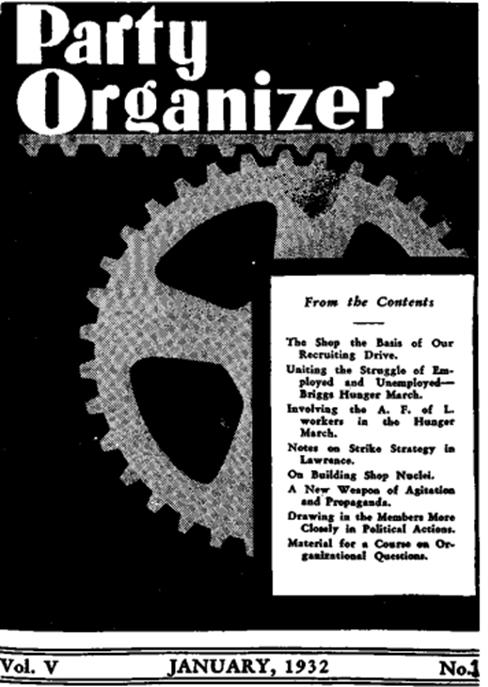
THE PARTY ORGANIZER VOL 1 APRIL 1927 ISSUE NO.1 – Workers (Communist) Party
VOL 1 APRIL 1927 ISSUE NO.1
WHY THE RUTHENBERG ENROLLMENT?
By Jay Lovestone, Acting Secretary, Workers (Communist) Party
MERELY to ask the question is to answer it. Outside of the Communist Party of the Soviet Union, our Party is the only one in the Comintern that has in recent years lost an outstanding figure of the active, virile central leadership. What this means to us can be seen with special clarity, when we examine the weakness of our forces, the slow. Painful and costly process of building up revolutionary proletarian leadership, and the tremendous difficulties under which the Communist Party is working in the United States.
Consequently, the Ruthenberg enrollment, the Ruthenberg Recruiting Drive, is not a campaign of bemoaning or mourning over our incalculable loss. At once the Ruthenberg Enrollment becomes that center, that unifying force of all our campaigns which serves to inspire and energize even our most inert and inactive members to greater efforts in every field of our work.
For revolutionary, for proletarian leadership there are needed three outstanding qualifications.
These are:
- Revolutionary inspiration.
- Intelligence.
- Industry.
Comrade Ruthenberg represents a rare combination of these three basic prerequisites for proletarian revolutionary leadership in abounding proportions. Obviously, the why and wherefore of the Ruthenberg Enrollment is to be found in the need for the Party’s bending every effort to make up the immeasurable loss of our leader.
If we take stock of the conditions of our Party, we find its many weaknesses only aggravated now. We, as Communists, must then set ourselves to the task of removing our shortcomings, of strengthening, of improving every phase of our Party life and efforts.
The death of Comrade Ruthenberg only serves as a terribly costly yet powerful reminder of the need for our fighting on, for our building the Party. In the Ruthenberg Enrollment all campaigns can merge. Making our existing shop and street nuclei better living political units, getting new members, fighting to save the unions as weapons of working-class struggle, the fight for a labor party, struggling against imperialism—all of these and many others of our activities converge towards the Ruthenberg Enrollment as the pivotal point of inspiration and energy.
Through the Ruthenberg Enrollment the Party membership must fortify itself in every way so as to improve our political and organizational fighting capacities. From Comrade Ruthenberg’s revolutionary inspiration we must draw courage and inspiration for greater powers of resistance and attack in all our work. From the keen intelligence of our dead leader, as evidenced by the concrete contributions he has made towards the Party’s development, we must strive to learn the need for raising substantially the theoretical level, the Marxian, the Leninist level of our Party forces.
And from the unbounded industry of Comrade Ruthenberg, as shown by his dynamic role in all of our campaigns, we must learn the need for redoubling our efforts, for bestirring ourselves to become more intense Party activity than ever before. All of our moves, all of our steps in the Ruthenberg drive are to be based solely on the magnificent role and inspiring, splendid achievements of Comrade Ruthenberg towards the advancement of the interests of our class, towards the building of our Workers (Communist) Party. Yes-let every member bring in a new member. Let us build the Party. Let all of us become more energetic, more effective, more devoted Communist fighters. This is the only road open to us by way of which we can hope to make up for our irreparable loss in the death of Comrade Ruthenberg.
RESOLUTION ON THE RESULTS OF THE REORGANIZATION OF THE WORKERS (COMMUNIST) PARTY OF AMERICA.
Adopted by the Organization Department of the Communist International
I. SUCCESSES IN REORGANIZATION
AT the Seventh Plenum of the Comintern, the Organization Department of the Communist International made a thorough investigation of the results and status of the reorganization of the Workers (Communist) Party. The American Delegation to this Plenum worked closely with the Organization Department of the Communist International in the investigation of our reorganization problems. The resolution herewith presented represents the findings and recommendations of the Communist International.
- In view of the report on the reorganization of the Workers (Communist) Party of America and the results hitherto achieved, the Organization Department of the Executive Committee of the Communist International declares that, through the reorganization of the Party on the basis of factory and street nuclei, the necessary organizational premise for a real Communist Party has been created. In spite of language difficulties, better collaboration already exists between the English speaking and the foreign-born workers, and considerable progress has been made with respect to welding together the Party (which consisted of 19 separate federations, each of which constituted so to speak, a party of its own.) into a united, centralized Party of the American proletariat. Despite the great difficulties which were even greater in the United States than in other countries and despite the talk of the “impossibility of reorganization in America (Lore),” and the pessimistic attitude of some comrades within the Party, who in the face of the difficulties and of some mistakes and shortcomings in the process of reorganization, clamored for the “reorganization of the reorganization.” the reorganization had been a great achievement for the Party. It is proven that reorganization is possible even under the most difficult conditions.
- Through reorganization on a factory nucleus basis, the actual composition of the Party has been improved and the nature of the Party work has been changed. While formerly the work, particularly in the language federations, was more social and of the nature of entertainments, and the entire Party life was carried on separately in the individual federations, now it may be said that a beginning has been made, with the transference of the work into the factories, and that this work has already had initial successes (election success at the committee elections to the Company Union, successful strikes conducted by the nuclei in several big enterprises of the motor-car industry, the textile workers’ Passaic strike, etc.)
- The activity of the Party membership is growing, as shown by the much better attendance at factory and street nucleus meetings, and in the publication of factory newspapers.
- Through the publication of 40 regularly appearing factory papers (mostly in the key industries) with a circulation of 80,000 copies, a great step forward has been made towards the permeation of the masses and toward the increased influence of the Party over them.
| At the seventh Plenum of the Comintern the Organization Deportment of the Communist International made a through investigation of the results and status of the reorganization of the Workers (Communist) Party. The American Delegation to this Plenum worked closely with the Organization Department of the Communist International in the investigation of our reorganization problems. The resolution herewith presented represents the findings and recommendations of this Communist International |
II. SHORTCOMINGS OF REORGANIZATION.
- In comparison with the number of street nuclei, the number of fac tory nuclei is still rather small in many districts. In some places most of the factory nuclei are still small and have in some cases but three or four members; most of these nuclei being in small or medium-sized enterprises. The reason for this is that the Party is, so far, strongest in the cities where small or medium enterprises predominate, while industrial centers, where the heavy industries and big enterprises are concentrated, have hitherto been neglected. The fact that so many members are isolated in small or medium enterprises is a great obstacle in the way of further development.
As street nuclei are more numerous and as their average strength is greater than that of factory nuclei, there is the danger of the street nuclei swamping the factory nuclei. There are furthermore a few places where part of the membership is still organized in the old residential groups.
- The political life of the nuclei is still weak. They have not yet become real fundamental units of the Party, capable of taking up a definite attitude on all Party questions. There are still but a few nuclei which have proper executives. This is partly due to language difficulties and partly to lack of suitable and well-trained revolutionaries.
- Through the reorganization many members, some of them very good proletarian elements, have been lost. This loss of membership has not yet been made good by the recruiting of new members.
- Work in the mass organizations of foreign-born workers, particularly the work of fractions in these organizations, is still inadequate.
- In connection with the publication of factory newspapers in enterprises employing mostly foreign-born workers, the fact that they do know English well was not sufficiently taken into consideration, i.e. no provision was made for columns in the language of these workers.
III. THE IMMEDIATE ORGANIZATIONAL TASKS OF THE PARTY
The continuance and completion of reorganization must be combined in all the districts with the campaign to increase the membership. For this purpose, the Party should concentrate on the centers of heavy industry where the mass of the industrial proletariat is to be found. In this connection more attention should be paid to work among the Negroes who are very numerous in heavy industry and who constitute good proletarian elements. This work requires the sending of suitable comrades into these districts and into big enterprises where factory nuclei should be formed.
In view of repressions on the part of the police and employers, the factory nuclei should function secretly, so that the leading cadres of the nuclei remain unknown to the police and the employers. However, these precautions must not weaken the contact of the nuclei with the masses of workers in the enterprise. For this purpose, in particular, the work of the factory nuclei should be strengthened in every way, and all its members, as well as sympathizers and non-Party workers, should be drawn in the work of the nuclei.
The most important task of the Party is the consolidation of the already existing factory nuclei and their politicization through the establishment of real nuclei executives capable of carrying out the necessary work.
It is necessary to call attention to the fact that factory nuclei restrict themselves, in a great many of instances, to the discussion of questions appertaining to factory life only. They must participate in the discussion of all important questions concerning the general political situation and general Party problems. As the nuclei meetings can only be short for many reasons and sometimes only deal with the most urgent questions and cannot always discuss thoroughly important political questions, general membership meetings on a city-section and sub-section basis must be called systematically so that the members can, according to the principles of inner Party Democracy, take a position on all these questions and express their opinion on them. For this purpose, efforts should be made to train more functionaries through the organization of courses for functionaries.
The Central Executive Committee of the Party must pay special attention to the very important problem of producing a cadre of capable Party workers. Chief attention must be concentrated on the preparation of nuclei and fraction secretaries and active workers in the districts, sections and sub-sections. The fundamental task, in preparing cadres of active workers, must be the preparation of leaders from the ranks of the workers and from lower organizations; then, again such comrades should be provided with systematic direction and assistance on the part of the competent Party committees.
The proletarian elements who were lost to the Party during the reorganization must be brought back into the ranks of the Party at all costs. In addition to this, the Party must double or even treble its activity with respect to recruiting membership in general. Systematic and persistent recruiting activity must be engaged in, in order to win new members for the Party. Simultaneously with the recruiting work, every effort should be made to retain the new members in the Party. This should be carried out by means of organizing short-term Party courses; supplying the comrades with suitable popular literature, and also by drawing the new members into the everyday work of the nuclei and the local organizations, and through these into the general Party work. The party must do all in its power systematically to bring forward into active Party work, American proletarians. The work within the trade unions must be strengthened by increased recruiting work within the already existing unions and by strengthening and extending the fractions within the trade unions.
The organizational co-ordination of the work of comrades who are isolated in small and medium enterprises, must be carefully studied. In this connection the experiences resulting from the concentration groups should be fully utilized. In view of the fact that there are still many members in the street nuclei although they are working in factories, it is especially necessary to hasten the transfer of such members into the factory nuclei (thereby avoiding mistakes of solving this problem mechanically).
The district executives must be systematically instructed by the competent departments of the Central Executive Committee. Special attention should be paid to the development of the, as yet, weak district executives, as well as to the development of city, section, and sub-sections executives. All of them must be developed into real executive organs, capable of controlling and guiding the entire political and organizational work of the nuclei. There should be a proper distribution of work through the establishment of departments (above all, Organization, Trade Union, Agitprop, and Women’s Department). Corresponding departmentalization should be established in the factory nuclei. More district organization conferences should be organized. The Central Executive Committee must strengthen its work in the organizational and political instruction of the local organizations and also its control over the carrying out of the decisions of the Central Executive Committee.
In view of the ever-growing demands made on the Party and the necessity of giving support and guidance to the work of the lower organs, the question of strengthening the various departments of the Central Executive Committee should be seriously considered. Special emphasis should be placed on the regular and proper functioning of the various departments of the Central Executive Committee (Organization, Trade Unions, Agitprop, Negro, Women’s, Agrarian), the Organization Department of the Executive Committee of the Communist International considers the strengthening of the Organization Department to be of particular importance. This should be done by drawing into the department some capable comrades who might be used as instructors in the districts (see directions on the structure of the Organization and Trade Union Department of the II Organization Conference of the Executive Committee of the Communist International.)
As co-operatives form a favorable ground for Party activity, the advisability of creating co-operative departments in the Central Executive Committee and in the district, executives should be considered.
Increased attention must be given to the improvement of THE DAILY WORKER. The paper must be improved as regards to its contents and must be brought nearer to the workers through increased drawing in of the workers from the factories as collaborators (worker correspondents). The paper must also deal more with questions of Party life, i.e. with all sides of Party activity. It should not be overloaded daily with lengthy, formal material. The organizational questions (difficulties, achievements, shortcomings) should also be dealt with more than hitherto in the light of practical experiences. Especially important is to popularize the achievements attained in various big enterprises and to get the utmost value of them. The experiences gotten on this field are not only an encouragement for comrades in other enterprises in the United States itself, but are also of great practical value for the other sections of the Comintern. On the other hand, the shop nuclei must make all efforts to distribute THE DAILY WORKER in their shops, to win new subscribers and to organize collections among the workers in the shops and in the unions in order to better support financially the Party organ.
The Young Workers (Communist) League, which is backward with respect to its reorganization must receive special attention and support from the Party, particularly in the establishment of factory nuclei. In enterprises where Party nuclei already exist and where many young workers are employed, the Party must take initiative in establishing The Young Workers (Communist) League factory nuclei (by introduction of youth columns in factory newspapers, etc).
In the enterprises employing large numbers of women, the work of the Party must be adapted to this circumstance, i.e. all-Party organs must devote attention to this question.
It is also necessary to concentrate more attention on the work of language clubs. The clubs should be of a universal type, having lectures, theatre performances, cinemas, dancing, etc. Courses in the English language should be organized in such clubs. Wherever possible English should be the language spoken at the meetings. But this should not be a hard and fast rule. Where the majority is composed of comrades who cannot understand nor speak English, the meeting should decide in which language proceedings should go on. (This applies also to the shop papers, which should also cater for the foreign-born workers). Translations must be provided in order that all comrades who cannot understand the principal language spoken at the meetings can follow the proceedings and take an active part in the whole life of the Party. The lower Party committees, city, section and sub-section, must make every effort to assist the nuclei in this respect, by appointing comrades as translators, translating instructions into the respective languages, etc
THE FORD WORKER
By the Ford Shop Nucleus Organizer
SEVERAL arrests and attempted prosecutions have been part of the experience of the Ford shop nuclei of Detroit in issuing THE FORD WORKER, their official organ. In spite of this opposition of the Ford Motor Co., and the Highland Park and Fordson police and judges, the monthly sale at the factory gates reached at one time a total of 13,000. Our experience will be of benefit to other shop nuclei who are striving to issue their shop paper. The first obstacle that the nucleus was confronted with was the question of financing the paper in order that it could come out regularly each month. We held a raffle under the auspices of an educational club and raised $367.50. One hundred dollars of this money was donated to THE DAILY WORKER last May. The balance of the money was used in printing the paper for free distribution. Beginning with the fifth issue, in July, the paper has been sold at one cent a copy. The paper is more than paying for itself. There was a surplus of $100 for September. This was donated to THE DAILY WORKER. Twenty-five hundred copies of the first issue were distributed free at Highland Park plant and this total was increased at the rate of 1,000 copies until we reached 5,500, with the fourth issue. The reason that more papers weren’t distributed was that Ford secret service and the municipal police interfered with distribution. There is an ordinance forbidding free distribution in Highland Park and Fordson, especially in the case of literature pertaining to the education of the workers. May 1 three comrades were arrested for distributing and were fined $20 each. The case was appealed to the Wayne County Circuit Court and the decision was reversed. By refusing to submit to Ford dictatorship exercised through the municipal police, Ford Shop Nucleus No. 1 won an important victory.
In the free distribution we organized a distributing squad of comrades who did not work at Ford’s – women comrades for afternoon and men comrades for midnight distribution. We had to work undercover and fast. Toward the last the comrades distributed about five minutes and at most ten minutes and then dispersed. The police, together with Ford Motor Co, have made it so hard for us to distribute any papers that in the latter part of June we decided to get newsboys’ licenses. Comrade Sarah Victor, the Detroit DAILY WORKER agent, was arrested three times in one afternoon. The next morning Chief of Police Charles W. Seymour and the city attorney could not convince the judge that THE FORD WORKER was not a newspaper. When the judge dismissed the case, the chief told Comrade Victor that at the next session of the city council her newsboy license and the license of six others would be revoked. The council has met many times but has not yet taken action against this growing shop paper. In spite of this opposition, we have succeeded in reaching a mass of workers who not only buy the paper to read it themselves but who distribute it among their shopmates and contribute stories about shop conditions.
THE FORD WORKER gives us the opportunity to agitate or propagandize among our shopmates. When the paper comes out, we naturally ask our shopmates if they read the latest issue of THE FORD WORKER and if they liked it. In the conversation that follows we get suggestions, pointers or valuable criticism. Even boys in the trade school and women in the plant are interested in the paper. Through our activities with THE FORD WORKER, we are also convincing the comrades who have stayed out of the Party that the reorganization of the Party along the basis of shops, mills and mines is effective. Through our activities all comrades are taking more interest in the Party work.
PROBLEMS OF THE TRADE UNION FRACTIONS
By Jack Johnstone
TRADE union fractions, although not units of the Party, are very effective cells for the carrying on of Communist activity within the trade unions and for the building of a strong left wing. As our Party more and more develops mass leadership, the fractions will be found not only to be complementary to the Party, but a source of strength and a power through which we can develop the shop and street nuclei. In other words, not only must we organize our Party members in the unions into trade unions into trade union fractions, but all units of the Party must be familiar with the work of the fractions, and in many instances, directly take part in what is generally considered trade union tasks. For example: In a drive to organize the unorganized our Party may or may not take part in this work officially. If the campaign through the effective work of the left wing, is launched by the unions, the Party units can aid the campaign in their particular sections, taking advantage of the situation, through the distribution of literature, supplying of speakers, etc. And in order to be able to do this work effectively, the Party members not only should be active in the campaign, but the nuclei must be familiar with every phase of work. The need for mobilizing our Party forces for trade union work should be obvious to all members of the Party. However, the small percentage who belong to unions, and a still smaller percentage who are active therein, shows that we have still the task before us of convincing a fairly large number of the necessity of working within the reactionary trade unions. Why does the Communist International emphasize the importance of trade union work? Why is that the Communist International, in the letter to the party, said: “No worker in an industrial country like America, can be a real Communist unless he is an active labor unionist. Those who desire to remain in the Party must be real Communists.” Why is that the Central Executive Committee demands that every member of the Party who is eligible to join a union must do so and become active in trade union work? These questions must be answered in the ideological struggle with those comrades who still refuse to participate in trade union work of the Party.
There is something radically wrong with the comrade who stands back and applauds those comrades who in the trade unions are pushing their way forward as mass leaders such as Ben Gold, Welsbord, etc: who will gladly donate to such campaigns as now being conducted In the Miners’ Union: who agree with the proposition of amalgamation: is for a Labor Party based upon the trade unions; who accepts our main slogan of “Organize the Unorganized!” yet refuses to join a union and take part in trade union work. The task of getting our members to join a union is a big one. It cannot be done by a Central Executive Committee alone. The comrades remaining out of the trade unions must be shown that they are wrong. This means that an intensive ideological campaign must be carried on within every unit of the Party. In line with this campaign, every member who is a member of a trade union must be organized into a trade union fraction. Help to build a powerful left-wing fraction within the union.
Get connected up nationally and industrially, so that all progressive proposals can be pushed simultaneously upon as wide a basis as possible. In order to do this, the following measures are necessary:
- Every district, city, section, and sub-section must immediately elect a trade union committee.
- An industrial organizer must be elected in every nucleus.
- Trade union work must be placed on the agenda of every unit.
- Industrial organizers’ meetings should be held by sections or cities once each month, to discuss the trade union campaigns of the Party and to develop ways and means of pushing the work in their localities.
- A network of trade union fractions must be organized, which should Include every member of the Party who is a member of a trade union or eligible to join one.
- Wherever a fraction exists a (T. U. E. L.) left wing and a progressive group must be formed.
- Whenever fractions are organized, they should be connected up with the National Office through their secretary.
- The fractions should keep the city trade union committee informed of their work, the problems confronting them, and report the Party members not attending to fraction, left wing, or union meeting so that these matters can be taken up in the proper Party units.
These are only a few of the necessary things that must be done in order to carry out effectively the tasks of the Party. While there are specific trade union tasks, every external campaign of the Party must he carried into the trade unions. “Keep The DAILY WORKER” campaigns should be as much a trade union campaign as that to “Organize the Unorganized” is considered to be. It can be said without contradiction that until we have enlisted all available Party members into trade union activity, organized them into a network of trade union fractions, coordinated their efforts nationally and industrially, that the Party enters every campaign under the severest handicap, being compelled to operate with its minimum instead of its maximum strength. The internal Party slogan is “EVERY MEMBER OF THE PARTY AN ACTIVE MEMBER OF A TRADE UNION.” What is being done in your nucleus to realize this slogan?
NEW JERSEY ONE YEAR AFTER REORGANIZATION
By Jack Stachel
COMRADE STACHEL is head of the Organization Department of the New York District. He has had considerable experience in practical organization work and is well-acquainted with the most acute problems of our reorganization campaign. This article should prove of special interest to all Party members located in the smaller industrial centers near our biggest cities.
THE Sub-District of New Jersey recently held a very important conference. This conference was held about one year after the reorganization of the Party. The status of the Party there at the present as compared with the Party in that section before reorganization, is concrete evidence of the achievements of the Party due to reorganization.
Once Only Foreign Speaking Branches.
The Party in the New Jersey Sub-District prior to the reorganization consisted of a number language branches. Russian, Ukrainian, Lithuanian, Czecho-Slovak, German, Polish, Italian, etc. There were practically no English-speaking T branches although in some of the cities there were isolated comrades here and there that formed the nucleus of an English-speaking branch. The few English-speaking members were mostly student members of the Young Workers League. The Party therefore functioned among the foreign-born workers and had practically no contact with English-speaking workers.
No Trade Union Work in the Past.
Most of the comrades were outside of trade unions. In fact, it is more correct to state that very few of our members were in the trade unions. This was due to the reason that our comrades had been in isolation for so long a time that there were some of them even opposed to working in the unions. Also, due to the fact that our comrades thought that there were insurmountable obstacles in their way to join the unions. Finally, our comrades, the majority of whom worked in large factories, in industries where there were no unions, naturally found themselves outside of the unions.
| Comrade Stachel is head of the Organization Department of the New York District. He has had considerable experience in practical organization work and is well-acquainted with the most acute problems of our reorganization campaign. This article should prove of special interests to all Party members located in the smaller industrial centers near our biggest cities. |
Nature of Other Mass Work.
The mass work that was carried on in the various language fraternal organizations in most cases had no bearing on the life of the workers in this country. Outside of the immediate problems connected with such organizations of workers as benefit societies, the work in these organizations was limited to questions pertaining to the country from which the comrades came to the United States. In very few cases was the work in language organizations connected up with the problems of the foreign-born workers as workers in the American industries. Except for such issues as the protection of the foreign-born, there was no political work carried on by the Party.
Many Little Parties Then.
The comrades of the different language branches looked upon each one of their language branches as an isolated single Party with no definite connections with the District Committee or the Central Executive Committee. The comrades brought their dues from the District or National Language Federations; received their literature from them, the general directions for work and in many instances looked upon directions from the Central Executive Committee and the District Executive Committee as “outside” interference. The fact is prior to the reorganization there was no committee in New Jersey to look after the work there and the District Committee in New York could not directly give the necessary attention to the work in New Jersey. This contributed to this loose working attitude towards the Party committees on the part of the comrades in New Jersey.
At the Last Conference.
The reports from the different cities at the last conference showed a remarkable change of condition in the Party organization in New Jersey. To begin with instead of many little Parties the delegates all represented English-speaking or International Branches and Shop nuclei. During this period the comrades have learned to speak English and participate in the discussions, and general work of the Party. The reorganization compelled them to overcome the language difficulty. The delegates at this conference discussed the general problems of the labor movement, the problems of the workers in New Jersey, instead of, as in the past, merely their narrow language problems. The composition of the delegation showed that the Party had made some progress in winning over English-speaking and American elements.
Now in the Unions
A good beginning has been made in work in the trade unions. Many of the comrades have joined the union of their industry and are among the most active members of their union. Our comrades are also realizing the importance of the central labor bodies in the various cities and have already achieved considerable success. One of the greatest achievements of the Party in New Jersey in the past year has been the stimulation of the organization of the unorganized. This has been achieved through the shop nuclei organized and factory papers published. New Jersey is a fertile field for the organization of the unorganized, and the Party has a great task ahead of it. To this end it is necessary that a number of comrades who have gained experience working in the city of New York be sent to the larger factories in New Jersey to help carry on the work there. It was due to the fact that some “colonization” was carried on that the successes were achieved. The District Committee will continue this “colonization” and now has gained some valuable as to whom to send in, and what should be the relations of the local comrades and the “colonizers.”
The Local Labor Movement Discovered
Our comrades discovered the local labor movement. Not only have they gained influence in the unions but thanks to the new orientation they have turned their attention to the political problems of the city in which they live and work. Heretofore they lived only in their language colony. This manifested by the participation of our Party in such campaigns as the defense of Sacco and Vanzetti, the agitation for a labor party, exposure of corruption in local union administrations, defense of the Negro masses in the Catharet race riots, etc. Also, the mass meetings arranged by the Party have been more of a mass character and have attracted new and American elements.
Only a Beginning.
All this is a good beginning and but merely a scratching of the surface. What we need at the present time is more systematic work in the large factories, the trade unions and the local labor movement in general. One of the greatest difficulties we are faced with is the lack of trained comrades to carry on the work. This we are trying to overcome by inducing some of the active comrades to take courses in the Workers’ School, the organization of local study classes, and by sending in some able comrades to New Jersey. In this way we hope to raise the ideological level of the Party in New Jersey and equip it with the necessary knowledge and experience really to become the leader of the labor movement in New Jersey.
| BUILD THE COMMUNIST YOUTH SECTION “A League Unit Wherever There is a Party Unit” |
We Need More Members
By Sam Darcy
Systematic organizational work will build the League. It is our greatest need and also our great shortcoming. Of the nineteen hundred members who hold League cards and attend meetings of the units only about a thousand pay dues regularly. Increasing the membership would be a simple task if properly organized. This we must accomplish or we don’t grow. We have about six thousand readers of the Young Worker. Only one-third of these are League members. This is an immediate source and a rich one for recruiting. Our subscription list, exclusive for bundle orders, totals three thousand. Less than half of our members are subscribers. This means that about two thousands of these subscribers are not League members. Thousands more whose subscriptions have expired in the past years and with whom we have lost contact might have joined if properly approached. Let our comrades see possibilities in their districts by the following list of subscribers. (exclusive of bundle orders):
| District | Subscribers | Estimated Membership | Dues Payments |
| 1 | 190 | 150 | 50 |
| 2 | 608 | 400 | 152 |
| 3 | 233 | 125 | 102 |
| 4 | 12 | 25 | 12 |
| 5 | 296 | 70 | 3 |
| 6 | 121 | 75 | 27 |
| 7 | 139 | 75 | 53 |
| 8 | 434 | 200 | 73 |
| Twin Cities | 88 | 25 | 13 |
| Superior | 442 | 380 | 211 |
| 12 | 33 | 120 | 45 |
| 13 | 126 | 65 | 50 |
| Miscellaneous | 102 | 150 | 80 |
This does not include the many readers that we reach through the sale of bundle orders which average from one to three thousand per issue.
The contribution that our subscription list can make to the organizational growth of the League lies not only in the new members it can give but also in the new contacts in cities where we have no Leagues at present. We have a total of ninety-five cities where units are located. We have subscribers in four hundred cities and towns.