Why There Are No Socialist Countries Today? – Serve the People Wholeheartedly, Brazil
Return to Brazil
Why There Are No Socialist Countries Today? 1
By
Serve the People Wholeheartedly, Brazil:
2016
Unofficial translation.
Introduction: the bankruptcy of revisionism
Revisionism is the right-wing opportunism in a more advanced degree, which configures the bourgeoisie’s interests in the ranks of the proletariat, and it is because of its actuation that there are no socialist countries in the world today.
We affirm, with no fear, that there are no socialist countries today, and we will clarify the reason starting our investigation in the Great Debate in the International Communist Movement, that was a milestone for unmasking the modern revisionists. It’s important that we comprehend the historical significance, including by the POV of the class struggle, of this great struggle between proletariat and bourgeoisie within the Communist movement.
We know the proletarian ideology is an invincible science, but isn’t possible to convince everyone on the truths of our ideology, starting from the fact that the human doesn’t has individual thinking and isn’t omniscient, but on the contrary, is moved by interests – and these interests are class interests. There are those that will be sure, even in an honest form, about the “justness” of revisionism, believing that it is Marxism. In Brazil, Prestes was an example of honest subject, that wanted to hit, but due to his limited class conception, he was the leader of the revisionist rightist line in the PCB [Communist Party of Brazil] for a so long time, and contributed to what PCBrasileiro [Brazilian Communist Party] is today. If Prestes didn’t make his self-criticism – that exposed his honesty – probably he would be erased from the Brazilian Communist movement as a revisionist today. With these small words of introduction, we want to clarify that there isn’t a case of analyzing the individual x or y, if they were a running dog or an honest and limited subject, etc., but only of analyzing the interests of which classes they defended in the point they made some positions.
The Great Debate and centrism
In the 60s, a great struggle between Marxism and revisionism does a new quality leap for the International Communist Movement, demarcating once more a line between the real Marxist revolutionaries and the reactionary revisionists in the Communist movement’s history. This struggle was led by the Communist Party of China’s Central Committee – led by the revolutionary line of Chairman Mao – which sent a correspondence to the CPSU – then led by rightist revisionist line of the renegade Khrushchev – entitled “Proposition on the General Line of the International Communist Movement” in June 14, 1963, criticizing his revisionist thesis, namely the ‘Three Alls’ and the ‘Peaceful Twos’, as well of the latter’s incorrect approach to the Stalin’s issue.
Such theories and position on Comrade Stalin that the “Soviet” revisionists imposed to the International Communist Movement were clearly anti-Communist and counter-revolutionary, that aimed at destroy the dictatorship of the proletariat in the USSR, at tarnishing the image of Comrade Stalin as the greatest representative of the proletarian line in the CPSU and at imposing a rightist, degenerated line, which prevented the advancement of the World Proletarian Revolution, to the Communist Parties in the whole world.
The historical importance of this struggle resembles so many other struggles between Marxism and revisionism in the history of the Communist movement. It was as important as the struggle waged by Marx and Engels against the Proudhonites and Bakuninites in the I International (a struggle which imposed Marxism as the universal ideology of the proletariat and unmasked anarchism as the deviation of the petty-bourgeoisie); or as to the struggle waged by comrade Lenin at the beginning of the century against the revisionist renegades of the II International commanded by Bernstein and Kautsky; or even as to the struggle waged by comrade Stalin’s revolutionary line against Trotsky and his followers in the 20s-30s.
All these mentioned struggles had in common, as well as the Great Debate, the function of sweeping from the workers’ and Communist movement the bodies alien to the proletarian class, the function of depurating the ranks of the International Communist Movement by demarcating a clear line where on one side are put the proletarian Communists and on the other side, the revisionists and elements of the bourgeoisie, in a situation where there is no middle ground or conciliation – and to do so is to take the side of the bourgeoisie and of revisionism. Finally, all the great struggles between Marxists and revisionists were (and always will be) reflections of the class struggle in the International Communist Movement, and their outcome was (and always will be) to unmask the revisionists as what they are: representatives of the bourgeoisie within the Communist and workers’ movement.
Thus, when the Great Debate explodes and the “Soviet” leaders commanded by Khrushchev and Brezhnev are exposed as revisionists and servants of the bourgeoisie and restorers of capitalism in the Soviet Union, a depuration in the International Communist Movement, or, in general, a “split” occurs. On one side were the revolutionaries and on the other the right-wing elements; there were also the centrists who, in the end, were pulled in by the right as a consequence of their ideological vacillation.
On the left, the Communist Party of China and the Party of Labor of Albania positioned themselves, influencing Communists from many countries to take the revolutionary position, like Communists from India, Brazil, Sri Lanka, Peru, Turkey, USA, etc.
To the right were placed all the swarm of revisionists directed by the “Soviet” masters of the revisionist CPSU, precisely, all the governments of the “socialist bloc” in Europe with the exception of Albania, which influenced the great majority of Communist Parties of the world to take the revisionist and counter-revolutionary position; in Brazil, its greatest expression was the PCBrasileiro, commanded by Prestes.
And finally, there were still the centrists that in a clear demonstration of ideological weakness and – also in some cases – economic dependence on the USSR, did not take a position in the Great Debate, but placed themselves in the middle, conciliating Marxism and revisionism, that is, conciliating class interests. In this camp the Communist Party of Vietnam and the Workers’ Party of Korea placed themselves.
Deepening the dictatorship of the proletariat: what happened after the Great Debate
It is important to note that from the Great Debate followed the most transcendental advance to the dictatorship of the proletariat and to socialism. Such an advance comprised the functioning of the class struggle in socialism. This concerns the Great Proletarian Cultural Revolution.
This is because Chairman Mao synthesized the experience of capitalist restoration in Yugoslavia and the USSR, thus developing scientific understanding of some facts. Namely:
- that the bourgeoisie subsists in socialist society by means of the culture, customs, values, etc. that correspond to the old society and the old relations of production, thus corrupting the most vacillating individuals (including those in positions of authority) and the hearts of the masses;
- that the socialist society under construction and consolidation continues to spontaneously engender bourgeois elements in society (developing the thesis of the great Lenin, who stated: “by misfortune, there still remains in the world a large amount of small production and this constantly engenders, day by day, hour by hour, capitalism and the bourgeoisie, by a spontaneous and massified process”), thanks to small production and small private commerce and the existence of “bourgeois law”, such as the difference between manual and intellectual labor, between countryside and city and between workers and peasants, in addition to the very existence of imperialist countries around the world; and that these spontaneously generated bourgeois elements constitute the new social base of the bourgeoisie, which will seek to resist and fight for the reconquest of power;
- that ideology is the center of the class struggle in socialism; and, finishing
- that the fact that a single factory is run by a vacillating individual, who does not constantly and fully apply the proletarian line of the Party, is already a political factor that constantly creates, generates and moves the new bourgeoisie and the restoration of capitalism.
Faced with these new understandings of the experience of the dictatorship of the proletariat, Chairman Mao understood that the latter cannot stagnate, cannot slow down, that the policy and ideology of the proletariat must direct everything – including and especially in the development of the productive forces – that the masses must oversee everyone, and thus he develops the practice of the Great Proletarian Cultural Revolution (GPCR) as a means of conjuring up and warding off capitalist restoration.
We will briefly summarize the lessons that the GPCR has brought us:
- the proletariat must direct everything – the ideology of the proletariat must be applied to everything, without exception, occupying all spaces, including in the cultural-ideological field – and the masses must supervise everything and everyone – this includes supervising the technicians and contributing to the direction of production, soldiers supervising the officers and building a dictatorship of the proletariat where the masses, in short, direct everything;
- considering that small production, the existence of imperialism, the old culture and “bourgeois law”, and the Three Great Differences (between manual and intellectual labor, peasant and worker, and countryside and city) are objective conditions that spontaneously generate the restoration of capitalism and counter-revolution, then all must be suppressed as much as possible, and in order to counter-balance this constant counter-revolution, it is necessary to have successive and continuous mass movements to oust the revisionists and opportunists – who are the product of this counter-revolution – and to go on depurating society (these mass movements are precisely the Great Proletarian Cultural Revolution); it must be made clear that as long as we do not enter Communism, there will still be bourgeoisie and a fierce class struggle, as insane, violent and stormy as the one we know in capitalist society;
- the Army is a state body and, for example, in China it was used by the revolutionaries to help the masses to oust the bureaucrats and revisionists and to depurate society with a new dominant culture and ideology; however, after 1976 it also served as a weapon of the revisionists to arrest, murder and liquidate the Maoists during the military coup d’état. This made it evident that the Army must be surrounded by – as Marx told us – a sea of armed masses that will be ready to surround the revisionist enemy in case it takes over the State and starts, by means of People’s War, the counter-restoration of socialism;
The Great Proletarian Cultural Revolution, as a product of the Great Debate of the 60s, became a watershed, and its teachings, a true reflecting mirror for revisionists. It is necessary to understand all socialist experiences by taking into account the most advanced experience of the dictatorship of the proletariat that was the Cultural Revolution. That is what we will do.
The consequence of centrism in the Great Debate
It is obvious to everyone who knows history that the USSR-Russia and the whole European “socialist bloc” collapsed and are not, today, socialist; however, the polemic about the existence or not of socialist countries has its core around Vietnam and – mainly – North Korea, which were countries that took centrist positions in the Great Debate and, apparently (only apparently), did not succumb to the “earthquake” of the 1960-1991 counter-revolution.
Let’s clarify the issue about the two countries.
Counter-revolution in Vietnam
During the Great Debate, the Communist Party of Vietnam, still led by Ho Chi Minh, put itself forward to – astonishingly – “deplore” the discussion between the Parties; in Ho Chi Minh’s so-called “political testament”, occasion in which centrism and ideological weakness were made explicit, he says:
I feel very saddened by the present disunity among the brother parties. I hope that our Party will continue to strive to contribute effectively to the restoration of unity among the sister parties, basing itself on Marxism-Leninism and proletarian internationalism, in accordance with logic and reason.
He called the Party not to unmask the revisionists and follow the proletarian line, the class line that would lead to Communism, but called the Party to mediate, conciliate, appease the class struggle in the International Communist Movement under the pretext of “struggle against disunity”. Ho Chi Minh failed to understand that this was not a disunity among Communists, among Marxist-Leninists, but a class rupture, where the representatives of the proletariat must unmask and kick away the representatives of the bourgeoisie.
The result of Ho Chi Minh’s misunderstanding was the complete degeneration of the Party, which was no longer representative of the proletariat. Since in the class struggle there is no empty space, then where the proletariat does not occupy, the bourgeoisie must occupy, and thus the Vietnamese State and the Communist Party there became a den of revisionism where the bourgeoisie set up a veritable headquarters against the proletariat, putting Vietnam completely aligned with “Soviet” social-imperialism. To complete its role as a mere pawn of social-imperialism and its complete degeneration, Vietnam’s revisionist clique even invaded Democratic Kampuchea in 1975, in a war of rapine coordinated by “Soviet” social-imperialism.
Currently, Vietnamese revisionists have been promoting a total submission to foreign capital supported by revisionist theories on the backwardness of the “productive forces”, claiming that economic backwardness precludes socialism; thus, they have promoted the restoration of capitalism and the opening to foreign capital “aiming at industrialization”, from which a bureaucratic bourgeoisie has ascended. The latter is the ruling class in Vietnam.
Counter-revolution in North Korea
During the Great Debate, Kim Il Sung put himself to mediate between “Soviet” revisionism and the proletarian line of the CPC and the PLA. In the same line of reasoning as the centrist Ho Chi Minh, Kim Il Sung and his Party considered the Great Debate as a “silly and petty disagreement” between brother Parties. He refused to take a stand and maintained relations of all kinds with both China and the “Soviets” (with the Soviets, relations were maintained until the last day of the USSR and continued close after its fall). With the latter, even, “loans” and all kinds of investment were added. The bribery of Russian social-imperialists and North Korea’s dependence on the bureaucratic capital of social-imperialist USSR and its “military help” made Korea completely hostage.
I. North Korean economy
North Korea even accumulated, by the end of USSR, US$ 10.96 billion in debts with Russian social-imperialism. A lot of this money, of course, acquired from the financial bribes of social-fascist Brezhnev and his policy of subjugation of the countries located under his area of influence. With his theory of the “International Division of Labor”, Brezhnev and the social-imperialist USSR perpetuated in the countries newly liberated by revolutions colonial-type relations for the benefit of the Russian bureaucratic bourgeoisie.
On the most recent economic level, since 1990 there has been a series of economic reforms being practiced in North Korea, aggravated by natural disasters and the disintegration of the USSR (which culminated in the withdrawal of “aid” – read bribery). Since then, the North Koreans have been seeking normalization of relations with South Korea and the United States, an endeavor that has since experienced ups and downs depending on the shift managers.
In this process, the North Koreans even signed a Non-Proliferation Treaty in 1994 that aimed at destroying two North Korean nuclear plants and replacing them with two new plants built by South Korea and Japan, as well as allowing inspectors linked to Yankee imperialism to spy on their nuclear facilities – thus preventing the production of plutonium for nuclear weapons. Even the recent H-bomb experiment is nothing more than a momentary resumption of the “nuclear diplomacy” that Korea adopts when relations with the South are thickened, which does not mean a “break” with the attitude taken in 1994.
In 2002, they went further, and under the pretext of improving the economy, they launched the so-called “Improvement of Economic Management” plan, which was, in fact, opening to foreign capital in certain areas called “Special Economic Zones” – just like in China today – and reforms in wages and the cost of living. Wages went down and subsidies for foodstuffs ended, and peasants were encouraged to sell their surplus production in the so-called Farmer’s Markets (similar to the Brazilian fairs).
From 2010 on, there was a further relaxation of the North Korean State’s control over the economy and a greater dialogue with the imperialists. This act turned into a bargain, where the European Commission returned to provide food aid to the country. In this period, even, there was a greater support of Chinese imperialism towards Korea in order to assure its influence in that region, the latter having first invested in “bilateral cooperation” (read “unilateral benefit” to China). In return, Korea promoted more openness towards Chinese capital and considerably expanded trade between both.
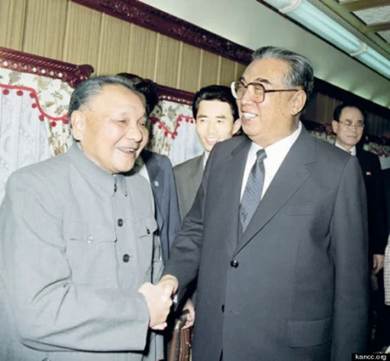
Kim Il Sung and the bastard Deng Xiaoping.
In 2011, Kim Jong-Il, the then leader of Korea, went to China and visited the most developed industrial zones (in the east of the country) to “study Chinese economic reform and apply it in Korea”. After that and as a result of the events of the previous year, China started to invest heavily in infrastructure in Korea. Even casinos and gambling, products of the degeneration of capitalism, are being practiced in the “better Korea”, aiming to stimulate tourism – already very frequent.
Thus, it is evident that since 1990 there is a decentralization of the economy, opening itself completely to foreign capital – mainly Chinese – and becoming economically, politically and militarily dependent on the latter, being under its area of influence (of Sino-Russian imperialism). However, the presence of foreign capital was already present even before the end of the USSR and the economic reforms, through Russian social-imperialism, which when it became Russia again did not cease to enjoy its share of the spoils.
II. The Juche Idea and the Songun Doctrine
North Korean centrism during the Great Debate was accompanied by the elaboration of a so-called “Juche Idea” (which means ‘self-confidence’ [in Korean]) in 1964, which already came accompanied with the germ of capitulation. Initially presented as a creative application of Marxism-Leninism to Korea’s reality, it came to be transformed into a completely “new” and “original” ideology which reneged on dialectical historical materialism. It is important to note that the Juche Idea also did not consider any of the learnings from the experience of the GPCR in China that we cited earlier, and made the same mistakes.
From here on, we will follow an evolution of the ideological degeneration of the Workers’ Party of Korea.
First, concerning dialectical materialism and the Juche Idea, there is the negation of the first and the affirmation of the second as being original and new, and not an “application of dialectical materialism in Korea” as some try to spread. As stated by Kim Il Sung, 2 the founder of the Juche Idea:
It is not the objective conditions, but man who plays a decisive role in the development of history. (…) Animals are part of nature and their fate is determined by the natural laws of change and development, whereas man is not a being who obeys the natural laws of change and development. (…) Unlike all living matter, which is subordinate to the objective world, man dominates and transforms the world according to his will and desire. 3
His son and heir, Kim Jong Il, follows:
Juche philosophy is an original doctrine that is developed and systematized in its own principles. Its historical merit in the progress of philosophical ideas is not in having developed Marxist materialistic dialectics, but in having defined new philosophical principles centered on man.
From the outset, too, society changes and develops not by the action of man but according to certain laws. However, the action of laws in society differs essentially from the case of nature. In these laws they act spontaneously, independently of man’s activities, but in society they act through the independent, creative, conscious activities of man. Among the social laws there are both general ones valid for all societies, regardless of their regimes, and those that are exercised only in certain social regime. Since all social laws are actuated by man’s activities, this action can be clearly realized, slowed down, or restricted according to man’s actions.
The main limitation of the materialist conception of history is that it has not clearly clarified the laws proper to social movement but has developed its principles principally according to his community and the evolution of nature, which are equally material. 4
This is nothing more than the same old bourgeois idealism that centers reality on man’s ideas and consciousness, treating him as the all-powerful, old bourgeois humanism, and worse, upholding man’s independence from nature; this is pure revisionism, a denial of Marxist philosophy.

Kim Il Sung and the Romanian revisionist Nicolae Ceausescu.
In a second moment, to follow, we will clearly see a leaning towards the “productive forces” theory in another guise, where developing the productive forces, as well as “revolutionizing, proletarianizing, and intellectualizing all members of society”, are the main goals and means to achieve Communism. Kim Il Sung affirmed:
In essence, the technical revolution consists in eliminating the fundamental differences between the various categories of labor and rescuing workers from burdensome tasks. The technical revolution is not a technical-professional enterprise just to develop technique and the productive forces in order to increase the production of material wealth; it is an important political work to further liberate the obstacles of nature already freed from exploitation and oppression and thus ensure complete equality in social life as well as an independent and creative life. Only by giving strong impetus to the technical revolution can the party of the working class eliminate the fundamental differences in labor, free the workers from arduous tasks, and successfully build the necessary material protection up to Communism.
We must unfailingly raise the productive forces at least to the level the developed capitalist countries, steadily and firmly consolidating the material foundations of socialism and completely eliminate the difference between the working class and the peasants. For this we must mechanize the agricultural tasks, carry out fertilization and irrigation, and implement the eight-hour per day, by means of the technical revolution to the degree to which the developed capitalist countries have carried out the capitalist transformation in the countryside.
The problem with this inclination to be more concerned with the productive forces than with the class struggle is that it makes room for advocating the further development of the productive forces as the only condition for achieving “independence” and “socialism”, even opening itself up to foreign capital (as a way to “promote the development of the means of production”, as occurred in Vietnam). This secondarizes the class struggle and prioritizes the productive forces when, in contrast, the ideology of the proletariat teaches that the class struggle is always the center of the question.
Third, finally, from the denial of dialectical materialism, there was a leap of quality in revisionism that went on to also deny Marxism in its complete entirety, reneging on it. Kim Jong Il stated:
Marxism represented the time when the working class had emerged on the historical arena and was waging a struggle against capital. But times changed and history developed, so Marxism acquired inevitable historical limitations. 5
On the revisionist degeneration of the WPK, there still remains the Songun Doctrine, where there are a wide overestimation of the Army and no encirclement of the Army by the armed masses, neither to prevent an eventual “anti-Party coup” nor to allow the masses to safeguard the homeland from a military onslaught by Yankee imperialism.
The Songun Doctrine does not consider the proletariat as the vanguard of the Revolution, but the Army! That is precisely disregarding the leading character of the proletariat.
By applying the Songun Doctrine, our Party has defined as the main force of the revolution, not the working class, but the People’s Army, starting from a new criterion and a new concept on the matter and on the role that the revolutionary Army plays in the revolutionary and constructive process (…) This is the sublime mission of the People’s Army, its heavy but glorious revolutionary duty, which neither the working class nor any social collective can fulfill in its place. 6
And finally, Kim Jong Il explains why the Songun Doctrine replaces the Marxist method of defending the Revolution:
In the middle of the 19th century, the analysis of socio-class relations in Western capitalist countries led Karl Marx to elucidate that the working class is the most progressive and revolutionary class, that assumes the mission of ending the domination of capital and all kinds of exploitative regimes and establishes socialism and Communism, and defines it as the leading and strong class of the revolution (…) But the theory or formula expounded by Marx a century and a half ago cannot be adapted to today’s reality. Too much time has passed and enormous changes have taken place both in social circumstances and class relations, as well as in the situation of the working class.
The Songun Doctrine meant, roughly speaking, the withdrawal of the proletariat as the ruling class of the Revolution, as the only one capable of being the defender of the Revolution and the fatherland. It was a complete denial of the Communist method of defending the Revolution, which consists, as Marx stated and Chairman Mao summarized, of a sea of armed masses defending their interests in a death struggle with class enemies.
And why just why did the Army replace the proletariat in the role of “the main body for the defense of the revolution”? This was a reflection of the objective reality where a new bureaucratic bourgeoisie situated in the Army’s upper echelon started to run the North Korean State, and no longer the proletariat.
To conclude, let’s see what the top leader of the WPK, Kim Il Sung, affirms in what respects to Perestroika and to Titoite revisionism. First, about Perestroika:
This new change now taking place in the Soviet Union is unthinkable apart from the energetic activities of Comrade Gorbachev, a staunch Marxist-Leninist. 7
Finally, on Titoite revisionism:
Yugoslavia and Korea are the non-aligned and socialist countries.
This whole process represents the gradual and progressive break of the WPK with Marxism-Leninism and Communism, a process that started after taking the centrist position in the Great Debate.
In a summarized way, the Juche Idea was already constituted with the germ of capitulation, which would come to develop, while the Songun Doctrine was the announcement of a consolidated break with the proletariat. The Songun Doctrine is the fruit of an ideology (Juche) alien to Marxism-Leninism-Maoism (or even Marxism-Leninism), and the same people try to affirm that, it is not news to anyone who has done any research on it.
And, finally, if we know that ideology plays a central role in revolution, and the only ideology of the proletariat is Marxism with its untouchable historical dialectical materialism, then outside of that there is no socialism nor dictatorship of the proletariat, and the Juche ideology – as a “new and original ideology” which denies the principles of Marxism – is no exception.
III. Internal class struggle
Considering the ideological and economic question of Korea, applying the teachings of the world proletariat with the Great Proletarian Cultural Revolution, we can make a scientific analysis as only the ideology of the proletariat can provide us.
It is a fact that in revolutionary China in the 1960-70s, it was concluded that it is not enough that the property regime be State-owned, but that the proletariat must run the State. This is because if the ideology of the proletariat is not correctly applied, there is the risk – eminent and certain – of the new bourgeoisie emerging from within socialism restoring its mode of production through revisionism, even in the form of State property, rising as a new State bureaucratic bourgeoisie (this is what happened in the USSR in the 60s and with China in the 70s).
In North Korea, where small production and small trade, “bourgeois law” and the Three Great Differences (mainly between manual and intellectual labor) are not suppressed but, on the contrary, are encouraged, thus neglecting the teachings of the Cultural Revolution about class struggle in socialism and the constant engendering of counter-revolution; then it is clear to us that the same has occurred there as well. Already a state monopoly bureaucratic bourgeoisie has emerged from the top echelon of the army, tied to the social-imperialism – first Russian, and then Chinese – that runs the country.
This dependence on Sino-Russian imperialism contributes to the military and aggressor siege by Yankee imperialism, since it is a double contradiction: the main one between the Korean nation and the aggressor Yankee imperialism; and also, the dispute between Chinese imperialism – which exerts influence there – and Yankee imperialism. Thus, we must defend Korea from Yankee aggressions and provocations, as well as legitimize its right to self-defense against imperialist aggressions.
However, it is not a proletarian regime for the mentioned points, and therefore, it is not socialist. The relatively high level of “democracy” – when compared to a Western capitalist country – present in Korea does not mean socialism, but on the contrary, is an expression of corporatism and domestication of the masses. North Korea is run by a revisionist Party which is controlled by the Army’s Upper Echelon, where the new ruling bourgeoisie is present.
Conclusion
Some honest comrades defend the existence of socialist countries because they are trapped in a logic of bourgeoisie thinking. According to this logic, if today there is no socialist country it is because “socialism has failed” and would thus be “impossible”. Such comrades need to break with bourgeois logic by studying the ideology of the proletariat, namely Marxism-Leninism-Maoism, to understand the teachings of the great leaders of the proletariat, to break once and for all with the bourgeois way of seeing the world and adopt the proletarian conception, and conceive reality as it presents itself, and not as we wish it to be.
To break with this bourgeois logic, we have to understand that no class conquered Power in a short period of historical time without going through a fierce struggle with the old classes that had been overthrown for centuries. The feudal class took 250 years to overthrow and overcome all resistance from the slavers in ancient China; the bourgeoisie, in the West, took 300 years to completely impose itself against the feudal lords and their attempt to restore the old society; in all the processes mentioned there was a struggle between restoration by the reactionaries and counter-restoration by the revolutionaries, and with the proletariat it is and will be no different. We have on average 150 years of struggle and this is relatively little for the experiences we have acquired, so that our defeats, contrary to what the bourgeoisie and its metaphysical reasoning logic instigates, are temporary and eventual, because the victory is inevitably of the proletariat.
To prevent the restoration of capitalism we need successive cultural revolutions purifying the new socialist society and advancing and deepening the dictatorship of the proletariat, arming the class and surrounding the state apparatuses with armed masses, making them ready to intervene against revisionism and the new bourgeoisie.
If we want to reach Communism, we must understand reality and not fall into revisionist illusions. We must, for this, deviate from anarchism, Trotskyism, Titoism, Krushchevism and Brezhnevism, Hoxhaist dogmatist-revisionism, centrism, Juche revisionism and the more recent revisionisms of the “Avakian’s New Synthesis” of the RCP-USA and the “Prachanda Path” in Nepal. All lead to the final path of restoration and capitulation and not to Communism.
Further reading:
- The Workers’ Party of Korea Organizes and Guides All the Victories of Our People, 1990, in Kim Jong Il, On Enhancing the Party’s Leading Role, Pyongyang, 1992
- http://juche.v.wol.ne.jp/pdf/fkimilsung200803.pdf
- http://g1.globo.com/mundo/noticia/2011/12/kim-jong-il-fez-da-china-sua-2a-casa-nos-ultimos-2-anos-de-vida.html
- https://portalvermelhoaesquerda.wordpress.com/2015/01/06/problemas-referentes-ao-periodo-de-transicao-e-da-ditadura-do-proletariado-por-kim-il-sung/
- http://gazetarussa.com.br/economia/2014/03/03/russia_perdoa_90_de_divida_norte-coreana_da_epoca_da_urss_24443
- http://oaji.net/articles/2015/2137-1438027973.pdf
7 Footnotes