Correctly Handle the Relations among the State. the Collective, and the Individual
Return to Fundamentals of Political Economy
20. Correctly Handle the Relations among the State. the Collective, and the Individual
The Distribution and Redistribution of the Socialist National Income 1
Products produced in socialist society must generally go through exchange and distribution before they are consumed. The repeated and continuously renewing process of production, exchange, distribution, and consumption is a process of reproduction. The correct handling of the relations among the state, the collective, and the individual with respect to distribution and the correct distribution of the social product and national income play an important role in the smooth conduct of socialist reproduction.
The Socialist National Income Comes from the People and Is Spent on the People
The Socialist National Income Can Continuously Increase at a High Speed
Socialist reproduction has its own characteristics. These characteristics are actually simply the repeated occurrence of the characteristics of socialist production. The purpose of reproduction is to satisfy the ever-increasing needs of the socialist state and the people. It is not for the purpose of exploitation as in capitalism. Socialist reproduction is carried on in a planned and proportional way. It is not the blind competition of capitalism. Socialist reproduction is continuous expanded reproduction. It is not interrupted by cyclical economic crises as in capitalism. These characteristics of socialist reproduction are inevitably reflected in the creation and distribution of the socialist national income.
National income is the total social product produced by the laborers of the material production branches in a country at a given period of time (usually a year) minus the depreciation of the means of production. It is the wealth created by the laborer of the material production branches.
Because of the dual character of socialist production, the national income created by socialist production is manifested in products as well as in value. National income in the form of products cannot be calculated by simple addition because of the different variety of products. But since it has value, its total and rate of increase can be calculated at current prices or constant prices.
The main factors determining the creation and increase of national income are as follows: increases in social labor, increases in labor productivity, and savings in the social consumption of the means of production.
In general, other factors being equal, the higher the amount of labor engaged in social production, the higher the national income created, both in physical and in value terms. Under socialism, the purpose of production and reproduction is to satisfy the ever-increasing needs of the state and the people. The scale of reproduction increases year after year, and the national income can also sustain its growth. Under capitalism, the purpose of production and reproduction is exploitation. The expansion of reproduction is often interrupted by economic crises. Relative overproduction is aggravated, leading to mass unemployment which is a unique social problem in capitalism. This way, the increase in the capitalist national income will certainly be adversely affected.
Also, if the amount of labor is constant, then the faster the labor productivity in the production enterprise is increased, the faster the physical volume of national income, that is, national income computed at constant prices, will increase. In socialist society, the initiative and activism of the laboring people can be fully exercised. Advanced technology can be widely disseminated. The unfolding of mass technical innovation and technical revolution provides a broad vista for increasing labor productivity and national income. In capitalist society, the laboring people are oppressed and exploited. The initiative and activism of labor are suppressed. Advanced technology is used only if it results in more surplus value. Therefore, the increase in labor productivity and national income face tremendous obstacles.
Let us look at the third factor in determining national income. If the total social product is fixed, then the more the means of production are saved in the production process, the smaller the deduction from the total social product will be and the faster the growth of national income will be. In socialist society, the laboring people are the masters. They can be actively concerned with the saving, substitution, and comprehensive utilization of raw materials and the regular maintenance and full utilization of the means of production. The planned nature of socialist reproduction enables the means of production to be more fully and rationally utilized in the whole society. All these make it possible to save the means of production, reduce their consumption, and increase national income. In capitalist society, although the capitalist tries to save the means of production to reduce capital expenses, a large amount of waste results from competition and chaotic production. In addition, under-utilization of capacity in the enterprises frequently idles a large amount of equipment. All these are unfavorable to increasing national income.
Because the factors determining the creation and growth of national income are different under different social conditions, the national income of the socialist country can increase faster than the national income of the capitalist country in the long run.
The Distribution of National Income Complies with the Basic Interests of the Laboring People
How is national income to be distributed after it has been created? The distribution of national income is ultimately determined by the ownership pattern of the means of production. In socialist society, the means of production are publicly owned. The laboring people are the masters in production. Therefore, the distribution of national income must comply with the interests of the laboring people and satisfy the ever-increasing needs of the state and the laboring people in a planned manner.
National income is created by the laborer in the material production branches. It must first undergo an initial distribution in the material production branches. In enterprises under the socialist state ownership system, national income is divided into two parts after the initial distribution: One part is wages to be used by the laborer in state enterprises for personal consumption; the other part is net income to become the centralized net income of the state after it is surrendered to the state in the form of taxes and profits.
In enterprises under the collective ownership system, after a primary distribution, one part of the national income becomes labor compensation for commune members for personal consumption; the other part becomes the net income of the collective. The net income of enterprises under the collective ownership system, unlike state enterprises, is not surrendered wholly to the state. A part of it is surrendered to the state as taxes to become part of the centralized net income of the state. The other part is retained as a public accumulation fund and a public welfare fund to be used for expanded reproduction of collective enterprises and collective welfare.
After the initial distribution in the material production branches, the socialist national income becomes state income, income of collective enterprises, and income of individual laborers. It is an important matter of principle to correctly handle the relations between the state, the collective, and the individual with respect to distribution. Chairman Mao teaches us:
“In distribution, we must consider the interests of the state, the collective, and the individual. The relations among state taxes, accumulation by the cooperative, and individual income of the peasant must be appropriately handled, and the contradictions among them must be regulated regularly.” 2
This instruction of Chairman Mao referred to the collective economy. But this principle also applies to the distribution of the whole national income.
After the initial distribution, a part of the national income must be reinvested (or plowed back into the economy), thus creating income again. 3 Why must national income be redistributed? This is because in socialist society, in addition to the material production branches, there are also cultural, educational, and health branches, some service industries, the armed forces, and state administration organs. These non-material production branches do not create national income, but they are necessary for the development of socialist society, the enrichment of the material and cultural life of the laboring people, and the consolidation of proletarian dictatorship. The personal income of the laborer in these non-production branches is provided through a redistribution of the national income. In addition, a redistribution of the national income is needed to satisfy the needs for social welfare and social assistance. This way, it becomes the personal income of those who enjoy such welfare and assistance.
The redistribution of the national income is carried on mainly through the socialist state budget, but activities of service industries can also bring about a redistribution of the national income. For example, barber shops and laundries charge certain fees to those who have received their services. From these charges, a part is used to pay wages to their employees. This way, personal income from the initial distribution is transformed into personal income of laborers in service industries, constituting a redistribution of the national income.
The redistribution of national income is also carried on to some extent through price adjustments. For example, the lowering of selling prices for industrial products and the raising of procurement prices for agricultural products in effect increase the income of the peasant.
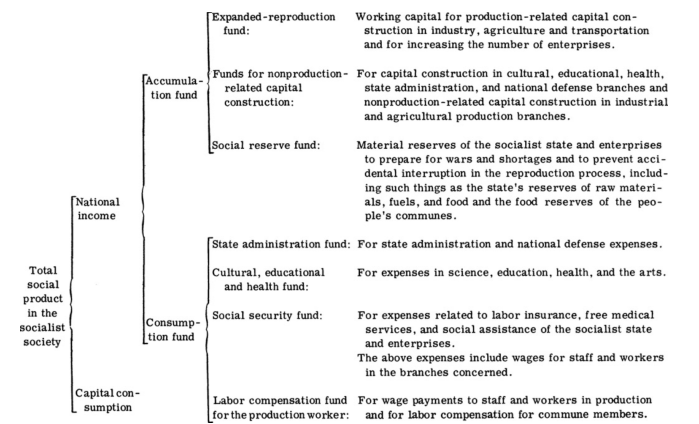
National income in socialist society is divided into two parts after distribution and redistribution: One part is under the control of the socialist state and enterprises under the collective ownership system to expand reproduction and satisfy other common social needs. The other part belongs to the individual laborer to satisfy his personal livelihood needs. These two parts of the national income are finally grouped into accumulation funds and consumption funds according to their different uses.
After distribution and redistribution of the social product and the national income, the final result can be categorized as in the table below.
After distribution and redistribution, the part of the socialist national income which goes for the laborer’s personal consumption contributes directly to his welfare. The part that goes to society contributes to the laborer’s collective welfare and his long-term interests. Just as Marx said:
“All the deductions from the producer as an individual will be directly and indirectly used for the welfare of this producer as a member of society.” 4
The socialist national income comes from the people and is spent on the people. It is fundamentally different from the distribution of the national income in the old society. In a society dominated by the exploitative class, the national income created by the laboring people is largely expropriated by the exploitative class to support a handful of parasites. People like Lin Piao vainly attempted to restore in China this order in which man exploits man. They advocated what Mencius, a faithful disciple of Confucius, said: “Without the gentleman, no one will rule the uncultured, without the uncultured, 316 no one will support the gentleman.” In their eyes, the domination and oppression of the laboring people were immutable laws. However, today is the age of imperialism and proletarian revolution; the exploitative system is doomed. This system is already extinct in socialist society. The laboring people will no longer support the “gentleman” of the exploitative class. People like Lin Piao who vainly attempted to turn history backward could not escape being crushed by the wheel of history.
The important Role of Public Finance in the Distribution and Redistribution of National Income
The State Budget Is an Important Link in the Financial System
In socialist society, the distribution and redistribution of national income is carried on mainly through finance. The socialist financial system consists of the state budget, state bank credits and loans, and state enterprise finance. Of these, state enterprise finance is the basis of the socialist finance system. It systematically reflects the use and turnover of capital funds in the production activities of enterprises. It also effects an initial distribution of national income to form the centralized net income of the state. State banks distribute temporarily idle funds in the national economy through loans to meet the needs for short-term working capital in production. The state budget obtains its revenues from its participation in the distribution of national income to meet the needs of consolidating proletarian dictatorship and economic and cultural construction. A fairly large part of the national income, especially a major part of socialist accumulation, is affected through state budget allocations. The state budget is a major link in the socialist finance system.
How does the state budget participate in the distribution of national income? Because the state budget consists of revenues and expenditures, this question has to be answered from the two aspects of the budget: revenues and expenditures. Budget revenues of the socialist state generally include income from enterprise and services, various taxes, and other income items. These budget income items come largely from the net income of socialist enterprises. In China, the net income of socialist state enterprises is at present surrendered entirely to the state budget in the form of taxes and profits. As early as 1959, payments surrendered by China’s state enterprises represented 91.8 percent of the state budget. Payments surrendered in the form of taxes by rural people’s communes represented 7.4 percent of the state budget. Together, the two sources represented 99.2 percent of state budget revenues. In China’s budget revenues, the items of public debt and foreign debt no longer exist. China has become a socialist country without any internal or external debt.
Socialist state budget expenditures generally include economic construction expenditures, social, cultural, and education expenditures, and national defense and foreign aid expenditures. Through these budget expenditures, various funds are established in a planned manner to meet the needs of consolidating proletarian dictatorship, expanding production, and developing cultural, educational and health services. Among budget expenditures, economic construction and social, cultural, and educational expenditures are of major importance. Expenditures for these two items increased from about 36 percent in 1950 to about 70 percent of China’s state budget expenditures in 1970. However, in imperialist and social imperialist countries, in order to encroach upon and plunder the laboring people of foreign countries and to oppress and exploit the laboring people of their own countries, expenditures for armament expansion and government administration represent a very substantial proportion of state budget expenditures. Expenditures often exceed revenues, resulting in sizable budget deficits.
The above conditions show that socialist finance is a distribution relationship centering on the socialist state’s participation in the distribution and redistribution of national income. Its purpose is to consolidate proletarian dictatorship, develop the economy and cultural, educational, and health services, and discharge its internationalist obligations. The differences between socialist finance and capitalist finance lie in the fact that socialist finance ultimately serves the interests of the broad masses of laboring people, rather than encroaching on those interests, and that it participates in the distribution and redistribution of national income outside the production sphere, as well as in the production sphere. It links the state budget, state bank credit, and state enterprise finance closely together to serve production growth.
The Economy Determines Finance, and Finance Affects the Economy
Since socialist finance is a relationship of distribution and redistribution of national income centered on the state, it is thus closely related to the development of the national economy. Marxism tells us that production determines distribution and distribution in turn affects production. Different forms of distribution in different societies are determined by different forms of social production. And the wealth made available by society for distribution is also determined by the national income created by the production sphere. Chairman Mao instructed us on the dialectical relations between the economy and finance:
“To develop the economy and guarantee surplus constitute the general policy of our economic and financial work.” “Whether financial policies are good or bad will certainly affect the economy. But what determines finance is the economy.” 5
Since liberation, the vast numbers of financial personnel have followed Chairman Mao’s instruction. They first paid special attention to the economy to promote a sustained increase in industrial and agricultural production. As a result, a stable and reliable material basis for China’s finance has been secured, and the scale of revenues and expenditures has developed at a relatively high speed. From 1950 to 1970, China’s total agricultural production in value terms increased by 1.1 times, and the total industrial production in value terms increased by 13.1 times. China’s state budget revenues increased by more than 9 times and state budget expenditures increased by more than 8 times.
The fact that the economy determines finance shows that a one-sided emphasis on finance, an ignorance of the importance of developing the economy, and a pure financial viewpoint which seeks to solve financial problems through purely financial means are erroneous. People holding a purely financial viewpoint who do not understand the dialectical relations among the economy, finance, production, and distribution and do not actively concern themselves with and promote production growth will not be able to solve the problem of financial revenues and expenditures.
The economy determines finance, but finance is not simply a passive or negative factor. It, in turn, plays a very important role in economic development. When the state wants to carry out economic construction and the enterprise wants to increase production, the necessary funds must be arranged. Through its participation in the distribution of national income, socialist finance allocates budget funds from its centralized net income to state enterprises to provide funds for economic construction. In the allocation of funds, if a balance can be achieved in the distribution of material resources, in other words, if the movement of value can be tied up with the movement of material resources (that is, the movement of use values) so that a certain amount of funds can be exchanged for a corresponding amount of material resources and so that they are used economically and properly, a high-speed development of the national economy in a planned and proportional manner can be guaranteed. Conversely, if socialist finance misallocates funds, such that the movement of value does not match the movement of material resources, or if material resources are not used rationally, the development of the national economy will be hindered.
Socialist finance centralizes the national income which is created in the production sphere in the hands of the state. This centralized net income of the state is then used to develop the national economy. This in itself is not sufficient. The vast numbers of financial workers, because of their wide contact with, and their knowledge of, the conditions of various enterprises, should also help enterprises improve management and operation, facilitate cooperative relationships, help enterprises perfect the interrelations within and among enterprises, and do a better job of tapping potentials in order to continuously promote the development of social production and the increase in national income. This way, on the basis of a developing economy, the sources of socialist finance can be augmented and guaranteed.
The Proportional Relations between Accumulation and Consumption Are Overall Proportional Relations
Socialist Accumulation Is the Source of Expanded Reproduction
In the distribution and redistribution of national income, there are proportional relations between accumulation and consumption which directly affect the development of the national economy and the improvement of the people’s livelihood. Like the proportional relations between the two major categories and the proportional relations among agriculture, light industry, and heavy industry, the proportional relations between accumulation and consumption are also overall proportional relations. 6
In the process of distribution and redistribution of national income, socialist finance must guarantee a certain amount of accumulation to be used for expanded reproduction. Accumulation is the source of expanded reproduction. However, in different societies, accumulation has different characteristics. In capitalist society, the laboring people are oppressed and exploited. They do not have enough to eat or wear, to say nothing of accumulation. Only the exploitative class has accumulation. But this accumulation serves to further the exploitation and oppression of the laboring people by the exploitative class. In socialist society, the laboring people control political power and own the means of production. They can thus accumulate funds through the state and the collective to be used to expand reproduction and to serve the interests of the laboring people. The more wealth accumulated by socialist society, the larger the scale and capacity of social production and the higher the standard of material and cultural life. The result will be overall moral, intellectual, and physical development. Material and spiritual conditions will also be gradually accumulated for the transition to communist society.
However, all opportunists and revisionists have attempted to gloss over the essential difference between socialist and capitalist accumulation. They have advocated a complete distribution of the socialist national income. More than a hundred years ago, a leader of the German workers’ movement, La Salle, proposed a so-called “undiluted labor income.” Dühring proposed another nonsensical “complete labor income.” Like La Salle, Dühring and other swindlers of the same ilk and Liu Shaoch’i also clamored that socialism meant “more distribution” and “more take-home pay.” Lin Piao maliciously slandered China as “a rich state with poor people.” He attacked socialist accumulation as “disguised exploitation” and conspired to get rid of socialist accumulation. To such ridiculous propaganda, Marx and Engels dealt head-on blows in Critique of the Gotha Program and Anti-Dühring. If the revisionist fallacies were implemented, there would not be any social accumulation. As a result, the socialist economy would not be able to carry on expanded reproduction. It could only maintain simple reproduction, or the function of accumulation would be transferred to private parties. This way, capitalism would be restored. Thus, we can see that the fallacies of distributing and spending everything advocated by Liu Shaoch’i and Lin Piao represent a vain attempt to undermine the socialist economy and restore capitalism.
The Ratio between Accumulation and Consumption Must Be Appropriate
Aside from what is used as accumulation funds, the rest of the socialist national income is used as consumption funds. “The problem of distribution between accumulation and consumption is a complex problem; it is not easy to solve in a short time.” 7 At any given period of time, the national income is limited. If the part used to increase accumulation is raised, then the part used to increase consumption has to be somewhat lower. A higher level of accumulation will certainly accelerate the pace of socialist reproduction, but it will also mean that the increase in the laboring people’s standard of living will have to be temporarily slowed down. Conversely, if the part used to increase consumption is raised, the part used to increase accumulation must be somewhat lower. A higher level of consumption can, of course, better satisfy the present livelihood needs of the laboring people, but the pace of socialist expanded production must then be slower. This will affect further improvement of the laboring people’s livelihood. These conditions show that there are contradictions between socialist accumulation and consumption.
But the contradictions are not antagonistic in nature. They are contradictions among state interests, collective interests, and individual interests. In other words, they are contradictions between overall interests and partial interests and contradictions between the people’s long-term and short-term interests.
In arranging the proportional relations between accumulation and consumption, we must first base any increase in accumulation on appropriately improving the livelihood of the laboring people. At the same time, any increase in consumption must also be based on continuously expanding production and improving labor productivity. The interests of the state, the collective, and the individual must be considered simultaneously. If we pay no attention to improving the livelihood of the laboring people and one-sidedly emphasize accumulation, it will not meet the objective requirements of socialist economic development; it will discourage the production activism of the laboring people. Conversely, if we pay no attention to accumulation and one-sidedly emphasize consumption, it will not be in the basic and long-term interests of the laboring people. In order to create favorable conditions for the correct handling of this contradiction, we must endeavor to develop social production. As long as production is developed and national income is increased, the livelihood of the laboring people can still be improved even if accumulation is appropriately increased. Therefore, for the overall and long-term interests of socialism, it is necessary to emphasize the revolutionary spirit of arduous struggle and building the country with diligence and economy.
Accumulation and consumption are a proportional relation in value terms. The proper handling of this proportional relation requires corresponding material resources as a guarantee. As for accumulation, it is used for capital construction and expanded reproduction. Once a certain amount of funds is available, there must also be a corresponding amount of the means of production. 8 Of the total national product in socialist production, only the added portion is to be used for expanded reproduction, while the other portion, equivalent to the previous year’s consumption, is to be used for simple reproduction. Therefore, to maintain a balance between supply and demand, the total capital fund accumulated must first equal the increase in the means of production. Otherwise, either the means of production will fall short of the accumulated fund, making expanded reproduction impossible, or the added means of production will not be sold, thereby creating a surplus. In either case, socialist expanded reproduction will be affected.
As far as consumption is concerned, since consumption funds are used to satisfy the material and cultural needs of the socialist state and the broad masses of laboring people, sufficient consumer goods must be available to guarantee that these needs will be satisfied. If the increase in consumption funds does not correspond to the increase in consumer goods, then either the supply of consumer goods will exceed the demand, resulting in unplanned 322 inventory accumulation, or demand for consumer goods will exceed their supply, resulting in shortages. Either way, it will be difficult to attain properly the goal of satisfying the needs of the state and the laboring people.
It can thus be seen that in order to maintain the proper proportional relations between accumulation and consumption; it is necessary to develop production by all means. Only when the production of the means of production and consumer goods is solved can both accumulation and consumption be increased and the contradiction between accumulation and consumption be better resolved. Here, it is of decisive importance to raise labor productivity continuously, use the means of production thriftly, and create more material wealth without increasing the use of manpower, material resources, and finance.
Major Study References
Marx, Critique of the Gotha Program, (l).
Engels, Anti-Dühring. Part 3, Chapter 4.
Chairman Mao, “On the Correct Handling of Contradictions among the People,” Sections 1 and 3.
Chairman Mao, “Economic and Financial Problems in the Anti-Japanese War.”
Review Problems
- How is socialist national income distributed and redistributed? What is the essential difference between this and the distribution of capitalist national income?
- What is socialist finance? How should we understand the relations between socialist finance and the economy?
- How do we correctly handle the proportional relations between accumulation and consumption?
8 Footnotes