III- Imperialism and Democratic Revolution
Return to The New Democratic Revolution is the main force of the World Proletarian Revolution
III- Imperialism and Democratic Revolution
In their criticism of the founding Parties and Organizations of the ICL, particularly the P.C.B., the UOC (MLM) point out the defense of the validity of the New Democratic Revolution in semi-colonial countries as dogmatism on our part. They criticize us for a supposed lack of “objectivity” in our analyzes of imperialism and the development of capitalism in oppressed countries. Both in their criticism and in other documents, the leadership of the UOC (MLM) formulates a “new” theory of imperialism, which attempts to pass off as a concrete and objective application of Maoism to the current world situation and oppressed countries. According to the UOC (MLM), imperialism would be a “world mode of production” in which “two tendencies [would coexist]: one towards stagnation (…) and the other towards progress”. This supposed progressive tendency would mean that imperialism “sweeps away the traces of pre-capitalist modes of production” in countries oppressed by imperialist powers. The sweeping away of semi-feudality by imperialism would imply, in turn, a full development of capitalism in these countries, particularly in the countryside and that the bourgeoisie of this country would obtain “a rate of profit equal to that of the bourgeoisie of other countries”, that is, imperialists. According to the UOC (MLM), oppressed countries are of two kinds: 1) oppressed capitalist countries and 2) semi-feudal countries, that is, two types of semi-colonies, the capitalist semi-colony and the semi-feudal semi-colony. In their formulation, oppressed capitalist countries and semi-feudal countries are both semi-colonies, but the character of the revolution in the former would be immediately socialist and the New Democratic Revolution would be in force only for semi-feudal countries.
When analyzing Avakian’s revisionist positions, it is not difficult to see that the source of the UOC (MLM)’s formulations on imperialism is precisely Avakianism. Just like this revisionist variant, the UOC (MLM) defends imperialism as a world mode of production whose dynamism sweeps away semi-feudal production relations, resulting in the emergence of predominantly capitalist oppressed countries whose revolution must be immediately socialist. Furthermore, the UOC (MLM) applies this Avakianist formulation in the “concrete analysis” of the Colombian situation, as we will demonstrate below.
According to the analysis of UOC (MLM), Colombia would be an oppressed capitalist country and, therefore, the character of the Colombian revolution would be immediately socialist. For Colombian peasants, the slogan “land for the tiller” would no longer be on the agenda. Taking just one piece of information: Colombia is the Latin American country that champions the concentration of land ownership, according to investigations by Oxfam (2016), 1% of the largest landowners own 81% of the land. Hence the nonsense contained in the UOC (MLM) program, according to which the task of communists in Colombia must be to “teach the peasants (…) to struggle against private property and to convert the property of their land into collective property and collective exploitation.” 1
For the UOC (MLM), if Colombia is an oppressed capitalist country, this condition would be even more explicit in countries such as Brazil, India and the Philippines:
“(…) The behavior of the Brazilian, Indian or Philippine bourgeoisie over the last decades is by no means that of a merely comprador bourgeoisie. For example, the Indian state is a peculiar type of post-colonial capitalist state characterized by a bourgeoisie which is neither national (…), nor comprador (because it is not only a servant and intermediary of the imperialists and … it has taken independent political decisions in contradiction with the metropolitan imperialist bourgeoisie) and even less an imperialist bourgeoisie (because the import of capital by the Indian bourgeoisie is much more than its export of capital, which has certainly been increasing over the last two decades). The character and role of the Brazilian bourgeoisie with regard to the BRICS shows that its international role is far from being that of a comprador bourgeoisie or one entirely subjugated to imperialism and that, within its limits, it aspires to be a regional actor already manifesting positions of predominance vis-à-vis other oppressed countries.” 2
That is to say, the leadership of the UOC (MLM) concludes that the Brazilian, Indian and Philippine bourgeoisies no longer have a comprador character. They state that the Brazilian and Indian bourgeoisies, in particular, although they are not imperialists, already export capital, rival the “metropolitan” bourgeoisie and subjugate other oppressed countries. Contrary to what the PCP, TKP/ML, CPI(Maoist), CPP and P.C.B. and the vast majority of Marxist-Leninist-Maoist parties claim, the UOC (MLM) suggests that revolutions in these countries would be immediately socialist.
The international line for the ICM, proposed by the UOC (MLM) points to a decrease in the importance of New Democratic Revolutions, as an integral part of the World Proletarian Revolution. After all, if imperialism continues to “sweep away” semi-feudality in oppressed countries, there are more and more “oppressed capitalist” countries and the immediately socialist revolution would be in force for an ever-increasing number of countries in the world. This analysis and conclusion by UOC (MLM) are a complete review of Leninism, mainly its theory of imperialism.
Contrary to this conclusion of the UOC (MLM), the scientific ideology of the proletariat, Marxism-Leninism-Maoism, points out that in the imperialist phase of capitalism, national oppression increases and does not decrease, that the tendency everywhere towards political reaction and violence is a law of imperialism that buried and abolished every progressive character that capitalism had, with the passage of capital from its phase of free competition to the phase of monopolies, the highest and last stage of capital. This is what the great leaders of the international proletariat say, it is the ABC of Leninism and Maoism and it is what we are seeing in a striking way in the world today: the growth of colonial oppression by superpowers and imperialist powers and, principally, the explosive growth of national liberation wars and struggles of which the heroic Palestinian National Resistance is the most inspiring example to the international proletariat. Imperialism is the parasitism and decomposition of capital, it is a moribund condition, whose crisis is the material basis of the accelerated putrefaction of bourgeois democracy, expressed in the reactionization of the state and the vertiginous growth of its fascistization in all countries of the globe. Therefore, very contrary to the conclusions of the UOC (MLM), the significance of the New Democratic Revolutions for the World Revolution has only increased in importance in recent decades. Understanding the relationship between the democratic revolution and the Proletarian Revolution is today, more than ever, a decisive question for communists around the world.
1- The fallacious “progressive tendency of imperialism”
For the leadership of the UOC (mlm), the imperialist phase constitutes a particular mode of production of capitalism, repeating the Avakianist mantra, they state that in the stage of free competition
“The world economy was not cohesive and the economies of each country were structured as independent processes, external to each other, linked little by little by the market”. In other words, they were linked only by the market, in the sphere of circulation. As for under imperialism, the world economy would have “unified itself into one single process (…) converting, in addition to the market, production itself into a global one, breaking the autonomy of the countries’ economies and chaining them into a single productive process.” 3
This globalized mode of production, opposing the capitalism of the free competition phase, would consist of the “progressive” aspect of imperialism:
“In the imperialist phase, two tendencies coexist: one towards stagnation and economic and political crises; and another toward progress, to the socialization of world production.” 4
For the UOC (MLM), this growth in the socialization of world production would be a “progressive” tendency as it would lead to the sweeping away of semi-feudality:
“Imperialism, as an internationalized mode of production, has chained all the countries, with their specific modes of production, into one single world economy. The exported capital acts on the capitalist germs or developments of the oppressed countries and, as an overall tendency, accelerates their development, sweeps away the traces of precapitalist modes of production.” 5
Furthermore, by itself “capitalism, when turning into a global mode of production” expresses more clearly that “the proletariat of all countries sells its labor power to the global bourgeoisie”. The bourgeoisie of semi-colonial countries, in turn, becomes “partners and participants in the world system of imperialism”. And by “benefiting from imperialist relations (…) it obtains an interest rate equal to that of the bourgeoisie in other countries”. In this way, the UOC (MLM) defines that:
“(…) Imperialism is an internationalized mode of production that include others, induce them, transform them, outwear them, exhaust them, in a world process of production, accumulation and generation of surplus value” 6
According to UOC (MLM) documents, its conception of imperialism can be summarized as follows: in the stage of free competition, the world economy was cohesive through the market; In the imperialist stage, capitalism became an internationalized mode of production, linking all countries, regardless of their specific modes of production, into a single world economy. This chain led to the sweeping away of pre-capitalist modes of production and the conversion of the semi-colonial bourgeoisies into partners of the imperialist world system, which guarantees them an “interest rate equal to that of the imperialist bourgeoisies”. Thus, a global bourgeoisie emerges that exploits the proletariat of all countries in a single productive process. Imperialism boils down to a world process of production, accumulation and generation of surplus value.
This conception of the UOC (mlm) attacks the Leninist theory of imperialism in its entirety, against the Marxist foundations of the study of the capitalist mode of production and converges with the Kautskyist “theory” of ultra-imperialism.
Firstly, the conclusion of the UOC (MLM) that in the free competition phase of the capitalist mode of production “the world economy was not cohesive” is completely opposite to Marxism. As the great Marx already demonstrated in the Manifesto of the Communist Party, big industry and the world market form a dialectical unit, in which big industry constitutes the principal aspect. However, both determine each other mutually, that is, big industry determines the formation of the single world market which, in turn, accelerates the development of this same big industry. For Marx, big industry develops only to the extent that it coheres the world economy:
“Modern industry has established the world market, for which the discovery of America paved the way. This market has given an immense development to commerce, to navigation, to communication by land. This development has, in its turn, reacted on the extension of industry; and in proportion as industry, commerce, navigation, railways extended, in the same proportion the bourgeoisie developed, increased its capital, and pushed into the background every class handed down from the Middle Ages. We see, therefore, how the modern bourgeoisie is itself the product of a long course of development, of a series of revolutions in the modes of production and of exchange.” 7
This is the period of capitalism’s flourishing, in which the bourgeoisie, as the new revolutionary social force, relegated all medieval junk to the past. Free competition capitalism could not develop, much less reach the imperialist phase, if the economies of each country were structured as independent processes. The intertwining of the world economy into a single process, the international division of labor, are not particularities of imperialism, they are previous historical achievements of the stage of free competition. This is what Marx and Engels establish as follows:
“The bourgeoisie has through its exploitation of the world market given a cosmopolitan character to production and consumption in every country. To the great chagrin of Reactionists, it has drawn from under the feet of industry the national ground on which it stood. All old-established national industries have been destroyed or are daily being destroyed. They are dislodged by new industries, whose introduction becomes a life and death question for all civilized nations, by industries that no longer work up indigenous raw material, but raw material drawn from the remotest zones; industries whose products are consumed, not only at home, but in every quarter of the globe. (…) In place of the old local and national seclusion and self-sufficiency, we have intercourse in every direction, universal inter-dependence of nations. And as in material, so also in intellectual production. The intellectual creations of individual nations become common property. National one-sidedness and narrow-mindedness become more and more impossible, and from the numerous national and local literatures there arises a world-literature.” 8
Is there any doubt that for Marx, as established in the founding work of scientific socialism, world production constitutes a single process precisely in free competition capitalism? The universal market presupposes big industry, both constitute contradictory aspects of universal material production, which represents the basis for universal intellectual production. These are historical products of the World Bourgeois Revolution, which ended with the advent of imperialism and which, with the October Socialist Revolution of 1917 in Russia, the bourgeoisie as a class, historically, lost its revolutionary and progressive aspect, turning completely to counterrevolution. Therefore, in no way does imperialism promote any progress, but, on the contrary, as a reaction on all line, it also turns against all these achievements reached by humanity.
But the UOC (MLM) is not only wrong when they characterize elements already present and constituted in the free competition phase as if they were particularities of the imperialist stage, they distort the very characterization of what this internationalized production would be. When dealing with the two tendencies of imperialism, they highlight the socialization of world production as if it could exist in the capitalist mode of production without its opposite aspect: capitalist private property. When they reaffirm that imperialism emerges as a mode of production that links the economies of countries as a single productive process, they hide the fact that alongside the socialization of growing production, capitalists continue to confront each other in the capitalist market as private owners. In other words, the imperialist world has not transformed into a single factory of a single global capital that jointly exploits the proletarians of all countries in the world. Such conclusions also seem a lot of the “post-modern” thesis of “global capital” defended by revisionists and opportunists who embellish the bourgeois ideology of “Globalization”, see Prachanda and company.
Imperialism, in addition to being “(…) a world process of production, accumulation and generation of surplus value”, is, at the same time, a global process of unbridled, violent and reactionary dispute for the repartition of this surplus value, for the private appropriation of this surplus value. If the prehistory of capitalism spilled blood from every pore, the present history of imperialism is the bloodiest war of the imperialist bourgeoisie for the repartition of this surplus value produced worldwide and for the plunder, looting and prey of semi-colonial countries. The imperialist bourgeoisie, in turn, disputes with the bourgeoisie of the semi-colonial countries, with the big bourgeoisie of these countries (bureaucratic and comprador) for who will get the largest portion of the social surplus value produced in them. Therefore, it becomes completely unreasonable to say that in imperialism the bourgeoisies of semi-colonies earn the same rate of profit as their imperialist “partners”.
Capitalist private property constitutes the right of the bourgeoisie to appropriate of the unpaid work from others, to appropriate surplus value. The golden dream of a progressive tendency of imperialism, spread by the UOC (MLM), hides “only” the fact that the increasing socialization of production with private ownership of the means of production is the fundamental condition for the existence of capitalism, it is its fundamental contradiction, in which these two aspects form a unity of opposites – capitalism –, whose dominant aspect is the private ownership of the means of production. This condition and fundamental contradiction of capitalism is the same in its stage of free competition and in its monopolistic stage, but on the condition that, in the second, simultaneously with the acceleration of the socialization of production, greater leaps are produced in the concentration and centralization of capital, due to the monopolistic nature of the predominant aspect. Let us see how Lenin deals with this issue in a comprehensive manner, when analyzing the phenomenon of socialization of production in imperialism:
“(…) then it becomes evident that we have socialization of production”, however “appropriation remains private.” 9
Therefore, monopolistic property, typical of the imperialist phase, cannot promote this socialization of production without increasing, at all times, the conflict with it. The socialization of production, in the era of imperialism, therefore, advances in a manner opposite to the progressive character highlighted by Marx in the Manifesto. The advancement of capitalist production, in its monopolistic phase, does not sweep away pre-capitalist modes of production, quite the contrary, financial capital, mainly through the export of capital, relies on these rotten bases, keeping them subjacent and does so through the evolution of its forms, often in an apparent “waged form”. Monopolistic competition (brutal competition) is based on the search for maximum profit and leads, inevitably and principally, to imperialist wars of aggression and prey, to the fight for the repartition of the world, to world imperialist war, to colonial enslavement and to fascism and to confront the world proletarian revolution. Imperialism thus prepared the objective conditions for the advancement of the world proletarian revolution in each country in the forms of socialist revolutions and new democratic revolutions uninterrupted to socialism, respectively corresponding to the nature of each country, in a process of uneven development, but of exclusive proletarian leadership.
The advent of imperialism and its opposite, the world proletarian revolution, brought about the disintegration of the single capitalist market and in no way led to a mode of production that united countries in a single process. As Comrade Stalin highlights:
“The disintegration of the single, all-embracing world market must be regarded as the most important economic sequel of the Second World War and of its economic consequences. It has had the effect of further deepening the general crisis of the world capitalist system.” 10
If with the development of imperialism and the advent of the world proletarian revolution not even the existence of a single world market is assured, how much less can be told about the formation of a mode of production that links the countries of the world into a single process. Much less in a progressive trend of imperialism that sweeps away semi-feudality. Chairman Mao summarizes these important theses of the 4th Congress of the CI, for semi-colonial countries, as follows:
“Imperialism ‘first allies itself with the ruling strata of the previous social structure, with the feudal lords and the trading and money lending bourgeoisie, against the majority of the people. Everywhere imperialism attempts to preserve and to perpetuate all those precapitalist forms of exploitation (especially in the villages) which serve as the basis for the existence of its reactionary allies’ (…) ‘Imperialism, with all its financial and military might, is the force in China that supports, inspires, fosters and preserves the feudal survivals, together with their entire bureaucratic-militarist superstructure.” 11
How is it possible to try to reconcile the defense of Maoism with the fallacious thesis of the progressive tendency of imperialism? How is it possible to claim to be a Maoist and say that imperialism sweeps away semi-feudal relations in semi-colonial countries? The UOC (MLM) states that they do not underestimate the fact that “in some countries the predominant tendency was, especially at the beginning of the phase, to reinforce pre-capitalist modes of production.” 12 They try to reconcile their explicit deviation from Maoism with a mend: in some countries, imperialism, in its beginnings, reinforced pre-capitalist modes of production. They thus convert the line of the CI and Chairman Mao into an exception and create a false dichotomy in the history of imperialism: at the beginning of the stage, it promoted pre-capitalist modes of production; then sweep them away. All that was left for the UOC (MLM) was to explain how this imperialist metamorphosis occurred: from the reaction everywhere to the supposed progressive trend. In opposition to revisionist conceptions like this, Chairman Mao states that imperialism “(…) will never become Buddhas.”
Furthermore, he clearly establishes that the objective of imperialism, when penetrating oppressed countries, was never to develop a social formation, to make it progress, nor to sweep away old modes of production, on the contrary:
“It is certainly not the purpose the imperialist powers invading China to transform feudal China into capitalist China. On the contrary, their purpose is to transform China into their own semi-colony or colony.” 13
Imperialism does not have a progressive tendency, nor can it be considered a mode of production that links the countries of the world into a single process. As Comrade Stalin establishes, imperialism is:
“The increase in the export of capital to the colonies and dependent countries; the expansion of ‘spheres of influence’ and colonial possessions until they cover the whole globe; the transformation of capitalism into a world system of financial enslavement and colonial oppression of the vast majority of the population of the world by a handful of “advanced” countries—all this has, on the one hand, converted the separate national economies and national territories into links in a single chain called world economy, and, on the other hand, split the population of the globe into two camps: a handful of “advanced” capitalist countries which exploit and oppress vast colonies and dependencies, and the huge majority consisting of colonial and dependent countries which are compelled to wage a struggle for liberation from the imperialist yoke” 14
There is a clear difference in the definition, as the UOC (MLM) classifies imperialism as an internationalized mode of production that sweeps away pre-capitalist production relations; Comrade Stalin defines it as a world system of financial enslavement and national (colonial) oppression. For Stalin, imperialism is not a mode of production that converts national economies into a single process, but rather that converts them into “links in a single chain”. In this chain of domination, a major part of the world, colonial and semi-colonial countries are shackled by imperialist domination. Assuming that imperialism promotes the progress of the countries it oppresses is a completely revisionist conception.
The UOC (MLM) states that “The tendency towards democracy typical of the old bourgeois revolution has been replaced by the tendency towards political reaction everywhere and in all orders.” They affirm this Leninist thesis, and then supports the revisionist thesis about two tendencies of imperialism. A conscientious reading of Lenin’s formulations on imperialism inevitably leads to rejecting this UOC (MLM) hypothesis. After all, as already seen, Lenin brilliantly establishes that imperialism has only one tendency:
“Imperialism is the epoch of finance capital and of monopolies, which introduce everywhere the striving for domination, not for freedom. Whatever the political system the result of these tendencies is everywhere reaction and an extreme intensification of antagonisms in this field. Particularly intensified become the yoke of national oppression and the striving for annexations, i.e., the violation of national independence (for annexation is nothing but the violation of the right of nations to self-determination)” 15
2- Imperialism prevents national development
As seen, the UOC (MLM) distorts the Marxist-Leninist analysis of the transformation of free competition capitalism into monopoly capitalism, at a global level, by attributing a supposed progressive tendency to imperialism. This “progress” would occur on a global scale to the extent that imperialism would correspond to a single productive process, and in oppressed countries, to the extent that it sweeps away pre-capitalist modes of production. It is impossible to ideologically reconcile these postulates with the Leninist analysis that imperialism intensifies particularly national oppression. In other words, the result of the capital exported by financial capital is not any progress for the oppressed countries. What Lenin highlights as a result of this export is the “extreme intensification of contradictions”, “the striving for domination, and not for freedom”. This particular condition of imperialism results in the increase of the national liberation struggle and makes it an inseparable part of the world proletarian revolution; the class struggle of the proletariat acquires an international character and the proletariat rises to the only consistent leadership of democratic and national liberation struggles as a whole. The International Proletarian Movement and the National Liberation Movement, the first as a lead and the second as a base, inseparable aspects of the WPR, constitute the only progressive trend in the era of imperialism.
The UOC (MLM), in a way opposite to Leninism, concludes that the main result of the export of capital to oppressed countries would constitute the sweeping away of pre-capitalist production relations by imperialism and not the intensification of national oppression and its twin sister – the reproduction of semi-feudal relations through the evolution of their forms. They take the predominance of capitalist relations of production in colonial and semi-colonial countries, which occurs in the imperialist era, as if they had the same progressive content that they once had in the stage of free competition capitalism. They falsely interpret that the export of capital would result in the subordination of feudalism to capitalism, and that this subordination would occur in oppressed countries only in the imperialist phase. The export of goods, the creation of the world market, typical of the free competition stage, had already imposed the subordination of slave and feudal production relations to the capitalist mode of production. They thus mix predominance with subordination, to reach the following conclusion: poor countries in which capitalist relations predominate over semi-feudal relations are “oppressed capitalist countries” and in these countries the revolution must immediately be socialist. Predominance, which for the UOC (MLM) is equal to subordination, and therefore for them the New Democratic Revolution would be in force, today, only in countries in which the capitalist mode of production was subordinated to the feudal mode of production. We question in which country in the world today is capitalism subordinated to feudalism?
The UOC (MLM) considers that the subordination of pre-capitalist production relations to the capitalist mode of production only occurred in the 20th century. The subordination of the slave and feudal modes of production to the capitalist mode of production is in no way a product of imperialism, or the result of the export of capital. This subordination occurred in free competition capitalism, and was part of the development of big industry, the creation of the capitalist single world market, and the international division of labor. Marx analyzes this question as follows in Capital:
“But as soon as people, whose production still moves within the lower forms of slave-labor, corvée-labor, &c., are drawn into the whirlpool of an international market dominated by the capitalistic mode of production, the sale of their products for export becoming their principal interest, the civilized horrors of over-work are grafted on the barbaric horrors of slavery, serfdom, &c. Hence the negro labor in the Southern States of the American Union preserved something of a patriarchal character, so long as production was chiefly directed to immediate local consumption. But in proportion, as the export of cotton became of vital interest to these states, the over-working of the negro and sometimes the using up of his life in 7 years of labor became a factor in a calculated and calculating system. It was no longer a question of obtaining from him a certain quantity of useful products. It was now a question of production of surplus-labor itself.” 16
Marx clearly highlights that the world market emerges as a product of big industry and is therefore dominated by the capitalist mode of production. Worldwide, capitalism is already the dominant mode of production since its development in the free competition phase. However, the leadership of the UOC (MLM) distorts the Maoist’s analyzes of Chinese society and states that:
“From these three texts and from Mao’s above-mentioned talks it is clear that (i) a semi-feudal and semi-colonial social formation is characterized by a limited development of capitalism and by the continued domination of feudal relations of production; the capitalist mode of production is subordinated to the feudal mode of production and to the imperialist domination implemented through the usurious commercial big bourgeoisie;” 17
The UOC (MLM) concludes that there is the possibility of the capitalist mode of production being subordinated to the feudal mode of production in the imperialist stage, and makes the absurdity of saying that this can be deduced from the works of Chairman Mao. In The Chinese Revolution and the Chinese Communist Party, the great helmsman states that:
“The foundations of the self-sufficient natural economy of feudal times have been destroyed, but the exploitation, not only remains intact but, linked as it is with exploitation by comprador and usurer capital, exploitation of the peasantry by the landlord class, which is the basis of the system of feudal clearly dominates China’s social and economic life.” 18
The UOC (MLM) interprets this predominance of landlord exploitation as the subordination of the capitalist mode of production to the feudal mode of production in Chinese society. However, to reach such a conclusion they need to hide that the predominant aspect in the process of development of the Chinese nation in the 20th century became imperialism, specifically, the imperialist powers that partitioned the Chinese coast among themselves in the first two decades, and mainly the Japanese imperialism that expanded its colonization from northeast China towards the center-south of the country in the late 1930s. In other words, what destroyed “the foundations of the self-sufficient natural economy of feudal times” was not the nascent Chinese national capitalism, but the capital exported by imperialism. Thus, feudalism predominates against national capitalism and not against imperialist capitalism, which oppresses, subordinates and subjugates the Chinese nation. Chairman Mao analyzes China’s social development as follows in On New Democracy:
“(…) in their aggression against China the imperialist powers have on the one hand hastened the disintegration of feudal society and the growth of elements of capitalism, thereby transforming a feudal into a semi-feudal society, and on the other imposed their ruthless rule on China, reducing an independent country to a semi-colonial and colonial country.” 19
The aggression of imperialist powers against China accelerates the growth of bureaucratic capitalism; The exported capital determined the accelerated conversion of feudal China into semi-feudal China. However, unlike the process of capitalist development typical of the free competition stage, this evolution of feudalism and this growth of mercantile and capitalist relations did not lead to greater national unification, on the contrary, they converted China from an independent feudal country into a semi-colonial country. and, therefore, colonial.
How, then, can the UOC (MLM) speak of the subordination of the capitalist mode of production to the feudal mode of production in China? What happened was precisely the opposite, imperialism subordinated the feudal forces in China; financed, armed and led the warlords against the bourgeois-democratic forces, thus preventing the development possibilities of Chinese national capitalism. This type of subordination was not a particular fact of Chinese society, but became the general rule in the imperialist phase of capitalism. Chairman Mao summarizes the “military, political, economic and cultural means of oppression” used by the imperialist powers to gradually convert China into a semi-colony and then into a colony:
“(1) The imperialist powers have waged many wars of aggression against China (…). (2) The imperialist powers have forced China to sign numerous unequal treaties (…). (3) (…) Thus, they have been able to dump their goods in China, turn her into a market for their industrial products, and at the same time subordinate her agriculture to their imperialist needs. (4) The imperialist powers operate many enterprises in both light and heavy industry in China in order to utilize her raw materials and cheap labor on the spot, and they thereby directly exert economic pressure on China’s national industry and obstruct the development of her productive forces. (5) (…) monopolize China’s banking and finance (…) (6) (…) have established a network of comprador and merchant-usurer exploitation right across China, (…) and have created a comprador and merchant-usurer class in their service, so as to facilitate their exploitation of the masses of the Chinese peasantry and other sections of the people. (7) (…) have made the feudal landlord class as well as the comprador class the main props of their rule in China. (…) (8) (…) to keep the warlords fighting among themselves and to suppress the Chinese people. (9) Furthermore, the imperialist powers have never slackened their efforts to poison the minds of the Chinese people. (…) (10) Since September 18, 1931, the large-scale invasion of Japanese imperialism has turned a big chunk of semi-colonial China into a Japanese colony.” 20
In the colonial and semi-colonial relation of domination and exploitation, imperialism is the dominant aspect in face of the Chinese people and nation. The imperialist powers turned the feudal landlord class and the Comprador bourgeoisie into the props of their rule in China. It is, therefore, a falsification to attribute to Chairman Mao the conclusion that in China the feudal mode of production subordinated the capitalist mode of production. Both in Marx’s example, taken from the 19th century, and in Chairman Mao’s analysis of China in the 20th century, the capitalist mode of production is already the dominant aspect in the world economy. Marx shows, in Capital, how slave labor relations of production in cotton production in the southern USA were already at the service of the production of surplus value in England. Because to the extent that they ensured a cheaper raw material for the textile industry than English cotton, or Indian or Egyptian cotton, the cotton produced by the blood of black people enslaved by the Yankees served a greater production of surplus value by the English bourgeoisie. In the 20th century, what happens is that imperialism will not only link these different relations of production to its service, but will also use all backward forces to ensure its national dominance. This is an indispensable condition to make it possible to obtain profits from exported capital. In this way, through unequal treaties, the subordination of agricultural production to imperialist powers’ needs, the direct installation of imperialist companies that exploit the raw materials and cheap labor force of oppressed countries, through these means, the imperialist powers obtain a much greater profit than was possible in the free competition stage. That is why Lenin highlights that the increase in national oppression is one of the results of the imperialist stage.
The UOC (MLM) distorts Chairman Mao’s analyzes of Chinese society, mix up the prevalence of semi-feudal relations of production with the subordination of the capitalist mode of production to the feudal mode of production, because they intend to present their proposition of socialist revolution to part of the oppressed countries as being based on Maoism. Thus, they present China as a semi-feudal and semi-colonial country, as if semi-feudality were the predominant aspect of this social formation and as if the complete justification for the New Democratic Revolution was laid in this predominance. Therefore, they deduce that a country in which semi-feudality no longer subordinates capitalist relations would require an immediately socialist revolution. They thus link the New Democratic Revolution solely and exclusively to the sweeping away of pre-capitalist relations of production, and places the national question within the scope of the socialist revolution.
The falsehood of this reasoning consists of two points: 1) imperialism did not sweep away semi-feudal relations, it only made their forms evolve while keeping them subjacent; 2) the new democratic revolution is not limited to the sweeping away of semi-feudality, its most important international significance is that it completely resolves the problem of the transition from the national liberation revolution to the socialist revolution, because its most important targets are feudalism and imperialism, and this is the principal thing. Let’s see how Chairman Mao states the issue for the Chinese Revolution:
“Such are the characteristics of China’s colonial, semi-colonial and semi-feudal society. This situation has in the main been determined by the Japanese and other imperialist forces; it is the result of the collusion of foreign imperialism and domestic feudalism. The contradiction between imperialism and the Chinese nation and the contradiction between feudalism and the great masses of the people are the basic contradictions in modern Chinese society. (…) [there are others] But the contradiction between imperialism and the Chinese nation is the principal one.” 21
One detail is to be noted, Chairman Mao in his definition of the character of China always highlights the semi-colonial aspect before the semi-feudal aspect, the UOC (MLM) when referring to China always invert the concepts placing the semi-feudal aspect in front to falsify the conclusion that this was the only determining characteristic of Chinese society. The decisive importance of the struggle for the destruction of latifundium in semi-colonial countries is precisely because this class constitutes the main pillar of support for imperialism, and is the most backward class. Against it, it is possible to unify the majority of the country’s social classes and a large number of political forces, a broad revolutionary united front of the proletariat with the entire peasantry (poor, middle and rich), the urban petty bourgeoisie and even the middle one (national bourgeoisie) under certain conditions. Only when an imperialist invasion occurs does it become possible to establish an even broader united front of revolutionary classes under the leadership of the Party of the proletariat. Therefore, in general, the contradiction against semi-feudality is the principal contradiction in the first phases of the New Democratic Revolution, but it by no means constitutes the only contradiction to be resolved by this revolution.
Until the early 1940s, Chairman Mao highlights that the targets of the New Democratic Revolution in China were imperialism and feudalism. From the mid-1940s onward, particularly during the Third Revolutionary Civil War (1947-1949), he always pointed to three targets: imperialism, feudalism and bureaucratic capitalism:
“At present our chief enemies are imperialism, feudalism and bureaucrat-capitalism, while the main forces in our struggle against these enemies are the people engaged in manual and mental labor, who make up 90 per cent of the country’s population. And this determines that our revolution at the present stage is a new-democratic, a people’s democratic revolution in character and is different from a socialist revolution such as the October Revolution.” 22
This specification of Chairman Mao’s position is the result of the ideological development of Maoism itself, as a reflection of the transformations in China and the world during and after World War II. The development of industrial production in countries dominated by imperialism is a tendency present throughout the 20th century, which alternated between periods of growth and regression. Resulting from the export of capital itself, as we saw in the above analysis of Chairman Mao, imperialism managed to establish companies in its colonies and semi-colonies with the aim of more easily exploiting the raw materials present there and super-exploiting the available labor force. However, due to the inter-imperialist contradictions (particularly during the World War I and II), due to the contradiction of socialism versus capitalism, due to the contradiction of oppressed nations and peoples versus imperialism and the contradiction of the proletariat versus the bourgeoisie at the world level, imperialism also was forced to intertwine with local big capitals from oppressed countries to develop capitalist companies in semi-colonies. Due to its economic weakness in the face of imperialist financial capital, semi-colonial big capital, in order to intertwine with it, had to do so, mainly, through the State. Bureaucratic capitalism in semi-colonial countries appears as non-state monopoly capitalism, but when it develops it uses the control of the old State machinery and becomes state monopoly capitalism, state in form but private in content, engendered and linked to imperialism, resulting in the differentiation of two fractions of this big bourgeoisie, the comprador, the first form of the big bourgeoisie in oppressed countries, and the bureaucratic fraction itself, resulting from this differentiation within the State. In China, this process intensified from 1945 onward, with the defeat and expulsion of Japanese imperialism, a period in which Chiang Kai-shek, at the head of the old state machinery and leveraged by Yankee financial capital, propelled this state monopoly capitalism. This process did not only occur in China, it occurred as an immediate result of the advent of imperialism, in all countries that were more backward and became colonies or semi-colonies of different imperialist powers, a phenomenon that became the rule in the monopoly phase of capital. The class struggle in this process and the two-line struggle in Marxism led, in sequence, by Lenin, Stalin and Chairman Mao resulted in the development of the theory of New Democratic Revolution in China, whose targets to be destroyed and removed are feudalism, imperialism and bureaucratic capitalism, the three mountains of exploitation and oppression of the popular masses and subjugation of the nation.
Reducing the New Democratic Revolution to the sweeping away of feudalism would correspond to reducing it to the agrarian revolution, this would be a falsification of Maoism. Stating that imperialism in alliance with the bourgeois landlord dictatorships of the semi-colonies would have solved the agrarian and peasant problem is the expression of the most puerile revisionist illusion with imperialism and the big bourgeoisie. After all, as Chairman Mao highlights that:
“(…) the road [of the bourgeois dictatorship in the epoch of imperialism for the oppressed countries] is blocked. In its fundamentals, the present international situation is one of a struggle between capitalism and socialism, in which capitalism is on the downgrade and socialism on the upgrade. In the first-place international capitalism, or imperialism, will not permit the establishment in China of a capitalist society under bourgeois dictatorship. Indeed, the history of modern China is a history of imperialist aggression, of imperialist opposition to China’s independence and to her development of capitalism. (…) True enough, this is the period of the final struggle of dying imperialism — imperialism is ‘moribund capitalism’. But just because it is dying, it is all the more dependent on colonies and semi-colonies for survival and will certainly not allow any colony or semi-colony to establish anything like a capitalist society under the dictatorship of its own bourgeoisie. Just because Japanese imperialism is bogged down in serious economic and political crises, just because it is dying, it must invade China and reduce her to a colony, thereby blocking the road to bourgeois dictatorship and national capitalism in China.” (Chairman Mao) 23
The leadership of the UOC (MLM) is against these conclusions of Chairman Mao, but does not say it so openly. They prefer to hide their divergence to sell their theory that a part of the countries oppressed by imperialism, during the course of the 20th century, developed into a capitalist society under bourgeois dictatorship, as a result of the “progressive” tendency of imperialism, as a Maoist theory. Maoism affirms the opposite: imperialism has closed the path to the national development of oppressed countries; After all, as Lenin establishes: “the specific political features of imperialism are reaction everywhere and increased national oppression.” 24 The UOC (MLM) position on imperialism sweeping away pre-capitalist modes of production and on so-called oppressed capitalist countries has nothing of Leninism, nor of Maoism.
3- Trotskyist analysis of the bourgeoisie in countries oppressed by imperialism
There is nothing easier than criticizing, in general, the bourgeoisie of oppressed countries. An economically weak bourgeoisie, politically dubious, incapable of leading its own bourgeois revolution, conciliatory with imperialism and latifundium, fearful of the proletarian revolution, hesitant in its support for the peasant struggle for land. All of these qualifiers are true. However, as a rule, the louder and more general are the criticisms of the bourgeoisie of oppressed countries, the more superficial are the classes analysis in said societies. The history of the Proletarian Revolution in the 20th century, especially in oppressed countries, serves as proof of the brutal error of considering the bourgeoisie throughout the world and, even in a given country, as a single bloc, without internal differences.
The UOC (MLM), for example, states that “it is incorrect to always assume, and without analyzing the class structure, the existence of a national bourgeoisie in oppressed countries”. They state this, because they conclude that in such oppressed capitalist countries there is no national bourgeoisie, there is only the local section of the world bourgeoisie; There is no lackey bourgeoisie, but rather an international society of bourgeoisie who jointly oppress the proletariat of all countries. For UOC (MLM), this way:
“The economic independence of the country contradicts its class interests (…) it is not mere employee in the capitalist imperialist business: it is an associate and participant of the imperialist world system.” inclusively, the bourgeoisie of the oppressed countries “receives a rate of profit equivalent to the bourgeoisie of other countries.” 25
They wrap everything up and simply disregard the existence, in countries oppressed by imperialism, of a vast layer of small and middle bourgeoisie who exploit the proletariat, but who at the same time have a contradiction with imperialism and the big bourgeoisie of these countries. In their program, they do not even make a distinction between the big bourgeoisie and the middle bourgeoisie in Colombia. For the UOC (mlm) there is only the bourgeoisie, which is a partner and participant in the unitary society of the world bourgeoisie. This whole “anti-bourgeois” speech may sound revolutionary, like “left-wing”, but it has nothing scientific, as it in no way corresponds to a concrete analysis of the concrete situation of the oppressed countries of the world, particularly in Latin America.
The existence of this intermediate layer, these small landowners who exploit waged work but who at the same time need to work in their own “businesses”, is an extremely present reality in LA. The enormous services sector present in all these economies, of which a large part is owed to small and middle-sized owners, is a clear expression of this reality. Disregarding it, classifying it only as proletarian owners or as big bourgeoisie, only serves to circumvent the problem instead of solving it. This is a very important mass, which has become the basis of fascist ideas, as has occurred other times in history and needs to be disputed by communists who must present a program corresponding to the character of the revolution necessary to transform these societies. Lenin, on this issue, stated that:
“What is Martynov’s muddle-headedness due to? To the fact that he confounds democratic revolution with socialist revolution; that he overlooks the role of the intermediate stratum of the people lying between ‘the bourgeoisie’ and the ‘proletariat’ (the petty-bourgeoisie masses of the urban and rural poor, the ‘semi-proletarians’, the semi-proprietors); and that he fails to understand the true meaning of our minimum program.” 26
The UOC (MLM) even mentions the semi-proletarians and small proprietors, but completely forgets about the rest of the intermediate layer and completely disregards the need for a minimum program for the revolution, that is, a program for a new democracy. In Russia, the liberal bourgeoisie was all reactionary, which is why the Leninist tactic established since 1905 was to carry out a bourgeois revolution against the bourgeoisie. However, this was not the same condition as in countries oppressed by imperialism, which precisely due to this oppression, contained particularities in the local bourgeoisie that differentiated it from the bourgeoisie in imperialist countries. Stalin addresses this issue in the decisive debates in the 1920s against Trotskyism over the CI’s line for the Chinese Revolution:
“The principal error of the opposition is that it identifies the 1905 Revolution in Russia, an imperialist country which oppressed other nations, with the revolution in China, an oppressed, semi-colonial country, which is compelled to fight imperialist oppression on the part of other states. Here in Russia, in 1905, the revolution was directed against the bourgeoisie, against the liberal bourgeoisie, in spite of the fact that it was a bourgeois-democratic revolution. Why? Because the liberal bourgeoisie of an imperialist country is bound to be counter-revolutionary. For that very reason among the Bolsheviks at that time there was not, and could not be, any question of temporary blocs and agreements with the liberal bourgeoisie.” 27
And laying down the guidelines for the general line of revolution in the oppressed countries, Comrade Stalin substantiates the matter in this way:
“Revolution in imperialist countries is one thing: there the bourgeoisie is the oppressor of other nations; there it is counter-revolutionary at all stages of the revolution; there the national factor, as a factor in the struggle for emancipation, is absent. Revolution in colonial and dependent countries is another thing: there the imperialist oppression by other states is one of the factors of the revolution; there this oppression cannot but affect the national bourgeoisie also; there the national bourgeoisie, at a certain stage and for a certain period, may support the revolutionary movement of its country against imperialism; there the national factor, as a factor in the struggle for emancipation, is a revolutionary factor. To fail to draw this distinction, to fail to understand this difference and to identify revolution in imperialist countries with revolution in colonial countries, is to depart from the path of Marxism, from the path of Leninism, to take the path of the supporters of the Second International.” 28
The founding Parties and Organizations of the ICL place ourselves on the path of the Communist International with the great developments brought by Maoism and that is why we defend the standard of the universality of the New Democratic Revolution for the countries oppressed by imperialism. For the principal international task of these revolutions is to defeat the imperialist domination imposed on colonial and semi-colonial countries. It was Chairman Mao who, applying the line of the Communist International to the revolution in colonial and semi-colonial countries, who, by leading the first victorious revolution in an oppressed country, fully developed this theory, establishing the formulation of the New Democratic Revolution. Maoism develops an understanding of the particularities of the bourgeoisie of oppressed countries, drawing the distinction between the big bourgeoisie and the middle bourgeoisie within these countries. Part of the big bourgeoisie, which is the lackey of imperialism, may turn against a certain imperialist power, like Chiang Kai-shek in the Anti-Japanese War, but never against all imperialism. The middle bourgeoisie or genuine national bourgeoisie, in turn, has contradictions with both the big bourgeoisie and imperialism, as both restrict their profits, as they are monopolistic bourgeoisies. The imperialist bourgeoisie imposes itself due to the gigantic magnitude of their capitals and the condition that their states politically and militarily dominate the oppressed peoples and nations; The big bourgeoisie of semi-colonial countries, in addition to the power of their capitals, dominate and control the state machinery of their countries. As monopolistic bourgeoisies, they earn super profits at the expense of the super-exploitation of the proletariat, but also by restricting and limiting the profit rate of the middle bourgeoisie and the petty bourgeoisie. This is the economic basis of the contradiction between the national bourgeoisie and imperialism. However, this same national bourgeoisie, in addition to suffering unequal competition in the national market with imported goods, also depends on the sale of part of its goods and services to the big bourgeoisie and to imperialism itself. In countless ways, it depends on both the big bourgeoisie and imperialism and due to its contradiction with the proletariat that it exploits, it fears the proletarian revolution, and is unstable in the new democratic revolution. Therefore, the national bourgeoisie is invariably vacillating, the proletariat must not count on it as a safe ally, but it is essential to establish a minimum program that takes into account its interests, particularly the guarantee of its property and market for its goods, aiming to unite the maximum strength to defeat semi-feudality and imperialism. Applying Comrade Stalin’s line, Chairman Mao analyzes that:
“Being a bourgeoisie in a colonial and semi-colonial country and oppressed by imperialism, the Chinese national bourgeoisie retains a certain revolutionary quality at certain periods and to a certain degree — even in the era of imperialism — in its opposition to the foreign imperialists and the domestic governments of bureaucrats and warlords (instances of opposition to the latter can be found in the periods of the Revolution of 1911 and the Northern Expedition), and it may ally itself with the proletariat and the petty bourgeoisie against such enemies as it is ready to oppose. In this respect the Chinese bourgeoisie differs from the bourgeoisie of old tsarist Russia. Since tsarist Russia was a military-feudal imperialism which carried on aggression against other countries, the Russian bourgeoisie was entirely lacking in revolutionary quality. There, the task of the proletariat was to oppose the bourgeoisie, not to unite with it. But China’s national bourgeoisie has a revolutionary quality at certain periods and to a certain degree, because China is a colonial and semi-colonial country which is a victim of aggression. Here, the task of the proletariat is to form a united front with the national bourgeoisie against imperialism and the bureaucrat and warlord governments without overlooking its revolutionary quality.” 29
And he develops the position of the International, clearly delimiting the distinction between the national bourgeoisie and the big bourgeoisie in countries oppressed by imperialism:
“At the same time, however, being a bourgeois class in a colonial and semi-colonial country and so being extremely flabby economically and politically, the Chinese national bourgeoisie also has another quality, namely, a proneness to conciliation with the enemies of the revolution. Even when it takes part in the revolution, it is unwilling to break with imperialism completely and, moreover, it is closely associated with the exploitation of the rural areas through land rent; thus, it is neither willing nor able to overthrow imperialism, and much less the feudal forces, in a thorough way. So, neither of the two basic problems or tasks of China’s bourgeois-democratic revolution can be solved or accomplished by the national bourgeoisie. As for China’s big bourgeoisie, which is represented by the Kuomintang, all through the long period from 1927 to 1937 it nestled in the arms of the imperialists and formed an alliance with the feudal forces against the revolutionary people” 30
Chairman Mao therefore concludes that the national bourgeoisie, to a certain extent, has a revolutionary character and, at the same time, tends to reconcile with the enemies of the revolution. In contrast, the big bourgeoisie surrenders itself with open arms to imperialism and allies itself with the feudal forces to fight the people. The New Democratic Revolution also targets the big bourgeoisie, bureaucratic capitalism, but preserves the private property of the middle and petty bourgeoisie, in addition to other rights of them. This was well established by Chairman Mao with the Six Laws of the United Front. This is the development made by Maoism, in the analysis of social classes in oppressed countries, particularly on how to understand their bourgeoisie and its fractions.
For the UOC (mlm), in such oppressed capitalist countries there is only the bourgeoisie in general and this is such an ally of the imperialist bourgeoisie that it becomes a member of the world bourgeoisie club and shares the same rate of profit with it. Furthermore, they claim that there is only monopoly bourgeoisie, those of local origin and those of foreign origin, and in the case of some of these countries, they claim to be both imperialist. Regarding Colombia, they state that:
“The so-called national bourgeoisie not only does not exist today in Colombian society, only those who act as their spokesperson, they are actually firefighters of class struggle, unrepentant conciliators with the hated enemies of the people.” 31
They claim that the national bourgeoisie does not exist in Colombia and they say that the supposed representatives of this non-existent class would be conciliators with the enemies of the people. Conciliating with the enemies of the people is the typical characteristic of the national bourgeoisie. However, this does not take away the revolutionary role it can play, particularly in periods in which direct imperialist aggression against national territory occur, either due to the development of the revolution in a given country, or due to the worsening of inter-imperialist contradictions.
The proletarian revolution in countries dominated by imperialism requires the stage of new democracy. In the era of imperialism and proletarian revolution, the bourgeois democratic tasks pending in these countries can only be solved by democratic revolution of a new type, that is, one led by the proletariat and that advances uninterruptedly towards socialism. Rising up against the importance of the peasant struggle for land in the revolution in these countries, rising up against the importance of neutralizing the intermediate layers, including the national bourgeoisie, for the democratic revolution, particularly in its national liberation phase, is to oppose Maoism and to assume the rotten Trotskyist program for colonial and semi-colonial countries:
“With regard to countries with a belated bourgeois development, especially the colonial and semi-colonial countries, the theory of the permanent revolution signifies that the complete and genuine solution of their tasks of achieving democracy and national emancipation is conceivable only through the dictatorship of the proletariat as the leader of the subjugated nation, above all of its peasant masses.” 32
This is the false leftist position trafficked by Trotsky, of wanting to resolve democratic, national and peasant questions immediately through the dictatorship of the proletariat. The UOC (MLM)’s characterization of the national bourgeoisie has the same essence.
4- The New Democratic Revolution and the national question
The UOC (MLM)’s defense of the immediately socialist revolution in semi-colonial countries follows the following logic: “major premise: resulting from the progressive tendency of imperialism that ‘sweeps away the traces of precapitalist modes of production’”, oppressed capitalist countries emerge in the world; minor premise: as the new democratic revolution aims to eliminate semi-feudality, therefore: the revolution in “oppressed capitalist countries” must immediately be socialist. Both the premises and the conclusion of this theory are completely false. Firstly, there is no progressive tendency of imperialism. As Chairman Mao highlights, the objective of exporting capital from imperialist powers is not to develop capitalism, but to colonially subjugate oppressed countries. Secondly, the theory of New Democratic Revolution aims at the destruction of imperialist domination, feudality and bureaucratic capitalism; Therefore, even if semi-feudality hypothetically did not exist in a given semi-colonial country, due to the fact that it is oppressed by imperialism, its revolution must necessarily be a Democratic Revolution uninterrupted towards socialism. For, this revolution invariably implies a civil war against the big bourgeoisie and latifundium and a national war against imperialist domination.
However, the UOC (MLM) has a completely distorted understanding of the content of the New Democratic Revolution, in addition to reducing its objectives exclusively to the agrarian revolution, they point out that one of its objectives would be to “develop capitalism”, on the contrary to the “Socialist Revolution” that would be destined to “abolish” “capitalism”. Furthermore, they eliminate the character of national liberation of such “oppressed capitalist countries”, opposing “socialist anti-imperialism” to the democratic struggle for national sovereignty in colonial and semi-colonial countries. In their Program, the question is as follows:
“The content of the anti-imperialist revolutionary movement, in this Epoch and in the oppressed capitalist countries, ceases to be bourgeois-democratic for liberation and turns into socialist (…). To keep considering that the anti-imperialist revolutionary movement has a democratic content also in those countries, which would not clash with the national base of the power of capital, but favor its development and, as such, demands a stage previous to the socialist revolution, would be to solve the problem in the manner of a semifeudal country.” 33
In other words, for the UOC (MLM) in a semi-feudal country, the democratic stage prior to the socialist stage is justified, in this case, the anti-imperialist content of the revolution is democratic-bourgeois liberation and, therefore, the revolution does not clash with the national basis of capital’s power, but on the contrary favors its development. How can an organization that claims to be Maoist present the content of the New Democratic Revolution developed by Chairman Mao in this way? How can you summarize in this way the meaning of the democratic stage of the socialist revolution formulated by the great Lenin? This is nothing more than a cheap falsification to justify the old Trotskyist “theory” of “permanent revolution” in countries oppressed by imperialism.
For Marxism-Leninism-Maoism, national liberation is a bourgeois democratic flag abandoned by the bourgeoisie of advanced countries still at the end of the 19th century and which, in the 20th century onward, cannot be consistently sustained by the national bourgeoisie of oppressed countries. This was the advent of imperialism, the passage of capital to its monopolistic and final stage, which marks the end of the era of the World Bourgeois Democratic Revolution and opens the era of the World Proletarian Revolution, already with the Great Socialist October Revolution and the passage of bourgeoisie as a historical social class toward counterrevolution. But even though the democratic revolution is a bourgeois revolution, under the leadership and hegemony of the proletariat, supported by the worker-peasant alliance, it becomes a bourgeois democratic revolution of a new type or New Democratic Revolution uninterrupted toward socialist revolution. Consequently, the struggle for national liberation goes beyond its bourgeois content, it ceases belonging to a narrow nationalism and takes on an internationalist content, as it fights against the national oppression of all peoples and not just its own people. It thus assumes a proletarian rather than bourgeois nationalist content, and is part of the World Proletarian Revolution.
Likewise, although the New Democratic Revolution, by destroying feudality, imperialism, and bureaucratic capitalism, clears the path for the development of capitalism in a given country, insofar as it destroys monopolist property of the means of production and allows the growth of small and medium property, favoring the development of capitalism does not constitute an objective of the democratic revolution of a new type, as it is under the joint dictatorship of revolutionary classes under the leadership and hegemony of the proletariat. After all, the objective of the New Democratic Revolution is to move uninterruptedly toward the Socialist Revolution; to establish the dictatorship of the proletariat and promote the construction of socialism; This is the principal task and objective of the New Democratic revolution. Let’s see how Chairman Mao states the issue:
“Although such a revolution in a colonial and semi-colonial country is still fundamentally bourgeois-democratic in its social character during its first stage or first step, and although it tends to clear the path for the development of capitalism, it is no longer a revolution of the old type led by the bourgeoisie with the aim of establishing a capitalist society and a state under bourgeois dictatorship. It belongs to the new type of revolution led by the proletariat with the aim, in the first stage, of establishing a new-democratic society and a state under the joint dictatorship of all the revolutionary classes. Thus, this revolution actually serves the purpose of clearing a still wider path for the development of socialism. In the course of its progress, there may be a number of further sub-stages, because of changes on the enemy’s side and within the ranks of our allies, but the fundamental character of the revolution remains unchanged. Such a revolution attacks imperialism at its very roots, and is therefore not tolerated but opposed by imperialism.” 34
Chairman Mao is unmistakably clear: the demands of the first phase of the revolution in semi-colonial countries tends to clear the path to the development of capitalism. This is an inevitable tendency, but it in no way constitutes the content of this phase, as this is no longer a bourgeois revolution of the old type. Therefore, the objective of the democratic stage of the revolution is: to clear the path for the development of socialism. The New Democratic revolution has phases, but its fundamental character remains unchanged; what character is this? The proletarian character, which is why imperialism does not tolerate it and fights against it. To say that the objective of the New Democratic Revolution is to favor the development of capitalism means to converge with Liu Shao-chi’s rotten falsification on the democratic revolution in China and with the rightism in which, in the past, the various communist parties in oppressed countries got caught with the tale that the objective of the democratic revolution was to develop capitalism, in general, and of the agrarian revolution was to develop capitalism in the countryside, in particular. These parties, in their decay, since the collapse of the revisionist and social-imperialist USSR, many of which concluded exactly that the character of the revolution in their countries was already socialist, as these had become countries of dependent capitalism.
Chairman Mao, in his Speech delivered at a Conference of Cadres (1948), establishes that the New Democratic Revolution is a “revolution against imperialism, feudalism and bureaucrat-capitalism waged by the broad masses of the people under the leadership of the proletariat.” 35 . In other words, in the democratic stage, in addition to the confiscation of landlords, handing over plots of land to poor peasants without or with little land, all imperialist and bureaucratic capital is expropriated, and all imperialist and local big bourgeois industries are converted into property of the New Democratic State. In other words, it socializes the most important part of the country’s industry, transport, big commerce and services companies, and banks, in addition to foreign business. Given this, how can the UOC (MLM) say that the New Democratic Revolution does “not clash with the national base of the power of capital”? This is an unacceptable falsification, it is a stupid rejection of one of the fundamental theories of Maoism that provided a solution to the problems of the revolution for the vast majority of countries in the world, for the immense majority of the popular masses on Earth! What is there of Maoism in this?
And after completely twisting the Maoist content of the New Democratic Revolution, the UOC (MLM) concludes that this is the way to resolve the national question “in the manner of a semi-feudal country”. Here they reinforce their understanding that the New Democratic Revolution is only valid due to semi-feudality, completely disregarding national oppression and the national liberation struggle as a bourgeois democratic task. The falsity of this point of view is proven in the quote above, when Chairman Mao specifies the need for a “first stage or first step” in the “revolution in a colonial or semi-colonial country”. Chairman Mao emphasizes the aspect of imperialist oppression and not feudal oppression as the distinguishing issue between the New Democratic Revolution and the Socialist Revolution.
In this way, the UOC (MLM) completely confuses what the bourgeois revolution is and what the agrarian-peasant revolution is, takes one for the other and completely disregards the fact that the struggle against national oppression and against bureaucratic capitalism are democratic tasks to be fulfilled in the first stage of the socialist revolution in colonial and semi-colonial countries. This same falsification was faced by Lenin in the two-line struggle against the Mensheviks after the Russian Revolution of 1905:
“Every peasant revolution directed against medievalism, when the whole of the social economy is of a capitalist nature, is a bourgeois revolution. But not every bourgeois revolution is a peasant revolution. (…) In other words, there can be a bourgeois country without a peasantry, and there can be a bourgeois revolution in such a country without a peasantry. A bourgeois revolution may take place in a country with a considerable peasant population and yet not be a peasant revolution; that is to say, it is a revolution which does not revolutionize the agrarian relations that especially affect the peasantry, and does not bring the peasantry to the fore as a social force that is at all active in creating the revolution. (…) The principal source of the error in the tactical line pursued by Plekhanov and his Menshevik followers during the first period of the Russian revolution (i.e., during 1905-07) is their complete failure to understand this correlation between bourgeois revolution in general, and a peasant bourgeois revolution.” 36
The New Democratic Revolution, due to its social characteristics, is a bourgeois-democratic revolution of a new type, that is, it carries out necessary democratic tasks under the leadership of the proletariat, which achieves hegemony by allying itself with the peasantry through its proletarian agrarian program and passes uninterruptedly toward socialist revolution and construction. The peasant revolution is one of its most important tasks, but it is not the only one. Presenting the democratic revolution as a peasant revolution is nothing more than UOC (MLM) sophistry aiming to smuggle into Maoism and thus intending to support in its name the old thesis of an immediately socialist revolution in countries oppressed by imperialism. Lenin is very clear in his historical analysis: the current peasant revolutions are, necessarily, bourgeois revolutions, since what is at the center of the peasants’ struggle is the right to individual private property of land. In turn, not every bourgeois revolution is necessarily a peasant revolution; that is, a given revolution will not lose its bourgeois character just because it does not count on peasant participation. In the same way, the national liberation revolution would not cease to have a bourgeois-democratic character due to the hypothetical fact that the peasant question no longer exists in an oppressed country. This is because the national liberation struggle in the imperialist stage of capitalism continues to be a bourgeois task, even though victory can only be achieved under the leadership of the proletariat and advancing uninterruptedly towards socialism.
The leadership of the UOC (MLM) seeks to equate, in an absolute manner, the anti-imperialist struggle with the national liberation struggle. The whole International Proletarian Movement is anti-imperialist, because in the stage of monopoly capital, fighting against capitalism is fighting against imperialism. The particularity of this struggle in countries oppressed by imperialism is that in these countries the anti-imperialist struggle takes on a democratic character of national liberation, but for UOC (MLM) to conceive the issue in this way is an “anti-scientific” attitude:
“The problem is on how to understand scientifically the relation between the struggle against foreign imperialism and the struggle for socialism in an oppressed country. (…) And in this case, in which the proletariat aims directly toward socialism, the struggle against imperialism fully coincides with the internationalist general character of the proletarian struggle, ceasing to be a democratic struggle to defend the bourgeois nation and turning into an anti-capitalist struggle to banish imperialism from the world.” 37
In other words, for the leadership of the UOC (MLM), in the struggle for socialism in an oppressed country, the struggle against imperialism ceases to be a national-democratic struggle, it becomes only a social struggle of labor against capital, of workers (allying with the poor peasants at most) against the world bourgeoisie. This has nothing of Leninism, nothing of Maoism. As the great Lenin states:
“Every war is the continuation of politics by other means. The continuation of national liberation politics in the colonies will inevitably take the form of national wars against imperialism.” 38
And still:
“Whoever expects a “pure” social revolution will never live to see it. Such a person pays lip-service to revolution without understanding what revolution is.” 39
For Leninism, no revolution will be socially “pure”, of one social class against another social class. The revolutions in the colonies against imperialism, due to their character, are for Lenin, inevitably, national revolutions and due to their political content, bourgeois revolutions, but bourgeois revolutions of a new type, of new democracy, as developed by Chairman Mao. The anti-imperialist struggle in countries oppressed by imperialism, therefore, has a social character (the revolutionary classes being: the proletariat – leading force –, the peasantry – main ally, the urban petty bourgeoisie and, in certain circumstances, the national bourgeoisie or middle bourgeoisie), has a national character (as it is the struggle of an oppressed nation against an oppressing power) and has a bourgeois political character, as the defense of the nation is a pending bourgeois task, which does not suppress the ownership of the means of production as a whole but, actually, only that of the local and foreign monopolistic big bourgeoisie, which concentrates private ownership of the fundamental means of production, as the proletarian revolution is invariably internationalist. Regarding the democratic content of the national liberation struggle, in the era of imperialism, Lenin establishes that:
“The undeveloped countries are a different matter. They embrace the whole of Eastern Europe and all the colonies and semi-colonies (…). In those areas, as a rule, there still exist oppressed and capitalistically undeveloped nations. Objectively, these nations still have general national tasks to accomplish, namely, democratic tasks, the tasks of overthrowing foreign oppression.” 40
In oppressed nations, therefore, the anti-imperialist struggle is not limited to a social struggle, it converges democratic and national elements that are essential for the victory of the revolution. To despise these elements is to lead the proletariat to defeat. The differences and convergences between the civil revolutionary war and the national revolutionary war were brilliantly dealt with by Chairman Mao in the formulation of the highest military theory of the proletariat, that of the Protracted People’s War in the new democratic revolution uninterrupted toward socialist revolution in China. Let’s see:
“The seizure of power by armed force, the settlement of the issue by war, is the central task and the highest form of revolution. This Marxist-Leninist principle of revolution holds good universally, for China and for all other countries.
But while the principle remains the same, its application by the party of the proletariat finds expression in varying ways according to the varying conditions. Internally, capitalist countries practice bourgeois democracy (not feudalism) when they are not fascist or not at war; in their external relations, they are not oppressed by, but themselves oppress, other nations.
China is different however. The characteristics of China are that she is not independent and democratic but semi-colonial and semi-feudal, that internally she has no democracy but is under feudal oppression (…) Basically, the task of the Communist Party here is not to go through a long period of legal struggle before launching insurrection and war, and not to seize the big cities first and then occupy the countryside, but the reverse.
When imperialism is not making armed attacks on our country, the Chinese Communist Party either wages civil war jointly with the bourgeoisie against the warlords (lackeys of imperialism), as in 1924-27 in the wars in Kwangtung Province and the Northern Expedition, or unites with the peasants and the urban petty bourgeoisie to wage civil war against the landlord class and the comprador bourgeoisie (also lackeys of imperialism), as in the War of Agrarian Revolution of 1927-36. When imperialism launches armed attacks on China, the Party unites all classes and strata in the country opposing the foreign aggressors to wage a national war against the foreign enemy, as it is doing in the present War of Resistance Against Japan.” 41
One of Chairman Mao’s many great contributions to the military theory of the proletariat is the particularity he discovered that the proletarian revolution in oppressed countries develops sometimes as a revolutionary civil war, sometimes as a national revolutionary war. In other words, in the different phases that this type of revolution goes through, the conditions of the war change depending on the principal contradiction whether it is a civil war or a national war. In the case of the Chinese Revolution, in the First Revolutionary Civil War (1924-1927), the proletariat and poor peasants allied themselves with the urban petty bourgeoisie and the national bourgeoisie in the struggle against the northern military warlords and imperialist domination; in the Second Revolutionary Civil War (1927-1936), the proletariat allied itself only with the peasants and the urban petty bourgeoisie in the struggle against the big landlords; As for in the War of National Resistance against Japan (1937-1945), the proletariat allied itself with all classes and social layers that opposed the occupation of Japanese imperialism.
Chairman Mao highlights that understanding these changes in the characteristics of revolutionary war is fundamental to its correct leadership. He shows how the laws of war change depending on the characteristics of the revolutionary war, that is, whether it is a civil war or a national war:
“Thus, the different laws for directing different wars are determined by the different circumstances of those wars — differences in their time, place and nature. As regards the time factor, both war and its laws develop; each historical stage has its special characteristics, and hence the laws of war in each historical stage have their special characteristics and cannot be mechanically applied in another stage.” 42
And so, Chairman Mao underlines the changes to the laws of revolutionary war depending on whether it is a civil war or a national war:
“In China the armed revolution is fighting the armed counter-revolution. That is one of the specific features and one of the advantages of the Chinese revolution. This thesis of Comrade Stalin’s is perfectly correct and is equally valid for the Northern Expedition, the War of Agrarian Revolution, and the present War of Resistance Against Japan. They are all revolutionary wars, all directed against counter-revolutionaries and all waged mainly by the revolutionary people, differing only in the sense that a civil war differs from a national war, and that a war conducted by the Communist Party differs from a war it conducts jointly with the Kuomintang. Of course, these differences are important. They indicate the breadth of the main forces in the war (an alliance of the workers and peasants, or of the workers, peasants and bourgeoisie) and whether our antagonist in the war is internal or external (whether the war is against domestic or foreign foes, and, if domestic, whether against the Northern warlords or against the Kuomintang); they also indicate that the content of China’s revolutionary war differs at different stages of its history. (…) they are all revolutionary wars, and all exhibit the specific features and advantages of the Chinese revolution. (…) The main task of the party of the Chinese proletariat, a task confronting it almost from its very inception, has been to unite with as many allies as possible and, according to the circumstances, to organize armed struggles for national and social liberation against armed counter-revolution, whether internal or external.” 43
Chairman Mao correctly highlights the decisive importance of considering the difference in the content of the revolutionary war in its different phases; he highlights how both civil war and national war led by the Communist Party identify themselves as revolutionary wars, but present great differences in terms of the scope of revolutionary forces and the targets against which each of these types of revolutionary war is lead to. After all, as Chairman Mao synthesizes, shortly before the beginning of the War of National Resistance against Japan:
“It was largely owing to the organized, armed masses of the people that the weak and small force of the Chinese Red Army was able to win many battles in the period of the Agrarian Revolutionary War. Logically, a national war should win broader mass support than an agrarian revolutionary war;” 44
Considering the different phases of development of the revolutionary war in semi-colonial countries, understanding that one of the particularities of the People’s War in these countries consist in that it develops either as a revolutionary civil war or as a national revolutionary war. Understanding that the laws of revolutionary war change from one phase to another, as the targets and forces in struggle change. Understanding that a national revolutionary war allows us to unite more forces and greater popular support than an internal civil war are great contributions of Maoism to the international proletariat. However, the UOC (MLM) despises this entire ideological development, as they claim that:
“Whatever the particularities, the capitalist character of a society in a country oppressed by imperialism demands an antiimperialist movement, not in a stage apart (…)” And further: “Neither nationalism, nor patriotism, nor national sovereignty are banners of the worker’s movement; on the contrary, they are old and frayed flags of the bourgeoisie and the petty-bourgeoisie.” 45
By negating the phases in the process of development of the revolutionary war in oppressed countries, the leadership of the UOC (MLM) only reveals their distortion of the law of contradiction, because as Chairman Mao establishes: every process of development of a thing has stages and phases. By merging qualitatively distinct phases of the protracted people’s war, they apply the rotten philosophy of “combining two into one”, typical of Prachanda. By denying the need for national revolutionary war for semi-colonial countries, they repeat the rotten “national nihilism” defended by the revisionist Avakian. When they speak out against the flag of national sovereignty, accusing it of “frayed flags of the bourgeoisie”, they are only expressing the sterile, petty bourgeois, childish and Trotskyist-influenced “left” opportunism; because it is evident that the flag of national sovereignty is bourgeois, but it is a flag that was abandoned by the bourgeoisie with the emergence of imperialism and that it is up to the proletariat to take it into their hands to consistently lead the National Liberation Movement. Therefore, these are not frayed flags, as they are in the order of the day and are essential for the advancement of the World Proletarian Revolution. Because as the great Lenin defines:
“Characterizing the approach of the world social revolution in the Party Program we adopted last March, we said that the civil war of the working people against the imperialists and exploiters in all the advanced countries is beginning to be combined with national wars against international imperialism. That is confirmed by the course of the revolution, and will be more and more confirmed as time goes on.” 46
And we conclude this point with the following words from Lenin, which completely disprove the petty-bourgeois outburst of the UOC (MLM) that aims to negate the validity and importance of the national liberation struggle, an inseparable part of the New Democratic Revolution, and its importance for the World Proletarian Revolution. Thus they demonstrate that they do not understand the problems of the proletarian revolution in the oppressed countries, which are the immense majority in the world, and therefore have a greater weight in the World Proletarian Revolution, just as they do not understand that the contradiction between oppressed nation/people and imperialism is, in general, the principal contradiction of era of imperialism, even though the inter-imperialist contradiction could precipitate a world war, which will inevitably turn into wars of national liberation, as well as a revolutionary civil war between the proletariat and the bourgeoisie in imperialist countries.
Lenin says:
“It is perfectly clear that in the impending decisive battles in the world revolution, the movement of the majority of the population of the globe, initially directed towards national liberation, will turn against capitalism and imperialism and will, perhaps, play a much more revolutionary part than we expect. It is important to emphasize the fact that, for the first time in our International, we have taken up the question of preparing for this struggle.” 47
The recent tactical counter-offensive of the heroic Palestinian National Resistance fully confirms these revolutionary words of Lenin. The ICL honors and continues this great Leninist precept.
5- The development of capitalism in the countryside and the peasant problem in semi-colonial countries
Previously, when dealing with the New Democratic Revolution, we abstracted, to a certain extent, the analysis of the agrarian and peasant problem in semi-colonial countries. We did this to highlight that the task of national liberation is a democratic task, only possible to be solved by this type of revolution because it is based on a front of revolutionary classes united with the proletariat and under its leadership, through the Communist Party. This way of approaching the problem is more convenient, as national oppression is much more visible than semi-feudality, as the latter continues to exist in an underlying manner, most of the time camouflaged by the evolution of its forms. In this topic and further on, we will seek to analyze the general characteristics of the penetration of capitalism in the countryside, its development and the current situation of the peasant problem in semi-colonial countries in the imperialist stage of capitalism departing from Marxism-Leninism-Maoism.
The UOC (MLM), when interpreting the agrarian and peasant problem in Colombia and other countries, adopts the same procedure as certain Brazilian Hoxhaists: 1st) they take, solely and exclusively, the Leninist work The Development of Capitalism in Russia as the theoretical basis of their analysis, as if this were Lenin’s last word on the issue; 2nd) they mechanically transplant the same categories of analysis as Lenin to Latin America without taking into account the particularities of the countryside in Russia; 3rd) they consider that the development of capitalism in Russian agriculture, in the period analyzed by Lenin, that is, from 1861 to 1897, the period in which the first phase of capital, of free competition, was still in force as if it continued without any change when already in its monopolist phase, imperialism. They conclude, therefore, that just as in Russia, in the 19th century, capitalism advanced in the Latin American countryside, in the 20th century, in an identical or very similar way. In the same way as the Brazilian Hoxhaists, the UOC (MLM) concludes about the non-existence of the peasant problem, since in the countryside of Latin American countries the peasant differentiation would be complete and, therefore, there would only be two classes: the agrarian bourgeoisie and the rural proletariat. The small property would survive as a museum piece, which must be respected, but which in practice plays no role in the revolutionary process. The agrarian program, therefore, must be a socialist program; and here they repeat the same confusion as the Brazilian revisionists: they take nationalization for collectivization of land, as they falsify that in the GSOR, Lenin, when proposing the nationalization of land, in October 1917, would have applied a socialist program for the Russian peasantry. Let us look in more detail at the harmful consequences of this falsification of theory and reality.
As seen in a previous topic, the UOC (MLM) believe that there is a supposed progressive tendency of imperialism, which, in turn, would imply that the capital exported to the semi-colonies would have the power to sweep away pre-capitalist modes of production, particularly in the countryside. In this way they state that:
“The exported capital acts on the capitalist germs or developments of the oppressed countries and, as an overall tendency, accelerates their development, sweeps away the traces of precapitalist modes of production, accelerates the decomposition of the peasantry” 48
They conclude, therefore, that the process analyzed by Lenin in Russia in the 19th century was completed in the same way in Colombia in the 20th century:
“In Colombia, the decomposition and differentiation of the peasantry between rural proletarians and bosses is a fact. This is the most noticeable phenomena of the economic and social development of agriculture during the last one and a half century. The essence of the process is the differentiation of the peasantry into classes, and not the ‘evolution of semi feudalism’. This process was carried out in an accelerated way, mainly through the violent expropriation of the independent producers and the concentration of land and capital.” 49
In other words, according to the UOC (MLM), the export of capital by imperialism accelerated the process of differentiation of the peasantry, dividing it into the agrarian bourgeoisie and the rural proletariat; As a result of this division, the process of violent expropriation of poor peasants accelerated. They conclude, therefore, that the agrarian bourgeoisie formed by the decomposition of the peasantry expropriates small owners, thus culminating capitalist development in the Colombian countryside. Expropriation would serve, on the one hand, to strengthen this newly created agrarian bourgeoisie, concentrating the land in its hands, and on the other, it would create the agricultural proletariat without any instrument of production and forced to sell its labor force.
The UOC (MLM) theory about the possibility of the emergence of an agrarian bourgeoisie, arising from peasant differentiation in semi-colonial countries during the imperialist era, only serves to adorn peasant expropriation, to paint this evolution of the forms of semi-feudality with progressive colors. The UOC (MLM), in studying the Colombian process, arbitrarily links the differentiation of peasants, the emergence of new bosses and the violent expropriation of small landowners. They highlight that the particularity of the Colombian case would be the extreme violence of these expropriations and provide us with impressive data of 165,000 deaths in the period 1946-1957. The issue that the UOC (MLM) hides is the analysis of which class carried out these expropriations. Which class is responsible for this slaughter in the Colombian fields? Would the agrarian bourgeoisie, arising from peasant differentiation, be responsible for this process?
The UOC (MLM) cunningly omits this question, because when formulating it they would have to indicate that the class responsible for these expropriations was the old criollo latifundium. They would have to conclude that these expropriations do not represent the emergence of a new class in the countryside based on peasant differentiation, but the strengthening of the old rural oligarchies that are so well known and archaic in Latin America. What the UOC (MLM) does is to mix up two distinct analyzes made by Lenin in 1899 and place them as the cause of violent peasant expropriations in Latin America.
In his masterful work, The Development of Capitalism in Russia, the great Lenin, when studying capitalist evolution in the Russian countryside, analyzes, one by one, two processes that are combined in objective reality: the peasant economy and the landlord economy. In the chapter on the capitalist development of the peasant farm, Lenin studies in detail the process of peasant differentiation, showing how the development of the mercantile economy invariably led to the process of dividing the peasantry into two opposing classes: the agrarian bourgeoisie and the rural proletariat. This study was particularly important in Russia, as populist currents argued that the Russian peasant community represented the most solid basis for the construction of socialism. The populists therefore considered the advance of the mercantile economy and peasant differentiation as reactionary. Lenin, in turn, will show the progressive character of this process, as the peasant community, as well as the landlords’, were inseparable parts of the Russian feudal economy. In this chapter, therefore, Lenin analyzes the emergence of the rural bourgeoisie, from the peasantry, “abstracting” the landlords, that is, not taking them into account, initially, to demonstrate more clearly the evolutionary capitalist process of the Russian peasant economy. Lenin then shows that rich peasants, when renting land from poor peasants, ended up concentrating these properties in their hands. The process led to a slow expropriation, distinct from landlord expropriation. For this reason, Lenin highlights, at the end of the chapter, that this newly created agrarian bourgeoisie was not the true ruling class of the peasant village, but rather the old landowner class:
“When we said above that the peasant bourgeoisie are the masters of the contemporary countryside, we disregarded the factors retarding differentiation: bondage, usury, labor-service, etc. Actually, the real masters of the contemporary countryside are often enough not the representatives of the peasant bourgeoisie, but the village usurers and the neighboring landowners. it is, however, quite legitimate to disregard them, for otherwise it is impossible to study the internal system of economic relationships among the peasantry.” 50
The UOC (MLM) absolutely abstracts who the true masters of the countryside in Colombia are, and presents the peasant differentiation and mass expropriation as chains of a continuous process of the full evolution of capitalism in the countryside of semi-colonial countries.
The process of development of capitalism in Russia, in relation to Latin America, has significant differences in time (19th century and 20th century) and space. The process studied by Lenin has as its starting point the year 1861, when the so-called “emancipation” of serfs took place in Russia, promulgated by Tsar Alexander II. The so-called end of serfdom was a direct result of the growth of the peasant struggle against latifundium, but the “solution” was a maneuver by the tsarist government against the peasants. Since ancient times, peasants in the Russian Empire were organized into the aforementioned communities, which had some important particularities: 1) the community’s lands were distributed equally among its members, and from time to time there was a rotation of ownership between these; 2) feudal tributes and charges were paid “collectively” by all peasants, if one stopped paying, the amount would have to be assumed by the others; 3) peasants were prohibited from selling their plots of land and leaving the community. Until 1861, each of these communities was dominated by a specific neighboring landowner, or directly by the imperial family. With the “emancipation” decree, the communities became formally separated from the neighboring landlord’s estates to which they were linked by a relationship of bondage.
However, the links between the peasant farm and the estates were maintained in two ways: land-redemption and cut-off lands. The redemption was the amount that the peasant had to pay for his “emancipation”, that is, the amount he had to pay for the plot of land he owned. The cut-off lands were large areas of peasant communities expropriated by landlords at the time of emancipation. These areas were, in general, the richest in natural resources and the most fertile ones. The cut-offs and redemption prevented the free development of peasant communities, as the peasants, in order to produce, needed to rent part of the cut-off lands, the forests as a source of wood, for example; in addition to having to spend an important part of their budget on paying redemption.
In The Development of Capitalism in Russia, Lenin centrally analyzes this process within the peasant community, the most significant result of which is the aforementioned peasant differentiation, in which wealthy peasants rented plots from poorer peasants in the same community. This differentiation led to a polarization within the community itself between rich peasants and poor peasants, a differentiation that tended to the decomposition of peasantry into the peasant bourgeoisie and the rural proletariat. In the analysis of capitalist development in the landlord economy, in turn, Lenin focuses on the study of the transformation of the system of payment in labor (typically feudal) to the wage system (typically capitalist).
As Lenin has this process of capitalist development in mind, he does not analyze, in this work, the previous, older, typically feudal or semi-feudal contradiction between landlords and peasants. For example, he does not analyze the impact of redemption and cut-off lands for the peasants, as he concludes that the process of proletarization of the poor peasantry was already consolidated. The Agrarian Program, for example, proposed by Lenin in 1903 at the II RSDLP Congress defended the expropriation of only the cut-off lands and their return to the peasants, and not all the lands of the landlords. At that time, there was no understanding of the need for a peasant agrarian revolution as an essential part of the bourgeois-democratic revolution, as economic data already indicated a consolidation of capitalism in the Russian countryside.
However, the social process is always more impetuous than the statistics. When the revolutionary process sparked in January 1905, soon in March the peasants entered the arena of class struggle with a force that surprised everyone. The struggle of this mass was not the struggle of the rural proletariat against the peasant boss or for better wages against the contracting landlord. The demand of these masses was only one: land. Not just the cut-off lands, expropriated by the aristocracy in 1861, but all of Russia’s land for the peasants. The demand for the nationalization of all lands and the right to their private usufruct for the tillers arose from the struggle of these masses.
Lenin is the first to grasp the significance of that peasant uprising for the Russian revolution, which would last until December 1907. At the Third-Party Congress, in April 1905, Lenin advances the Bolshevik position, which until then was the fight for hegemony of the proletariat in the bourgeois revolution, for the understanding that this hegemony could only be achieved if supported by the peasants. The fundamental tactic of the Bolsheviks then became that of the “revolutionary democratic dictatorship of workers and peasants”, as the only way to bring the bourgeois democratic revolution more radically to the end and ensure its uninterrupted transition to the socialist revolution.
In accordance with this tactic, the Bolsheviks would have to direct their attention not only to the contradiction between the agricultural proletariat and the peasant bourgeoisie or the capitalist landlords; Lenin highlights, from 1905 onward, that:
“At the present time, as well as in the future, pending the complete victory of the peasant uprising, a revolutionary slogan must necessarily take into account the antagonism between peasant and landlord” 51
The revolution of 1905, with all its teachings, implicated in changing important aspects of the Bolsheviks’ tactics and Agrarian and Peasant Program. After all, a true revolutionary program is formulated from the concrete struggle of the masses and not from the simple comparison of statistical data. These modifications did not detract from the importance of Lenin’s brilliant work, Development of Capitalism in Russia, as it was fundamentally correct and correctly analyzed all development tendencies in Russia, thus arming the Bolshevik Red Faction of Social Democracy with a powerful class analysis. But the revolutionary struggle of the masses demonstrated that the evolution of those tendencies would not be as rapid as Lenin supposed in 1899. After all, the class struggle is the main data for the interpretation of social reality:
“Here too, we must make allowance for the fact that the absence of an open mass movement at that time made it impossible to solve this question on the basis of precise data (…) No one could say in advance with certainty to what extent disintegration among the peasantry had progressed as a result of the partial transition of the landlords from the labor-service system to wage-labor. No one could estimate how large was the stratum of agricultural laborers which had arisen after the Reform of 1861 and to what extent their interests had become separated from those of the ruined peasant masses.” 52
Life taught the Bolsheviks that this differentiation had not been so profound; that the principal contradiction in the Russian countryside was between peasants and landlords, and not between the agrarian bourgeoisie and the agricultural proletariat. Lenin was fully aware of this insufficiency and, applying the mass line to the process of development of revolutionary ideology, of the guiding thought of the Russian revolution, he showed that the basis of the errors of the agrarian program of 1903, which defended the agrarian revolution only on lands expropriated by the landlords, and not on all the lands of the landlords, was an “overestimation of the degree of capitalist development in Russian agriculture”. Thus, Lenin analyzes the:
“(…) mistake of our ‘cut-off lands’ program of 1903. That mistake was due to the fact that while we correctly defined the trend of development, we did not correctly define the moment of that development. We assumed that the elements of capitalist agriculture had already taken full shape in Russia, both in landlord farming (minus the cut-off lands and their conditions of bondage – hence the demand that the cut-off lands be returned to the peasants) and in peasant farming, which seemed to have given rise to a strong peasant bourgeoisie and therefore to be incapable of bringing about a ‘peasant agrarian revolution’. The erroneous program was not the result of ‘fear’ of the peasant agrarian revolution, but of an overestimation of the degree of capitalist development in Russian agriculture. The survivals of serfdom appeared to us then to be a minor detail, whereas capitalist agriculture on the peasant allotments and on the landlord’s, estates seemed to be quite mature and well-established.” 53
Lenin describes the process of realizing the insufficiency of the line and the need for its development as follows:
“The revolution has exposed that mistake; it has confirmed the trend of development as we had defined it. The Marxist analysis of the classes in Russian society has been so brilliantly confirmed by the whole course of events in general, and by the first two Dumas in particular, that non-Marxist socialism has been shattered completely. But the survivals of serfdom in the countryside have proved to be much stronger than we thought: they have given rise to a nation-wide peasant movement and they have made that movement the touchstone of the bourgeois revolution as a whole. Hegemony in the bourgeois revolution movement, which revolutionary Social-Democracy always assigned to the proletariat, had to be defined more precisely as leadership which rallied the peasantry behind it. But leading to what? To the bourgeois revolution in its most consistent and decisive form. We rectified the mistake by substituting for the partial aim of combating the survivals of the old agrarian system, the aim of combating the old agrarian system as a whole. Instead of purging landlord economy, we set the aim of abolishing it.” 54
The UOC (MLM), firstly, synthesizes two distinct phenomena (peasant differentiation and violent expropriation) into one and considers making a concrete analysis of peasant expropriation in the 1950s as a process of capitalist development in the countryside and not of strengthening and capitalization of archaic latifundium. There is nothing dialectical in this analysis; their synthesis is once again the combination of two into one. Secondly, they completely disregard Lenin’s analyses after the Revolution of 1905, the corrections made regarding the speed of this development, as well as the development of the tactic of struggling not only against the survivals of the old agrarian system, but for the destruction of the landlord system. They thus twist Leninist theory to supposedly anchor their erroneous analysis of the possibility of a capitalist development in agriculture in semi-colonial countries in the epoch of imperialism that “sweeps away” semi-feudal relations.
And this distortion becomes even more absurd, when they start to analyze the relations of production present in Colombia between the “rural proletariat” and the “capitalist latifundium”. The UOC (MLM) asserts that sharecropping relations in the Colombian countryside are not semi-feudal relations, but covert forms of salaried, purely capitalist relations. They once again misapply Lenin’s teachings in The Development of Capitalism in Russia, once again they disregard the later development of Leninist analyzes on the issue and, in opposition to these, formulates the question as follows:
“The ascension process of the agrarian proletariat in actually the process of dissolution of the peasants, especially the small landowners, who subsist in the countryside, not on the quality of serfs, but of semi-proletarians, fulfilling a special role in the network of the capitalists relations of production in the countryside, when they are retained on the land through a small plot, in order to ensure cheap workforce in the modern agriculture or livestock production (…) The sharecropping, which has classically been the system of transition between the feudal and capitalist relations, that is, the typical representative of semi-feudalism, in Colombia has evolved its real content and has converted into one of the modalities of retaining the workers on the land in order to supply wage labor power, cheap and close to the capitalist farms, that is, it has converted into a modality of capitalist exploitation of land. This wage relation of production has maintained itself disguised with the old veil of sharecropping, semi-feudal appearance, but capitalist in essence.” 55
Lenin, in The Development of Capitalism in Russia, analyzes exactly this same type of relationship, the sharecropping, in which the landlord concedes a piece of land to the peasant with the aim of retaining labor force in the countryside, to have it available at times when agricultural labor requires a greater number of workers, such as sowing or harvesting. Lenin characterizes this form of exploitation as a mix between the labor-service system (feudal) and the capitalist system (wage); that is, precisely a semi-feudal form. The leadership of the UOC (MLM) says that in Colombia this form has turned into a complete form of “capitalist exploitation of land”. But how could this conversion have occurred if one of the conditions for the capitalist relation of production is that the worker is free (dispossessed) of the instruments of production? The economic explanation they give for this conversion, that is, from sharecropping as a typical semi-feudal relation to a typical capitalist relation, is the following:
“And nowadays, the content of the typically capitalist relation of production hides in appearance: the capitalist (…) invest his capital in the field: part as constant capital (tools, buildings, seeds, fertilizers, and other inputs) and another part as variable capital (corresponding to the minimal wage that he is forced to give “in advance” to the partner, formally due to the participation of it in the “profits”). And it is both the variable capital, that is the capital invested in buying workforce for the production, which in the moment of the “partition”, the supposed “advance money” is discounted from the part of the partner, when there is any; if there is not, the partner is not obliged to any restitution of such “advance money”. It matters little the fact that in some cases the partner has as a supposed concession of the right to cultivate on his own in a small plot. We already know the role that plays this access of the proletarian to land, in the whole of the capitalist relations of production in the countryside: to retain the cheap workforce for the plantations of commercial crops and livestock.” 56
Firstly, retaining a worker on the land, whether by any means, forced or by the “free” concession of a plot constitutes a feudal element. This form of retaining, of “sharecropping” is also very common in Brazil, and in this form an exploitative relation is often hidden as if it were a free association between owners. In the example provided by UOC (MLM), it is a form of sharecropping in which the worker would not enter with any instrument of production, but would simply “earn” a piece of land for his own cultivation. They then say that the sharecropper’s share of the profit is not actually profit, but just wage; as proof, they present the fact that if there is a loss in business and there is no profit to share, the sharecropper keeps his share and does not have to return it. This fact only proves that profit sharing is a sham, however it does not prove the UOC (MLM) conclusion that this type of sharecropping would be a capitalist relation of production. However, this is an impossible proof, as the retaining of the labor force, whether compulsory or “free” (through the concession of a plot of land), cannot be interpreted as a free wage relation, typically capitalist.
When the UOC (MLM) states that “it matters little that some sharecroppers” can cultivate a small plot, they are simply bypassing the essential particularity of this relationship. Because it is precisely this “right” to cultivate a plot “conceded” to the worker that allows, for various reasons, the super-exploitation of the working masses. The leadership of the UOC (mlm) are aware of this super-exploitation, and even highlight the social importance for the entire Colombian exploitation regime, however, they do not explain what economic conditions ensure this super-exploitation:
“[the sharecropper workers] play a special role in the network of capitalist relations of production in the countryside, when they are retained in the land through a small plot, to guarantee cheap workforce in the modern plantation or livestock production. They are the main source of the latent relative overpopulation, which in Colombia is one of the most important causes for the defilement of salaries, not only in the countryside but also in the city, and in the end the super-exploitation of the proletariat.” 57
The UOC (MLM) points to an objective problem which is the relationship between the oppression of the peasantry by landlords and the super-exploitation of the labor force by the bourgeoisie in the process of extracting surplus value in semi-colonial countries. However, once again they bypass the problem without reaching its essence. They highlight that the retaining of the workforce in the countryside, through the concession of plots of land, acts as a source of general super-exploitation in Colombian society, as it creates a latent relative overpopulation. In other words, they highlight only one aspect of the issue, which is the increase in competition among rural workers, a competition that allows the price of labor force to be lowered, up to a certain limit. But this competition exists both in the countryside and even more intensely in the city; Therefore, this cannot be the explanation of the particularity of the phenomenon. The precise explanation of the process of super-exploitation of the peasants in the sharecropping relation was made by Lenin, and that is why we say that the leadership of the UOC (MLM) misapplies the teachings set out in The Development of Capitalism in Russia:
“Thus, under labor-service (…) the prices paid for labor are usually less than half those under capitalist hire. Since labor-service can only be undertaken by a local peasant, and one who must be ‘provided with an allotment,’ [nadiel] the fact of the tremendous drop in pay clearly indicates the importance of the allotment as wages in kind.” 58
Lenin is dealing with an example very similar to that presented by the UOC (MLM). A landlord hires a peasant with an allotment (nadiel) next to his property; he spends on this worker half of what he would spend if he used the capitalist system, that is, if he hired a seasonal worker from another region. Lenin then lists two reasons that make this lowering of the price of labor force possible. The first is competition between the peasants surrounding the estate, because as they own the plot of land, in general, they can only sell their labor power to that nearby big landlord and to the other surrounding peasants are in the same situation. This forces down the price of labor force because it represents, as the UOC (MLM) itself indicates, the source of latent overpopulation. The second reason points to the importance of the allotment as wages in kind. In other words, as the peasant has a plot, even if his economy is ruined, what it provides serves to some extent to cover part of the costs of the annual reproduction of his labor power. As part of his necessary labor is covered by his labor in “his” plot, what Lenin calls the “wages in kind”, it allows the landlord employer to pay half the wage he would pay to a seasonal worker coming from another region and who had no plot of land. Lenin explains the issue even more clearly in another work:
“How is a peasant able over a number of years to perform work that is worth 10 rubles 69 kopeks for 6 rubles? He is able to do it because his allotment covers part of the expenditure of his family and makes it possible for his wage to be forced down below the “free-hire” level.” 59
This is the secret that allows the salary of the peasant sharecropper to be lowered, which in turn, as highlighted by the leadership of the UOC (MLM), allows for downward pressure on the wages of workers throughout the economy, thus ensuring the super-exploitation of labor, which according to Marx is the purchase of labor force at a price below its value. The question, therefore, that fits into the analysis of this form of sharecropping is to identify what type of relation of production it configures, whether purely capitalist or semi-feudal. We can immediately discard, however, the downgraded assessment made by UOC (MLM) when considering that it matters little if the sharecropper can cultivate a plot on their own. No, in this case this is what matters most.
In the complete economic analysis of this type of sharecropping, we see, as in every capitalist waged relation, that the “sharecropper’s” part of the working day is to reproduce his labor force, or as Marx characterizes it, constitutes the necessary labor; and part of the working day constitutes surplus-labor. Let us suppose that the salary of the peasant with a plot is 6 rubles, while that of the “free” wage laborer is 10 rubles, for the same labor and the same working day, it is easy to deduce that the surplus-value extracted from the peasant is 4 rubles more than that of the “free” waged worker. If the value produced during the working day is 20 rubles, the surplus-value produced by the wage-peasant will be 14 rubles, and that of the “free” waged-worker will be 10 rubles. The rate of surplus -value, according to one of the formulas presented by Marx, will be:
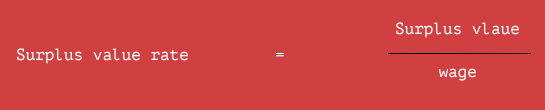
For the “free” waged worker = 10/10 = 1 = 100%; while the rate of surplus value obtained by exploiting the “sharecropper” will be = 14/6 = 2.3 = 230%. It is precisely the cultivation on the plot “conceded” by the landowner to the sharecropper that ensures this difference in the rate of surplus value. And the UOC (MLM) state that “it matters little if sharecropper cultivate on a plot”.
As Lenin indicates, the secret of this super-exploitation is that peasant labor in its plot constitutes his natural salary, covers part of the expenditure of his family, so he can reproduce his labor force by receiving a salary 4 rubles lower from the landlord. However, the landlord is the owner of the plot conceded “free of charge” to the waged-peasant worker. The peasant’s production on this plot is not independent, as there is an exploitative relation between the landlord who concede it and the peasant who cultivates it. The concession, as we have seen, is not free, since the peasant’s work in it provides the landlord with an extra surplus value of 4 rubles. The peasant’s work on the plot, therefore, is also divided into necessary labor and surplus-labor; whatever he produces there that serves to cover the 4 rubles that the landlord takes from his salary is surplus-labor that the landlord indirectly appropriates. The land is therefore not conceded free of charge to the peasant, the value of the hidden rent he pays to the landlord is exactly the amount he deducts from his salary.
It is this relation of production that is hidden in the sharecropping, which aims to retain the labor power in the countryside. It appears as a free concession of land, as a favor that the landlord grants to the peasant. The peasant feels obliged to repay this gift, with more extra labor, for example: repairing fences and other care on the property, or his wife’s labor on domestic chores around the house, in addition, of course from his family’s vote on the list of candidates appointed by the kind landlord. This is the bond of personal dependence, this alone explains why the peasant accepts being “retained” on the land, accepts earning a salary below the market price, even because he has no choice in the situation, he finds himself in. This is a waged and servile relation, that is, typically semi-feudal, in no way typically capitalist. This is an example that illustrates very well how underneath the forms of wage labor there are pre-capitalist relations that are reproduced and maintained by imperialism because they are the ones that are most useful in obtaining maximum profit. This is the historical and present reality of oppressed countries, in which the reactionary imperialist bourgeoisie, through the export of capital, engendered bureaucratic capitalism in them on the pre-capitalist, feudal/semi-feudal, basis and it maintains and reproduces its subjacent relations of property and exploitation of work through the evolution of its forms. In other words, contrary to the understanding of the UOC (MLM) leadership that such a sharecropping is “in appearance semi-feudal, but in essence, capitalist” it is in appearance capitalist and in essence semi-feudal.
However, once again the leadership of the UOC (MLM), in addition to misapplying Lenin’s teachings in The Development of Capitalism in Russia, they do not take him as a whole of his work, in how he subsequently developed his analysis of the meaning of this type of sharecropping relationship. Thus, they cite the following passage from Lenin to characterize this relationship of exploitation as typically capitalist:
“The allotment of land to the rural worker is very often to the interests of the rural employers themselves. and that is why the allotment-holding rural worker is a type to be found in all capitalist countries. the type assumes different forms in different countries: the English cottager is not the same as the small-holding peasant of France or the Rhine provinces, and the latter again is not the same as the Knecht in Prussia. Each of these bears traces of a specific agrarian system, of a specific history of agrarian relations – but this does not prevent the economist from classing them all as one type of agricultural proletarian.” 60
The UOC (MLM) takes this passage as a basis to classify this form of sharecropping as typically capitalist. Firstly, the fact that it is a relation present in all capitalist countries does not mean that it is a typically capitalist relation. Secondly, as we saw in Lenin’s texts after 1905, he recognizes that at times he overestimated the degree of development of capitalism in Russian agriculture, and that it was hard to: “estimate how large was the stratum of agricultural laborers which had arisen after the Reform of 1861 and to what extent their interests had become separated from those of the ruined peasant masses.”. Lenin himself would later classify this type of exploitative relation with greater precision:
“(…) in all capitalist countries, even the most advanced, there still exist survivals of medieval, semi-feudal exploitation of the neighboring small peasants by the big landowners as in the case of the Instleute in Germany, the métayers in France, and the sharecroppers in the United States (not only Negroes, who, in the Southern States, are mostly exploited in this way, but sometimes whites too).” 61
Or how Lenin analyzes the typical sharecropper relation in the South of the USA, as a transition from slave labor to wage labor, a particularly important phenomenon for the study of the economic-social formation of Brazil and Colombia, due to the accentuated weight of the slave exploitation of black people also in these two countries:
“The typical white farmer in America is an owner, the typical Negro farmer is a tenant. (…) These are not even tenants in the European, civilized, modern-capitalist sense of the word. They are chiefly semi-feudal or—which is the same thing in economic terms—semi-slave share-croppers.” 62
And classifies this type of share-cropping as a basis:
“It is the typically Russian, “purely Russian” labor-service system, which is known as share-cropping.” 63
This type of share-cropping, even if in its most evolved form, intended only to retain labor in the countryside, it cannot be considered as typically capitalist. Its particularity, the one that allows the price of labor power to be lowered below its value as a waged-peasant worker, is precisely the indirect exploitation of the landlord over peasant labor in his plot. The UOC (MLM) points out the importance of this type of relation in the economies of semi-colonies as one of the main sources of the super-exploitation of the proletariat and the masses of oppressed countries. However, they incorrectly interpret the economic and social content of this relation of production, classifying it as typically capitalist when it is typically semi-feudal. This is a theoretical question of utmost importance resolved by Lenin and previously pointed out by the great Engels:
“Only the actual semi-serfdom sanctioned by law and custom, and the resulting possibility of the unlimited exploitation of the rural workers” 64
If the leadership of the UOC (MLM) is consequent in their analyzes of Colombia, if they recognize the colossal error of classifying share-cropping as a typically capitalist relation, they will be forced to conclude that the super-exploitation of the Colombian proletariat when based on share-cropping relations, is based on semi-feudal relations of production and not capitalist ones. This conclusion has great significance for the Colombian revolutionary process, as understood by the CPC (Red Fraction) 65 and Proletarian Power-PO-MLM, which will provide new impulses for the march of the proletariat of this country towards the reconstitution of its vanguard Party and the Colombian Revolution.
We assess that from a practical point of view, from the class struggle in recent years in Colombia, there are many elements that justify this rectification. Colombia and Mexico are, par excellence, the homelands of peasant guerrillas in Latin America. The uninterrupted decades of peasant guerrillas in Colombia express the immense effort of the peasant masses that have not prospered precisely because they lack a suitable proletarian leadership.
From a theoretical point of view, we assess that the errors in the analysis of Latin American economic-social formations lead the UOC (MLM) to present an agrarian program incapable of mobilizing the peasant masses. Also, because it leads one to consider that this is not a strategic task for the Colombian revolution, as they conclude that the process of differentiation of the peasantry is completed, which means that the fundamental classes of the Colombian countryside would today be the agricultural proletariat and the rural bourgeoisie. That the old latifundium, based on typically capitalist relations, evolved to become big capital. Therefore, there would be no economic basis for speaking strictly about the antagonism between peasants and landlords, as they would have transformed themselves into proletarians and bourgeoisie; What would remain would be just a survival of small production, such as is also preserved in the cities.
The peasant differentiation identified by Lenin in 1899 cannot develop in the same way during the era of imperialism, in colonial/semi-colonial countries. In the differentiation that exists in rural communities today in Brazil, the peasantry is divided into a rich or middle peasantry that exploits the labor force of the poor peasantry, especially those without land or with little land. However, the conditions for transforming this rich peasantry into an agrarian bourgeoisie changed completely. We are in the epoch of imperialism, of monopoly capital, so the peasant economy, even the wealthy one, cannot progress much, as it competes with the big agricultural production, from the old latifundium allied with the big bourgeoisie and, in most cases, intertwined with finance capital. Even if a peasant differentiates himself and exploits the poor peasants in his village, at most he can be a privileged lackey of the local estate; he will very rarely become a bourgeois, in the same way that small industry can only subsist in urban centers as an auxiliary productive unit of large-scale production, generally in permanent ruin.
Another particularity of Latin America, in relation to Russia as studied by Lenin, is that its landlord economy did not evolve into a mercantile form only in the 19th century, it was born in this condition, focused on the foreign market, under the mark of the international division of labor. Therefore, the characteristic content of the economic-social formations of some Latin American countries is marked by the plantation system, large-scale monoculture productions for export, based on slave and servile labor. In Russia, at the end of the 1861 Reform, peasant communities were in possession of half of the arable land. Small peasants were semi-owners of plots of this land, the nadiels, and leased them out. The leasing of land by poor peasants in Latin America is a very rare phenomenon. In Brazil, it will appear more frequently in more recent history, in the “Settlement Projects” of the bureaucratic “agrarian reform” of the old State. In them, the poorest peasants end up leasing their land to the neighboring landlord or to the local wealthy peasant. Or when several of these peasants on the same continuous strip of land jointly lease it to the big soybean and sugarcane producers, as they are surrounded by these estates, also when transforming their land into pastures and leasing them out to the landlord cattle rancher, or with others to raise cattle on a half-share [meia] basis. But this is a recent phenomenon, a result and not a cause of the development of capitalism in agriculture. What has always happened and continues to happen is that a poor peasant without any land or a small landowner rents a plot from a neighboring farmer, generally for a period of ten years, to cultivate it on a half-share, or third-share, basis, and at the end of the contract, he has to hand over the plot and also other hundreds of hectares of land owned by the landlord with usable pastures. Still as part of the contract, he also has to make maintenance of the fences of the whole estate and other services.
The Spanish and Portuguese crowns transposed to America an outdated system based on the feudal monopoly of land, where in many cases a feudal regime was established and a slave-feudal regime in others, which in both cases, as a rule, completely excluded peasant property from the land. In Brazil, in general, the peasant has always been a resident in the landlord’s land. He only became free if he fled to the most remote regions beyond the agricultural frontier. There he established his farm, his natural economy and his precarious freedom compared to his previous servitude. He remained that way until the “owner” of the land arrived, with a “legal” or forged title of property provided by the notary bureaucracy of the old State, supported by the oligarchic power that used and expropriated the peasant lands. The saga of the squatter (posseiro) peasants in Brazil, in a permanent struggle against expropriation by landlords, is a core and essential part of our history, of a continuous peasant war interspersed with moments of rise and fall.
The capitalism that penetrated and developed in Latin American agriculture is particularly different from the form that took place in Russia analyzed by Lenin. Here the rich peasants had no way of transforming themselves into an agrarian bourgeoisie; As a rule, it is the old latifundium that becomes bourgeoisie. Brazil’s role in the world economy has boosted the capitalist relations in the countryside, there is a marked capitalist development in agriculture. But this capitalism is not the same as the one analyzed by Lenin, in the 19th century, in the era of free competition. It is a capitalism that was formed in the epoch of imperialism and in an oppressed country; Russia was, in Lenin’s words, a “military-feudal imperialist” country. Here in Brazil, what developed was a bureaucratic capitalism engendered by imperialism and completely at the service of the needs of the imperialist powers; Unlike the Russia analyzed by Lenin, there was no national agricultural machinery industry here that would impulse independent national agricultural development. Capitalist development has always been subjugated to the interests of the metropolis. And this is why imperialism never swept away semi-feudal relations in the countryside; therefore, these relations continue to exist in a covert way through the evolution of their forms.
In semi-colonial countries, peasants are the principal and not the agricultural proletariat, although the peasants are expelled from the countryside, it is the agricultural proletariat that dwindles in quantity with the advance of mechanization – already at the stage of application of robotics and soon with the remote operation of machines. Semi-feudal exploitation is the basis of bureaucratic capitalism engendered by imperialism, as a necessity for the semi-colonial subjugation of the country and the super-exploitation of its proletariat and other working masses. That is why it continues to reproduce itself and the peasant economy, although ruined, does not disappear, because it is necessary for the type of capitalism that can be reproduced in countries dominated by imperialism. With this backward and anachronistic economic base, the superstructure corresponding to it still remains, fundamentally, underlying semi-feudality in new, apparently bourgeois forms and, secondarily, in the same old forms, such as in the legal field, the inequality of civil rights, in the countryside. All this garbage that can only be swept away if the latifundium property is destroyed. This is a task of utmost importance for the proletarian revolution and the more radically it advances, the closer we will be to socialism. Therefore, peasant expropriation in semi-colonial countries does not constitute any progress, here this is not a sign of social development, but of backwardness, of emptying the countryside, of its depopulation, which has become the main counter-revolutionary policy of imperialism in the oppressed countries and mainly Yankee imperialism for Latin America, particularly after the triumph of the Chinese, Korean, Vietnamese and Cuban Revolutions. Engels, in 1894, already highlighted this issue in his criticism of Kautsky, on account of the Agrarian Program of the Social Democratic Party of Germany:
“The greater the number of peasants whom we can save from being actually hurled down into the proletariat, whom we can win over to our side while they are still peasants, the more quickly and easily the social transformation will be accomplished. It will serve us naught to wait with this transformation until capitalist production has developed everywhere to its utmost consequences, until the last small handicraftsman and the last small peasant have fallen victim to capitalist large-scale production.” 66
The masses that will most radically sweep away the landlords and the monopoly of land ownership, in favor of its future nationalization will be the masses of peasants, mainly the poor peasants. The banner that can rally these masses is the confiscation and immediate delivery of land to these peasants. This struggle can only be carried out broadly linked to the struggle for the conquest of Power, because if the peasant problem is the problem of land, the problem of land is the problem of political Power, the problem of overthrowing the power of the latifundium and the semi-colonial imperialist domination that relies on it by impulsing bureaucratic capitalism.
Therefore, the UOC (MLM) agrarian program for semi-colonial countries is completely incorrect, as can be seen:
“It is indispensable that the agriculture proletariat, who does not have the degree of concentration as the industrial proletariat, gets independent of the peasantry, both due to their program as for their organization; only then he is able to get rid of the rural petty-bourgeois atmosphere of the proprietor and of the illusion in the small property. Only then he could teach the peasants that for them to save themselves they must ally with the proletariat to struggle against private property and to convert the property of their land into collective property and collective exploitation, because the individual exploitation conditioned by the individual property is what pushes the peasants into ruin.” 67
The leadership of the UOC (MLM) insistently accuses us of being “leftists”, however, there cannot be a more “left” opportunist agrarian-peasant program than theirs; it is “left” opportunist and idealist. Intending to mobilize the scarce agricultural proletariat to teach poor landless peasants and peasants with little land the importance of the struggle against private property, to convince them to convert their small properties into collective farms is something even more childish than the dreams of Russian populists, which intended to convert peasant communities into bastions of socialism. It is a demonstration of total ignorance about the nature of the peasantry and its greatest demand, land ownership, is to push them against the proletariat and tie them to the field of counter-revolution. It is a sterile and simply foolish doctrinal idealism. More than that, a policy carried out in this way among the peasantry is a crime against the proletariat’s strategy of hegemony in the united front and its conquest of power.
What the peasant understands is that the absence of land, of little quantity and poor quality, is the immediate cause of his ruin. This sensitive knowledge is revolutionary, as it directs the peasant fury against the opposing class: the landlord who concentrates and monopolizes land and natural resources. It is actually necessary, in the course of the struggle, to convince the peasantry that there is no point in destroying only the neighboring estates, but the entire latifundium system and also confiscating the big private companies, in the liberated areas, for the new people’s revolutionary state, until it is established across the whole country. In the course of this struggle, only then can he learn that private property is no redemption, that if he stops his struggle in the midway, he will again ruin himself; the land would again be concentrated. The same iron cycle that binds the workers’ struggle will be repeated if it is restricted to the economic and trade union struggle. Under the conditions of imperialism, only with Power in the hands of the revolutionary united front under the hegemony of the proletariat, through its Communist Party, will the peasants fully understand the limits of small property. They will thus be able to forge this consciousness during the course of the revolutionary war, as there they learn the importance of new relations of production. And, above all, they learn that freedom is more important than land ownership. As Lenin stated, the peasant in the struggle for land picks up the rifle, with the rifle in his hand he discovers freedom, then this becomes more important to him than the land. Thus, transforming themselves into revolutionary peasants firmly united with the proletariat. And he stresses once again already with the dictatorship of the proletariat in force on the illusion of convincing the peasants only with well-intended proclamations and exhortations:
“The proletariat must now solve the second problem: it must prove to the peasant that the proletariat can provide him with the example and practice of economic relations of a higher level than those under which every peasant family farms on its own. The peasant still believes only in this old system; he still considers this the normal state of affairs. That is beyond doubt. It would be absurd to think that the peasant will change his attitude to vital economic problems, as a result of our propaganda. His is a wait-and-see attitude. From being neutrally hostile, he has become neutrally sympathetic. He prefers us to any other form of government because he sees that the workers’, the proletarian state, the proletarian dictatorship, does not mean brute force or usurpation, as it has been described, but is a better defender of the peasants than Kolchak, Denikin, and the rest are.” 68
In addition to the illusion of convincing through propaganda, the UOC (MLM) presents the proposition of collectivization as the banner on the order of the day. This task was not even posed by the Socialist October Revolution, which despite having established the dictatorship of the proletariat, by nationalizing land ownership did not immediately collectivize peasant production. Lenin addresses the problem of land collectivization in the Russian Revolution in this way:
“As to the mode of cultivation of the land that the victorious proletariat confiscates from the big landowners, the distribution of that land among the peasantry for their use has been predominant in Russia, owing to her economic backwardness; it is only in relatively rare and exceptional cases that state farms have been organized on the former estates which the proletarian state runs at its own expense, converting the former wage-laborers into workers for the state and members of the Soviets, which administer the state. (…) ‘state farms’” 69
The banner of nationalization, raised by the peasants in 1905, adopted by the Party from then on, does not yet equate to the collectivization of agriculture, much less its socialization, as revisionists and Trotskyists falsify. Lenin defines “the nationalization of the land, which all the representatives of the peasantry were demanding, more or less consistently, in the period between 1905 and 1907” as the most radical form of sweeping away serfdom, as a bourgeois-democratic task, therefore:
“The abolition of private property in land in no way changes the bourgeois basis of commercial and capitalist landowning. There is nothing more erroneous than the opinion that the nationalization of the land has anything in common with socialism, or even with equalized land tenure. Socialism, as we know, means the abolition of commodity economy. Nationalization, on the other hand, means converting the land into the property of the state, and such a conversion does not in the least affect private farming on the land. (…) Nationalization makes a clean sweep of all medieval relations in landowning, does away with all artificial barriers on the land, and makes the land really free (…) Nationalization would hasten the death of serfdom and the development of purely bourgeois farming on land free of all medieval lumber. That is the real historical significance of nationalization in Russia—what it has come to mean by the end of the nineteenth century.” 70
Nationalization did not emerge as a banner for the peasantry in Latin America, which is why our slogan must be “land for those who till it and live on it”. The experience of the Great Socialist October Revolution and the Great Chinese Revolution demonstrated that the agrarian-peasant revolution was, par excellence, the way to ensure the nationalization of land and, therefore, collectivization in agriculture, ensuring the hegemony of the proletariat in both cases: the dictatorship of the proletariat in Russia and the joint dictatorship of revolutionary classes and its uninterrupted transition toward socialism. Lenin highlights that, despite the economic inconveniences that may arise from excessive land sharing, the principal aspect in implementing the correct agrarian program is the issue of ensuring the triumph of the revolution and consolidating the New Power:
“It would, however, be grossly erroneous to exaggerate or to stereotype this rule [of collectivization] and never to permit the free grant of part of the land that belonged to the expropriated expropriators to the neighboring small and sometimes middle peasants. First, the objection usually raised to this, namely, that large-scale farming is technically superior (…) To achieve the success of this revolution, the proletariat should not shrink from a temporary decline in production (…) What is most important to the bourgeois is production for the sake of production; what is most important to the working and exploited population is the overthrow of the exploiters and the creation of conditions that will permit the working people to work for themselves, and not for the capitalists. It is the primary and fundamental task of the proletariat to ensure the proletarian victory and its stability. There can, however, be no stable proletarian government unless the middle peasantry is neutralized and the support is secured of a very considerable section of the small peasantry, if not all of them.” 71
Imperialism and the development of capitalism in the countryside do not solve the agrarian-peasant problem in colonial and semi-colonial countries. Therefore, the semi-feudality at the basis of the fundamental social contradiction in the countryside of these countries is the antagonism between the poor peasantry and the landlords. The agrarian program to be established by the communists must depart from the concrete experience of leading the struggle of these masses in defense of their demands, especially land for those who till it and live on it. Advancing this struggle invariably leads to the problem of revolutionary violence and the struggle for Power. After all, as Chairman Gonzalo brilliantly established:
“(…) to speak of the peasant problem is to speak of the problem of land, to speak of the problem of land is to speak of the military problem, and to speak of the military problem is to speak of Power, the Power of the New State to which we achieve with the democratic revolution led by the proletariat through its Party, the Communist Party.” 72
Avoiding the leadership of the peasant struggle for land is invariably avoiding the military problem, an issue that immediately arises in the initial and most elementary forms of the struggle for land.
72 Footnotes