Revolution in Peru – The Committee to Support the Revolution in Peru
Return to Peru
REVOLUTION in PERU 1
Published by
THE COMMITTEE TO SUPPORT THE REVOLUTION IN PERU
First Printing, May, 1985
INTRODUCTION
A revolutionary war of great significance is raging today in Peru. Although largely blacked in the U.S. press since the Communist Party of Peru 2 (known as the “Sendero Luminoso” or “Shining Path” in the press) launched the armed struggle in 1980, the Peruvian revolution has been the target of increasing attention, and attack, in recent months.
Commenting on U.S. “hotspots” worldwide, William Randolph Hearst, Jr., devoted several paragraphs in a September 16, 1984, issue of the San Francisco Examiner, to the “Maoist rebellion” in Peru, calling it “potentially the most explosive situation of in the Western Hemisphere.”
Yet, while many of the “hotspots” the U.S. is presently involved in are prominently in the news day after day and get detailed analysis, the revolutionary war in Peru has been only sporadically reported upon, and then with a tint of bewilderment and sensationalism; for example, headlines like “Peru, Corner of the Dead,” or “Red Rebs Machinegun U.S. Embassy in Peru,” or comments like the following from the Washington Post: “Sendero Luminoso remains probably the most enigmatic guerrilla movement in the hemisphere…it does not seek international allies and there is no evidence that it has any.” And, “Relatively little is known about Sendero, which scorns traditional political propaganda as well as most Marxists elsewhere. There is no evidence received outside support.”
Translated, the PCP “enigma” is the fact that while wars erupt all over the world with armies trained, equipped and directed either openly or covertly by either the U.S.A. or the U.S.S.R., the revolution in Peru is being developed politically and militarily in opposition to both superpowers and their blocs. It does not consider the Soviet Union, or any other country today, socialist. All this is so “enigmatic” if one looks at the PCP’s actual writings, and the party does seek international allies as shown by its participation in the Revolutionary Internationalist Movement (RIM) which was formed by 17 parties and organizations worldwide in early 1984. In fact, far from seeing the struggle as an isolated one, the PCP sees it as an integral part of a world revolutionary change. In their publication Develop Guerrilla Warfare, they say:
We are firm practitioners of the great principle of reliance upon our own strength, as we are firm followers of proletarian internationalism, unfurling that immortal call of Marx and Engels, “Workers of All Countries, Unite!” And as communists we always raise up the three great banners together of Marxism-Leninism-Maoism, which demands of us that we be irreconcilable enemies of revisionism and all forms of opportunism, and in waging the revolution in our country we serve the world proletarian revolution which waged and will be waged until communism shines over the face of the earth.
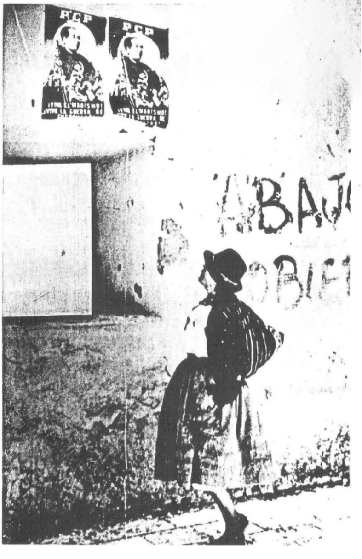
The strength the PCP is speaking of here is its own people, and all indications point to the fact that the struggle has grown significantly since 1980 and gained broad support. In its report to the RIM in May, 1984, the PCP stated:
…the People’s Guerrilla Army, organized in the first part of 1983, has become several times larger through the massive joining of peasants, especially poor peasants; the People’s Committees have multiplied considerably, and most importantly, have developed in terms of their exercise of state functions, and an Organizing Committee of the People’s New Democratic Republic has been formed, while the Revolutionary People’s Defense Front in the countryside and Revolutionary People’s Defense Movement in the city are taking form, with the centers of resistance as their axis. Finally, 1983 saw more than half of the 15,000-armed actions carried out in the four years of armed struggle…
Among these more than 7,500 actions are included clashes in the northernmost jungle areas, attacks on government institutions and military posts in almost every department 3, including in the mountains and mining areas, and attacks within all major cities. In fact, this new offensive has completed a picture of a revolutionary army able to strike almost simultaneously from one end of the country to the other, mobilizing forces from diverse sections of the people and areas. Today, even the Peruvian government admits that what they used to call a “handful of delinquents” has become an army with real support among broad strata of the population. This new assessment of the situation is shared with U.S. leaders:
The Reagan administration plans to ask congress to double military aid to Peru next year, which would make that country the largest recipient of U.S. military aid in South America, State Department officials said yesterday…”We want to encourage the Peruvians to be in a position to fight their own, significant internal difficulties.” (New York Times, 1/30/85.)
These are some of the factors that have led to the U.S government concern expressed in press reports about the situation being so explosive it could be even more dangerous than the present war in Cinereal America.
HISTORY and BACKGROUND
When the Communist Party of Peru launched the armed struggle in 1980, the political-economic situation in Peru was at an extreme: by 1979 the decade that had begun with the then-ruling General Velasco’s promises of reform and an end to foreign domination ended in a foreign domination more intense than ever. General Velasco had come in via military coup to save the country from President Belaunde in 1968. General Morales saved Peru from General Velasco in 1976. Belaunde returned in 1980 via U.S.-orchestrated elections to save Peru from General Morales. Conditions in Peru had become so heated because of the disastrous economic situation, that that foreign investors feared chaos or even worse (for them), an uprising. To stop this ferment and bring Peru thoroughly back into the U.S. orbit, the U.S. fashioned Belaunde’s “return to democracy.” Belaunde came with solid credentials: raised and educated in the U.S. he was an was old hand at fine speeches and rhetoric. He was also an old hand at smashing popular uprisings, having unleashed the Armed Forces on the Peruvian people more than once in the ’60s. Soon after his election, he filled his cabinet with men like the Wells Fargo Bank vice-president who was made Minister of the Economy and Finance, and went on to remove any remaining barriers to U.S. penetration. President Belaunde is fond of blaming the “Senderistas” for Peru’s problems, but the massive foreign debt, the IMF “austerity” measures that exacerbate the poverty, the social unrest, the racism, the land question, the Armed Forces running rampant over people —all this was part of the Peruvian reality long before the PCP launched the armed struggle.
Peru’s domination by foreign powers began in the 1500s with the Spanish, was assumed by the British in the 1800s, and in the 1900s, fell to the U.S., with penetration so thorough that by the 1960s, Peru’s oilfields, mines, sugar and cotton plantations, fishmeal industry and even its railroads, phone company, electric companies and water companies were mostly U.S.-owned.

During the revolutionary upheavals worldwide in the 1960s, Peruvians also sought to free themselves from the intolerable foreign domination that had control of their economy, their political life and even their cultural life. Massive popular uprisings, including general strikes and peasant land seizures shook the country. The military coup of 1968 carried out to deal with this unrest as well as handle the crippling economic problems caused both by this foreign penetration as well as the backward feudal land relations from the times of the Spanish. Thus began the 12 year “revolution” of Generals Velasco and Morales. Velasco nationalized those industries, resources and services most in need of modernizing; he initiated a land reform, mainly of the coastal plantations, that left the same managers and overseers in charge. He even began a mild flirtation with the U.S.S.R., who nosed into U.S. territory enough to become a major weapons supplier to the Peruvian Armed Forces, but Velasco never broke with the U.S. nor did he ever intend to. His main purpose was to better exploit the Peruvian economy, not radically change social, economic or political relations. Peru fell under a top-heavy bureaucracy dependent on foreign loans and aid from Western Europe and the U.S.
Eventually the Velasco-led regime ran up against the limits of this sort of expansion. Rising political dissidence accompanied the economic failures. When it became clear Velasco could no longer serve as an effective demagogue of development and leader of the dictatorship, he was replaced by Morales Bermudez as head of state. Although Morales cut back considerably on many of the failed programs, Peru’s economic crisis continued to develop as grip of foreign capital, particularly U.S., squeezed the country. Peru increasingly became a debtors’ prison for its people. For years, the generals welcomed injections of huge amounts of capital from international financial institutions, both public and private, for “development projects” that used Peru’s oil, copper and other natural resources for collateral. One manifestation of the inevitable crisis appeared when international trade prices fell on the commodities Peru exports during the worldwide recession of 1974-75, and Peru could not keep up the payments on the interest of its loans, let alone the principal. The IMF and other U.S.-led institutions began to demand severe austerity measures of Peru in exchange for refinancing the debt (and not taking even more severe measures to gather repayment). In 1983, Peru was paying one-third of its national budget to “service” (make repayment on) the national debt. Today, Peru has one of the highest per capita debts in the world, $13.5 billion (NYT, 4-14-85), for a nation of less than 18 million people.
Translated into human terms, the infant mortality rate is among the third or fourth highest in the Western Hemisphere. Unemployment is officially at 41%. Caloric consumption, low by U.N. standards all over the country, falls to only 420 calories a day in some parts of the Sierra. The prices of staples, government-subsidized, are the first to rise when the IMF “austerity measures” are imposed; some items like sugar are rationed even though Peru is a sugar- exporting country. Medical services for the poor are almost non-existent. And despite the fact that Peru has a very rich intellectual culture, the majority of Peruvians are illiterate.
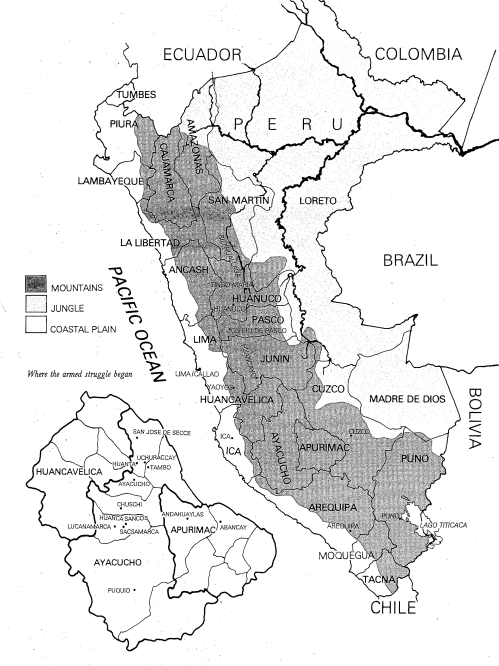
The interior has always been the hardest hit by effects of foreign domination. Like any other “third world” country where development and progress are geared directly to the “Great Powers'” orbit, certain areas (in Peru, generally, the coastal areas) are built up while other areas are left to rot. In Peru, the areas least useful, and expendable, economically, to foreign capital are the relatively inaccessible interior —the jungle (Selva) and mountainous regions (Sierra). Even today the best roads in the mountains are those ordered built by the Incan empire in the 1400s. It was in this interior, high in the mountainous regions of Peru’s poorest area, that the Communist Party of Peru first began the Armed Struggle.
BEGINNING of the STORM
The Communist Party of Peru is called the “Sendero Luminoso” by the press because of a student newspaper it once published under that name. It comes from a quote by Jose Carlos Mariátegui that revolution is the shining path the world proletariat must take in order to liberate itself and all of humanity. Although the party, which was formed in 1928, affiliated with the Third Internationale of Lenin and Stalin, after Mariátegui’s death, revolutionary struggle was set aside for over a generation, until the early 1960s, when Mao Tsetung’s polemics against the direction the Communist Party of the Soviet Union was taking, led to a reawakening of this spirit and a rediscovery of Mariátegui. Later in the decade the influence of the Cultural Revolution would also be extremely important. Pro-Cuban forces which had not made any break with the Soviet line took armed struggle and were crushed. For the Marxist-Leninists in the PCP, the armed revolution was an immediate responsibility, and any further inactivity was intolerable. As Comrade Gonzalo, then the leader of the party’s work in Ayacucho was to declare, “It is not enough to criticize revisionism. We must assume our own responsibilities.”
Under the leadership of Comrade Gonzalo, the party was rebuilt along revolutionary lines through the next 15 years; this took many difficult twists and turns and was to result in several major splits, but the result was a steel-forged and conscious force of cadres ready to begin a people’s war. Most of them were the sons and daughters of peasants, and they spent 10 years living with their people in the mountains. In 1979, they spent a year of concentrated preparations, including the study of the conditions and feelings of various social strata, which along with geographical considerations, was used to decide where the armed struggle would begin. A party military school was established to train these cadres to lead the armed struggle. (World to Win, 1985/1 p. 35)

They launched the armed struggle in 1980 with the bombing of polling places because they wanted to expose the whole “return to democracy” as a patent fraud, a sham manipulated by the U.S. and promising only more of the same for the people. More importantly, they wanted to show that the path forward was the shining path, the armed revolution, the only real alternative for the majority of Peruvians.
By 1982, when they published their manifesto, Develop Guerrilla Warfare, with a bright red cover, and distributed more than 100,000 of them throughout Peru, they could proclaim:
The Communist Party of Peru, the organized vanguard of the proletariat, founded by Mariátegui and rebuilt through more than 15 years of stubborn struggle as a Marxist-Leninist-Maoist party of a new type, assumed its historic role, determined to fight for power for the class and the people, and set burning in May, 1980, the invincible and ever-growing flames of armed struggle, of guerrilla war, in our country. This struggle is linked to, and rooted every day more deeply in, the class struggle in our land; it will soon become a raging hurricane of armed battle, to demolish the old, rotten order, and bring to life a really free country with Sovereignty and well-being for the millions of exploited and oppressed.

That they did unleash a “raging hurricane” soon proved true, especially in the impoverished highlands. A major battle was fought March 2, 1982, with a pre-dawn raid on the prison in Ayacucho city, 250 miles south of Lima. Even the international press took notice of it:
That night, approximately 150 “delinquents” blacked out Ayacucho city, the capital of the department. Firing automatic weapons stolen from the police and using Inca slingshots (called huaraca) to hurl dynamite, they overran the city’s maximum-security prison. There, they sang revolutionary hymns, raised red flags, and freed all 247 prisoners, a number of whom were suspected of being terrorists (sic)…(Atlantic, May, 1984)
In the towns and cities, fierce armed actions have also taken place. One of the most spectacular actions of this kind occurred in April, 1983, when high tension towers were dynamited4 and the capital city of Lima darkened for an entire night. The guerrillas then hit specific targets like police stations, banks and the huge $250 million Bayer chemical factory, which was completely destroyed. A blackout like this does not affect the slums, which have no electricity, but the lighting of huge bon-fires in the shape of hammer and sickle (to signify the worker-peasant alliance) above the city in the hills has a profound psychological effect, both on those forces supporting the guerrillas as well as on the enemy. During the recent visit of the Pope Peru, PCP supporters answered his call to lay down their arms (made just at the time the U.S. Administration was asking Congress to double military aid to Peru) by blacking out Lima as his plane landed and lighting a huge hammer and sickle on the hill of St. Christopher (patron saint of travelogs) above the city.
The “hurricane” has blown inside the prisons as well, brought by the prisoners themselves through intense struggle with the prison authorities. In El Fronton, the notorious island prison off the port of Callao, hundreds of “Senderistas” are jailed:
The terrorists (sic) have a privileged position in El Fronton: they have converted the jail into a sort of terrorist university; they have their “liberated” territory (the Blue Pavillion), their own mural newspaper, radio parts to receive messages, weekly newspapers to “raise consciousness” to which their visitors subscribe and even their own red flags fly over the island. (Oiga, 12/21/83; Peruvian magazine)
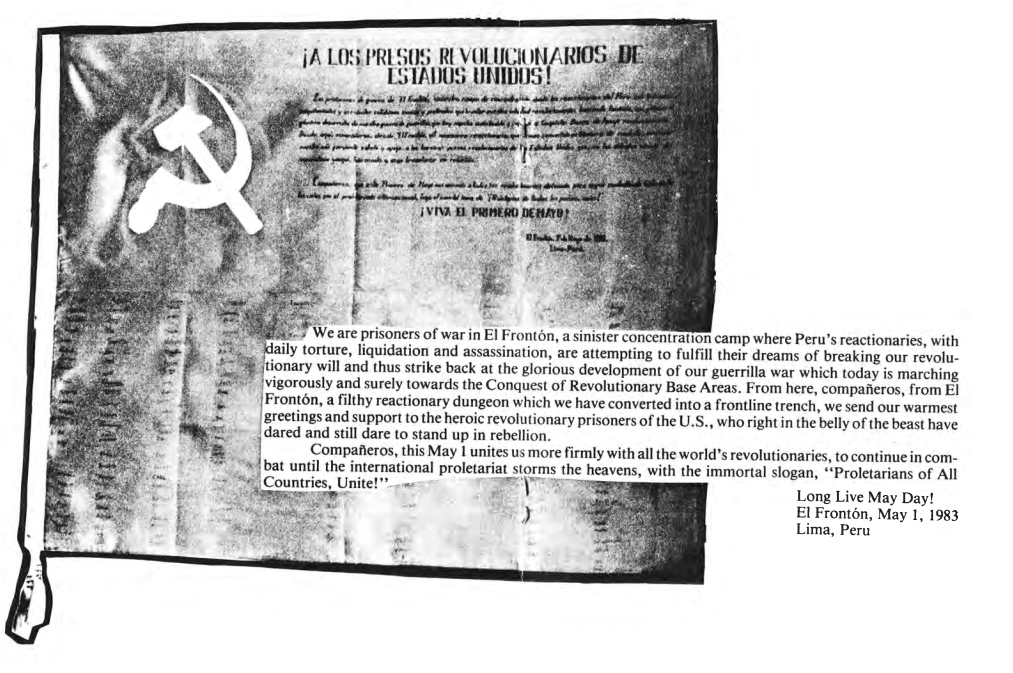
The article neglects to inform the reader this situation has been brought about despite extreme and sub-human conditions in the jail: tuberculosis is endemic; food s nearly non-existent and must be supplemented by donations from relatives and friends (when allowed); prisoners have been shot down in the courtyard for singing the Internationale (Caretas, 5/18/83; 9/20/82). Red flag flying or no, items of the color red and particularly red cloth are strictly prohibited in this prison, but nevertheless, a red satin banner was smuggled out as an international exchange for May Day, 1983. On it was inscribed “To the Revolutionary Prisoners of the U.S.!” and the names of hundreds of prisoners.
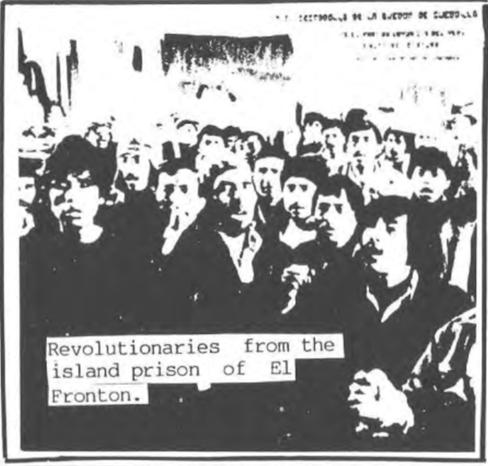
The high morale of the prisoners in El Fronton and in other prisons around the country was described in a NYT article, 9/7/84:
Amid broken windows, swarms of flies and the stench of an open sewer, the guerrilla prisoners—young and middle-aged men—with Indian features—were writing, weaving or reading books from their small library.
Frayed volumes had been stitched with cotton thread: texts of Mao and Lenin, a Bible, poetry from Spain, the writings of Jose Carlos Mariategui…
In a woman’s prison, the article continues,
In Peru’s traditional society, many people have been shocked by the fact that women have not only joined the guerrillas but at times, have reportedly led attacks.
Holding her baby, born in jail two months earlier, Lilian Torres, 23 years had worked as a maid and street vendor in Lima since she was 17.
She had been afraid at first “to join the party,” she said, but became aware of her responsibility when she learned about “the class struggle” and the “offensive of world revolution” taking place in Peru.
“Now I am happier,” she said. “I have stopped being a vegetable.”
RURAL ORGANIZATION
The media often claims PCP actions have no rhyme or reason. Actually, to anyone familiar with Mao’s writings, the strategy is both evident and logical. Roughly, it is to develop a United Front which includes many strata in society, but whose core is an alliance of peasants and workers led by the vanguard of the proletariat. This united front is built around a program of “New Democratic Revolution,” whose main targets the PCP identifies as imperialism, feudalism and bureaucratic capitalism which is aligned to both. This revolution is itself a prelude to the socialist stage of revolution. The strategy is to “surround the cities by the countryside:”
The mountains and countryside are a powerful and natural base for any revolutionary war in our country. Ours is a peasant war, led by our party, which is converting the countryside into the armed bastion of the revolution, in the concrete form of base areas embryos of the New State of workers and peasants and isolating the reactionaries and their imperialist masters in the cities. There, the proletariat and the masses burn the bottoms of the enemy’s bloody paws mainly through armed actions which serve the struggle in the countryside, the center of the storm, and prepare the conditions for the final assault on the cities and the army that maintains it. (Develop Guerrilla Warfare)
In order to establish and develop these rural revolutionary base areas, peasant support and participation are absolutely vital. No guerrilla war can be fought without them. Peru’s prime minister, Luis Percovich, described this quite frankly in an inter- view he gave to the Mexican newspaper, Excelsior, 9/24/83:
…in Ayacucho, the Senderistas operate on foot in small groups of militants armed with machine guns and revolvers, who attack with the massive support of the peasants carrying sticks of dynamite, steel weapons and simple farm implements.
These last are called “guerrilleros de la noche” (night guerrillas – tr.), that is, those who ordinarily live in the same zone where the attack takes place, and later return to their usual, occupations; the initial group will eventually leave the zone to them.
In other cases, the guerrilla is massively accompanied by the entire population of a community or county that has decided to support them…
Much of the media has claimed that the peasantry supports the guerrillas because it is “terrified” of them a difficult proposition given the words of Prime Minister Percovich, and a truly ridiculous idea given the massive government terror against the people. In fact, this is the very first time in their centuries-long history that the indigenous peasantry has been called upon to rise up like human beings and really take history into their Own hands.
The Andes constitute what one writer has called a “‘fourth world enclave’ in a ‘third world’ country.” Audrey Bronstein describes this “fourth world enclave” in her book The Triple Struggle in Latin America:
In southern Peru, 60% of the rural population are without access to health services. Three-quarters of rural children who start school do not even finish the primary years. Services such as clean water and electricity are available only to people living close to the urban centers, and even then, only to those who can afford it. In fact, 83% of the rural population are without clean water; 98% have no sanitation facilities.
Illiteracy is high amongst the peasants, higher still amongst the women. The Indians speak Quechua or Aymara to each other, using Spanish only when they themselves have to go to town or when an outsider comes to the village. Very few women in the remote areas speak Spanish.
The peasants of this interior, feudal terrain are the descendants of the indigenous peoples the Incas brought together in one enormous empire stretching from Ecuador to Chile. Their life expectancy is 44 (on the coast it is 54, lower than Bangladesh). They have always worked land belonging to others; their status was so low that when the hacendado or latifundista sold his land, “his” Indians were included in the deal. The much touted “land reform” of General Velasco in the ’70s was described by secretary general of the Confederation of Peruvian Peasants thusly:
“For us the state became the new landowner and maintained not only the same forms of exploitation, but above all, the same methods of production.” (The Guardian, 2/5/81)
Even this farce of land reform was centered on the coast, and barely affected Ayacucho department, Peru’s poorest and most neglected area.
Along with their terrible poverty, the peasantry suffers a cultural oppression as well: they are utterly despised, their language, dress and customs are cause for derision and contempt. To be called “indio” (Indian) in Peru is to be called “nigger.” One of the worst insults you can throw at a Peruvian is “! Indio tienes que ser!” (“You’ve got to be an Indian!”) It should come as no surprise that it was among these people that the PCP found its first base of support.
The RIM report quoted in the introduction describes the popular support the PCP has earned the past five years. The support arises directly from the participation of the peasants. No “condescending saviors” are placed over them; they themselves must actively take part in all aspects of this struggle. In the “revolutionary base areas” which are now being developed, the People’s Committees are the embryos of the New Democratic Republic.
The first People’s Committees were formed toward the end of 1982, on the basis of committees formed by the peasants to divide up the harvest in the areas where the peasants under PCP leadership had overthrown the landlords and local authorities. Soon the newly formed committees took on the additional tasks of organizing the collective planting of crops and work in general, and increasingly, other functions of political rule as well.
In 1984, the Lima press published what they claimed was a captured PCP document describing the first popular meeting in a Lima shantytown that gives an idea of how these popular organizations govern: it was decided to ban gambling, drugs, fortune telling, continual drunkenness, beating women and other family members, robbery, bullying, and police collaboration. Penalties for violations ranged from small fines, to cutting hair, to execution in the case of police agents. The press made much of this last penalty, but without such enforcement, the people would have no power to impose their will and would be afraid to step forward and join the struggle.
There are still few places in Peru where the authorities can’t enter if they amass enough and when they do come in, they always take reprisals, including public torture and execution, especially of those openly allied with the guerrillas. However, their ability to do this is severely limited in many areas and can be applied to only a few places at one time. Large areas of the country, in fact, remain out of their control. Because of these reprisals, it became impossible to choose committee members by mass vote at a public meeting. Now they are chosen secretly, by village representatives. Committee members are called “commissars” because they have a commission (revokable) from the people; there is a secretary, a commissar of security to watch over pro-government elements in the village, a production commissar who regulates production and commerce, someone to register births, marriages and education, etc. and someone who heads up all the various organizations the villagers have formed like the poor peasants’ movement, the class conscious laborers and workers’ movement, the women’s movement and even a children’s movement which began completely unforeseen by the PCP because of the demands of the children themselves. (See, World to Win, 1985, 1, pp. 38-39)

People’s spirits have been lifted considerably with the dream of actually changing society from bottom up becoming a reality before their eyes, and the peasants and working people and poor of Peru have taken up some highly advanced notions of the real possibility of changing not only their own status, but providing an example to the people of the world:
We have printed the poster announcing the formation Revolutionary Internationalist Movement. It will continue to be used mainly for propaganda and agitation. It has been distributed to the party organizations, platoons of the People’s Guerrilla Army, People’s Committees…unions and peasant organizations in general. The majority of posters were sent to the countryside for the education and mobilization principally of the poor peasants. In the cities it was centered especially among the proletariat and also the poor working masses who live in the slums, as well as among the university students. The center of the campaign is the RIM as a new world unification of communists faithful to Marxism and the explanation of the revolutionary content of the slogan “Break the Chains” and “Proletarians of All Countries, Unite!” is of great importance. (Report to the RIM, ibid)

In the first few years of the armed struggle, the PCP lost a large number of its original members, but its ranks have increased greatly since then, and their influence in the rural areas has grown to such an extent that by June, 1984, there were about 100,000 people living under and participating in the new political power led by the PCP.

| FREE MECHE! This letter was sent all over the world from Peru in July 1984: “This is to tell you that Laura Zambrano Padilla, a teacher, known as Meche and a great revolutionary fighter, was arrested this past July 20. We must develop a campaign to save her life, and against the cruel and savage torture to which she has been subjected. They are trying to kill her— this was openly threatened by the head of DIRCOTE (Police Anti-terrorist Command) himself, whose name is Gastelu, and it must be exposed. “Here a campaign is developing to defend political prisoners and denounce the ‘disappearances’: Since the struggle has reached its highest level, once again they are carrying out massacres and bodies are appearing in the hills and ravines. On July 25, 80 Republican Guards (prison police), called the Llapan Atiq in Quechua, went into the prison at Callao where 84 women fighters are locked up. They violently abused the women, robbing them of all their possessions that might be worth anything, and destroying everything else. They threw in tear gas bombs and beat the women brutally. Ten women were injured in this way: comrades Delia Taquiri, Elizabeth Romani, Dihla Ruiton, Juana Cuyubamba, Jenny Rodriguez, Isabel Gonzales, Nancy Burga, Dora Munoz, Isabel Carhuentico, Aida Zaire, Lina Romero and Marina Infanzon. But of all this, the centre of the exposure campaign should be the teacher Laura Zambrano, known as ‘Meche.”” |
ROLE of WOMEN
As the NYT article of 9/7/84, pointed out, “In Peru’s traditional society, many people have been shocked by the fact that women have not only joined the guerrillas, but at times have reportedly led attacks.” Many units within the People’s Guerrilla Army established in 1983 and with a reported strength in the several thousand are commanded by Women as well as made up of a majority of women. Women are also in the top ranks of party leadership, which gives some idea of the content of this being waged in a country where the “right” of the landlord and his cohorts to rape peasant women at will reveals women’s overall situation in the old society. This position has been described in detail as the “triple oppression” (see for example the above-cited book by Audrey Bronstein), i.e. the oppression of being women, Indians, and peasants or workers in a society that despises and abuses all three.
Women leaders and fighters of the PCP have been targeted for special abuse by the authorities. One case in particular brings this out: in 1984, Professor Laura Zambrano Padilla was detained during a police sweep and accused in a sensationalist campaign in the press of all manner of deeds against the regime, including, most critically, of being “an important ideological leader of Sendero.” A letter sent from Peru (see box) describes her as “a great revolutionary fighter.” She has been the police anti-terrorist command, formed expressly to deal with urban supporters of the PCP, and the head of this fascist-type unit has openly vowed to kill her. Her family and friends, as well as a wide range of political forces, charge she has been tortured, and an international campaign has been launched to free her.
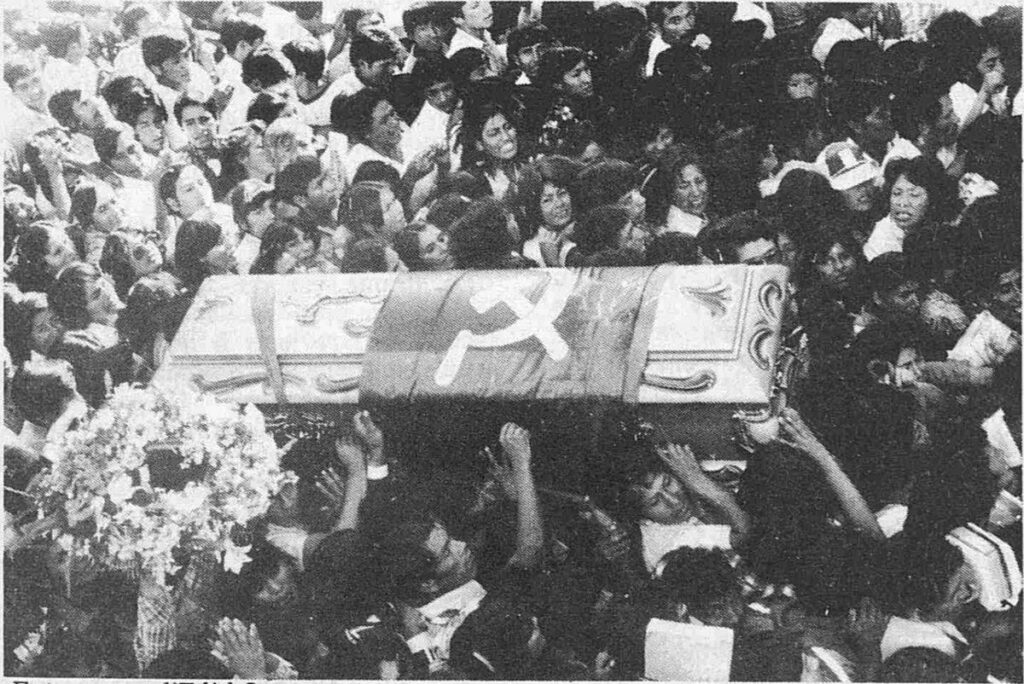
Earlier in the struggle, another arrest and murder of a woman fighter also became a national incident in Peru. In September, 1982, Edith Lagos, was captured, tortured and bayoneted to death death in Ayacucho by Civil Guards enraged at the fact that an Indian peasant, and a 19-year-old woman at that, had dared defy their authority. They banned any public funeral for her, but the people of Ayacucho came out en masse. Over 30,000 people—in this city of 80,000— filled the streets to carry her coffin draped with the red PCP flag.
STRUGGLE in the CITIES
The struggle in the countryside— the main focus of the people’s war—interpenetrates with the struggle in the urban areas. During the 1984 May Day campaign to agitate around the formation of the RIM, the PCP managed to create a good deal of public opinion:
We should emphasize that because of the concentration of the workers and of greater literacy in the capital, almost 30% of the leaflets were distributed there… The welcome that the posters and leaflets have had among the government workers is outstanding (500,000 state workers held out for more than three weeks in an indefinite strike) since agitation, with the RIM documents, was carried out in the midst of their strike, especially in their protest marches confrontations with the police. (RIM report, ibid)
The PCP has been increasingly successful building support among strata like industrial workers, especially from smaller factories, where even worse conditions prevail, and middle sectors; though some workers and people more in the middle sectors might have gotten a few crumbs during Velasco’s days, now they are in the throes of a 30-50% reduction in real wages since 10 years ago, 130% inflation, and the prospect of little or no future.
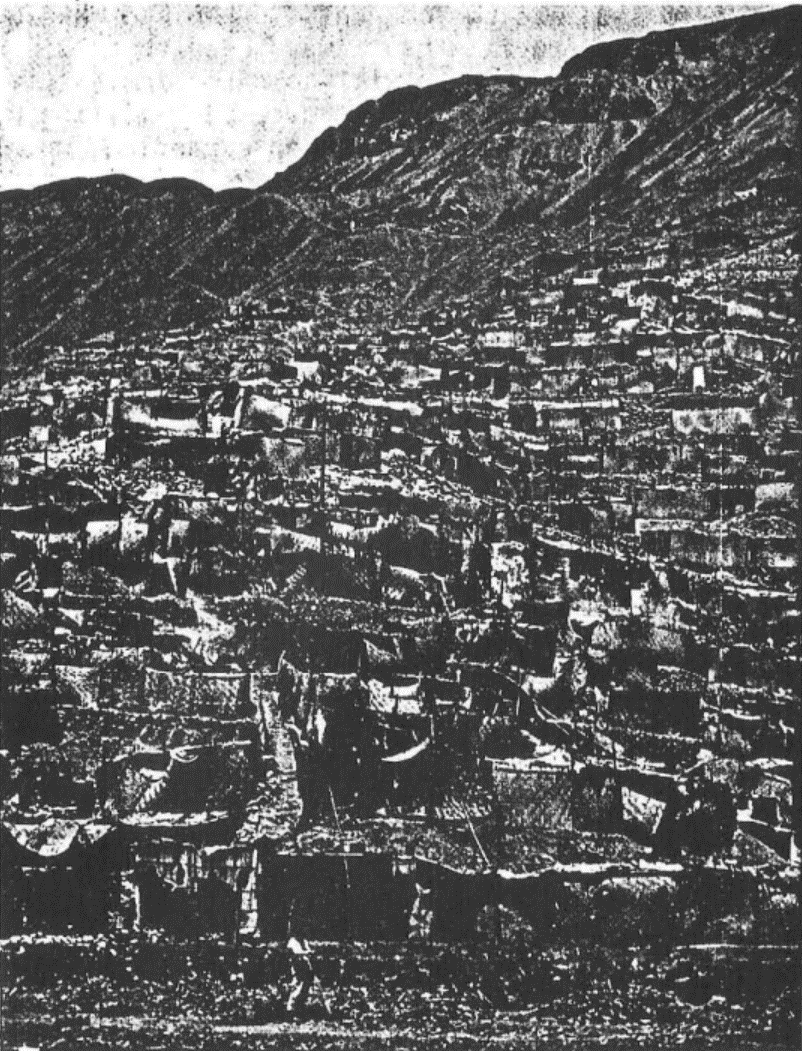
The party’s broadest support in these urban areas today, however, comes from the poor and dispossessed in the vast urban slums. Some of these are presently workers, while many are unemployed. Since the ’60s, peasants by the thousands have been driven off the land and into the coastal, urbanized areas. The joke among Peruvians has always been that “since Lima won’t go to Peru, Peru will come to Lima.” Lima grew from 1.5 million in 1961 to over five million by 1980. These new arrivals live in an expanding wheel of roofless shacks euphemistically called “pueblos Jovenes” (“young towns”) by the government. They have no water, electricity or bus service, and three-fourths of Lima’s six million plus population lives there. This is the “mob” Lenin encouraged his followers during the Russian revolution to put themselves at the head of, and the PCP has done that, not only to support the rural war, but to carry out propaganda actions in the city as well. In one form of struggle, hundreds and sometimes thousands of these people are mobilized in a matter of minutes for a lightening rally, or to surround and destroy government building or other targets and then scatter again.
Though the cities are still the main bastions of the regime, it can hardly be said the authorities feel “secure” in their realms. Lima has been under martial law on and off for months. Within a 72-hour period in July, 1984, 19,000 people were captured in police sweeps in Lima, Ayacucho and other cities. Police raided bars, restaurants, gambling halls, stores, plazas, and streets detaining everyone who could not present proper ID or who aroused their suspicions in any way (such as being too poor, too young and/or too Indian). It was during this sweep in Lima that Professor Laura Zambrano Padilla was captured.
At the time of this police sweep, the PCP brazenly carried out a number of military actions. July 18 is Independence Day and July 23 is Air Force Day, and the government wanted to put on a big show of patriotism and support for the regime, police sweeps and PCP armed actions notwithstanding. The Air Force in particular went all out with parades, and Belaunde gave an impassioned speech, accusing the revolutionaries of being “drug traffickers and outsiders” bent upon destroying the very foundations of the country’s institutions. The PCP responded with heavy attacks on those institutions, and the government forces protecting them. Electricity was cut that same night in more than a dozen cities, an army garrison at Huancayo, 180 miles east of Lima, was attacked, and other army posts, police stations, government buildings, etc., were hit hard in the next few days. The offices of the soviet airliner Aeroflot, located in the ultra-luxurious Sheraton Hotel in Lima, were destroyed also.
Again, the newspapers were filled with headlines indicating official amazement and outrage over the fact that women had led many of the attacks: “A Woman Leads Assault on Oil Refinery in Uchiza;” “Terrorists Led by Women Burn Furniture Factory ‘501’”…
WHO ARE the REAL TERRORISTS?
In December, 1982, President Belaunde, who had proved his worth as a democratic leader in the ’60s by supervising the massacre of over 8,000 rural poor, found himself in the throes of a recurrent nightmare: the Andes were on fire again. His bloody imposition of rural “peace and quiet” had not lasted long. Worst of all, the leadership of this blaze appeared to have far better understanding of how to wage revolution and far deeper ties with the peasantry than any he’d ever seen. He declared the territory an emergency military zone and sent in 3,000 Civil Guard under General Noel. As commander of three departments comprising the military zone (Ayacucho, Huancavelica and Apurimac), General Noel (or “Papa Noel” Santa Claus as the inhabitants of Ayacucho derisively called him) established a record for rape, corruption, summary execution, torture and looting. Despite these tactics, Noel made no progress at all in eradicating the guerrilla. In fact, the revolutionary forces grew so much that the police chief of Ayacucho publicly declared, “Ayacucho is 80% Senderista.” Noel was replaced by Huaman who was replaced in August, 1984, with Mori. The regime was determined that the status-quo, the age-old lot of the peasantry with all its attendant misery, was going to be enforced and upheld at any cost, even as the PCP cut the ground out from under them.
Contingents of the various branches of the military had come in with the Civil Guard, but the Army did not have official control. In 1984, the president did grant the Armed Forces full control, since the Civil Guard was suffering from “acute problems of morale.” 5,000 regular troops (Army, Marines, Air Force) entered the area. Recently, massive scandals involving these troops and particularly the Marines, have shaken the country, as mass grave after mass grave has been discovered, full of their victims. Headlines, even in such conservative publications as the newspaper La Republica, proclaim “They Killed Them at the Foot of Their Graves, Sadistically, Without Compassion.”
The “necessity” of such tactics was made clear in a NYT interview with Ayacucho’s police chief, quoted above regarding the composition of Ayacucho: “80% Senderista.” He also said, “What is needed here is the Argentine solution,” an unsubtle referral to the slaughter of tens of thousands of civilians in Argentina by the military in an effort to root out resistance to their rule. Prime Minister Percovich whom we quoted earlier about the “massive support” of the peasantry for the PCP, said, in reference to this Argentine solution, “We know how to use the examples we have been given.” Statements like these make clear the lie— and the vicious purpose—behind the common “wisdom” in the U.S. press that in Peru “poor peasants are caught in between the Army and the guerrillas.” And the government armed forces also make this clear daily with their bloody deeds fighting the only way a reactionary force can against a genuine people’s war.
Disappearances, torture and execution of guerrillas and sympathizers are no new feature of the military’s counter-insurgency suspected campaign. Amnesty International first produced a report in September, 1983, drawing President Belaunde’s attention to the beginnings of official terror tactics. “But in the president’s own words, it was ‘tossed into the wastepaper basket.’ Equally detailed reports from local sources have been similarly ignored. The state attorney, Zegarra Dongo, reported in February that there had been 1,500 recorded ‘disappearances’ in Ayacucho.” (Andean Group Report, 8/31/84)
Equis X, a Peruvian magazine, claims over 5,000 disappeared in 1984 (9/3/84). and for the hundreds who search for their missing relatives and friends, the burden is compounded when they come to the makeshift morgues knowing that recognition of one previously-arrested person would bring further reprisals upon them and their families. Furthermore, there is growing evidence the actual reporting of these atrocities, with all their gruesome headlines and official horror at the “excesses,” is being allowed precisely to inhibit and terrorize the local population. It is worth quoting the Americas Watch report on this:
Despite suggestions that cases of police brutality are individual excesses, all evidence suggests that this is a part of a calculated effort to gain control of region. Moreover, it appears that the military have decided to make no secret, as least in Ayacucho, about their own use of terror…a counter-insurgency expert in Ayacucho…said that the security forces purposely leave bodies on public display. “This raises doubt about who did it, dissuades people,” he said…he alluded to the Argentine anti-guerrilla campaign of the 1970s when thousands of guerrillas, sympathizers, and peaceful opponents of the government were killed…
Sinchi patrols terrorize communities where Sendero has passed through. Villagers report that Sinchis and Marines rape women of all ages, steal valuables and animals, and burn homes. In some cases, they take prisoners, while in other cases, prisoners are summarily shot. It is rumored among some resentful soldiers the Sinchis get a special combat bonus to do their dirty work.
The “Sinchis” referred to are Green Beret-trained special forces within the Peruvian Civil Guard. There is a particularly blatant picture of one of them on the cover of Caretas magazine, 1/10/83. He is at a training camp, stripped to the waist, coming at the camera with a knife and covered with blood. Such are the forces of civilization who are gallantly keeping the country safe from terrorism.
A more recent atrocity involving innocent civilians was the “massacre at Huanta,” which was given passing mention in a NYT article about “official terror” in Peru (9/2/84), but elsewhere in the U.S. press described ‘Senderista” massacre. What Peruvian newspapers report is that a Marine contingent, supposedly acting upon the word of an informant, invaded an Evangelist church in a tiny village in Huanta and dragged out six parishioners during vespers and killed them. Family and friends who protested the murders “disappeared.” When mass graves filled with hacked-up and tortured peasants began to be found in the area, public outcry became very great; then La Republica reporter Jaime Ayala “disappeared” after entering Marine headquarters in an attempt to investigate the stories. The Marines finally admitted publicly they were responsible for the deaths of the Evangelists, whom they claimed were revolutionaries. They proved their claim by pointing to the supply of wooden rifles in the church used for the Christmas pageant. As for the mass graves, the Marines said they were graves used by the guerrillas to bury their comrades fallen in battle, but some of the victims in the graves were last seen in Marine custody, and in December, 1984, the body of Jaime Ayala was found in one of them.
Clearly then, police and Armed Forces’ atrocities go beyond those suspected of outright guerrilla activities. Newspaper reporters (see box on Uchuraccay), trade unionists, even government officials have become victims. The national leader of the National Agrarian Confederation, Jesus Oropeza, found savagely tortured and mutilated in a shallow grave after his arrest by the Civil Guard. Priests have been persecuted and harassed, and urban, church-backed welfare projects threatened with bombing. It seems the authorities’ position is so weak even the mildest, reformist kind of work or questioning of the status quo is a threat.
| UCHURACCAY In January, 1983, the the government announced what they termed a serious reversal in peasant support for the guerrillas: the Civil Guard Command in Ayacucho smugly reported that 11 “Senderistas” had been murdered by the villagers of Uchuraccay, a tiny village high above Ayacucho in Huanta. Eight reporters from various left-wing newspapers convened upon the area to investigate the reports, which they considered very suspicious. Their subsequent murders, again supposedly by the villagers of Uchuraccay, hit the international press. Mario Vargas Llosa, a novelist of world-wide repute, was chosen by President Belaunde to head up an “investigatory commission” to find out how the villagers “mistook” the reporters for guerrillas. The Civil Guard’s original report claimed the reporters had carried the PCP flag upon entering the village and could not communicate with the Quechua-speaking villagers. This report was immediately suspect: four of the reporters spoke Quechua fluently, and one was from the area. The reporters’ guide was the cousin of that reporter from the area. Vargas Llosa did not come up with some unsophisticated fairy tale. His investigation was published internationally (the NYT Magazine gave it a cover story) and was very well- written. He never gave a clue that anyone else besides the villagers was suspected of killing the reporters. He claimed the reason the villagers killed the reporters was that they were caught between their primitive, ignorant ways and this new war which they didn’t understand and didn’t want any part of. The fault, Vargas Llosa went on, lay with all Peruvians for abandoning these difficult regions and their impoverished inhabitants; yet, he made it clear the Indians were really “beyond help” due to their primitiveness. “All Peruvians” refused to believe the investigation report. A straw poll taken in Lima at the time the report was published showed that only 13% who read it believed it. The reporters’ families, their employers, other journalists and lawyers, etc., demanded a further, non-government investigation. The scandal became so great that even forces within Belaunde’s government—who are counter-revolutionary but have some tactical disagreements with the regime—were anxious to try and deal with it. By December, 1984, a Court of Inquiry convened in Ayacucho, set up to try some of the villagers, established that Sinchis and other government forces were present at the time of the murders of the eight, and that the village headman was a former lieutenant in the Peruvian Army. It was also established that the 11 murders the reporters had gone to investigate were also committed by Sinchis, and that the 11 were youth between the ages of 13-17. Vargas Llosa was put under house detention in Ayacucho for his role in what all of Peru has come to see as a whitewash of a foul crime. The villagers on trial were eventually released (as Vargas Llosa). The NYT, of course, has not seen fit to publish a word of this. |
TO FIGHT A WAR
The PCP is fighting a war in order to overthrow those who would maintain a status quo that is steadily drowning the majority of Peruvians in death and misery. Such defenders of the status quo—Peruvian or otherwise—and their well-equipped, well-trained.
[PDF is missing page 39]
WHICH ROAD to FOLLOW?
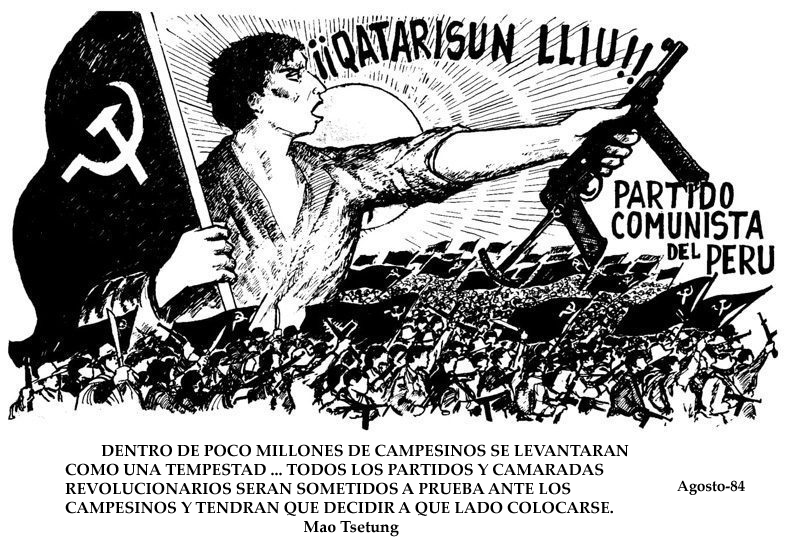
On June 22, 1984, the PCP launched a new military campaign called “Begin the Great Leap,” calling it “the first of various successive campaigns with view towards the political conjuncture in which are developing in this country, part of which are the 1985 (presidential – tr.) elections. The current campaign is developing as part of the political strategy of ‘conquering bases,’ (that is, revolutionary base areas) and it serves to concertize the orientation of ‘Strengthen the People’s Committees, Develop the Base Areas, and Advance the People’s New Democratic Republic.” (RIM report, 1984) 100,000 leaflet posters produced and distributed by the PCP in 1984 vividly illustrate this: on one side in red ink is a huge figure surging forward with rifle and red flag under the Quechua words, “Let Us Rise Up Together!” An army of workers and peasants advances beneath him and the quote, from Mao, is, “Within a short time, millions of peasants will rise like a storm…all revolutionary parties and comrades will be put to the test before the peasants, and they will have to decide which side they are on.”
On the other side, in black ink, is a depiction of the “electoral circus,” a game of dice played by the candidates over piles of slaughtered bodies, the death tolls of the “authorities” represented in the drawing by the vampire bat Belaunde, the U.S. and the U.S.S.R. kibbitzing off to the left and the sour-faced, fully armed military, death squads and vigilantes off to the right, ready to step on stage when they are needed. The quote is from Marx: “Every few years the poor are allowed to choose which members of the oppressor class will represent and crush them in parliament.”
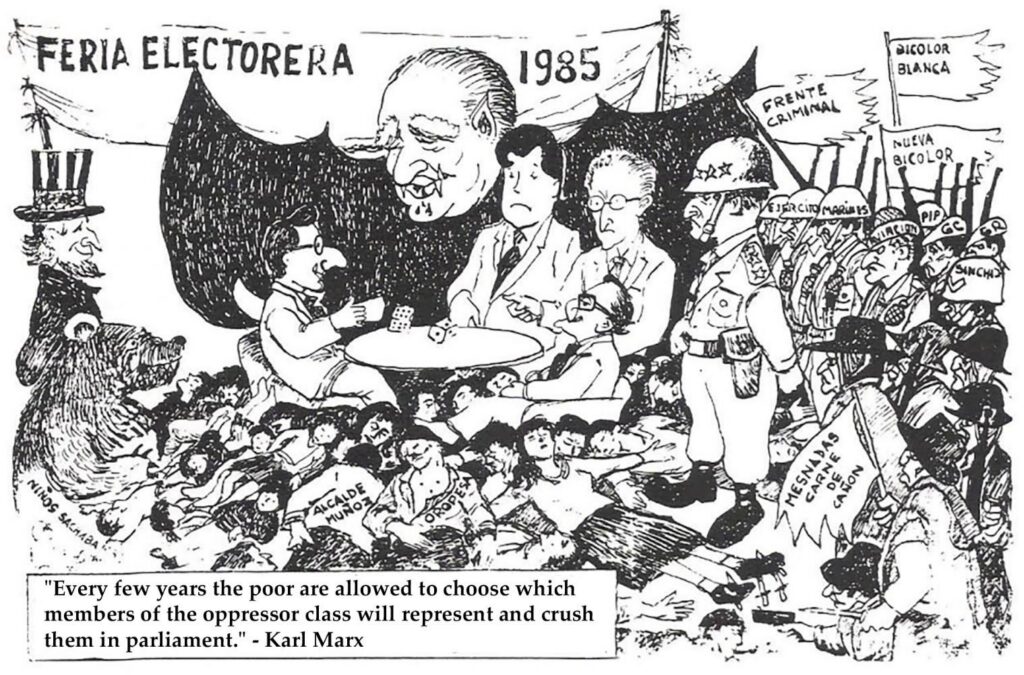
The PCP considers the elections a circus because none of Peru’s problems will be settled by them. As the old saying goes, “If elections had ever changed anything, they would be illegal.” The two main dice players (candidates) are the heads of the APRA party and the IU or United Left. APRA is a party formed in the 1930s as an “insulator,” keeping the Peruvian industrial workers away from “communist influence,” according to one author (David Chaplin, The Revolutionary Challenge and Peruvian Militarism). Stephen Gorman, editor of Post-Revolutionary Peru, describes APRA as “social democratic by necessity with overtones of neofascism.” APRA flirted heavily with the military regime in the ’70s and lost many of its working-class adherents in the process, though recently it has recovered some ground, especially among the more middle and military strata, and probably has the best chance of winning the ’85 elections.
The United Left, or IU, stands to run second and has been put forward very strongly by various American “leftist” parties, as well as the governments of the U.S.S.R., China, Cuba and some European organizations as a real alternative for change in Peru. It is a coalition of reform parties including the pro-Soviet Peruvian Communist Party and the Patria Roja which supports the present regime of China. Their goal is to share power with the present government, to wheel and deal for “a piece of the action,” and they do have some credibility as the “loyal opposition,” the obligatory left standard bearers in democratic Peru. They managed to get their candidate, Alfonso Barrantes, elected mayor of Lima in 1983. 5
The first thing Mayor Barrantes did when he came to office was fly to Europe to beg the IMF for a loan of $150 million for reform programs in Lima. There is a joke in Lima that every time a new Peruvian is born, he has by the mere act of his incurred a debt of some $2,000 (referring to the per capita foreign debt). Mayor Barrantes saw fit to augment this debt in order to obtain one daily glass of milk for each poor child in Lima, the latter a goal he did not achieve.
This sort of drop-in-the-bucket reform and its attendant obligation is an example of Barrantes’ view of the Peruvian people and where he thinks they fit into his scheme of things. His view of the revolution is much the same as President Belaunde’s. As the revolutionary forces grow and storm their way onto the political stage, all factions, including the legal left, find themselves more and more forced to take sides, whether it be with the government and Armed Forces and all the powers they represent, the so-called “democratic institutions” of the country, or with the peasants and poor and working people demanding by force of arms to take over their destiny. When President Belaunde finally turned over control of the counter-insurgency to the Armed Forces, Mayor Barrantes applauded the action: “We consider that this decision is a step that the President of the Republic should take, but we affirm that measures are insufficient if they are not accompanied by social and political measures to stand up to terrorism (sic).” In order to achieve such measures, he said, what is necessary is “the unity of all democratic forces against this phenomenon of Senderism.” When asked about the massacres by the police and army in the emergency zone, he stated that criticism against police “excesses” should not become a “condemnation of the institution.”
Along with with the illusions of the “electoral circus” public opinion is also being prepared for a military coup. What is happening is that the economic crisis—conditioned by the overall world situation and all of Peru’s other major social problems, as well as the advance of the revolution, are causing the rulers of Peru to fight among themselves as to how to manage all of this. And a military coup is one option that some powerful forces favor.
THE SHINING PATH
As these crosscurrents rise, the regime responds the only way it can, with more force and more weapons. A report compiled for the Heritage Foundation of Washington by Edward A. Lynch (now a Central America consultant for the White House) stated, “If the U.S. waits too long, saving Peru will require more effort and more money than preserving Peru…full scale war would be far worse current El Salvadoran war.” Cincinnati 12/24/83) The latest news is that the U.S. is going all out to “preserve” Peru. Belaunde met with President Reagan in Washington in September, and Peru was granted some temporary and minor relief from the IMF’s relentless demands. As we stated at the beginning, the Administration has asked Congress to double Peru’s military aid to enable the military to fight a war of counterinsurgency. Human rights organizations in Europe report the presence of foreign mercenaries and the beginning of aerial bombing, strategic hamleting and the use of napalm in the Andes.
In July, 1984, the Peruvian and U.S. navies engaged in joint “wargames” maneuvers which included the landing of paratroopers and frogmen on the Peruvian coast. These wargames were televised onto giant screens placed in what official spokespeople called “strategic locations,” apparently in an attempt to intimidate pro-PCP forces and boost confidence morale among the regime’s supporters.
The U.S.-U.S.S.R. contention in this arms buildup is also evident: the army still has 160 Soviet advisors from the days of General Velasco, and many of their arms are Russian-made, making it necessary to go to the U.S.S.R. for parts. General Julian Julia, a hardline, pro-U.S. military man was recently appointed Minister of War; one of his first duties was to go to an arms show in Moscow. The U.S.S.R. has dangled an offer of $50 million to fight the guerrillas before Belaunde; it was just after that offer was made that Belaunde visited Washington.
But the greatest concern for all these forces in Peru is the growing strength and influence of PCP and the Maoist revolution it is leading. The onslaught of imperialist powers vying to provide Peru with the latest weaponry, the saber-rattling of wargames, the mass graves, mass arrests, torture, and other atrocities really point to the fact that there is no way out for these frantic defenders of status-quo, and that the insurgents have dealt them some hard blows. Nor will such methods deter the revolutionaries from their shining path:
The struggle is taking a very cruel form and the bloodshed will grow as the reaction launches its counteroffensive; thus, the repression applied so far will worsen in every way. But taking into account the grave problems and contradictions which burden the reaction in this country, and above all, the objective conditions and the development of our revolutionary forces, we have the ability and the resolve to pay the necessary price, no matter what, to carry forward the armed revolution in our country, unshakably decided to build the New State which has already begun to be built, since, as Lenin said, “Without state power, all is illusion.” This is our commitment and responsibility to Peruvian revolution and even more to the world revolution of which we are component part and which we serve and will serve.
The armed struggle being led by the PCP is the most significant revolutionary struggle being waged in the world today. It is a tremendous material force on the side of peoples yearning to be free of the powers in this world that hold us all hostage to their empire building and rivalry. It is a revolution that should be supported and upheld by progressive people, and all moves to attack and slander it should be exposed, denounced and opposed.
Those of us who live in the U.S.A., the country that is most responsible for the misery and poverty of the Peruvian people, have a special duty to refute the slanders and attacks upon the Peruvian revolution and its leadership, the Communist Party of Peru.
The Committee to Support the Revolution Peru exists exactly for this purpose. We want to popularize the development of revolutionary struggle there and disseminate the truth of what is really happening. We have a slide show with presentation and music, books and information, and we are available for forums, panel discussions and radio shows. We also have buttons, posters, and are preparing a t-shirt for the near future.
We encourage all progressive and revolutionary-minded people to join the Committee and/or contact us to arrange for the above-mentioned activities and materials. Funding, to keep up our support campaigns, research and the dissemination of materials and information, is urgently needed: we encourage you to both con- tribute and fundraise.
THE COMMITTEE TO SUPPORT THE REVOLUTION IN PERU
PO Box 1246
Berkeley, CA 94701
(510) 644-4170
5 Footnotes