The Process of the Movement of Capital Is the Process of Exploiting and Realizing Surplus Value
6. The Process of the Movement of Capital Is the Process of Exploiting and Realizing Surplus Value
The Circular Flow of Capital, the Turnover of Capital. and the Reproduction of Social Capital 1
Capital must be in constant motion to play its role. It passes from the exchange process to the production process and then from the production process to the exchange process in an endless repetition.
In the previous two chapters, we temporarily ignored the exchange process and looked at capital in the production process. In this chapter, we shall analyze the motion of capital and its inherent contradictions from the exchange viewpoint.
The Circulation of Capital Passes through Three Phases and Takes Three Forms
The Three Phases of Capital Circulation Represent the Unity between the Production Process and the Exchange Process
In its motion, capital passes successively through three phases and takes three corresponding forms.
In the first phase of capital motion, the capitalist must first take out a certain amount of money to purchase means of production and labor force in the market. Using G to represent money, W commodities, A labor force, and Pm means of production, this process can be illustrated as follows:
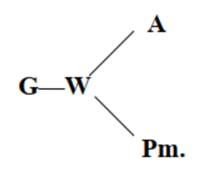
In this phase, the money in the capitalist’s hands serves as a means of purchase and a means of payment. However, at the same time, it also serves as capital because what the capitalist purchases are the labor force and means of production needed to extract surplus labor from the laborer. Here money becomes money capital. Through the purchase of means of production and labor power, money capital is transformed into production capital. Without money capital, there is no production capital and no production of surplus value. The function of money capital is to prepare for the creation of surplus value.
In the second phase of capital motion, the capitalist engages in production by combining the means of production with the labor force. Thus, the exchange process of capital is terminated, and its production process is started. Through this process, labor power is consumed, raw materials are processed, equipment is worn down, and a certain number of commodities is produced. Production capital is thereby transformed into commodity capital.
The commodity capital in this phase already embodies the surplus value created by the worker. It not only looks different from the commodities bought earlier but also has higher value than the original capital.
This process can be illustrated as follows:

Here P represents production capital in the production process. The dotted lines before and after P denote the termination of exchange and the beginning of production. W’ represents commodities with embodied surplus value.
In this phase, the means of production and the labor force not only play the role of factors of production but also the role of capital because these means of production and labor force are combined in the hands of the capitalist for the production of surplus value. The function of production capital is the production of surplus value.
In the third phase of capital motion, the capitalist must take the commodities which have thus been produced and embodied with surplus value to the market for sale. Through the sale of commodities, commodity capital is again transformed into money capital. Thus, capital is converted back to the form of money.
This process can be illustrated as follows:
W-‘G’.
Here G’ denotes money capital whose value has been augmented. It consists of both the value of capital advanced by the capitalist and of the realized surplus value. Therefore W’— G’ is not only a transformation process in form between commodities and money, but more importantly, is also a process in which the surplus value embodied in the commodities and expropriated by the capitalist is realized. The function of commodity capital is to realize surplus value.
The three phases and three forms of capital show that capital in each of the phases and forms performs an independent function. After a certain function has been performed, it passes into another phase and takes another form. This capital which goes through these successive transformations is industri70 al capital. This so-called industrial capital not only includes manufacturing capital, but also the capital in other material production sectors such as agriculture and construction. This capital changes its form successively and passes through three phases to increase its value and then returns to its starting point. This motion is the circulation of capital. Its entire process can be shown as follows:

In the circulation of industrial capital, the first and third phases are exchange processes; the second is a production process. The production process plays the determining role in these three phases because it is the only process which can produce surplus value. In the first and third phases, merely the form of capital is transformed; its value remains constant. However, the exchange processes are indispensable for the circulation of industrial capital. Without the exchange processes, the capitalist would not be able to produce and realize surplus value. Therefore, the circular flow of industrial capital is the unity between the production and exchange processes. Because of this, the three phases of circulation in industrial capital must be interrelated, and capital must pass from one phase to another. If the circulation of capital is hindered in the first phase (G—W), it becomes hoarded money and cannot play the role of capital. If its circulation is hindered in the second phase, there will be no production of surplus value. If its circulation is hindered in the third phase, then the surplus value created cannot be realized.
The Circulation of Industrial Capital Represents the Unity among Three Circular Flows
To extract surplus value continuously, the capitalist must ensure the continuous circulation of capital. Thus, the formula for the circulation of industrial capital is endless:

The above formula shows that the continuous motion of industrial capital assumes not merely one, but three, circular flows, namely, (l) circulation of money capital: G … G’; (2) circulation of production capital: P…P; and (3) circulation of commodity capital: W’—W’. To ensure the continuous circulation of capital, the capitalist must ensure that his capital exists simultaneously in three forms and that the capital in its three forms circulates continuously according to the circulation flows. For example, say a capitalist has 60,000 yuan of capital. He divides it into three parts, with 20,000 yuan in the form of money capital, 20.000 yuan in the form of production capital, and 20,000 yuan in the form of commodity capital. They are made to circulate along their respective courses. Thus, while this capitalist transforms 20,000 yuan of commodity capital into money capital, 20,000 yuan of production capital is being transformed into commodity capital and 20,000 yuan of commodity capital into production capital. If all 60,000 yuan were in one form, production could not be carried on continuously, but only intermittently. If the circulation of capital in any one of the three forms is hindered in its motion so that circulation is interrupted, for example, if commodities cannot be sold and commodity capital cannot be transformed into money capital, then the circulation of the whole capital is destroyed, and the motion of capital interrupted. Thus, the capitalist is forced to close down production.
The Turnover of Capital Is the Continual Production and Realization of Surplus Value the Length of Production and Exchange Time Determines the Speed of Capital Turnover
he circulation of capital continues in an endless repetition. The continuous circulation of capital is called the turnover of capital. Marx pointed out, “When the circulation of capital is regarded as a periodic process and not as isolated incidents, it is called the turnover of capital.” 2 The turnover of capital passes through the production and exchange spheres. The period when capital is in the production sphere is called the production time of capital. The period when capital is in the exchange sphere is called the exchange time of capital. The sum of these two constitutes the turnover period of capital.
The production period of capital includes the following three parts:
First, the period when the means of production perform their function in production. This is primarily the labor time spent by the laborer on objects of labor to produce certain products. The length of labor time is determined by two factors. One is the nature of the production sector. For example, a yarn mill can spin a certain amount of cotton into yarn in one day; but a shipyard takes several months or years to build a ship. Thus, the latter requires longer labor time than the former. Another is the labor productivity of the enterprise. Among enterprises producing the same kind of product, the enterprise with higher labor productivity takes a shorter time to produce the product. On the other hand, a longer time is required by enterprises with lower labor productivity. In some production sectors, the period when the means of production perform their function in the production process also includes time needed for natural forces to act on the objects of labor as well as labor time. For example, wine brewing requires time for fermentation, timber takes time to dry, and crops take time to grow.
Second, the period when production is interrupted but the means of production still stay at the production sites. For example, when machines and equipment are idle at night or because they are out of order.
Third, the period when the means of production have already passed into the production sphere but not into the production process. For example, the time when raw materials are stored.
Among these periods, labor time is the most important. Only in this period can the worker create value and surplus value. Therefore, the capitalist always tries his best to shorten the other times in order to make production time approximate labor time and extract more surplus value from a given amount of capital in a given period of time.
The exchange period of capital includes both the time for the transformation of money capital into production capital, that is, the time when the capitalist purchases the means of production and labor force, and the time for the transformation of commodity capital into money capital, that is, the time when the capitalist sells his commodities.
The length of capital circulation is determined primarily by the supply and demand conditions in the market, the distance between the point of production and the market, and the conditions of transportation.
Because of the varying effects of the above factors on different production sectors and enterprises, the production period and exchange period of capital vary among them so that the turnover period of capital is not uniform.
Because of the differences in the turnover time of capital, the speed of turnover also varies (the speed of capital turnover is calculated on an annual basis). Suppose the capital of a certain capitalist takes one month to be transformed from money to production capital and from commodity to money capital and the capital production period is three months. Then it takes four months for the capital to turn over once. Thus, the capital turns over three times a year. Further suppose that the capital of another capitalist turns over once every half a year. Then the annual rate of capital turnover is two.
From the above analysis, one knows that the rate of capital turnover is determined ultimately by the production and circulation periods of capital.
The Effects of Capital Composition on the Rate of Capital Turnover
In the above analysis, we assume that every part of the production capital is transformed into commodity capital in one process. But, in fact, the nature and mode of circulation of the various parts of the means of production are all different. From this viewpoint, the composition of production capital can be divided into fixed and working capital.
Fixed capital refers to capital in the form of plants, machines, and equipment. It is paid for in one installment. Its material forms participate in the production process in its entirety and are used more than once. But its value is transferred to the new products gradually according to the rate of depreciation. Because of the special way in which the value of this capital is transferred, we call it fixed capital. For example, if one lathe costs 4,000 yuan and lasts for ten years, then every year 400 yuan of capital value is transferred to the products produced. When the products are sold, 400 yuan of capital value returns to the hands of the capitalist in the form of annual depreciation. The value of this lathe will be completely transferred in ten years.
Working capital refers to that part of the capital which exists in the form of raw materials, fuel, and auxiliary materials or which is used to purchase labor power. Raw materials, fuel, and auxiliary materials lose their material forms in one production process, and their values are completely transferred to the new products in one process. When the products are sold, the total value of this capital returns to the hands of the capitalist in the form of money. Therefore, capital used to buy raw materials, fuel, and auxiliary materials is called working capital. That part of the working capital which is used to purchase labor power does not have its value transferred to the new products. An equivalent value in the new products is created by the new labor of the worker. Although this part of the working capital used to purchase labor power has this characteristic, its mode of value circulation is similar to the working capital used to purchase raw materials, fuel, and auxiliary materials. Because the value produced by the worker in the production process which is equivalent to the value of labor power is also transferred to the products in one process and returns with the sale of products, the capital used to purchase labor power is also working capital.
Now, we know that Marx classified capital into two categories. In the chapter on the production of surplus value, we talked about the classification of capital into constant and variable capital based on the different roles capital plays in the production of surplus value. This classification makes us understand that surplus value is produced by variable capital and reveals the secret of the capitalist’s exploitation of the worker. In this chapter, the classification of capital into fixed and working capital is based on the nature and mode of turnover of various parts of capital. This classification allows us to understand the various factors affecting the speed of capital turnover from the composition of capital.
These two classifications of capital can be illustrated as follows:

We mentioned above that the value of fixed capital is transferred gradually to new products according to its rate of depreciation. This depreciation has direct effects on the size of the value of fixed capital being transferred and the speed of turnover. To further study the characteristics of fixed capital turnover, we must also analyze the depreciation of fixed capital.
The depreciation of fixed capital can be classified as visible or invisible according to the reasons for its occurrence. Visible depreciation is primarily the result of use in the production process and secondarily of the action of natural forces, such as the decay of timber and the corrosion of iron. Therefore, this depreciation is also called material depreciation. Invisible depreciation is due to the improvement in production techniques which reduces the socially necessary labor time to produce similar machines and thus reduces the value of the original fixed capital. It is also due to the appearance of new and better machines, leading to a decrease in the value of the original machines. The depreciation due to a decrease in the value of the original machines is called non-material, or invisible, depreciation. To avoid such depreciation, the capitalist endeavors to lengthen working hours, raise labor intensity, and adopt shifts to accelerate the turnover of capital and increase the exploitation of the worker in order to recover the value of fixed capital as soon as possible.
Because of the differences in the speed of turnover between fixed and working capital, the speed of capital turnover generally refers to the average speed of capital turnover. The general turnover speed of capital advanced is determined by the average turnover speed of various components of capital. The formula to calculate it is to divide the total capital advanced into the total capital turnover in one year. The following table shows the general turnover of capital advanced. All figures are hypothetical.
| Components of Production capital | Value (yuan) | Number of turnovers per year | Total amount of turnover per year (yuan) |
| Fixed capital | 100,000 | 1/10 | 10,000 |
| Plants | 30,000 | 1/30 | 1,000 |
| Machines | 60,000 | 1/10 | 6,000 |
| Small tools | 10,000 | 3/10 | 3,000 |
| Working capital | 50,000 | 4 | 200,000 |
| Total capital advanced | 150,000 | 1.4 | 210,000 |
From the above table, we can see that dividing the total capital advanced, 150,000 yuan, into the total capital turnover, 210,000 yuan, gives us the turnover speed of the total capital advanced as being equal to 1.4. We can also see that the composition of production capital has an effect on the speed of capital turnover. The turnover speed of fixed capital is low, while that of working capital is high. If the share of fixed capital is large, the turnover speed of the total capital will be low. On the other hand, if the share of working capital is large, then the turnover speed of the total capital is high.
The Capitalist Tries His Best to Accelerate the Speed of Capital Turnover to Extract More Surplus Value
The speed of capital turnover has a direct bearing on the production of surplus value. The acceleration of the speed of capital turnover not only can reduce the amount of capital advanced, but can also accelerate the turnover of variable capital in working capital so that more surplus value is produced. Suppose two capitalists both have 2,000 yuan of variable capital and the rate of surplus value is 100 percent for both of them. If the capital of A turns over once a month and the capital of B turns over once every six months, A can obtain 24,000 yuan of surplus value a year, but B can only obtain 4,000 yuan of surplus value a year. Even though their rates of surplus value are equal, the annual rates of surplus value (the ratio between the surplus value produced in one year and the total value of variable capital advanced in one year) are different:
Capitalist A’s annual rate of surplus value = m/v = 24,000/2,000 = 1,200%
Capitalist B’s annual rate of surplus value = m/v = 4,000/2,000 = 200%.
Therefore, though the amount of variable capital advanced by capitalist A and capitalist B is the same, the speed of capital turnover for capitalist A is six times the speed of capital turnover for capitalist B. Consequently, the surplus value obtained is also six times as great.
The capitalist always tries his best to shorten the turnover time of capital, namely, the production time and exchange time, to accelerate the turnover of capital and obtain more surplus value. To achieve this objective, the capitalist lengthens the worker’s labor time, raises labor intensity, and improves production methods in the production sphere to shorten production time. In the exchange sphere, he develops transportation, postal and telecommunications services, and improves business organization to shorten exchange time. However, the inherent contradictions of capitalism hinder the improvement of techniques and impose difficulties on the sale of commodities. Therefore, the capitalist’s attempt to accelerate the turnover of capital is not always successful.
Capitalist Reproduction Is Realized Spontaneously amidst Antagonistic Contradictions
Social Capital Is the Sum of Individual Capital
There exist numerous capitalist enterprises in the capitalist society. Each enterprise’s individual capital functions independently with respect to other capital to augment value. However, this individual capital is not mutually exclusive. It is interrelated and interdependent because every individual capital must be associated with other capital through the exchange process in order to augment value. Take the example of a yarn mill. It has to be associated with enterprises that supply spinning machines and cotton. On the other hand, it must also be associated with enterprises that consume its products, such as the weaving enterprises. Therefore, close and mutually dependent associations exist between various enterprises. Through these associations, the individual capital forms an organic whole. The sum of this associating individual capital constitutes the social capital. The sum of the movement of the individual capital constitutes the movement of social capital.
Our earlier analysis of the circulation and turnover of capital was conducted from the viewpoint of the reproduction of individual capital. It dealt primarily with the production and realization of surplus value. We have not analyzed where the capitalist sells his commodities, where he purchases his means of production, and where the capitalist and the worker purchase their means of subsistence. However, when we analyze the reproduction of social capital, things are different. Because the social capital already comprises all individual capital, material means consumed in its reproduction process can only be replenished from the total social product. Thus, whether the gross social product can replenish in kind the various inputs consumed in the current production, and if so, how, constitutes an important problem concerning how social reproduction proceeds. As Lenin pointed out:
“The problem now involves where do the worker and the capitalist obtain their consumer goods, where does the capitalist obtain his means of production, and how can products satisfy these needs and permit expanded reproduction? Here it is not only a question of ‘value replenishment, but also the replenishment of products in kind.” 3
Therefore, the reproduction of social capital must be examined in terms of replenishment in value as well as in terms of replenishment in kind.
Marx clearly pointed out that the total social product of capitalism can be divided, in value terms, into constant capital (c), variable capital (v), and surplus value (m). In material terms, it can be classified according to its function in the reproduction process into means of production and means of consumption.
To correspond to the classification of products in kind, Marx divided the whole social product into two sectors: the first was the production of means of production (I), namely, the production of machines, equipment and raw materials; the second was the production of means of consumption (II), namely, the production of food, clothing and daily commodities. Within each category, many production departments were included.
Necessary Conditions for Simple Reproduction
To facilitate exposition, we assume that there are only the bourgeoisie and the proletariat in the capitalist society. The production cycle is one year, and the total value of constant capital is transferred to new products in one production cycle. All commodities are sold according to their values, and there is no fluctuation in the values and prices of commodities; nor is there foreign trade. Under these assumptions, the realization of total social product under simple reproduction can be expressed as follows:
I. 4,000 c + 1,000 v + 1,000 m = 6,000
II. 2,000 c + 500 v + 500 m = 3,000.
Here we assume that in the first sector the constant capital is 4,000, the variable capital 1,000, and the surplus value 1,000. The total value of products is 6,000. Its material forms are the means of production. In the second sector, the constant capital is 2,000, the variable capital 500, and the surplus value 500. The total value of products is 3,000. Its materials are means of consumption.
To continue reproduction, the products of both sectors must be realized. What is the realization of products? It is to say that things that have been consumed must be replenished in value terms and at the same time be replaced in kind. In common language, it must be possible to sell them and buy them back. In the following we will see how the products of these two sectors are realized.
First are the internal exchanges within the first sector. In the beginning of the year when the production process starts in the first sector, there are means of production valued at 4,000. Suppose at the end of the year when the production process is completed, all of them have been consumed. In order to carry on simple reproduction in the second year, new means of pro78 duction valued at 4,000 must be replenished. Where can the capitalist obtain these means of production? They can only be obtained by exchanging commodities within the sector because only the first category produces means of production. For example, the capitalist of the machine-building plant buys iron and steel from the capitalist of the iron and steel mill, the capitalist of the iron and steel mill buys coking coal from the capitalist of the coking plant and machines from the machine-building plant. Thus, through exchanges within the first sector, 4,000 c can be replenished and exchanged both in value terms and in material forms. Just as Marx said, “These exchanges are between one type of constant capital and another; that is, between one type of means of production and another.” 4
Next are the internal exchanges within the second sector. In the second sector, when the production process is completed at the end of the year, the worker receives 500 in wages to be spent on personal consumption. The capitalist gets 500 in surplus value. Under simple reproduction, there is no capital accumulation. The 500 in surplus value is also spent on means of consumption. Then, where can they buy the means of production they want? Only within the second sector because only the second sector produces means of consumption. Through internal exchanges within the second sector, that part of the product representing 500 v and 500 m can be realized in value terms as well as in material forms.
Finally, there are exchanges between the two sectors. After the above two types of exchanges, products valued at 1,000 v and 1,000 m still remain in the first sector. In the second sector, products valued at 2,000 c still remain in the second sector. These two remaining parts of products cannot be realized within their own sectors because the 1,000 v and 1,000 m in the first sector, in value terms, should be used for personal consumption by the worker and capitalist. However, these products are means of consumption, not means of production. In the second sector, the 2,000 c in value terms should be used by the capitalist to replenish means of production consumed; but these are means of consumption, not means of production. How can these contradictions be resolved? They can only be resolved through exchanges between the two sectors. The result of these exchanges is that the worker and the capitalist in the first sector obtain their means of consumption and the capitalist of the second sector obtains means of production needed for reproduction the next year. The exchanges between these two sectors can be illustrated in the following chart:

The result of the whole exchange process shows that under simple capitalist production there must be a given proportional relationship between the two sectors; namely, the sum of variable capital and surplus value of the first sector must be equal to the constant capital of the second sector in value terms. In other words, I (1,000 v + 1,000 m) must be equal to II 2,000 c in the above example. Only by maintaining such a proportional relationship can simple capitalist reproduction be carried on. Therefore, I (v + m) = II c is the condition for the realization of social product under simple capitalist reproduction.
Necessary Conditions for Expanded Reproduction
We know that the characteristic of capitalist reproduction is expanded reproduction. To carry on expanded reproduction, the capitalist cannot consume all his surplus value. He must continuously convert part of the surplus value into capital to expand the scale of production. To do so, the capitalist must use part of his newly created capital as constant capital to buy machines and raw materials needed for expanded reproduction. The rest is converted into variable capital to hire additional workers. Therefore, to carry on expanded capitalist reproduction, the total annual products of the first sector must have surplus means of production in addition to those needed to replenish what has been consumed in the first and second sectors during the year. This condition can be expressed in terms of an inequality: I (c + v + m ) > I c + II c . Both sides of the inequality contain I c, showing that means of production consumed in the first sector can be replenished from within the same sector. If we cancel out internal replenishments and concentrate on the relationship between the first and the second sectors, the above formula can be expressed as I (v + m) > II c. This is to say that the variable capital and surplus value of the first sector should be larger than the constant capital of the second sector. This is a precondition for expanded capitalist reproduction.
The following chart is used to show how the social product is realized under conditions of expanded capitalist reproduction:
I. 4,000 c + 1,000 v + 1,000 m = 6,000
II. 1,500 c + 750 v + 750 m = 3,000.
The above are hypothetical production figures for the first year. They meet the requirement for I (c + v + m) > I c + II c or I (v + m) > II c. Now that the capitalist wants to expand reproduction, he cannot spend all the extracted surplus value on consumption. Suppose the capitalist in the first sector spends half of 1,000 m on personal consumption and converts the other half as added capital in the same proportion as the original organic composition of capital, that is, 4:1 (4,000 c: 1,000 v). The distribution of 1,000 m is as follows:

We know that the 400 for added constant capital in the first sector is spent on means of production. Its material forms are also means of production. Therefore, they can be obtained through internal exchanges within the first sector. But the 100 for added variable capital in the first sector is used to hire additional workers who will spend it on means of consumption. However, its material forms are means of production. Therefore, it must be exchanged with the second sector to obtain means of consumption.
Because the material forms of the added variable capital 100 in the first sector are means of production and must be exchanged with the second sector for means of consumption, this creates conditions for expanded reproduction in the second sector. But it also requires the second sector to carry on corresponding capital accumulation for expanded reproduction to meet the increased demand for means of consumption from expanded reproduction in both sectors. Suppose the capitalist of the second sector exchanges part of his surplus value (100 m) for means of production from the first sector to be converted into added constant capital and uses another 50 m as added variable capital in order to conform to the proportion of the original organic composition of capital in the second sector, namely 2:1 (1,500 c: 750 v). Then 750 m will be distributed as follows:

Through the above capital accumulation, the products of the two sectors are rearranged as follows:
- (4,000 c + 400 c) + (1,000 v + 100 v) + 500 m = 6,000
- (1,500 c + 100 c) + (750 v + 50 v) + 600 m = 3,000.
Thus, the capital of the two sectors is larger than the original capital advanced, and the conditions for expanded scale of production in the following years in both sectors are guaranteed.
Then, under the condition of expanded reproduction, how are the products of the two sectors realized?
Under the condition of expanded reproduction, the realization of social production is carried on in three aspects just as in simple reproduction: internal exchanges within the first sector, internal exchanges within the second sector, and exchanges between the two sectors. In terms of charts, it is:

Through the above exchanges, the capital of each sector is larger than the original capital advanced. The composition of capital in the second year is as follows:
- 4,400 c + 1,100 v = 5,500
- 1,600 c + 800 v = 2,400.
If the rate of exploitation stays at 100 percent in this year, the production of the two sectors in the second year is:
- 4,400 c + 1,100 v + 1,100 m = 6,600
- 1,600 c + 800 v + 800 m = 3,200.
Compared with the first year, expanded reproduction has been realized. The Contradictions of Capitalist Reproduction Are Antagonistic
Through the above analysis, we know the necessary conditions for the realization of social product under capitalist simple and expanded reproduction. But this is not to say that these conditions always exist in the capitalist society. In fact, these conditions are frequently violated in the capitalist society. Just as Lenin pointed out:
“Abstract theory of realization assumes, and should assume, that products are distributed proportionally in the various departments of capitalist production. But such an assumption does not imply that products are, or can always be, distributed proportionally in the capital ist society.” 5
This is due to the fact that in the capitalist society, means of production and products are privately owned by the capitalist and the whole social production is governed by competition and chaotic production conditions. Thus, the proportional relationship between the two sectors and among production departments within each of the sectors is frequently violated. Because of the antagonistic contradiction due to the immense increase of productive forces in the capitalist society and the relative decrease of effective demand from the laboring masses, the necessary proportional relationship between the two sectors cannot always be maintained. Therefore, capitalist reproduction cannot but encounter all sorts of difficulties and obstacles.
There exists a series of antagonistic contradictions in the capitalist reproduction process. These contradictions in due course inevitably led to economic crises.
Major Study References
Marx, Capital. Vol. 2, chaps. 1, 2, 3, 7, 8, 20, 21.
Lenin, “On the So-called Problem of the Market,” Complete Works of Lenin. Vol. 1.
Review Problems
- How does the capitalist extract more surplus value through the circulation and turnover of capital?
- What are the conditions for the realization of capitalist reproduction? Are these conditions always satisfied in the capitalist society? Why?
5 Footnotes