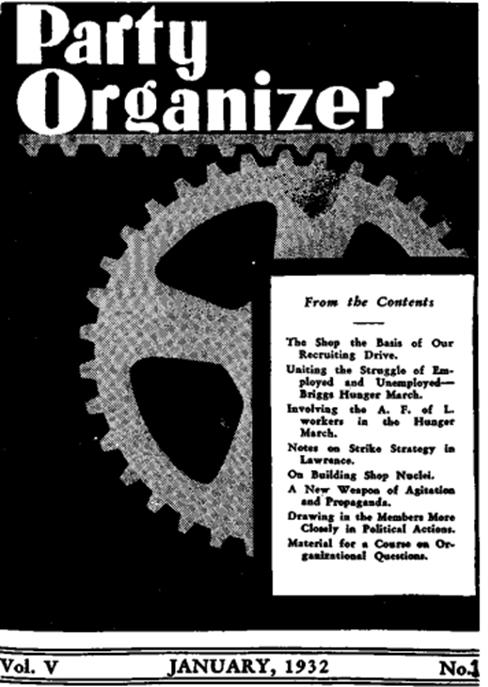
VOL V JANUARY1932 ISSUE NO.1 – Workers (Communist) Party
The Shop the Basis of Our Recruiting Drive
THE recruiting drive of our Party which starts January 11 and will end on March 18, is now rapidly getting underway. Prior to these dates many districts made the recruiting drive a part of their every-day activities to bring in new members into the Party as a result of the struggles led. This is a good beginning. This recruiting drive intends to establish recruiting as a natural every-day activity of our Party.
The recruiting drive is in time. Our Party is now involved in a series of campaigns which if properly developed will mobilize millions of workers in the struggle against the economic and political offensive of the bosses. The February Fourth campaign and the struggle for the Workers Unemployment Insurance Bill, the support to the Kentucky striking miners, the struggle for the unconditional release of the Scottsboro boys, the fight against the ever-increasing war danger, will mobilize masses of workers under the leadership of our Party.
In order to carry through all these campaigns we must shift the base of these campaigns to the shops and factories and there, as well as among the unemployed, bring these issues to the forefront and link them up with the every-day conditions of the workers in the shops, neighborhoods and breadlines.
Therefore shop work is not a separate campaign of the Party. It is the base on which all the Party campaigns are built and carried on. In the past, while carrying on struggles, the building of the Party was neglected and we repeated many times the correct formulation that our Party will be built in struggles, but when struggles occurred we were absorbed in these struggles without understanding that one of the major tasks of our Party in these struggles is to build our Party, to recruit new members and to strengthen our organizational base.
This recruiting drive of the Party stresses primarily this question and while leading masses of workers in the struggle for better conditions, against wage-cuts and speed-up, against unemployment, for the support of the miners, the Party will become the unifying factor of all these struggles, the leader of all these movements, and must be brought as such to the masses of workers. This is how we will build our Party and this how our recruiting drive will be successful. Quite often struggles are considered only strikes — thus the approach that where strikes are not developed yet, our Party cannot be built. This is a wrong conception. The preparations for strikes are a part of the struggle. The building of shop committees, the building of our unions, the organization of the unemployed is an important part of the struggles, because they lead to the development of struggles.
It is in these preparatory steps where our Party must be strengthened—must be built. It will be the Party nucleus which will accentuate and lead the struggle of the workers. The recruiting drive is on. We have set definite objectives:
- Double the Party membership
- 100 new shop nuclei
- 30 new shop papers
Can it be carried through? Of course it can. We will do it only, if we on one hand make this drive a real political drive, linking it up with the political campaigns of the Party, and simultaneously take the necessary organizational steps to insure a successful drive.
The steps being taken are:
- Bring in the drive into every unit, every fraction, every Party committee, and through them into the shops, unions and mass organizations.
- Show the comrades how to approach the workers in the shops to join our Party.
- Make the Party unit a fit place to keep and develop the new members.
The Polburo Circular No. 5 shall be studied by every Party member (it was printed in the Daily Worker in installments). The revolutionary competition will bring out more and more potential forces in this drive, which if properly carried through, will not only bring in new members into the Party, but help to solve some burning problems of our Party—closer connections with the shop, more proletarian cadres, and above all the developing of new struggles against the economic and political offensive of the bosses and their government.
| From the Practical Work For the Practical Work In this Section of the Party Organizer the comrades of the shop nuclei, fractions and street nuclei speak. Send in your experiences in all fields of the Party work to the Party Organizer, P.O box 87, Station D, New York City. |
Unemployment Work
Uniting the Struggle of Employed and Unemployed
Briggs Hunger March
Conditions in the Briggs Shop
by Nydla Barker (Detroit)
ON November 23rd for the first time we had united employed and unemployed workers of a factory placing their demands for Unemployment Insurance before the factory gate and employment office. How did the union organize this action?
First lets us see what are the conditions in the Briggs H. P. plan. There were at one time 10,000 working now there are about 500. In Dept. No. 272, three butt welding machines were introduced which have put out of work permanently 100 men who will never get their jobs back. In the Carpeting Department the girls formerly got 60c an hour; they have been cut 6 times. Those that are working make part time. One worker reported $4.75 at the end of two weeks. Another Negro worker reported $2.75 for two weeks’ pay. And he has a family of 4. Out of these pays $1.25 had gone to the Community Fund and for ‘‘insurance” which never insured anyone. There is a sign in the Briggs lavoratory for girls which says that any girl found talking with a Negro worker will be immediately fired. The majority of the Briggs workers are starving. The Briggs Plant depends on Ford for its orders.
The YCL Gets on the Job
A few months ago, the YCL decided to concentrate on this plant and in one of the units we organized a Shock Brigade. After getting a couple of connections we did not let them stay on file in order to accumulate enough to build a union branch, but immediately asked these workers to build groups from their department or floor. In a short time, there were about 10 union members meeting regularly in each other’s homes. Almost every week the leading comrades would come down and speak on the necessity of organization and the victories of the unemployed councils in winning relief for the unemployed families. After a while these workers began to say: “why can’t we do something also?” “Why can’t we have a Hunger March, like the Unemployed Council?” And so, we discussed it and decided to bring our demands to the Briggs Company. Briggs is supposed to have “Welfare”. They are supposed to give $5 a week to unemployed Briggs families and free food checks. But only a very few workers get this. If they do they have to get the O.K. from the Plant Manager to the smallest straw boss. We decided to ask the Unemployed Council and other working-class organizations in that neighborhood for assistance in mobilizing the unemployed Briggs workers. We drew up a plan of how to work. First, we drew up our demands which were:
- Unemployment insurance equal to wages while working and not less than $15 a week.
- No discrimination against women, single, Negro, or young workers.
- 8 tons of coal immediately for the families. Free groceries until insurance goes into effect.
And for the employed:
4. Full pay for part time work.
5. No insurance money out of our pay.
In order to widen the appeal of the Hunger March we decided to raise demands for the unemployed Ford workers. In the same block as the Briggs employment office is the Company grocery store. We asked the Ford workers to march with the Briggs workers for free groceries. We knew also that in order to present our demands more effectively before the company, we should have a list of the families that are in need of spot relief. The territory surrounding the Briggs Plant is most like a company town with the streets occupied entirely with Briggs and Ford workers. So, we mapped out a number of streets and with the help of the Unemployed Council and the Y.C.L. we went from house to house telling of the Hunger March and asking for the names of those who needed aid immediately. In one week’s, time we secured almost 35 Briggs Families and 40 Ford families and cases of young workers who were on the verge of starvation.
There were 4 kinds of leaflets issued. One leaflet called upon all Unemployed Briggs and Ford workers to support the Hunger March; this was used in the house-to-house canvas. Another leaflet was to the workers directly in the shop. One Was for the young workers, and one for all unemployed workers called for support for the Hunger March. Three mass Meetings were held in preparation, one of which was held by the Y.C.L. At these meetings we collected money for the leaflets. The day before the Hunger March there were two children’s parades who marched around in the territory with noise makers and signs saying: “Walter P. Briggs children have their own ponies. Briggs workers’ children starve. All out to the Briggs Hunger March.” All this raised great enthusiasm for the march.
The March
Our leaflets called upon the unemployed Briggs and Ford Workers to assemble at the Unemployed Council headquarters to prepare for the March. Early in the morning we had distributed special leaflets to the men in the plant that we were coming about noon hour and that they should come out and support the fight for unemployment insurance. At 10 o’clock about 250 men and women and children assembled in the Council headquarters to prepare for the march. First, we had a meeting. A vote was taken on the demands. A committee of 5, was elected, one Negro Briggs worker, one young girl Briggs worker, one white worker, and two members of the Unemployed Council. Ford workers. This committee to be our spokesmen and present the demands. The Workers then lined up and received their banners. And then the March began. But here we saw how far Murphy’s demagogy had penetrated even the leadership.
We thought we would have no trouble in marching because we had been allowed before. We had not marched two blocks when Murphy’s police in scout cars drove into a street we were crossing and made a barricade of scout cars. But the workers fought back and defended their banners. Especially the women led the line to smash through the police. Three times the workers were attacked and fought back with the utmost militancy defending themselves with bricks and sticks from their banners. The police were repulsed and the line now swelling to 600 marched in orderly fashion on to the plant. Just as we reached Highland Park, the H.P. police came to meet us and asked us who was in charge. The workers almost as one answered “We are!”
Locked in the Shop
The auto bosses unable to smash the line before we got there tried another method. When we got to the plant, they swung every gate and door tight shut. They locked the workers in the shop from coming out at lunch hour. In front of the plant there were many workers waiting for the March to arrive and in about 15 minutes there were around 5,000 workers in front of the Briggs employment office. The employment bosses sneaked away from meeting our committee. Inside the plant the workers demanded that they be allowed to go out. In fact the work for the whole afternoon was disrupted. The fellows who had gone out for the early lunch were locked out and could not go into the plant to join the demonstration. Many workers sneaked out through an unused door and joined in. The rest of the workers leaned out of the windows listening to the speakers. We told the workers “We, the unemployed, are organizing. If you fellows go out on strike, we will not scab. We must fight together for unemployment insurance from the company.” A vote on the demands was taken with unanimous voting and cheering on every demand. The delegates to the National Hunger March spoke and the crowd voted to support the National Hunger March to Washington and cheered the delegates. For two hours we demanded that the Briggs boss see our committee. We then took a vote from the workers to march to the Food Company Store. With a cheer the workers marched to get their “turkey.”
Just as we reached the Ford Company Store the Ford flunkeys hurriedly cleared the store of customers and slammed the doors in the face of the hungry Ford workers the day before Thanksgiving. When it became apparent that we could do nothing more then, we marched back to protest the arrest of two workers during the fights in the March. At the protest meeting 45 workers joined the Union from Ford, Briggs and other plants. Now the Union has been following up these contacts and many have become real members. Many of the families who signed up for relief also joined the Union. The original Union group has grown to about 25 and the Ford group has jumped to over 100 members in that territory. A characteristic of the whole march was the large number of young workers, about 30%
The workers are now all saying How about a Hunger March to our plant? The whole prestige of the Union has been raised. Now the Union group says we cannot rest on the laurels of the last demonstration, we still have not received relief for the starving Briggs families. So now we are going to take these families down in committees to the Briggs Welfare and demand relief for them. Now the Ford Branch of the Union is planning a Hunger March to the Ford River Rouge plant to demand jobs or Unemployment Insurance. It will take place on February 8 with the eyes of all the workers on this united move of employed and unemployed Workers.
Involving the AF of L Workers in the Hunger March
by W. Reynolds (Detroit)
THE importance of the National Hunger March as an action placing important organizational and political tasks before the movement as an immediate practical task that must be carried through without delay is nowhere better set forth than in our experience in Kalamazoo, Michigan.
Kalamazoo was chosen as an overnight stopping point of Column No. 3 of the March, despite the fact that we had no connection then to solve the problem of housing and feeding the marchers.
Going into the town less than two weeks before the March we were able to get the carpenters’ union (Local 297) to vote the use of their hall free of charge for the marchers, and the Federation of Labor of Kalamazoo which manages the city-controlled dining room, agreed to feed the marchers. We went before the city manager, city mayor, and city commission and got an emphatic refusal from each. Despite the attitude of the bosses’ agents in city government, the federation proceeded to prepare to prepare the food and when the police on orders from the mayor refused the marchers admission to the building where the food was prepared, the workers in the kitchen took the food to Carpenters’ Hall and served it there. The March had been attacked in Hammond, Indiana, and the marchers delayed, and until midnight officials and workers of the union were serving food to the marchers who had been condemned by Green, Woll, and the rest of the fakers.
On the return journey the men were immediately housed and fed. However, when a meeting in the court arranged on the return journey was stopped by police, the Carpenters Union secretary opened the office of the union and held the local police out while a hunger marcher spoke from a second story window to some 600 workers who had gathered below. Only after a contingent of the state had reinforced the local club-wielders was the secretary brushed aside and the speaking stopped.
Thus, in a town wherein we have no connections we have been able to get the fullest cooperation from the AFL workers that has marked the whole Hunger March. We have established that these workers of Kalamazoo who are typical of rank-and-file elements throughout the country are opposed to Green’s and Woll’s policy of betrayal and starvation.
We have involved the Carpenters’ Union in an action of great political significance wherein the workers could see the role of the police and of the government representing bosses.
In Kalamazoo the practical tasks set forth by the Hunger March have borne political fruits of the highest order. Kalamazoo indicates the seething cauldron upon which Wall and Green sit with such foolish and callous complacency.
Let us have more hunger marchers compelling us where this compulsion is necessary to say to the workers in American Federation of Labor locals, “Here are problems of hunger. Fight side by side with us to solve them!”
Local Struggles and the Building of Unemployed Councils in Preparation for the Hunger March
By G.P. (Chicago)
IN order to build Unemployed Councils and to speed up the organization of the unemployed, it is necessary for us to be flexible and adopt proper demands that will fit in for the territory in which we build.
Here on the North Side in Chicago we had some very interesting experiences which proved to us that the workers are ready to struggle if proper demands are put up.
Council No. 17 is located in a territory where most of the unemployed workers are single men and there are no provisions made by the charities for single men. In order to lead the workers in this locality in struggle, new methods had to be adopted as we could not lead them on the issues of evictions—^no shutting off of gas, electricity, etc.
We organized a committee to present the demands of the single men to the alderman of the ward, Oscar Nelson, who is also vice-president of the Chicago Federation of Labor. Oscar Nelson met the delegation not alone, but with the Red Squad present.
The results of this committee was reported before a huge open air meeting and a date was set for a demonstration to he staged in front of the alderman’s office.
On the day of the demonstration the street in front of the alderman’s office was lined with police and detectives for several hours before the announced time of the demonstration and of course succeeded in breaking up this demonstration. The Council reacted real quickly to this situation, mimeographed new leaflets and distributed them the same night, calling the workers’ attention to the fakery of Oscar Nelson and for the support of the unemployed. This demonstration was staged on the next night with splendid response from the workers.
The shortcoming of the Council was that they were satisfied with the small concession that they had gained and did not continue to struggle. Instead of organizing bigger demonstrations and taking advantage of the favorable situation, the Council lagged in their work and gave the bourgeoisie a chance to divide the workers by giving certain ones a hand-out.
To utilize the situation which exists on the North Side, it is necessary to adopt such slogans and to use tactics which will apply to both married and single men. To intensify the struggle against the faker Oscar Nelson, with special attention to the American Federation of Labor locals. To organize real mass demonstrations in front of his office. The National Hunger Marchers can very well be utilized in this campaign, both in exposing faker Oscar Nelson before the American Federation of Labor locals and in stimulating and helping the workers on the North Side to build a bigger unemployment movement.
Strike and Trade Union Work
Notes on Strike Strategy in Lawrence (MA)
by Nat Kaplan
THE Lawrence workers struck twice in 1931. In February 10,000 American Woolen Company workers came out against the speed-up and won a partial victory. On October 5th to November 11th, the mills were completely emptied by the walkout of 23,000 workers. The February strike showed the possibility of striking and winning under Communist leadership in the midst of the economic crisis. The October strike was the first mass answer of the workers to the national wage cutting drive of 1931. It was defeated by a United Textile Workers sell-out. In this short article I will indicate three reasons (among others) for our inability to prevent the U.T.W. sell-out:
1. Lack of Preparatory Work for the Strike
From February to October, we did not continue our work in Lawrence. The necessary change of orientation to the Rhode Island silk strikes last summer led to an impermissible exodus from the Lawrence sector; particularly since we had failed to build a local union and Party leadership last February. We took a step towards preventing the recurrence of this situation in the October strike by building four mill nuclei with 40 new Party members, recruiting 30 Y.C.L. members, about 700 new union members, four mill locals of the union, a union District Board and retaining 3 union organizers and one-Party organizer in Lawrence after the strike. We now have the task of systematically continuing the struggle with this organizational basis.
2. Narrowing Down the United Front
The workers could see no distinction between our union and the united front during the strike. There was neither a broadly organized united front nor a real independent role of the union within the united front. Our efforts to capture the masses from the UTW -American Union bureaucrats lacked the following decisive features:
A) Building of an opposition to the bureaucrats at the City Common meetings by concrete exposures through questioning, challenges, proposing concrete actions, etc.; B) building a steady opposition group in the U.T.W. and American Union locals C) sending of open letters and delegations to the reactionary unions to win the members for concrete aspects of the united front (one picket line, one relief committee, etc.) This was only undertaken in the last week and weakly applied.
Other indications of the narrowness of our united front tactic were (a) the call for the strikers’ conference to elect the rank and file united front strike committee was issued in the name of the rank and file committee and the N.T.W.U.; leading to a confusion of the united front with the union, (b) the initiative of the united front strike committee was stifled by certain long-winded organizers—instead of arousing action they talked the committee to sleep; (c) there was no Strike Committee Bureau functioning daily. Hence the execution of strike decisions was left solely in the hands of the leading Party fraction (during the strike no leading union committees existed.)
3. Need for Bolshevik Decisiveness
During crucial moments of the strike our leadership showed a lack of Bolshevik decisiveness as for example: (a) when the masses swung out of the mills on October 5th on the basis of our strike call we allowed them to disperse for home instead of marching them on to the City Common, taking it over and electing the strike committee then and there. This has a historical significance in connection with past Lawrence strikes; (b) on November 10th (the day before the final back to work stream) when 8,000 strikers were deserted on the City Common by the A. F. of L.-Socialist misleaders, we were not there to give them leadership; we were quite busy repeating the same old speech to 500 workers on our own lot. We failed to recognize that a strike is a major battle in the class war and we have to think fast in order to move our army (and with them our generals) to a decisive front of the battle.
Party Recruitment Work
A Brief Glimpse at the Recruiting Drive in Chicago District
by J. Williamson
AT the District Plenum held in July, 1931, we decided to double the Party membership in Chicago by November 7 and in out-of-town sections by Lenin Memorial. Supplementing this, at a later Plenum in September, we placed greater emphasis on recruiting from shops, indicating specific shops for concentration and decided that at least 20 per cent of new recruits must be from shop nuclei or shops of concentration.
To What Extent Carried Out?
Between July 18 and November 28 (approximately 4 1-2 months) there were a total of 1,374 new members accepted into the Party and issued membership books on the basis of having attended two-unit meetings and paid initiation. This means more than doubling the total membership, as the actual membership on July 1 was 1,268. Five sections (2, 4 and 6 in Chicago and Indianapolis and Calumet out of town, doubled their membership).
An interesting fact to be elaborated upon later, is the steady growth of recruiting monthly until November, when there was a drop. It runs like this: July (last two weeks) 45; August 255; September 285; October 506, and November 283.
Have We Penetrated the Shop?
An examination of these 1,374 new recruits shows 80 per cent were unemployed and only 20 per cent employed, according to initiation. The majority of the sections adopted plans of work. In ten of these there are a total of 40 shops being concentrated upon to recruit and build new shop nuclei during the 4 months plan of work (October 15 to February 15).
An examination of the recruiting from shops since the Plenum (September 15 to November 28) shows that 40 new members were recruited from shops of concentration; 23 new members were recruited by old shop nuclei, and 3 new shop nuclei were organized with a total of 21 members. This makes a total of 84 new members from these three shop sources. Contrasted with the total recruited during this same exact period we find it to be a little more than 9 per cent. Therefore, while we fulfilled our objective, we have fallen down on the more important objective of rooting the Party in the shops.
Fluctuation of Membership
Another serious problem is our capacity to keep the new members, which, incidentally, is closely connected to an extent with the type of workers recruited arid the methods used. Examining section by section, their membership on July 1st, also their new recruits and contrasting this with what their membership should be if all new and old members were kept in the Party, with the actual membership, we see the high rate of fluctuation. While District 8 membership has increased absolutely from 1268 on July 1st to 1,963 on November 28th, if the fluctuation was not so high we should have a much larger membership. On a district scale we have a fluctuation of 47% during this period. What is important is the fact that those sections which are conducting their mass work and all-Party work best, have the lowest fluctuation. This fluctuation raises four basic problems of:
(1) improving the political life of the Party units, (2) improving the inner organizational functioning of lower Party organs, (3) more concentrated recruiting from shops and through our fractions and (4) more intensive Party education.
Yardstick of Membership
The only reliable yardstick of membership is dues sales. While a small margin can always be allowed even in the best functioning Party, the excuses of some districts about rawness of new members or unemployment should not be tolerated. Generally these same comrades whose rawness is used as an excuse by the district committee, understand the importance of paying dues in a working-class organization, due to years of training in trade-unions. Certainly, unemployment is no excuse since there is such a thing as exempt stamps. In District 8, while on July 1st when we had 1,268 actual members we had an average dues sales for the three preceding months of 1,093, today when we have an actual membership of 1,963 we have an average dues sales for the months of October, and November of 1,735. There is still too great a discrepancy but the substantial increase of dues sales shows the solid character of the present actual membership.
Start “Drive for New Members from Shops’’
As a part of the recruiting drive of the whole Party, Chicago district will concentrate during January and February to increase the present membership by 50%, but the emphasis will be in the mining, steel, railroad and packing industries.
Challenge Pittsburgh District
As a part of this drive, the Chicago District challenges Pittsburgh district to the following during the two-month period of January and February:
- To increase our ‘present actual membership by 50% quicker than Pittsburgh.
- What at the end of this drive, the average dues sales for the months of December January and February must be equivalent to 90% of the actual ‘membership
- That Chicago district will double the present number of coal miners in the Party and challenges Pittsburgh to do likewise.
- That we will organize 10 new shop nuclei in steel and metal industry and recruit at least 175 new Party members from steel and metal industry.
- To issue 7 new shop papers each month during this period.
Importance of Records and Statistics
Every district org. department should have a sub-committee on Party statistics. Some comrades scorn this, but if the Party is to draw some important political and organizational conclusions, the vital statistics of our Party is absolutely necessary. This, of course, should not become an end in itself or hamper the study or understanding of the political events taking place. Only through organized collective work can the Party understand the events taking place and its role in the class struggle as the political and organizational leader of the masses.
(Later on, a separate article will analyze the reasons for the fluctuations and some important political and organizational conclusions from the above figures of Chicago district, which lack of space prevents in this article.) – J.W.
On the Building of Shop Nuclei
by J. Halpern (NJ)
TO BE able to recruit our new members from the shops and build shop nuclei we must make clear to the entire membership of the Party the methods of building organizations in the shops, and how to approach a worker in order to draw him into organization.
Very often good contacts, workers working in big factories, are scared away from organization by a wrong approach. They think that by joining the Party they must carry on open carry-on open activities and are forced to drop out from the Members of the Party working in big shops are made to activities, expose themselves and lose their jobs.
Members of the Party working in big shops are made to carry on open activities and are forced to drop out of the Party.
Workers through wrong approach get the wrong and dangerous conception that our Party – the Party that is fighting for the final emancipation of the working class – is not interested in the immediate betterment of the conditions of the workers.
These misconceptions expressed themselves clearly in the following 2 instances: In visiting contacts of a factory where about 1,200 workers are working over time to prepare hospital supplies for the coming war I found the following:
One of the contacts was a Party member for quite some time. Being in the Party he was made trade union organizer of the unit, had to come up to Party headquarters (which in a small town means to openly expose himself) and carry on in other open Party activities. As a result, he started to drop out from the Party and was, a couple of months ago, officially dropped by the unit.
After I explained to the worker that he can be m the Party without doing any open Party work, that he can carry on work in the shop without exposing himself, he was ready to give us information on the shop, and agreed to meet with a couple more Workers.
The comrade who was with me visiting the contacts an active member of the unit, in place of trying to find out the specific grievances of the workers in the shop and on that basis try to draw the worker into organization, in a “very short and business-like manner” explained to the worker that: “The party has decided to build a shop nucleus in the shop, and would he like to join it!”
It is clear that with this method of approach, with this conception of how to activize members of the Party working in important shops we cannot build shop nuclei.
If we are to recruit our new members from the shops and build shop nuclei, we must make clear to the membership of the Party that the shop nucleus is an illegal form of organization especially at this period. We must emphasize that nuclei can be built only on the immediate and partial demands of the workers in the shops.
At the last Plenum of our Central Committee comrade Browder in speaking, in his report, on the building of properly functioning shop nuclei said:
“I think it would not be a bad idea to give the task to each district committee to select one shop nucleus for which the district committee assumes direct responsibility for leading. The district committee should assume complete responsibility for acquiring a knowledge of the problems of that shop in the next sixty days, and working out for that shop such methods of work by the comrades there that will successfully carry on some mass work in that shop and not get discharged.”
This can be very well applied to the section committees. The section committee should assume direct responsibility in conducting the work in a shop where one or two Party members are working; acquire a knowledge of the problems of that shop; meet with the comrades from the shop, work out with them methods of work, assign members of the section committee to visit, together with members of the unit in that territory, the contacts from the shop for the building of a shop nucleus and carry on mass work. Doing that we will suddenly begin to find this not such a difficult problem when we go about it right. It can be done.
Concentration Work
by J. Perilla
HOW is our concentration work carried on? The plan of the district is that shock troops (special groups) are chosen on the basis of special abilities, and adaptability for the work. This is on a voluntary basis. The comrades in the shock troop must be so organized that they are able to work together without any difficulties. Each individual comrade in the shock troop must be given a specific task (getting new contacts, visiting old contacts, distribution, etc.), the carrying out of which is checked up regularly by the captain of the group. This shock troop is not a regular Party organization. This is important to note because of the fact that there has been a tendency to turn these shock troops into regular units of the Party. These comrades although members of a particular shock troop remain in their own unit but devote their major activity to the shock troop.
The work of the shock troop must be coordinated with the work of the particular union or league working in that trade. The plan worked out by the shock troop must be gone over with the comrades in the trade unions.
We must not be mechanical in forming these groups for if a comrade is active and is needed in a particular trade union (especially A. F. of L.), this comrade should not be taken out from this work. We have one instance where a comrade was drawn into a shock troop to build a group of the metal workers when this comrade was actively engaged in work in his own local of the Carpenters Union and where the possibilities of taking the leadership of the union was very good. This is not our understanding of shock troop work.
We must also blast the idea that concentration work means only carrying out work in the concentration point. To do this will tend to liquidate the Party organization. The general work of the Party goes on, but the best forces are drawn into this phase of activity. You must work in such a way that struggles and movements are developed in other phases of activity so that work can be developed outside of our concentration points.
Concentration means planned work which must penetrate all our Party and trade union activities.
Agit Prop Work
By -G. H.
Shop Papers 1931
WITH the issuance of the December number of the “National Shop Paper Editor,” the first year of concrete guidance of our shop papers by the central office came to a close. Looking back over this year, we see a great deal of progress in the improved quality of the shop papers, but also the hang-overs of some very great shortcomings.
Shop News
The greatest improvement is in the field of concrete shop news. Most of the papers actually reflect conditions in the shop, and to such an extent that the “Pravda,” central organ of the C.P.S.U., devoted almost a third of a page on Nov. 15, to showing how the shop papers in the United States reflect the crisis, and how they give the reader a concrete picture of the worsening conditions in the shops.
Linking Up
However, the papers have not yet learned how to use this material skillfully for mobilizing the workers for our campaigns and for raising the political level of these workers.
There is great improvement in some papers in this direction. Not an event in the shop without either organizational or political conclusions drawn from it. But this holds true only of a few papers. Too often, for example, a small item on a lay in the shop is printed in a small paragraph somewhere without comment, and then a long heavy article on our unemployment program somewhere else in the paper, without any shop material whatever.
More and more the comrades are beginning to suggest action on the basis of some grievance in the shop through the shop paper. Hardly any of the papers made a practice of doing that formerly. Some of them still confine themselves to saying “we must do something about this,” when describing a shop grievance. But there has undoubtedly been great improvement in some of the older papers.
The Shop Paper as Organizer
Also, the phrase “we must get together,” is no longer the only organizational advice which a paper gives, except in the very recent papers which have not yet had any experience as organizer within the shop. At least the paper suggests some form of organization.
The type of organization inside the shop. In some articles the comrades advocate a grievance committee, department committee, shop committee, and union, all in one breath, and some even take the Party into this list.
However, in these shops where the comrades active in the organizing work are those who put out the paper, we find the most careful formulation attempted in putting forward shop organization.
Although on organizational forms in the shop, they do not yet approach the workers concretely enough toll them how a grievance committee functions, what to do to organize a grievance committee, etc.
The greatest weakness of the papers, however, is the irregularity with which they appear and the small number of papers in the country. The very fact that the greatest number appear in the occasion of our regular campaigns-January 21, May 1, August 1, and November 7-shows that the comrades don’t know yet that the shop paper is the regularly appearing organ of the unit in the shop, and not a special bulletin issued on a special occasion, to mobilize the workers for a special campaign. And yet these special bulletins appear as shop papers, with the name, the date, the volume and number, as though they were regularly appearing organs.
1932
During the coming year, the shortcomings will be still further overcome, for the progress has been steady and rapid. Also, there will be stress laid on getting out more shop papers. It will be necessary to get the districts as a whole behind shop paper work. Left entirely within the district agitprop apparatus, the shop papers will not flourish. They must be the pro-duct of agitprop, org. and trade unions, with the district leadership coordinating this work, for they are not only agitators and propagandists in the shops, but active organizers of the Party and of the union.
A New Weapon of Agitation and Propaganda
By Ben Blake, Sec. 1, N. Y.
Agit-Prop Theatre in New York City Elections
IN the recent election campaign, the Communist Party had the services of an agit-prop theatre group formed by the Workers Dramatic Council of New York. A com-committee of the Dram-Council wrote a play, Vote Communist!, especially suitable for performances from even the smallest platform. After four rehearsals, the agit-prop theater group gave their first performance at an open-air election meeting on Tuesday, October 27. They were enthusiastically received by the workers. A second performance was given at another open-air meeting on Thursday. And on Monday evening, November 2-the day before election the group, by arrangement with the campaign manager of Section 1, came to the big open-air meeting of Section 1, which was being conducted from four platforms. There they gave four performances in succession-one from each platform. Party functionaries of Section 1 saw for themselves how effective this work was, both in drawing the masses of workers around the speakers’ platform (where the workers remained afterwards to hear our speakers) and in arousing the enthusiasm of the workers. This enthusiasm was a very important factor in the good collections for the campaign funds that were taken up after the performances.
The production of the agit-prop play was made with careful consideration of the technical limitations of open-air meetings. Platform space was needed for just one player; at first a capitalist, who after being exposed in his three disguises of Democratic party, Republican party, and Socialist party, was then displaced by a Communist. Six other worker-players spoke their lines from that section of the audience nearest the platform. Each had a red megaphone (made of card-board), which helped them to be heard. The final slogans, each ending with “Vote Communist!“, were quickly caught up and shouted by the workers.
This was only the beginning of outdoor agit-prop theater work. At indoor meetings and workers’ affairs, another Vote Communist! play was presented several times by the Workers Laboratory Theater, of the W.I.R. The Prolet-Buhne, a New York group, has presented Vote Communist! plays in German. Bearing in mind how effective the agit-prop play can be in attracting the workers to our meetings, in educating and arousing their enthusiasm for our policies, and in stimulating the collection of funds (and the sale of our literature), our Party should encourage and support the workers theater movement, which is developing throughout the country.
Agit-prop theater groups can quickly be built up in number and influence on a national scale through active support by the Party. In many countries of Europe, the revolutionary theater is already a mass weapon of agitation and propaganda. And when a considerable number of such groups exist here, the Party ‘will have a powerful weapon for reaching and influencing wide masses of workers quickly with effective agitation and propaganda in every big campaign of the Party.
Improving Internal Life of the Party
From a Report from the Detroit District by A. G.
Drawing in the Members More Closely in Political Actions
THIS is a report on activities immediately prior and after the smashing of our two demonstrations, i.e., the Hunger March demonstration, Wednesday, November 25, and the children’s and parents demonstration on Saturday, November 28. The first had the demands of housing and feeding the Hunger Marchers, also anti-war; while the second had for its demands that money collected by Murphy’s Tag Day for children (Murphy is the demagogic mayor of Detroit), be turned over to the Workers International Relief for the children’s feeding stations.
These two demonstrations were prepared in a very short time, and upon the conviction of the district buro that permits would be granted for both, otherwise we would not have prepared for two demonstrations within three days. Meetings have been peaceful in Detroit since March, 1930.
Because of the fight with the police on Wednesday we had an emergency mobilization of Party members in about 36 hours and got 350 members present, where we discussed the events of Wednesday, and also laid down plans for Saturday’s demonstration. The next day (Saturday) the news-papers carried reports of cur Friday membership meeting, also plans laid. The whole police department was mobilized (about 1,500 uniformed policemen were out besides the detectives) and having reports from our membership meeting, knew how our Party membership was to be stationed, and forestalled an effective fight on our side. Attempts were made to carry out our decisions, but were not very successful.
We thought that as a result of the Saturday’s demonstration, pessimism would develop and therefore called a meeting of unit organizers for Tuesday, December 2, prior to the unit meetings, to lead discussions in the units.
At this meeting of the organizers, questions were asked as to what the opinion of Party members is in regards to the smashing of the demonstrations, change in Murphy’s policy, the district leadership, also what our sympathizers think, and finally what the workers in general thought. Twenty-two out of twenty-seven organizers were present and the concern of opinion was:
- Our Party membership was glad that this happened, and it will help them greatly to expose Murphy.
- Time for demonstrations too early (10 A. M.); should have been 1:30 or 2 P. M.
- Most sympathizers were surprised, but thought it a good thing to happen, when it did, while the hunger marches were coming to town.
- Workers, in general, thought that Murphy was “better” than Bowles, but now found out the true side and role of him.
- Criticism from some sympathizers, that defense corps was not organized.
- Party members and sympathizers expecting another demonstration, but better prepared, with defense corps and general mobilization with more time.
On the whole, only one organizer displayed a little pessimism, as to the possibility of mobilization of the masses, also Party members.
Now we will have a discussion in the units on Murphy’s smashing our demonstration to draw the necessary lemons.
NOTE: The above report shows two things first, a particularly healthy relationship between the district leadership and the membership (Lower functionaries, etc.). Both during and after the critical period of these two demonstrations the leadership far from bureaucratically cutting itself of from the lower ranks, mobilized them and invited and stimulated criticisms and suggestions. The value of the suggestions is obvious, the leadership was informed of mood of the rank and file and the non-Party members, and as a result pessimism did not develop neither on top nor below.
Organize the Work Among Women!
By Κ. Ε.
THE recent Party registration shows just how we recruit women for the Party. In the Chicago District only 15 per cent of the membership are women. Of this 15 per cent, only half are working women. What number of the 7 per cent are in shop units is not reported. Considering the number of members in shop units in this District, it is safe to say that very few women are in the shop units. On checking up on the method of recruiting women for the Party and Trade Union Unity League in in shops, this is an example that happened in Section 6, Chicago:
A woman comrade is working in a steel mill; there are only a small number of women compared to men working in the mill; the Party is trying to build an organization committee in the mill (there is no shop unit there), but no one thinks it is important to ask the woman comrade to join the Trade Union Unity League or to ask her to work among the women and draw them into the shop organization committee. Our comrades think that this small number of women in the steel mill is very insignificant and why should they waste their time in trying to organize them? They do not consider that the women could help in getting contacts with men in the mills, that women could help in organizing and winning the wives of the steel workers for our movement and really prepare the ground for strike struggles in the steel mills.
The wages of steel workers are very low, many are un employed and the conditions of the steel workers’ children are very bad. Through the women we would be able to reach the children and develop fights around the schools for free food and clothing, for free school supplies, etc. Such things are overlooked by our comrades who are trying to organize the workers in the factories.
In the work among the unemployed, the situation is not much better. Our methods of work in drawing women into the unemployed organizations are not the best. In most sections the women are organized in women’s councils and mothers’ leagues, instead of being drawn into the unemployed branches and block committees. There is an instance in
Morgan Park where the comrades have organized a Women’s Unemployed Council and a Men’s Unemployed Council. Instead of organizing both men and women into the unemployed branch, they are dividing the two sections of the working class into two separate unemployed organizations.
In some of our unemployed branches in Chicago, the women constitute the most active elements in the unemployed branch, yet we find that at a meeting of the City Committee of the Unemployed Councils only one woman delegate is present. The tendency in the unemployed councils is that women can do the technical work, distribute leaflets, Sight evictions and appear before charities for relief, but women are not eligible as delegates to the City Committee from their respective unemployed branches.
At the last meeting of the City Committee of the Unemployed Councils, we took up the question of women’s committees in the branches and block committees, about calling special neighborhood meetings of women, of getting these women to join the branches in order to fight effectively for relief and unemployment insurance. There was a good discussion in the City Committee. Our tasks now are to see to it that the decisions made at the City Committee are carried out. This can be done if there is a functioning apparatus on a district, section and unit scale. The Party sections must see to it that unemployed women comrades are active in the unemployed branches and give leadership in calling special neighborhood meetings of women, taking up the demands of women in that particular neighborhood. Through all these activities, we must draw women into our Party. Every effort must be made to develop these women into able leaders instead of just giving them technical work.
Study circles involving as many women as possible, Party and non-Party, especially women who are active in unemployed councils and mass organizations, should be organized on a section scale to develop women for leadership in Party and the mass organizations.